
How Each AI Engine Picks Sources to Cite
ChatGPT, Perplexity, AI Overviews, Gemini, and Claude don't pick sources alike. Compared on retrieval, evaluation, citation.
 By David Jubé · Jun 17, 2026 · 13 min read
Five AI answer engines can read the exact same page and reach five different verdicts on whether to cite it. ChatGPT, Perplexity, Google AI Overviews, Google Gemini, and Claude run the same three-step source-selection process, but each step runs on different inputs.
This page is the map. Each engine gets one row here and one deep playbook of its own.
Key takeaways
- ChatGPT, Perplexity, Google AI Overviews, Gemini, and Claude all run the same three steps, retrieval then evaluation then citation, but feed each step different inputs, so one page earns five different verdicts.
- Retrieval is the cheapest lever, because a page outside an engine’s candidate path is never a candidate at all, so being named by one engine but not another signals a retrieval mismatch, not weak content.
- Evaluation signals diverge sharply: ChatGPT weights authority plus third-party corroboration, Perplexity rewards freshness and source diversity, and the Google surfaces lean on E-E-A-T, where ranking never guarantees citation.
- Live retrieval is the dividing line for citation: Perplexity attributes aggressively with several numbered links, AI Overviews shows links but rarely sends the click, and any engine answering from training absorbs you silently.
The Short Answer: Five Engines, Same Three Steps, Different Execution
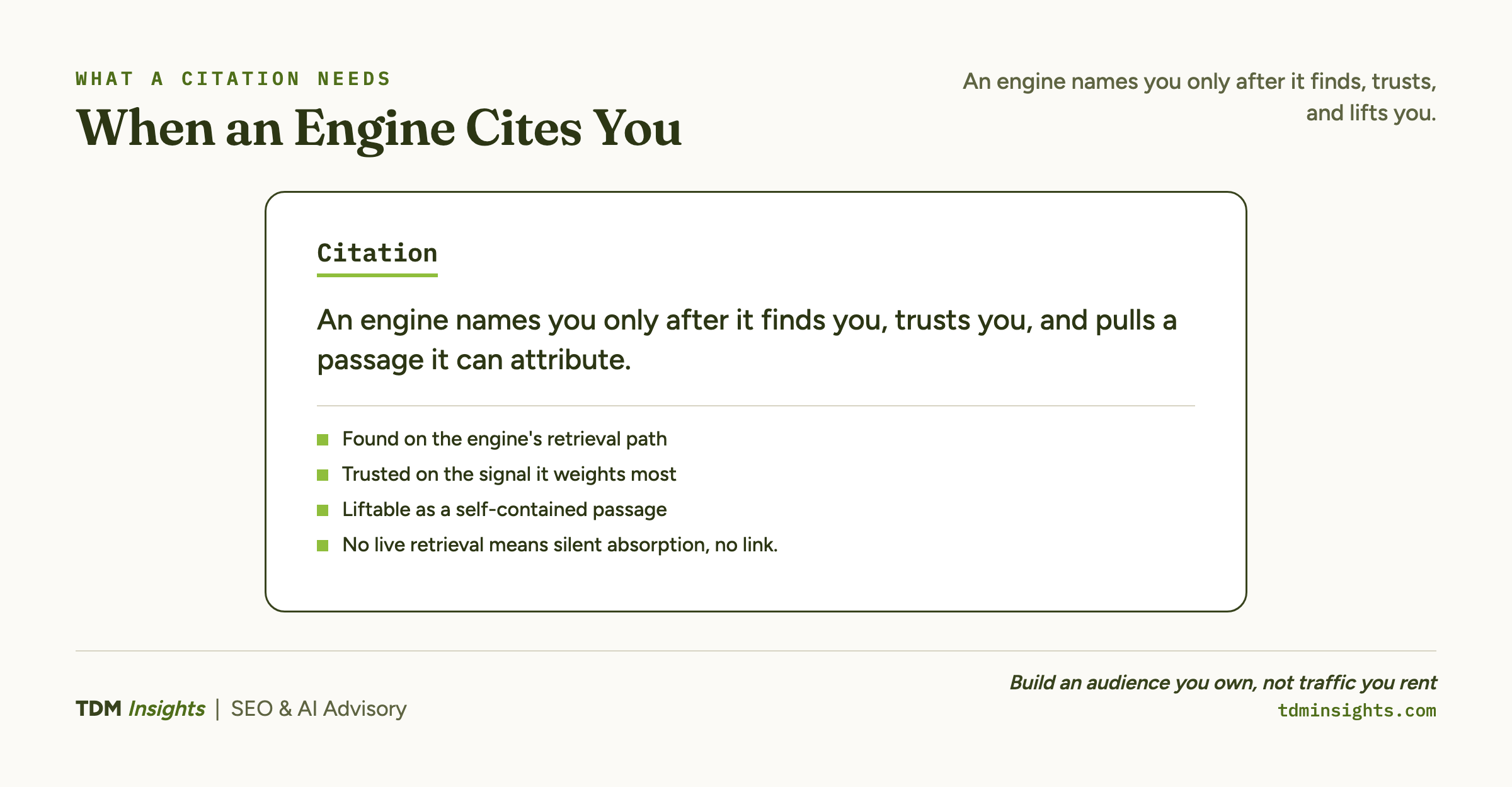
Each AI engine cites you only after it finds your page, decides it can trust it, and pulls a passage it can attribute. That sequence is universal. The inputs are not.
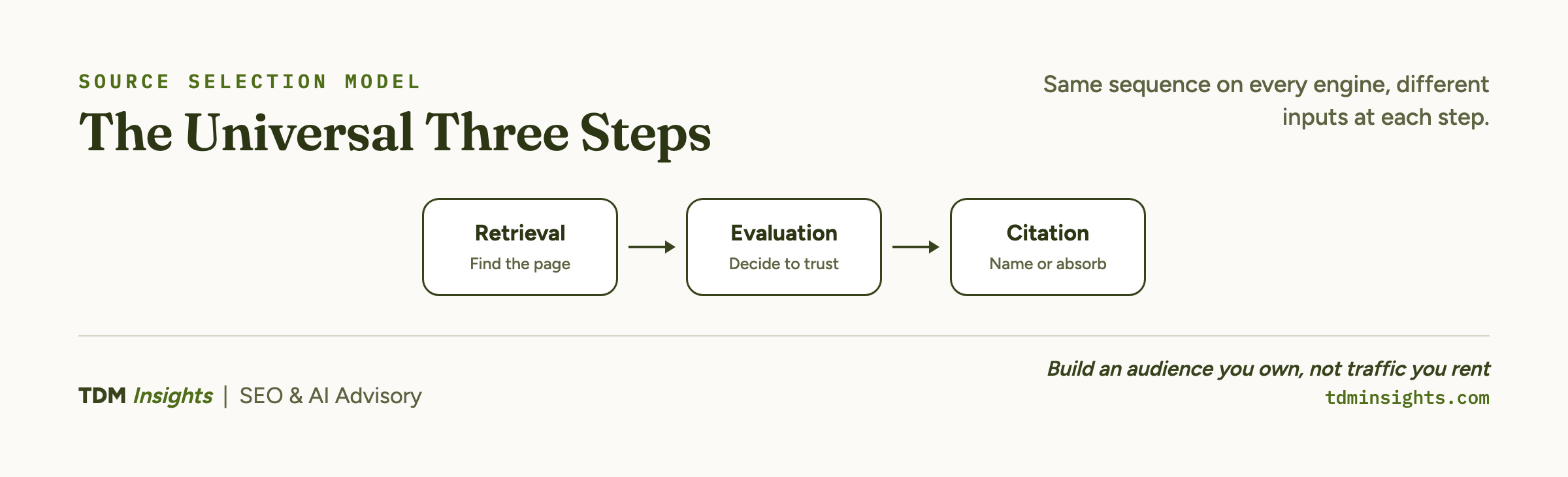
Retrieval is where the candidate set comes from. A few engines run a live web search on the query, others lean on a partner search index, others draw on Google’s own index, and others only see what the user pasted in. If you are not reachable by the path that engine uses, you never enter the running.
Evaluation is what the engine trusts once it has candidates. One engine over-weights conventional search ranking, another over-weights corroboration across independent sources, another weights recency hard, and another leans on its host search engine’s quality signals.
Citation is whether, and how, the engine names you.
A few attribute aggressively with inline links. Others show a link but rarely send the click. Others absorb the answer silently when they reply from training instead of browsing.
Here is the version you can lift in a sentence: each engine assembles a different candidate set, weights different trust signals, and attributes sources differently or not at all, so the cheapest visibility win is usually matching the retrieval path you are currently missing. That is also the diagnostic payoff. When you get cited by one engine but not another, that is almost always a retrieval-path mismatch, not a content-quality problem.
A 30-Second Refresher on Retrieval, Evaluation, Citation
The full shared model is its own walkthrough of how AI engines find, evaluate, and cite a source, and that piece is the spine these five playbooks extend. The on-page version of that discipline lives in content built to rank and get cited by AI.
There is also a shorter survey that covers the three biggest engines in one pass, useful if you want orientation before the deep dives. Treat that as the overview of the three biggest engines; Google Gemini and Claude get their own deep dives.
The Per-Engine Map: Retrieval, Evaluation, and Citation by Engine
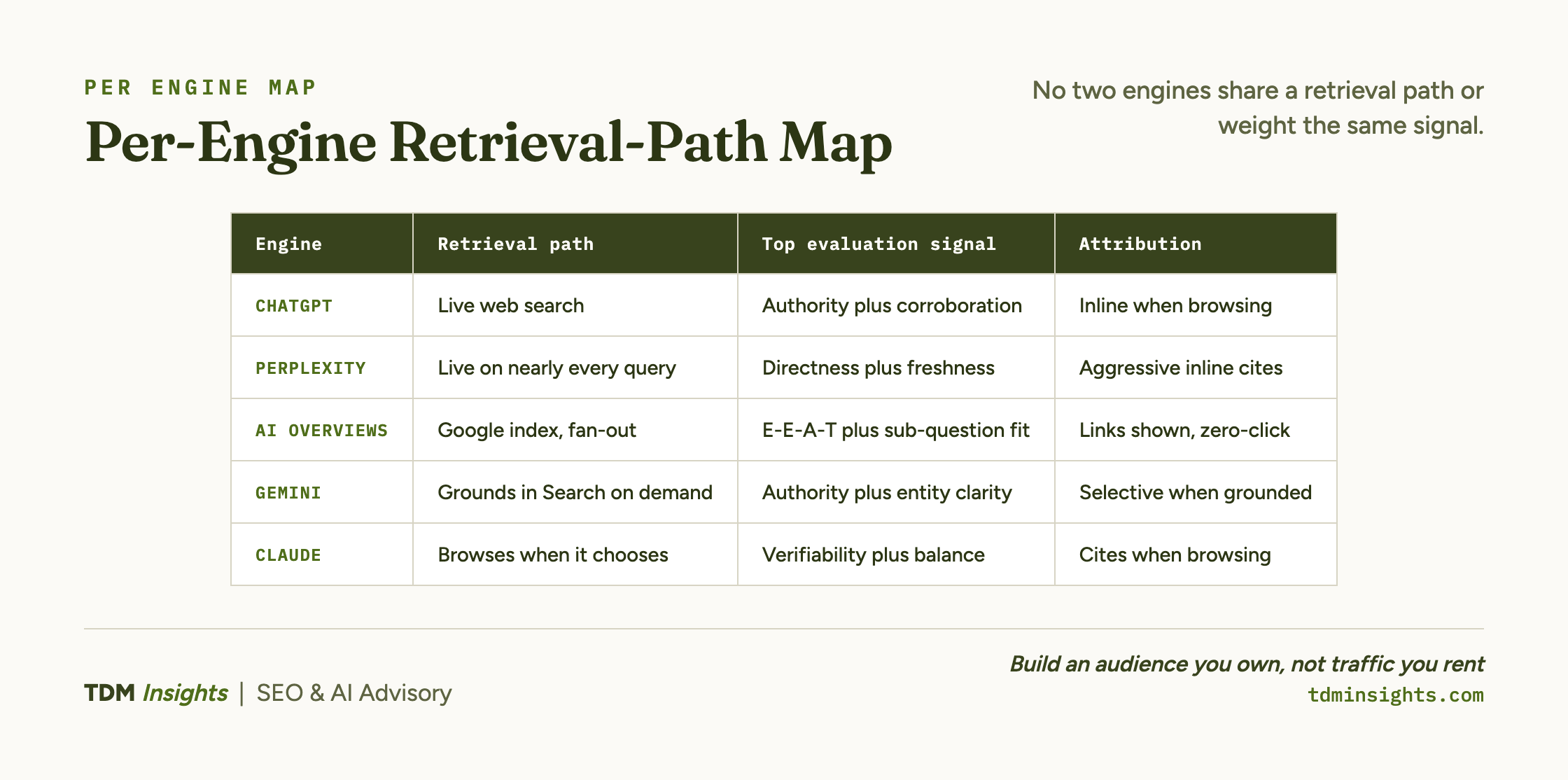
The table below is the Per-Engine Retrieval-Path Map. Read each row as one engine’s full path, then jump to its playbook when you want the depth.
The pattern across the table is worth naming. No two engines share a retrieval path exactly, and the evaluation signal shifts row to row.
Cross-engine audits bear this out. One large study of cross-engine citation behavior found limited domain overlap between engines, and ranked data on which domains the engines cite most shows the source pools diverge sharply by engine. The pools also move over time: one analysis documented how a model change cut the domains ChatGPT cited per response by about 20 percent.
Retrieval Differs: Live Search, Index, Crawl, or User-Supplied
The first place engines diverge is what they even look at. Get this wrong and nothing else you do matters, because a page that is not in the retrieval path is not a candidate at all.
Four retrieval paths are in play across the five engines:
- Live web search. Perplexity runs one on nearly every query. ChatGPT runs one when its search tool triggers. Both reach the open web in real time.
- Host search index. Google AI Overviews draws on Google’s existing index rather than crawling live, and fans one prompt into several related sub-queries.
- Grounding on demand. Gemini rides Google Search but decides per query whether grounding would improve the answer, so it browses selectively.
- Browse-or-train choice. Claude reasons about whether a live search helps, then browses and cites or answers from training silently.
A systems-level look at how Perplexity built its answer engine shows the live-retrieval-then-rerank flow in detail, and it is a useful contrast with the index-based path the Google surfaces use. The practical takeaway: identify which path your priority engine uses, then make sure you are reachable on that exact path before you touch on-page craft. The crawl-and-index layer that makes you reachable at all is the technical SEO base every founder should verify.
For the two Google surfaces especially, the retrieval floor is classic indexation. If Google cannot index you, neither AI Overviews nor Gemini can ground in you, which is why retrieval still depends on classic indexation and the AEO layer rides on top of solid SEO rather than replacing it. If the alphabet soup of acronyms is what trips you up, it helps to see how GEO, SEO, AEO, and LLMO actually relate before you start picking battles.
Evaluation Differs: Ranking, Corroboration, Recency, Host E-E-A-T
Once an engine has candidates, it filters them, and the filter is not the same engine to engine. The signal that wins one engine can be near-irrelevant on another.
Four evaluation leanings show up across the map:
- Conventional ranking and authority. ChatGPT leans on the relevance and authority signals of the search it draws on, then weights third-party corroboration heavily on top.
- Corroboration and source diversity. Perplexity rewards claims echoed across several independent sources, and it favors a wide candidate set. Feeding that test means earning authority and third-party mentions without a budget, since the corroboration often runs through sites you do not own.
- Recency. Perplexity weights freshness hard. The case for update cadence as a citation signal is well documented, and engines weight it differently. When an aging page starts losing ground here, a deliberate refresh that wins back the rankings you lost is often the cheapest move.
- Host quality and E-E-A-T. The Google surfaces inherit Google’s E-E-A-T (experience, expertise, authoritativeness, trustworthiness) machinery and add their own sub-question relevance test.
The Google surfaces deserve a specific warning, because the most expensive mistake here is assuming ranking equals citation. Original research showing AI Overview citations diverge from classic organic ranking makes the point with data, and a separate study found AI Overview placements churn fast. Ranking is necessary for the Google surfaces and not sufficient.
Intent matters too. Research on which query intents trigger AI citation shows the surfaces light up for some intents and stay quiet for others, which shapes where your effort pays off.
Citation Differs: Who Names You, Who Absorbs You
The last divergence is whether you actually get named. The same page, retrieved and evaluated identically, can be cited on one engine and absorbed silently on another.
Perplexity attributes the most aggressively, with several inline numbered citations per answer. Google AI Overviews shows links but frequently satisfies the query without sending a click.
ChatGPT and Gemini cite selectively when they browse and stay silent when they answer from training. Claude cites when it browses and is silent from training.
The dividing line is live retrieval. Without web access, any of these models can answer from training and absorb your information with no citation at all. That is the strategic reason enabling and earning the live-retrieval path matters more than simply existing in the training data: training-data answers carry no link back to you.
Measurement follows the same split. Because the citation behavior differs by surface, you have to track each one on its own terms, and much of it arrives with no referrer, which is why measuring AI traffic when there is no referrer is its own discipline.
For the Google surface specifically, a practitioner walkthrough of how AI-surface clicks and positions register in Search Console is a useful starting point. The click-tracking method itself is documented here.
Book a free diagnosis
If you have read this far, you can already reason about your odds on any single engine. What you cannot see from the outside is which of the five cite your pages right now, and which retrieval path you are missing on each. We will run your priority pages through all five engines, founder to founder, and hand you a single read: who names you today, who absorbs you, and the one path that is cheapest to fix first.
Which Engine to Optimize For First
Start with the engine your audience actually uses for your category, then weight effort by how many sources that engine cites per answer. There is no universal “best” engine to chase first; there is the one your buyers ask.
Use this decision rule:
- Where do your buyers ask? If your category lives in developer and professional workflows, Claude and ChatGPT carry weight. If it is research-heavy and comparison-driven, Perplexity and AI Overviews dominate the moment of consideration.
- How much does the engine cite? Perplexity cites far more sources per answer than the others, so it is the easiest engine to earn a first citation on and the easiest to measure.
- What is your retrieval gap? The cheapest win is the path you are already strong on everywhere except one engine. Fix the mismatch before you start new work.
ChatGPT holds the largest user share, but share is not the same as citation odds. Perplexity’s high citations-per-answer and Gemini’s fast growth can each be the better first target depending on who your buyers are. Track where the questions get asked before committing the calendar.
The on-page craft is shared across all of this. The same answer-first, extractable, entity-clear writing is the on-page work that makes a page liftable on any engine, so the per-engine differences sit on top of one disciplined content base, not five separate ones.
Where to Start, by Engine
Pick the engine that matters most to your buyers and go deep. This page is the router; each engine playbook is the territory. All of it pays off fastest when it sits on a content library that ranks, gets cited, and pays for itself.
There is a dedicated playbook for each engine: ChatGPT, Perplexity, Google AI Overviews, Google Gemini, and Claude. Each one takes that engine’s row from the map above and turns it into a checklist mapped to Retrieval, Evaluation, and Citation. If you optimize for every engine, you can walk them in order, ChatGPT through Claude, and land on the diagnosis at the end.
If your honest answer is “I want all five checked at once,” that is exactly what the Claude playbook closes on, because the only way to know your standing across all five is to measure all five. The links to every engine playbook sit in the Continue Reading block below.
Frequently Asked Questions
Do different AI engines pick sources differently, or is it all the same?
Yes, substantially differently. Studies of millions of citations find limited domain overlap between engines, with one analysis showing only about 11 percent of domains shared between ChatGPT and Perplexity. Each engine pulls from a different index, weights authority differently, and favors distinct source types, so winning on one does not guarantee visibility on another.
Why does my page get cited by one AI engine but not another?
Because each engine retrieves from a different index and rewards different signals. ChatGPT and AI Overviews lean on Bing or Google ranking, Perplexity reranks live retrieval, and Gemini weights extractability and entity authority over backlinks. A page strong on one signal set can miss the bar another engine uses, even when content quality is identical.
Which AI engine should I optimize for first?
Start with the engine your audience actually uses for your category, then match effort to citation volume. ChatGPT holds the largest share, but Perplexity cites far more sources per answer and Gemini is growing fast. Track where your buyers ask questions before committing resources, since the cheapest win is the retrieval path you currently miss.
How does each engine decide what to retrieve before it answers?
Each engine runs a retrieval step first, then filters. ChatGPT and Gemini draw on Bing and Google indexes, Perplexity uses live hybrid retrieval with reranking, and Google AI Overviews fan a query into sub-queries. Each then filters retrieved pages down, citing only a small fraction of what it actually pulled and evaluated.
Which engines show a link, and which just absorb the answer?
Perplexity, Google AI Overviews, Gemini, and ChatGPT search all attach visible source links or chips when they retrieve live pages. Without web access, any model can answer from training and absorb information silently with no citation. That is why enabling and earning live retrieval, not just being in the training data, matters for visibility.
Do ChatGPT and Perplexity cite the same sources?
Rarely. Cross-engine audits show very low overlap, with one finding only about 11 percent of domains shared between them. ChatGPT skews toward encyclopedic and high-authority pages, while Perplexity cites many more sources per answer and pulls heavily from community and forum content, so their citation lists diverge sharply.
Continue Reading:
More On Per-Engine Citation Playbooks
- How to Get Cited by ChatGPT
- How to Get Cited by Perplexity
- How to Show Up in Google AI Overviews
- How to Get Mentioned by Google Gemini
- How to Be the Source Claude Recommends
- Comparison Tables and Formats LLMs Love to Cite
More from TDM Insights
- SEO for Startups: What to Do in the First 90 Days
- Technical SEO Checklist for Founders, by Severity
- Topic Clusters and Pillar Pages: How They Work
- Content That Ranks and Gets Cited by AI
- Content Strategy for Founders: A Library That Ranks, Gets Cited, and Pays for Itself
Explore TDM Insights Categories