
How to Show Up in Google AI Overviews
Ranking is not citation. How the index feeds AI Overviews, and the passages it actually pulls, so you land in the box.
 By David Jubé · May 12, 2026 · 10 min read
Ranking number one in Google does not guarantee a place in its AI Overview. The Overview composes its own answer and often cites the page that best resolves the specific sub-question, not the page that ranks highest overall.
The path runs through the Retrieval, Evaluation, and Citation steps in the model for how AI engines find, evaluate, and cite a source that sits under every engine. Get indexed and relevant first, then answer the precise sub-question in the first sentence of a section, backed by specific sourced detail. That extractable passage is the heart of content built to rank and get cited by AI.
Everything below separates ranking from citation, maps the AI Overviews path to those three steps, and is straight about the zero-click reality.
Key takeaways
- Ranking number one in Google does not guarantee a place in its AI Overview, because roughly 40 percent of AI Overview citations come from pages that sit outside Google’s top 10 results.
- AI Overviews retrieves from Google’s existing index rather than crawling your page live, and it splits one prompt into several sub-searches, so your page must already be indexed and relevant before it can be cited.
- To be cited, put the direct answer to a sub-question in the first one or two sentences of a section and back it with specific, sourced detail, so the passage stands alone and is liftable.
- Appearing in an AI Overview rarely sends a click: Pew Research found users clicked a result in just 8 percent of searches showing an AI summary, and clicked links inside the summary only 1 percent.
Ranking in Google Is Not Appearing in AI Overviews
The most costly misconception in this whole topic is “I rank in Google, so I will show in AI Overviews.” It is often false, and acting on it wastes effort.
The two outcomes overlap but are not the same. Studies show a large and shrinking share of cited pages also rank in the top 10, and roughly 40 percent of AI Overview citations come from pages outside it. You can rank well and never be cited, or be cited while ranking on page two.
The mechanism is the sub-question. AI Overviews fans one prompt into several related searches, then composes an answer that resolves each piece. The page it cites for a given piece is frequently not the page holding the top overall position.
Mapping those sub-questions is the work of keyword research that finds demand you can win.
Original data on how AI Overview citations relate to organic ranking substantiates the split, and hands-on SEO analysis of what determines AI Overview citation and position shows the factors diverge from classic ranking. Treat ranking as necessary and not sufficient. If the relationship between ranking and citation feels muddled, it helps to see how SEO, AEO, GEO, and LLMO each name a different layer of the same effort.
How AI Overviews Retrieves: The Index It Inherits
AI Overviews retrieves from Google’s existing search index rather than crawling the page live at query time, and it often runs several related searches behind a single prompt.
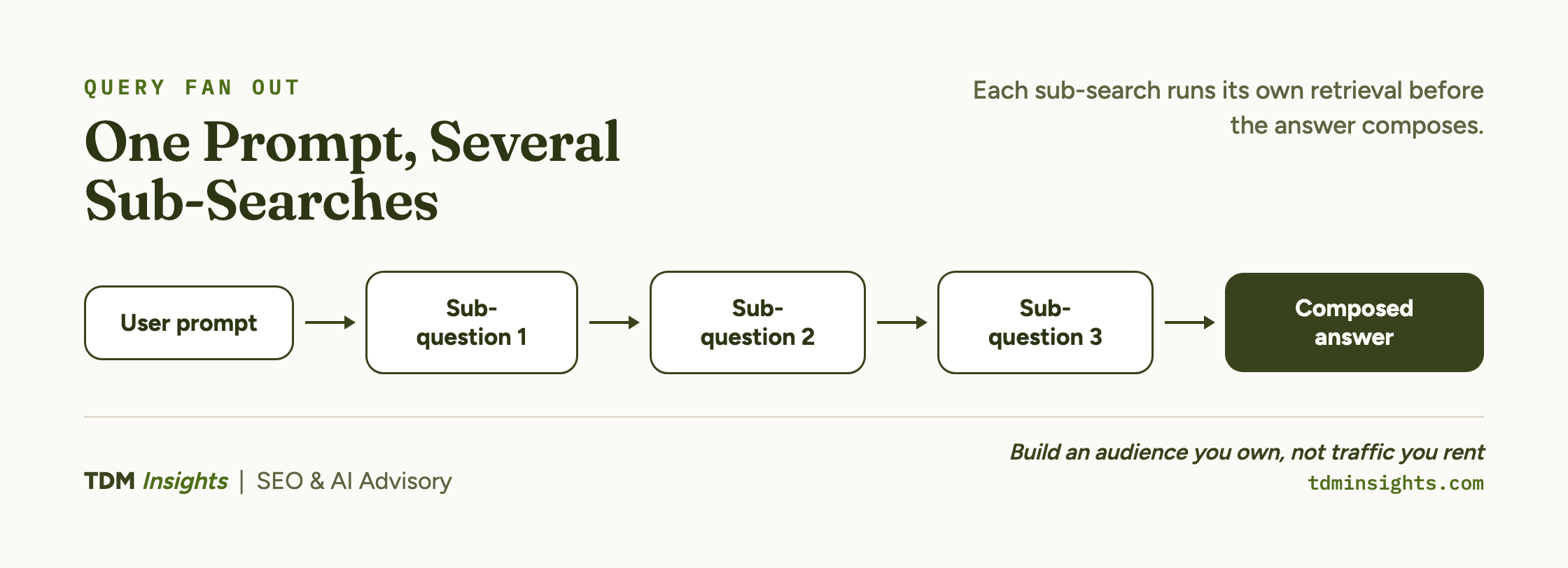
That has two consequences. First, your page must already be indexed and relevant for the query before it can be considered, because there is no live-fetch rescue for a page Google has not indexed.
Second, each sub-search pulls its own candidate pages, so coverage of the specific sub-questions around your topic matters as much as coverage of the head term.
A deep technical breakdown of AI Overview retrieval, query fan-out, and grounding walks the mechanics, and a data-backed explainer of how AI Overviews assemble and cite sources covers the same flow at a practical level. Google’s own AI features and your website guidance confirms there is no separate markup to opt in: the same indexable page that ranks is the one eligible for the Overview.
Of all five engines, this is the clearest case of AI Overviews retrieval depending on classic indexation: get the SEO fundamentals right or the Overview cannot consider you at all.
This dependency is why answer engine optimization sits on top of solid SEO rather than replacing it. Indexation itself depends on the crawlable, indexable technical base every founder should verify.
What AI Overviews Evaluates: E-E-A-T Plus Sub-Question Relevance
AI Overviews evaluates candidates on Google’s E-E-A-T signals plus a sub-question relevance test, then cites the passage it judges most directly answers the piece it is composing.
E-E-A-T stands for experience, expertise, authoritativeness, and trustworthiness, the quality framework Google already uses across Search. AI Overviews inherits it, then layers on the question of which page resolves the specific sub-query cleanest.
Three evaluation realities follow:
- Topical authority carries over. Pages from sites Google considers authoritative on the topic start ahead.
- Sub-question coverage decides ties. A competitor that covered the sub-question you skipped gets the citation even if your page is broadly stronger.
- Placements are volatile. A study found AI Overview citations churn fast and diverge from ranking, so even well-matched pages trade places frequently. When a page that once held a placement slips out, a deliberate refresh to win back the ground you lost is often the fastest way back in.
The source mix is worth knowing. Analysis of the source types AI Overviews actually cite and a 30-million-source study of which domains dominate AI citations show the pool is broader than the classic top 10, and reporting on how Google selects preferred sources for its AI surfaces points to Google nudging the pool deliberately. The peer-reviewed research on the mechanics of being cited by generative engines grounds the evaluation step academically.
How AI Overviews Attributes: Links Shown, Clicks Often Not Sent
AI Overviews shows source links but frequently satisfies the query without sending a click, which is the zero-click reality you have to plan around.
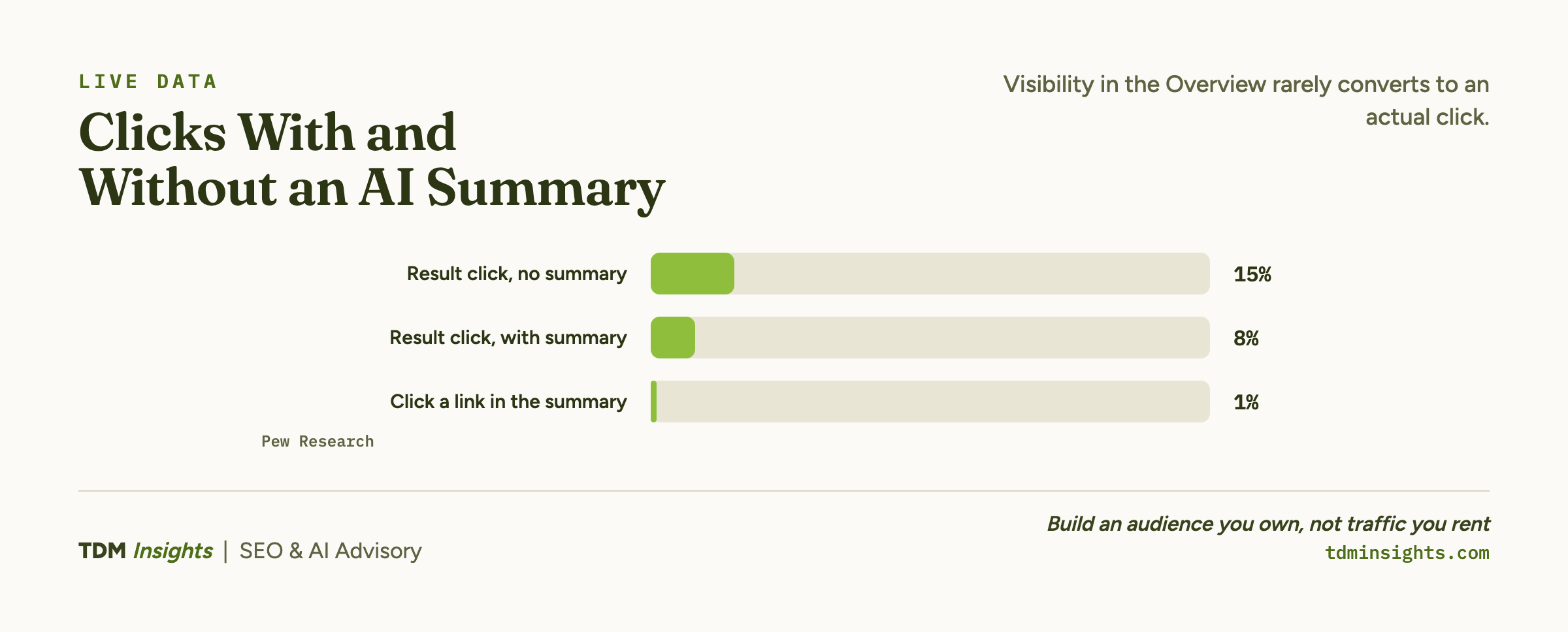
The numbers are sobering. Pew Research found users clicked a traditional result in just 8 percent of searches showing an AI summary, versus 15 percent without one, and clicked links inside the summary only 1 percent of the time. AI Overviews keeps most users on Google, so citation visibility does not translate cleanly into traffic.
That does not make the citation worthless. Being named is brand visibility at the moment of the question, and it can still be the deciding impression even without a click.
But it does mean you should not justify the work on click volume alone, which is part of the broader question of when SEO is worth investing in for a startup and when to wait. Set the expectation correctly up front.
Book a free diagnosis
Plenty of founders rank well in Google and assume that means they show in AI Overviews. Often it does not, and the gap is specific: a sub-question you skipped, a passage that is not liftable, or an indexation issue. We will check which of your pages AI Overviews actually cites for your category, and which it skips, founder to founder, then tell you the one change that earns the placement.
The AI Overviews Checklist, Mapped to Retrieval, Evaluation, Citation
Work this as a procedure, one item per step. Each stands alone.
Retrieval (get indexed):
- Confirm the page is indexed and ranking somewhere for the target query.
- Cover the sub-questions around your topic, not just the head term, since fan-out pulls them separately.
- Keep the page technically clean so Google’s index holds the current version.
Evaluation (get trusted):
- Build genuine topical authority and clear E-E-A-T signals.
- Answer the specific sub-question a competitor might be winning.
- Add structured data so Google can parse your entities and claims.
Citation (get liftable):
- Put the direct answer in the first one or two sentences of a section.
- Back it with specific, sourced detail in the same passage.
- Write each passage to stand on its own, resolving one question completely.
A practical framework for getting cited in AI Overviews lays out the same answer-first, extractable shape in more detail.
How to Measure AI Overviews Appearances and Their Traffic
Measure AI Overviews with Google Search Console by filtering its Performance report for AI-related search appearances, then accept that coverage is limited and pair it with a dedicated tracker.
Search Console will show impressions, clicks, and CTR for AI search appearances, but with real caveats: AIO queries are anonymized, the reported position reflects where the Overview sits rather than your link, and conversions cannot be attributed cleanly. So Search Console tells you that you are appearing without telling you the full value.
The fuller method, including how to reason about AI traffic that arrives with no referrer at all, is its own discipline. We cover the full method for measuring AI appearances when there is no referrer separately, because measurement is where most founders stall on the Google surface specifically.
For orientation before the depth, the overview of the three biggest engines is the shorter survey; Google Gemini and Claude each get a deep dive too.
AI Overviews is one Google surface. Gemini is the other, and it behaves differently despite sharing Google’s grounding. A dedicated playbook covers Gemini next.
Frequently Asked Questions
How do I get my page into Google AI Overviews?
Earn it by answering the query directly in the first one or two sentences of a section, then backing it with specific, sourced detail. Google pulls AI Overview citations from its existing index, so strong topical relevance, clear extractable passages, and genuine authority on the question all raise your odds of being surfaced.
Is ranking in Google the same as appearing in AI Overviews?
No. They overlap but are not the same. Studies show a large and shrinking share of cited pages also rank in the top 10, and roughly 40 percent of AI Overview citations come from pages outside it. You can rank well and never be cited, or be cited while ranking on page two.
Why does AI Overviews show my competitor and not me?
Google selects the passages it judges most directly answer the query, from sources it considers authoritative and relevant. A competitor may phrase the answer more cleanly, cover the sub-question you skipped, or carry stronger topical authority. AI Overview citations are also volatile, so placements shift frequently even between closely matched pages.
Does AI Overviews pull from the regular index or live search?
It draws from Google’s existing search index rather than crawling the page live at query time. It often runs several related searches behind one prompt, then grounds its summary in those indexed results. So your page must already be indexed and relevant for the query before it can be considered for citation.
Do AI Overviews actually send clicks?
Rarely. Pew Research found users clicked a traditional result in just 8 percent of searches showing an AI summary, versus 15 percent without one, and clicked links inside the summary only 1 percent of the time. AI Overviews keep most users on Google, so citation visibility does not translate cleanly into traffic.
How do I track AI Overview appearances in Search Console?
Use the Performance report and filter for AI-related search appearances to see impressions, clicks, and CTR. Coverage is limited: AIO queries are anonymized, position reflects where the Overview sits, and conversions cannot be attributed. Pair Search Console with a dedicated AIO rank tracker for fuller visibility.
Continue Reading:
More On Per-Engine Citation Playbooks
- How Each AI Engine Picks Sources to Cite
- How to Get Cited by ChatGPT
- How to Get Cited by Perplexity
- How to Get Mentioned by Google Gemini
- How to Be the Source Claude Recommends
More from TDM Insights
- SEO for Startups: What to Do in the First 90 Days
- Technical SEO Checklist for Founders, by Severity
- Keyword Research for Startups: Demand You Can Win
- Is SEO Worth It for a Startup? When to Invest and When to Wait
- Content That Ranks and Gets Cited by AI
Explore TDM Insights Categories