
How to Get Mentioned by Google Gemini
It grounds answers in Search and differs from AI Overviews. How Gemini decides, and the signals that earn the mention.
 By David Jubé · Apr 30, 2026 · 10 min read
Gemini is a conversational assistant that grounds answers in Google Search, on a different surface and with different attribution than Google’s AI Overviews block. The two share Google’s stack but are separate targets.
Because Gemini’s grounding rides Search, a strong Google Search presence is the Retrieval floor, the same first step from the model for how AI engines find, evaluate, and cite a source. Gemini browses selectively, so being the clean authoritative source for the exact factual question is what earns the mention, the standard set by content built to rank and get cited by AI.
Here is the answer-first version: win Google Search grounding first, then be the clean, directly-on-point source for the specific factual query. Crawlable, indexable, fast pages with a direct answer near the top and clear entity signals get surfaced most.
Everything below disambiguates the two Google surfaces, then maps Gemini’s path to Retrieval, Evaluation, and Citation.
Key takeaways
- Gemini grounds its answers in Google Search, so a strong Search presence is the retrieval floor: win indexation first, then become the clean, directly-on-point source for the exact factual query.
- Gemini and AI Overviews are two separate Google surfaces with low source overlap, so optimizing for one does not automatically win the other and you should target each surface deliberately.
- Gemini decides per query whether to search the web or answer from training, and only the grounded path attaches links you can earn, which it gets by fanning your prompt into sub-questions you should cover fully.
- To earn the cite, put a direct answer in the first 100 words, state your entities consistently, add structured data so Gemini parses them, keep facts fresh, and earn third-party mentions.
Gemini Is Not AI Overviews: Two Google Surfaces, Two Behaviors
Gemini and AI Overviews share Google’s search infrastructure but are separate surfaces with measurably different citation behavior. Optimizing for one does not automatically win the other.
AI Overviews appears inside the search results page, above the links, and leans more on user-generated content and video. Gemini is a standalone conversational assistant that grounds in Search but cites more conservatively. Studies show low source overlap between the two surfaces, which is the clearest evidence they are distinct targets.
Data on how Gemini differs from and feeds the AI Overview surface documents the divergence, and analysis of how a Gemini model change reshuffled which sources get cited shows the two surfaces move on their own clocks. Treat them as a pair to cover deliberately, not a single box to tick.
This is why the two Google surfaces get separate playbooks. A dedicated walkthrough covers the AI Overviews surface and how it differs; this page is the Gemini half of that pair.
When Gemini Grounds in Search vs Answers From Training
Gemini decides per query whether to ground in Google Search or answer from its own training, and only the grounded path attaches source links you can earn.
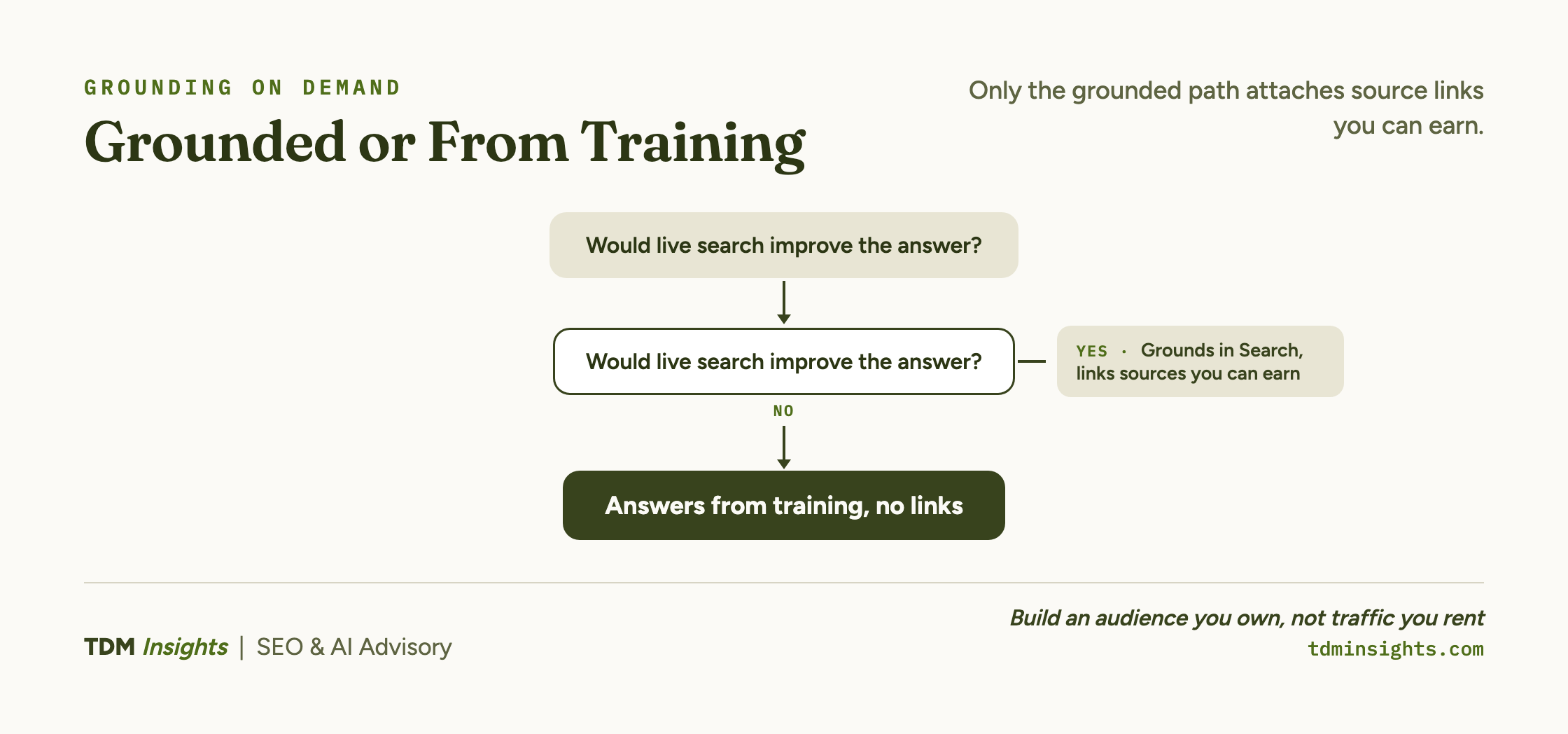
The model scores whether a live search would improve the answer. Time-sensitive, recent-event, “best,” and “how-to” informational prompts usually trigger a web search with cited links. General or stable-knowledge questions often get answered straight from training, which carries a knowledge cutoff and shows no source links.
Grounding is the feature name for the connection to live Search. The official documentation on grounding with Google Search in the Gemini API describes how the model generates search queries, retrieves current pages, synthesizes an answer, and returns structured citation data linking each statement to its source. A complementary technical doc on the grounding feature and how it surfaces sources covers the same mechanism.
The implication for you is direct. You can only influence the grounded path, the one that browses and cites. Stable-knowledge training answers are out of reach for the next reply, the same way they are on ChatGPT and Claude.
How Gemini Retrieves: Grounding in Google Search
On the grounded path, Gemini fans your prompt into sub-queries and pulls indexed pages to answer from. Two retrieval realities follow:
- Indexation is the floor. Gemini ignores pages it cannot retrieve from Google’s index, so being crawlable, indexable, fast, and mobile-ready is the precondition for any mention. Google’s AI features and your website guidance confirms eligibility for its AI surfaces flows from normal Search indexing, not a separate sign-up.
- Fan-out rewards sub-question coverage. Original research on how Gemini fans a prompt into sub-queries shows one prompt becomes several searches, so covering the specific sub-questions around your topic widens your chances of being pulled.
A practitioner breakdown of the query fan-out behind Gemini and Google AI retrieval and a plain-language explainer of the fan-out mechanic that decides what gets cited both make the same operational point: optimize for the cluster of sub-questions, not just the head term. Mapping that cluster is exactly what keyword research that finds demand you can win is for, and structuring the answers into topic clusters built around pillar pages is how you cover every sub-question without leaving gaps.
That base sits on the crawlable, indexable, fast technical work every founder should verify and on the SEO fundamentals you set up first, which Gemini visibility builds on rather than replaces.
What Gemini Evaluates and How It Attributes
Gemini evaluates grounded candidates on authority, entity clarity, structure, and freshness, then attributes by linking the exact passages it pulled, leaning toward institutional and clearly structured sources.
Four evaluation leanings stand out:
- Institutional bias. Gemini favors institutional sites such as .gov and .org and clearly structured content, more so than the AI Overviews surface does.
- Entity clarity. It rewards pages where who you are, what you do, and what the page covers are stated consistently and unambiguously.
- Factual density and structure. Clean structure, named entities, and primary-source citations read as more trustworthy.
- Freshness. Current content wins on time-sensitive queries, so a regular refresh that wins back rankings you have lost keeps a page eligible for the grounded answer.
On attribution, the grounded path links the specific passages Gemini used, while training-data answers show no links. A practical guide to earning Gemini citations underlines that most Gemini citations point to sites the brand does not own, so third-party validation matters alongside your own pages. An overview of tools to measure whether Gemini cites you supports the tracking step, and because much of this visibility lands with no referrer, measuring AI traffic when the referrer is missing is the discipline that closes the loop.
Entity clarity is the lever Gemini rewards more than most engines, which is where Schema.org markup and answer-first writing do real work: structured data lets Gemini parse your entities and relationships without guessing. This pays off broadest when it sits on a content library that ranks, gets cited, and pays for itself.
Book a free diagnosis
Gemini and AI Overviews look like one Google target and behave like two. If Gemini grounds in Search but never names you, the gap is usually entity clarity, indexation on the right sub-questions, or a passage that is not clean enough to lift. We will check both Google surfaces for your site, founder to founder, and tell you which signal is keeping you out of the grounded answer.
The Gemini Checklist, Mapped to Retrieval, Evaluation, Citation
Work this as a procedure. Each item stands alone.
Retrieval (get grounded):
- Make the page crawlable, indexable, fast, and mobile-ready.
- Confirm strong Google Search presence on the target query and its sub-questions.
- Cover the cluster of related sub-questions, since fan-out pulls them separately.
Evaluation (get trusted):
- State your entity signals consistently: name, role, what the page covers.
- Add structured data so Gemini parses your entities cleanly.
- Cite primary sources, keep facts dense, and refresh time-sensitive content.
- Earn third-party mentions, since most Gemini citations point to sites the brand does not own.
Citation (get liftable):
- Put a direct, factual answer in the first 100 words of the section.
- Name concrete entities rather than speaking in generalities.
- Write self-contained passages that resolve one factual question each.
The Google-Surface Strategy: Covering AI Overviews and Gemini Together
Cover both Google surfaces with one disciplined base, then handle the differences at the margin. The shared foundation is indexation, sub-question coverage, and answer-first passages.
In practice, the work stacks. Get indexed and answer the sub-questions cleanly, and you become eligible for both surfaces.
Then sharpen entity signals and structured data, and you tilt the Gemini half in your favor specifically. You are not running two separate programs; you are running one with a Gemini-aware finish.
Ranking number one does not guarantee the mention, though. The Gemini-specific finish is the source-craft Gemini weighs over raw backlinks: clear structure, entity clarity, factual density, freshness, and third-party authority.
For orientation before the depth, the overview of the three biggest engines is the shorter survey; Google Gemini gets this deep dive, and Claude gets one too.
That is four engines covered. The fifth, Claude, recommends sources differently again, and it is also where you decide to check all five at once. A dedicated playbook covers Claude next.
Frequently Asked Questions
How does Gemini decide which sources to mention?
Gemini grounds answers in Google Search, then cites pages it judges most relevant, authoritative, and extractable for the specific claim. It leans toward institutional sites (.gov, .org) and clearly structured content, and it links the exact passages it pulled from. Crawlable, indexable, fast pages with direct answers near the top get surfaced most often.
Is Gemini the same as Google AI Overviews?
No. They share Google’s search infrastructure but are separate surfaces with measurably different citation behavior. AI Overviews appear inside search results and lean more on user-generated content and video. Gemini is a standalone assistant that grounds in Search but cites more conservatively, favoring institutional sources. Studies show low source overlap between the two.
When does Gemini search the web versus answer from its own knowledge?
Gemini decides per query. It scores whether live search would improve the answer. Time-sensitive, recent-event, or “best” and “how-to” informational prompts usually trigger a web search with cited links. General or stable-knowledge questions often get answered straight from training data, which carries a knowledge cutoff and shows no source links.
How do I get Gemini to cite or link my site?
Make your page eligible for Google retrieval first: crawlable, indexable, fast, and mobile-ready. Put a direct, factual answer in the first 100 words, name concrete entities, cite primary sources, and keep content fresh. Earn third-party mentions too, since most Gemini citations point to sites the brand does not own.
Does optimizing for Google Search help with Gemini?
Partly. Strong Search performance is a prerequisite, because Gemini grounds in Google’s index and ignores pages it cannot retrieve. But ranking number one does not guarantee a citation. Gemini rewards clear structure, entity clarity, factual density, freshness, and third-party authority over raw backlinks, so treat Search as a foundation, not the finish line.
What is grounding with Google Search in Gemini?
Grounding is the feature that connects Gemini to live Google Search results instead of relying only on training data. The model generates search queries, retrieves current pages, synthesizes an answer, and returns structured citation data linking each statement to its source. It reduces hallucinations, covers recent events, and is why Gemini can show clickable source links.
Continue Reading:
More On Per-Engine Citation Playbooks
- How Each AI Engine Picks Sources to Cite
- How to Get Cited by ChatGPT
- How to Get Cited by Perplexity
- How to Show Up in Google AI Overviews
- How to Be the Source Claude Recommends
More from TDM Insights
- SEO for Startups: What to Do in the First 90 Days
- Technical SEO Checklist for Founders, by Severity
- Keyword Research for Startups: Demand You Can Win
- Content That Ranks and Gets Cited by AI
- Content Strategy for Founders: A Library That Ranks, Gets Cited, and Pays for Itself
Explore TDM Insights Categories