
SEO for Startups: What to Do in the First 90 Days
Runway is short, so sequence matters. The first-90-days order of operations, and the timeline a startup should actually expect.
 By David Jubé · Jun 12, 2026 · 15 min read
The startups that win at search are not the ones doing the most SEO. They are the ones doing the right steps in the right order. The order matters more than the effort.
That order is the whole point of this article. Search engine optimization (SEO) for a startup is not a checklist of fifty tasks you attack at random. It is an order of operations you run against a runway.
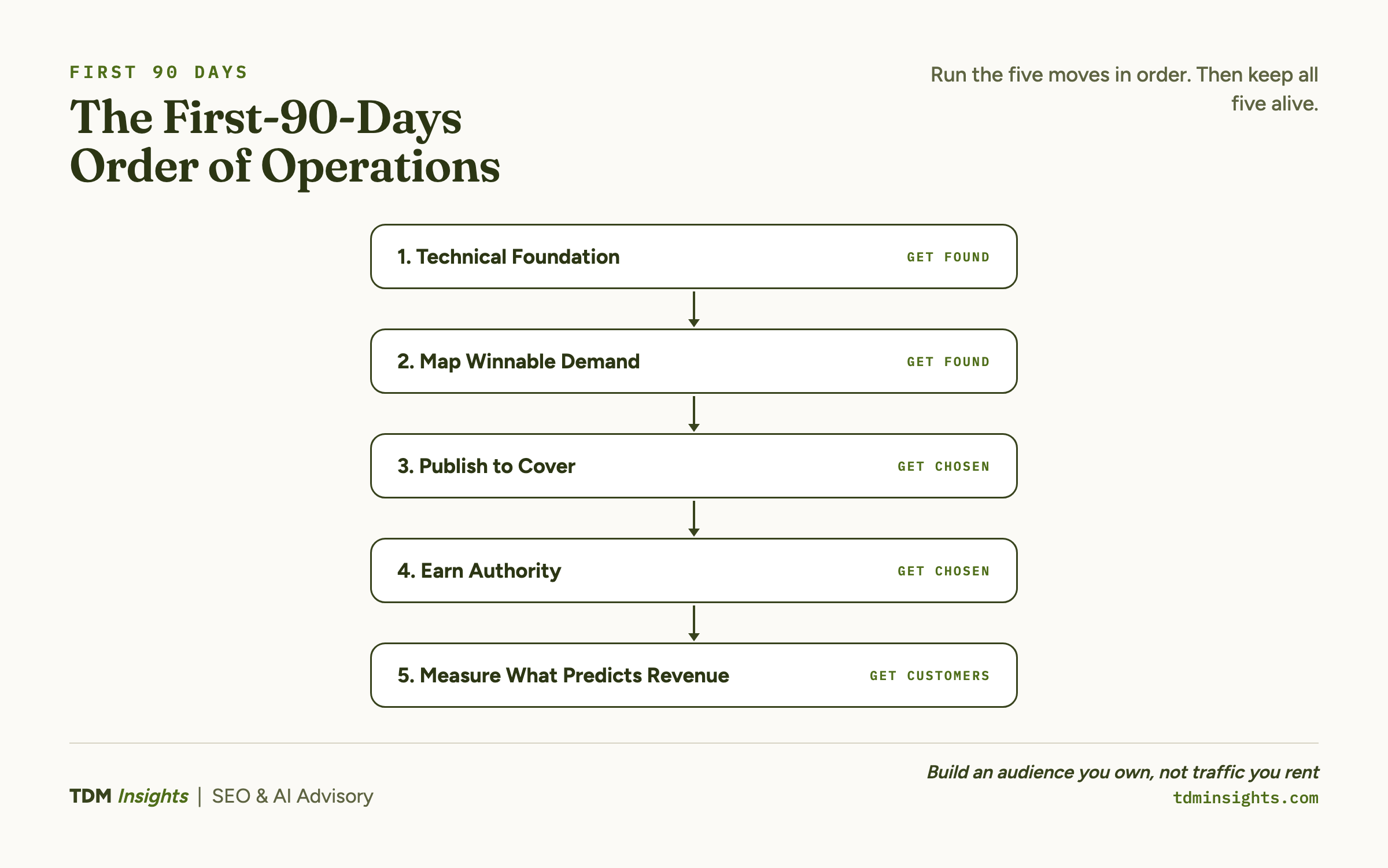
Here is the short version, the First-90-Days Order of Operations:
- Build a technical foundation so engines can crawl, index, and trust your site.
- Map winnable demand so you target keywords you can actually rank for.
- Publish to cover the topic so the pages exist that earn the click.
- Earn authority through real links once you have something worth linking to.
- Measure what predicts revenue so you do not quit before SEO pays off.
Do step four before step one and you burn months you do not have.
Key takeaways
- Startup SEO is an order of operations you run against a runway, not a checklist of fifty tasks you attack at random.
- Run the five steps in this starting order: build the technical foundation, map winnable demand, publish to cover the topic, earn authority, then measure what predicts revenue.
- Fix only the blocking technical issues first, crawlability and indexing, then move to content immediately, because nothing you write ranks if Google cannot read your pages.
- Target roughly 20 to 30 low-difficulty, long-tail keywords in your first 90 days, since a new domain has no chance of outranking established sites on a competitive query.
- Earn links, do not buy them, and only after you have published something worth linking to, because authority is an accelerant, not the engine.
The short answer: the first-90-days order of operations
Startup SEO works as a sequence, not a pile of tips. Tips are not a plan. The reason order matters is compounding: each step only works if the one before it is in place. Earning a backlink to a page Google cannot crawl is wasted effort. Publishing for a keyword you have no chance of ranking for is wasted effort.
The sequence exists to stop you from wasting the one thing a startup cannot replace, which is time.
Here is the full model, mapped onto the three stages of organic discovery (getting found, getting chosen, and getting customers):
You do not finish step one and forget it. You run them in this starting order, then keep all five alive at once. But in the first 90 days, the order is how you decide what to touch on any given morning.
The rest of this article walks each step, then shows what the sequence looked like on a real site.
Step 1: build the technical foundation
The first step is the least glamorous and the most decisive. Before anything you write can rank, a search engine has to be able to reach the page, read it, and store it. If a robots.txt file blocks your own site, or a stray “noindex” tag tells Google to ignore a page, no amount of good writing rescues it. The page is simply invisible.
So the first 90 days start with the blocking issues only. You do not need a perfect technical audit before you write a word. You need to confirm four things:
- Google can crawl your pages.
- Google is indexing the important ones.
- Your site has a clean structure.
- Your pages load on mobile without falling apart.
Google has to be able to reach you at all before anything else counts, and its own documentation on how Googlebot crawls is the plainest reference for what the crawler actually does and how to keep it unblocked.
Speed and mobile soundness sit just under crawlability. They are real ranking inputs, not cosmetic polish, and they shape whether a visitor stays once they arrive. The clearest framework here is Core Web Vitals, Google’s set of page-experience measurements covering loading, interactivity, and visual stability.
You do not need to chase a perfect score, but you should fix clear failures, and the canonical explanation lives on Google’s own developer resource for Core Web Vitals.
Treat this step as triage: clear the issues that stop Google from reading and trusting your site, then move to content immediately.
For the deeper version of this step, including the platform-specific gotchas on WordPress, Shopify, Wix, and Squarespace, work the technical foundation in order of severity.
Step 2: map the demand you can actually win
With the foundation clear, the second step is choosing what to rank for. This is where most startups quietly lose the next three months. They look at a keyword tool, see a term with high search volume, and write toward it. Then they wait, and nothing happens, because a new domain has no chance of outranking established sites on a competitive query.
The fix is to stop optimizing for volume and start scoring for what we call winnable demand: the combination of search volume, buyer intent, and attainable difficulty, where attainable is judged relative to your site’s current authority.
A keyword difficulty (KD) score of 30 is trivial for an established brand and unwinnable for a week-old domain. Volume is the least useful of the three numbers, because you cannot bank a ranking you cannot reach.
A useful sanity check is whether real searchers turn to Google for this kind of question at all, and the most recent large-scale clickstream data, SparkToro and Datos’ finding that Google search grew more than 20 percent in 2024 to over five trillion searches, is a reminder that the demand is genuinely there to capture once you target it correctly.
In practice this means targeting roughly 20 to 30 low-difficulty, long-tail keywords in your first 90 days, terms where the intent is clear and the competition is thin. Those early wins prove the engine works and start building the authority that later makes harder terms reachable.
If you are new to the discipline entirely, a beginner’s guide to SEO is a solid orientation before you start scoring candidates. This step is the hinge of the whole sequence, and it has its own full method for mapping the demand you can actually win.
Step 3: publish to cover the topic
Once you know what you can win, you build the pages that win it. Step three is publishing, and the goal is coverage and depth, not word count for its own sake. A single thin post rarely ranks. What ranks, and what AI answer engines tend to cite, is a topic covered thoroughly: a pillar article that frames the subject and a set of satellite articles that each answer one specific question fully.
This is the step that turns visibility into being chosen. Getting found is necessary, but a search engine showing your page is only an impression. The same depth that earns a click is what makes a page citable by AI, which is the heart of what answer engine optimization actually is.
The reader still has to click, and then has to stay. That happens when the page genuinely answers the question they searched, in plain language, faster and more completely than the alternatives. Depth and clarity are what earn both the click and the trust.
There is a structural payoff too. When you publish a cluster rather than scattered posts, the pages reinforce each other through internal links, and the whole topic reads to a search engine as something you have real expertise in. This is why it helps to understand how topic clusters and pillar pages work before you start drafting.
The discipline of deciding which pillars and satellites to build, and in what sequence, is a content-strategy question in its own right.
To go from a keyword map to a concrete editorial plan, see how to turn winnable demand into a publishing plan.
Step 4: earn authority
Authority is step four for a reason. Backlinks, which are links from other websites pointing to yours, remain one of the signals Google weighs most heavily, and you can see that in any serious breakdown of the factors Google weighs.
But a link is a vote for a page, and a vote only helps if the page is worth voting for. A founder who chases links before publishing anything worth citing is paying for traffic to a page that cannot keep it.
So the rule for the first 90 days is earn, do not buy, and only after step three has produced something worth linking to. Earned links come from creating things other people want to reference: original data from your own product or customers, a genuinely useful free tool, a sharp point of view, or expert commentary a journalist can quote. Bought links and link schemes violate Google’s policies and put your rankings at risk, which is the opposite of what a startup can afford.
In the first quarter, authority is an accelerant, not the engine. A handful of relevant, earned links can meaningfully speed up how fast your winnable-demand pages climb. But the sequencing is non-negotiable: the page comes first, the links come second.
The full founder-executable method for earning links without a budget, including how this changes in the era of AI answer engines, is its own article in the cluster. The same trust signals that earn links now also decide how to get cited by ChatGPT, Perplexity, and AI, so the work pays off in both places at once.
Step 5: measure what predicts revenue
The last step is the one that keeps founders from quitting too early. SEO lags. The work you do this month shows up in rankings and traffic over the following months, and revenue later still. If you judge month one by revenue, you will conclude SEO does not work and shut it off right before it pays.
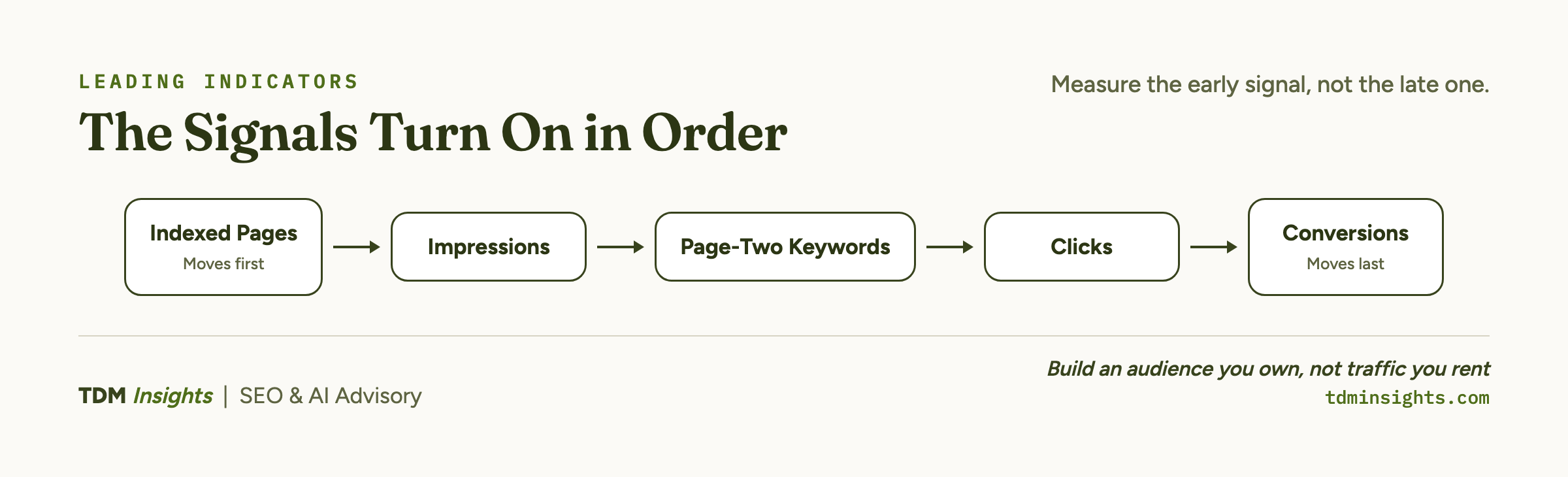
The defense is to measure the leading indicators, the signals that move first and predict the lagging ones.
In order, the early signals are: indexed page count, then impressions, then keywords entering positions 11 to 50, then clicks, then conversions. A healthy first quarter looks like rising impressions and a growing band of keywords climbing onto page two, well before traffic arrives in volume.
Those signals tell you the engine is working even when the bank account does not yet show it. The single most important setup task here is to set up Search Console, Google’s free tool that reports exactly which queries surface your pages, what they rank for, and how impressions and clicks are trending week over week.
A newer signal belongs on this list too. As AI answer engines route more discovery, learning how to measure AI traffic when it arrives with no referrer lets you track citations as an early sign of authority alongside impressions.
Measurement is also how you stay honest about the timeline. Knowing that impressions move first, then clicks, then revenue, is what lets you read a flat-looking month one correctly instead of panicking.
For the full breakdown of what to watch at month one, three, and six, follow the honest SEO timeline.
What this looks like in practice
The order of operations is not theory. We refined this sequence on a site we operate before bringing it to clients, and the shape it produced is the same shape the discipline predicts.
The technical foundation goes in first. Then you map winnable demand and ignore the big head terms in favor of terms the site can realistically reach. Then you publish to cover those topics as a cluster, begin earning authority once the pages exist, and measure the leading indicators throughout.
Two things about that shape are the whole lesson.
First, for the early weeks, almost nothing visible happens. A founder watching daily sees flat lines and is tempted to quit. The leading-indicator discipline of step five is what makes it possible to keep going.
Second, when the curve finally bends, it bends because the earlier steps have compounded, not because anyone suddenly worked harder. The work in the first stretch is the foundation the later lift stands on.
Book a free diagnosis
Knowing the order of operations is one thing. Knowing which step your own site should run first, against the runway you actually have, is another. We offer founders a free diagnosis: a quick read on whether your technical foundation is clear, whether the demand you are chasing is winnable, and what a realistic first 90 days looks like for your specific site. No pitch, no obligation, just a straight answer on where to start.
Agency, freelancer, or founder-led?
The last decision is who runs the 90 days. The honest answer is that a founder can run the first 90 days alone if the site is small and the demand is winnable, because the early steps are mostly setup and writing, not deep engineering.
Clearing crawl and index blockers, scoring keywords, and publishing intent-matched pages are all learnable, and Google’s own documentation plus the references above will carry a motivated founder a long way.
Hire help in two situations.
The first is when the technical foundation is genuinely complex: a large or legacy site, a tangle of redirects, or a platform fighting you. The second is when your own time is simply worth more applied elsewhere, on product or sales, than on learning SEO from scratch.
A freelancer suits a focused, well-defined gap. An agency suits a startup that wants the whole order of operations run for it on a predictable cadence.
The corroborating perspective from independent guides like this SEO for startups guide and this startup SEO blueprint lands on the same place: match the choice to your runway and your ramp, not to a vendor’s pitch.
For a budget-minded view of the same tradeoff, this guide on growing search visibility on a budget is a useful second read.
Whoever runs it, the sequence is the same.
Foundation, demand, coverage, authority, measurement.
Run them in order against your runway, and you give yourself the best chance of drawing your own version of that curve: flat at first, then bending upward, then compounding.
Frequently Asked Questions
In what order should a startup tackle SEO tasks in the first 90 days?
Sequence it: technical foundation first, then winnable-demand mapping, then publishing to cover the topic, then earning authority, then measuring. Crawlability and indexing come first because nothing ranks if Google cannot read your pages. Demand mapping prevents wasted writing. Authority and measurement compound only after real pages exist to point links and data at.
How many keywords should a startup target in its first 90 days?
Target roughly 20 to 30 low-difficulty long-tail keywords in your first 90 days, not high-volume head terms. A new domain has no authority to win competitive queries yet. Pick terms where buyer intent is clear and competition is thin, so your early pages can realistically reach page one and prove the engine works.
What leading indicators show SEO is working before traffic arrives?
Watch impressions, indexed page count, and keywords entering positions 11 to 50 first. These move weeks before clicks and revenue. A healthy first quarter looks like rising impressions, 15 to 25 pages indexed, and a growing band of keywords on page two. Traffic and conversions follow those signals, not the reverse.
How soon after publishing can a new startup site expect its first ranking lift?
First measurable lift on a new site often appears around week 6, starting with impressions rather than clicks. Impressions typically climb for weeks before clicks follow, and the curve tends to keep compounding well past the first quarter. Expect signals in weeks and meaningful click volume over the following months.
Should a startup fix technical SEO or publish content first?
Fix the technical foundation first, but only the blocking issues: crawlability, indexability, sitemap, and a clean site structure. You do not need a perfect technical audit before writing. Clear the issues that stop Google from reading and indexing pages, then move to content immediately, since published pages are what actually earn rankings.
Do I need an SEO agency, a freelancer, or can a founder do this?
A founder can run the first 90 days alone if the site is small and the demand is winnable, since the early steps are setup and writing, not deep technical work. Hire help when the technical foundation is complex or your time is worth more elsewhere. Match the choice to your runway and ramp.
Continue Reading:
More On SEO for Startups
- How Long Does SEO Take? An Honest Timeline
- Is SEO Worth It for a Startup? When to Invest and When to Wait
- Technical SEO Checklist for Founders, by Severity
- Keyword Research for Startups: Demand You Can Win
- Backlinks for Startups: Earn Authority, No Budget
- How to Structure a Page to Rank and Get Cited
- Internal Linking: The Most Underrated SEO Lever
More from TDM Insights
- Content Strategy for Founders: A Library That Ranks, Gets Cited, and Pays for Itself
- Topic Clusters and Pillar Pages: How They Work
- Answer Engine Optimization: What AEO Actually Is
- How to Get Cited by ChatGPT, Perplexity, and AI
- How to Measure AI Traffic With No Referrer
Explore TDM Insights Categories