
Topic Clusters and Pillar Pages: How They Work
The architecture that concentrates authority: how pillar pages and their clusters compound rankings instead of scattering them.
 By David Jubé · May 28, 2026 · 16 min read
A blog post published alone competes alone.
The same post, placed inside a tight group of related articles that link to each other, inherits authority from every one of them.
That structural difference is the entire reason one site outranks another on the same topic with the same word count. It is the architecture that lifts search impressions without any extra publishing budget.
A topic cluster is a group of articles that all cover one subject, linked together so search engines read them as one body of expertise.
A pillar page is the comprehensive hub article at the center of that group: the broad, definitive piece on the subject.
The articles around it, the satellites, each answer one specific question under that subject and link back up to the pillar. Together they signal that you cover the whole topic, not a single slice of it.
That is the answer in one paragraph.
The rest of this article is the mechanism: why the structure works, how authority actually moves through it, how to choose your pillars, and the worked example you are reading right now, because this very cluster is built on the model it describes.
Key takeaways
- A topic cluster is a group of articles that all cover one subject, linked together so search engines read them as one body of expertise.
- The pillar page is the comprehensive hub article at the center of the cluster, and the satellites each answer one specific question and link back up to it.
- Internal linking is the mechanism that concentrates authority on the pillar, returns it to each satellite, and keeps it circulating inside the cluster instead of leaking out.
- Choose pillars from your biggest buyer questions, not keyword volume alone, and apply the five-satellite test to keep a pillar broad enough to support five real sub-questions yet narrow enough to win.
- A cluster appreciates instead of decaying, because every new satellite you add raises the authority of every article already in the cluster, including the pillar.
What a topic cluster and a pillar page actually are
Strip away the jargon and a cluster is a hub and its spokes. The hub is the pillar. The spokes are the satellites.
The pillar page takes the broad subject and gives the reader a complete mental model of it.
It does not try to exhaust every sub-question in depth, because that would make it unreadably long. Instead it covers the whole subject at a useful altitude and points to the satellites for depth on each part.
This page is the one you most want to rank for the broad, competitive query.
Each satellite article takes one specific, narrower question and answers it thoroughly. It goes deep where the pillar stays broad.
Crucially, every satellite links back up to the pillar with descriptive anchor text, and the pillar links down to every satellite.
The result is a closed loop of related pages that search engines can crawl as a set and understand as coverage of one topic.
This is the model HubSpot popularized as the topic-cluster model, and it works because it matches how both search engines and humans look for information: start broad, then drill into the specific question you actually have.
Good information architecture is not a search trick. Nielsen Norman Group’s work on findability and information architecture shows that structure which helps people locate what they need is the same structure that helps machines understand a site.
The cluster serves both audiences at once.
This cluster sits inside the compounding content library this architecture sits inside, where structure is the first of five stages that turn a pile of posts into an asset.
Architecture comes first because nothing downstream compounds without it.
The Cluster Map: how authority concentrates instead of scatters
Here is the model to keep.
Picture every article on your site as a container holding a small amount of topical authority. Publish them as isolated posts and that authority stays trapped in each container, doing nothing for its neighbors.
Link them into a cluster and you cut channels between the containers, so authority flows toward the page you most want to rank.
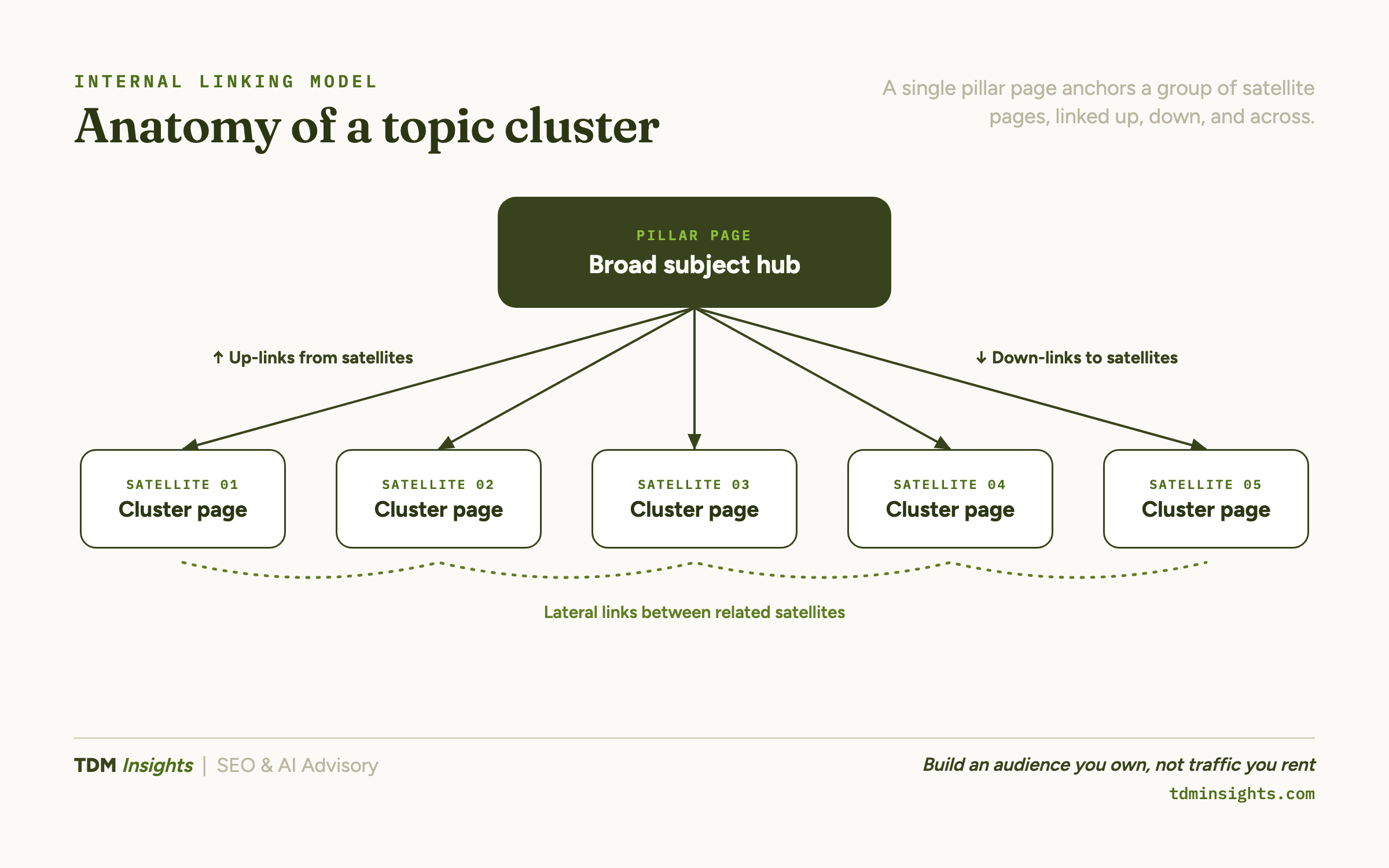
The Cluster Map has three movements, and all three matter:
Satellites link up to the pillar. Every satellite passes a share of its authority to the hub through a descriptive contextual link. With five satellites pointing up, the pillar accumulates authority from five sources, which is why a well-supported pillar can rank for a competitive head term that no single satellite could win on its own.
The pillar links down to every satellite. The hub returns authority to each spoke and, just as importantly, tells search engines these specific pages belong together. A satellite that nothing links to is invisible. A satellite the pillar introduces is part of a recognized set.
The most related satellites link to each other laterally. Not every satellite needs to link to every other one, but the closely related ones should. This keeps authority circulating inside the cluster rather than leaking out, and it gives readers the natural next article instead of a dead end.
The mechanism underneath all three is internal linking.
Search Engine Journal’s analysis of internal linking and topical authority describes the same effect: links inside a cluster pass authority and context between pages, and a deliberate internal-link structure raises the whole group rather than any single page.
Ahrefs frames the outcome as building topical authority, the state where a site is treated as a credible source on an entire subject rather than a one-off answer.
That state is what a durable impressions lift is made of. It is not one viral post. It is clusters concentrating authority until a site is read as an authority on its topics.
This is also where AI answer engines enter the picture.
The same comprehensive coverage that earns topical authority in Google is what makes AI engines treat you as a reliable source.
If you want the detail, see how AI engines weigh topical coverage; the short version is that breadth and depth on a subject are a signal both classic search and answer engines reward.
This cluster as the worked example
Rather than describe an abstract cluster, look at the one you are reading.
The pillar is Content Strategy for Founders. It is broad on purpose: it makes the economic case for treating content as an owned, compounding asset and lays out a five-stage system.
It does not exhaust any single stage. It hands each stage off to a satellite.
The five satellites each own one stage and one buyer question:
- This article, Topic Clusters and Pillar Pages, owns the architecture stage. It answers “how do I structure content so it compounds.”
- How Many Blog Posts to Rank owns coverage. Once you have the shape, the next question is the number of articles your architecture actually needs to fill it.
- Content That Ranks and Gets Cited owns dual-optimization, the question of winning Google and AI engines with one page.
- Content That Converts owns conversion, turning the reader into a customer.
- The Content Refresh owns maintenance, including merging thin posts during a refresh so the cluster stays clean.
Now watch the Cluster Map operate on this set.
Each satellite links up to the pillar with a contextual anchor (you saw this article do it two sections ago). The pillar links down to all five, introducing each at its stage.
The most related satellites link laterally: this architecture article and the coverage article are natural neighbors, so they link to each other directly.
And the forward spine runs pillar to S1 to S2 to S3 to S4 to S5, so a reader who lands anywhere is handed the exact next question rather than dropped.
That hand-off design is deliberate.
The point of a cluster is not only to concentrate authority for machines; it is to keep a human moving through the topic until they are ready to act. Structure does both jobs with the same links.
How to choose your pillar pages
The most common cluster mistake happens before a word is written: picking the wrong pillar.
Two rules keep you out of trouble.
Choose pillars from your biggest buyer questions, not from keyword volume alone. Volume tells you demand exists; it does not tell you the question sits at the center of how your buyers think.
A pillar should be the broad subject a buyer is trying to understand on the way to choosing you. Map the questions your buyers actually ask, which is where keyword research that finds winnable demand does the heavy lifting, find the few broad subjects those questions cluster under, and your pillars are sitting there.
Apply the five-satellite test. A good pillar is broad enough to support five or more genuine satellite articles, yet narrow enough that you can realistically become the most useful source on it.
If you cannot list five real sub-questions under a candidate pillar, it is not a pillar; it is a satellite that belongs under a broader hub.
If a candidate could support fifty satellites, it is probably too broad to win and should be split into two pillars.
Getting this right is the difference between depth and dilution.
Semrush’s work on topic coverage that compounds makes the point that comprehensive coverage of a defined subject is the compounding mechanism.
A pillar scoped too narrow runs out of satellites and never reaches depth. A pillar scoped too broad spreads its satellites thin across territory it cannot own.
The five-satellite test is the practical check that keeps a pillar in the productive middle.
If you are building this on a brand-new site, sequence matters.
The cluster architecture sits on top of basic search fundamentals, so get internal linking and authority for a new site working in parallel; clusters concentrate authority faster when the underlying site is technically sound, which is why it pays to clear the technical issues that block crawling and indexing first.
The internal-link rules that make authority flow
A cluster is only as good as the links holding it together. Five rules carry almost all the weight.
Every satellite links up to the pillar, every time. This is the non-negotiable one.
A satellite with no up-link is an orphan: it cannot pass authority to the hub and the hub cannot vouch for it. One contextual up-link per satellite is the floor.
The pillar links down to every satellite. The hub introduces each spoke at the relevant point in its own narrative. This both returns authority and defines cluster membership for search engines.
Use descriptive anchor text, not “click here.” The anchor text is a signal of what the linked page is about.
Google’s own guidance on crawlable links and anchor text is explicit that anchor text helps both crawlers and people understand the destination, and that links must be genuinely crawlable to pass any value at all.
A link wrapped around a meaningful phrase does work that a link wrapped around “here” cannot.
Link the closely related satellites to each other. Lateral links keep authority circulating and give readers the obvious next step.
Do not force a link between two unrelated satellites just to fill a grid; relevance is what makes a link count.
Keep every link relevant and earned. Stuffing a page with cluster links to manipulate the structure backfires.
Each link should help the specific reader of that specific page. The structure is a byproduct of genuinely useful linking, not a substitute for it.
Run these five rules across a cluster and the Cluster Map assembles itself: authority concentrates on the pillar, circulates among satellites, and the whole group rises together.
You can make the relationships even more explicit to machines by adding structured data for content, which marks up the role of each page so engines read the hub-and-spoke relationship directly rather than inferring it from links alone. The same markup feeds AI answer engines, which is the ground covered in schema markup and answer-first writing.
When you scale this up to a real site with many clusters, you are managing an internal-link graph, and the count of articles each cluster needs becomes its own question, which is exactly the number of articles your architecture actually needs.
Book a free diagnosis
If you have a pile of posts and no real cluster structure, it is hard to see from the inside which articles are orphaned, which are competing with each other, and which pillars are too thin to rank. A free diagnosis maps your current cluster architecture against where your buyers actually search and shows you the specific links and gaps to fix first. It is a working read on your real pages, not a sales call.
The common mistakes that leak the authority you built
Three failure modes account for most underperforming clusters. Each one leaks the authority the architecture is supposed to concentrate.
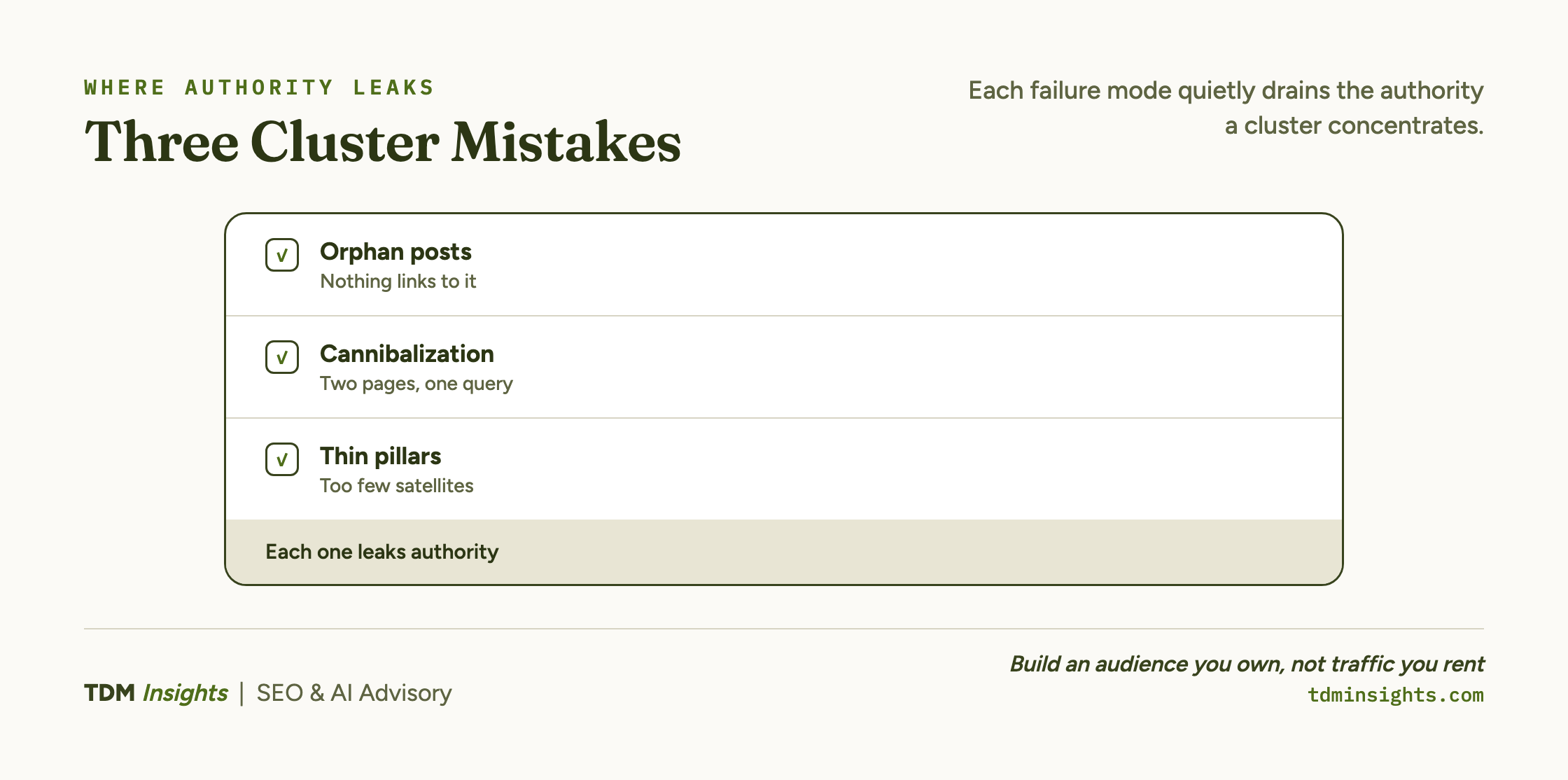
Orphan posts. An article that nothing internal links to is cut off from the cluster’s authority and often from the crawl path. It sits alone and competes alone, which defeats the entire purpose of building a cluster.
The fix is to find every orphan and give it at least an up-link to its pillar and a lateral link to its nearest neighbor.
Cannibalization. When two articles target the same query, they split each other’s authority and confuse search engines about which page to rank, so often neither ranks well. This usually happens by accident as a site grows.
The fix is to decide which page owns the query, then merge the weaker one into the stronger or repoint it to a distinct sub-question.
Doing this cleanup is part of merging thin posts during a refresh, where pruning and merging are routine maintenance rather than emergency repair.
Thin pillars. A pillar with only one or two supporting satellites has not earned topical depth, so it underperforms on the competitive head term it was built to win.
The fix is the five-satellite test applied after the fact: map the buyer questions the pillar should cover, then fill the gaps until the pillar is genuinely supported.
All three mistakes share a root cause, which is treating articles as standalone outputs rather than parts of a structure.
The Cluster Map is the antidote: it forces you to ask, for every article, what it links up to, what links down to it, and which neighbors it connects to laterally.
Answer those three questions for every page and orphans, cannibalization, and thin pillars largely stop happening.
How clusters compound over time
The reason this architecture is worth the effort is the compounding.
A single post peaks and decays. A cluster appreciates, because every new satellite you add raises the authority of every article already in the cluster, including the pillar.
The hub gets stronger each time you support it, and the stronger hub lifts every spoke.
That is the asset behavior behind a compounding impressions curve.
It does not come from publishing more in the conventional sense. It comes from publishing into a structure, so each article makes the others more findable instead of competing with them for the same scraps of attention.
The architecture is what turns a publishing schedule into an appreciating asset.
This article is the architecture stage of a larger system. The full economic argument, and the four stages that come after structure, live in the compounding content library this architecture sits inside.
If you have published for a while with no real structure, that is the place to start, because architecture is the stage that makes everything downstream compound.
If you want a clear-eyed read on whether your current content is structured to compound or quietly leaking authority, a free diagnosis maps your cluster architecture against where your buyers actually search.
Frequently Asked Questions
What is a topic cluster and what is a pillar page?
A topic cluster is a group of articles that all cover one subject, linked together. The pillar page is the comprehensive hub article at the center; the satellites each answer one specific buyer question and link back up to it. Together they tell search engines you cover the whole topic, not just one slice of it.
Why do clusters rank better than the same posts published in isolation?
A post published alone competes alone. The same post inside a cluster inherits authority from every related article linked to it, so internal links concentrate topical authority on the pillar and circulate it among satellites. That concentration, not the individual posts, is what drives a durable impressions lift.
How do I decide what my pillar pages should be?
Choose pillars from your biggest buyer questions, not from keyword volume alone. A good pillar is a subject broad enough to support five or more satellite articles but narrow enough that you can genuinely become the most useful source on it. If you cannot list five real sub-questions, it is a satellite, not a pillar.
How many supporting articles does one pillar need?
There is no fixed quota. A pillar needs enough satellites to answer every distinct buyer question under its subject, which is usually five or more. A pillar with one or two thin supporting posts underperforms because it has not earned topical depth. Map the questions first, then the count answers itself.
How do internal links between cluster articles pass authority?
Internal links pass authority by signaling relationships search engines can follow. Satellites link up to the pillar with descriptive anchor text, the pillar links down to each satellite, and the most related satellites link to each other. This routes accumulated authority toward the page you most want to rank and keeps the cluster crawlable.
What are the most common topic-cluster mistakes?
The three that hurt most are orphan posts that nothing links to, cannibalization where two articles target the same query and split each other’s authority, and thin pillars with too few satellites. Each one leaks the authority the cluster is supposed to concentrate. Fixing them usually means merging, relinking, or filling gaps.
Continue Reading:
More On Content Strategy
- Content Strategy for Founders: A Library That Ranks, Gets Cited, and Pays for Itself
- How Many Blog Posts Do You Need to Rank?
- Content That Ranks and Gets Cited by AI
- Content That Converts Readers Into Customers
- Content Refresh: Win Back Rankings You Lost
More from TDM Insights
- SEO for Startups: What to Do in the First 90 Days
- Keyword Research for Startups: Demand You Can Win
- Technical SEO Checklist for Founders, by Severity
- How AI Answer Engines Choose Their Sources
- Schema Markup for AI: Answer-First Writing Guide
Explore TDM Insights Categories