
Content That Ranks and Gets Cited by AI
Content strategy and SEO meet AEO: how one page can rank in Google and get cited by ChatGPT, Perplexity, and AI Overviews.
 By David Jubé · May 4, 2026 · 16 min read
A founder should not have to choose between a page that ranks in Google and a page that gets quoted by an AI engine. They are the same page.
Search Engine Optimization (SEO) and Answer Engine Optimization (AEO) are one structure with two payoffs: an answer-first opening and clean, extractable blocks earn the AI citation, while depth, internal links, and demonstrated experience earn the ranking.
You write the article once, structure it deliberately, and both channels can use it.
AEO, short for Answer Engine Optimization, is the practice of structuring content so AI answer engines like ChatGPT, Perplexity, and Google’s AI Overviews can extract and quote it. SEO is the practice of structuring content so a page ranks in Google’s results and a human clicks through.
The second one already gets your budget and attention. The mistake is treating the first as a separate, competing project. It is not.
The page you are reading is built to do both, and it shows you how.
Key takeaways
- SEO and AEO are one structure with two payoffs, so you write the article once and both Google and the AI engines can use it.
- Most AI citations come from pages that already rank well, which makes ranking the on-ramp to citation rather than a separate game.
- Ranking is a strong predictor of citation but not a guarantee, since only about 11 percent of sites get cited by both ChatGPT and Perplexity.
- A Dual-Optimization Page runs six elements together: an answer-first opening, extractable blocks, genuine depth, internal links, first-hand experience, and schema.
- There is exactly one way to get this wrong, and it is thinning your depth to chase extractability, so add the extraction layer on top and never carve the depth out.
The two payoffs come from one structure
Here is the part that saves you from doing the work twice. The signals that make a page citable by AI engines are largely the same signals that make it rank in Google.
Clarity, helpfulness, a direct answer, evidence, and trust drive both outcomes. When you optimize honestly for one, you tend to lift the other.
The reason is mechanical. AI citations are rarely pulled from the open web at random.
They come from pages that already rank well in conventional search, because the engines lean on existing relevance signals to decide which sources to trust and quote. The detail of how AI answer engines choose their sources makes plain why ranking is the on-ramp to citation rather than a separate game.
If your page is invisible in Google, it is mostly invisible to the answer engines too. The ranking is not a separate goal from the citation. It is the on-ramp to it.
That overlap is large, but it is not total, which is the catch that makes deliberate structure worth it.
A page can rank well and still get skipped by AI engines because nothing in it is cleanly extractable: no direct answer near the top, no scannable blocks, no machine-readable markup.
And a page can be beautifully extractable and never rank because it lacks the depth and authority Google requires. You need both halves.
Call this the Dual-Optimization Page: one article engineered so the same words satisfy the human reader, the search crawler, and the answer engine at once.
If you are new to the citation side of this, start with what answer engine optimization actually is before going deeper here. The rest of this article assumes you want one page to win both channels.
SEO vs AEO vs the dual-optimized page
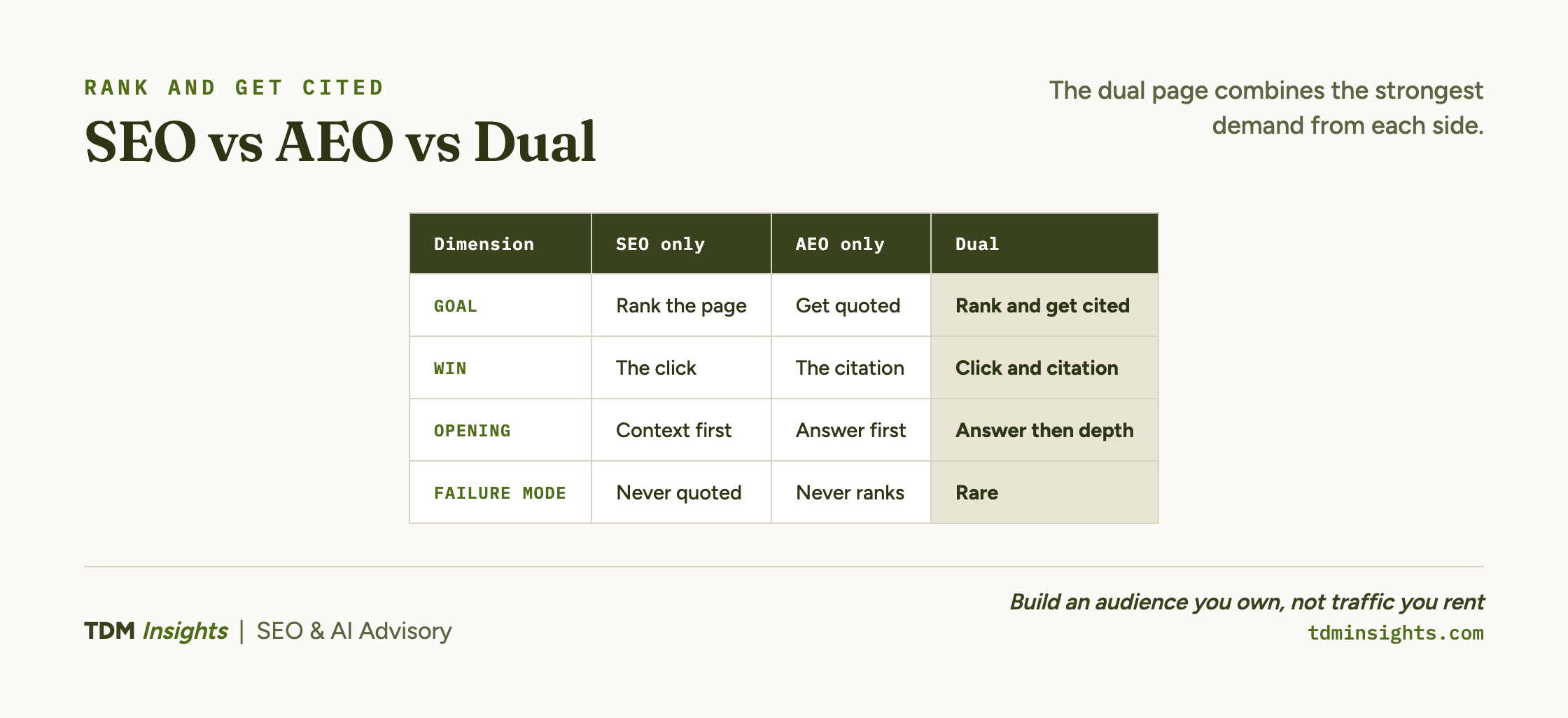
The fastest way to see why this is one structure and not two is to compare what each approach optimizes for, then notice how much the right-hand column simply combines the first two.
Read the table top to bottom and the pattern is hard to miss. The dual-optimized column almost never invents a new requirement. It takes the strongest demand from each side and asks the page to meet both.
An answer-first opening (an AEO instinct) does not weaken the depth Google rewards; it just puts the conclusion before the depth instead of after it.
Internal links and demonstrated experience (SEO instincts) do not block extraction; they give the AI engine a reason to trust what it extracts.
The two columns were never really in conflict. They were the same page, described from two ends.
For a practitioner-level walkthrough of how these acronyms relate, including the newer GEO label, this GEO and AEO explained overview is a useful companion, and Ahrefs’ breakdown of what answer engine optimization is ties the citation game back to SEO fundamentals rather than treating it as a separate discipline.
Why most AI citations come from pages that already rank
It is worth being precise about the overlap, because the precision changes what you build.
The optimistic version of this story is that ranking and citation are the same thing, so SEO alone is enough. That is close to true, but not true enough to bet a content strategy on.
The realistic version: ranking is a strong predictor of citation, not a guarantee of it.
Independent analysis of AI search results has found that the set of sites cited by ChatGPT and the set cited by Perplexity overlap surprisingly little, with only around 11 percent of sites earning citations from both engines.
Each engine has its own retrieval quirks and its own bar for what counts as a clean, quotable source.
So a page that ranks well clears the first hurdle, getting read by the engines, but it still has to be structured for extraction to clear the second, getting chosen as the quote.
That is the practical case for deliberate dual optimization.
Because citation is not a free byproduct of ranking, the few structural moves that make a page extractable carry outsized return: they convert rankings you have already earned into citations you would otherwise leave on the table.
The depth and the links that earn the ranking come first; treat them as the SEO foundation a founder needs first. The extraction layer is what you add on top.
The anatomy of a Dual-Optimization Page
Here is the structure, in the order a reader and an engine encounter it. None of these elements are exotic.
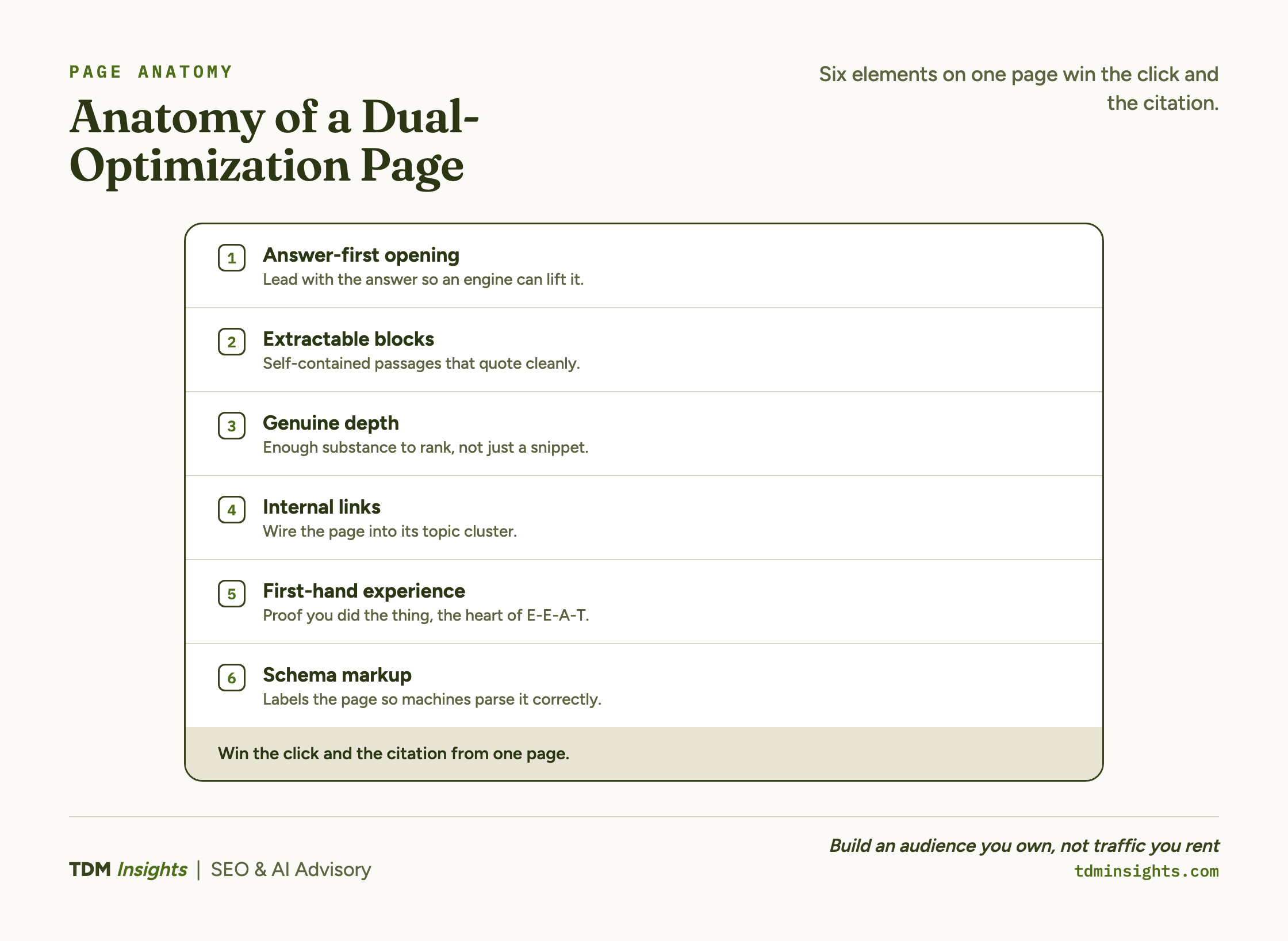
The discipline is doing all of them on the same page, deliberately, instead of half of them by accident.
1. The answer-first opening. The direct answer to the page’s main question appears in the first paragraph, before any background.
The human reader gets what they came for immediately. The AI engine gets a clean, quotable passage exactly where it looks for one.
The depth still follows; it just comes after the answer rather than building up to it. This single move also tends to win featured snippets, which makes it one of the highest-return edits in content.
(Notice that this article opened with its own answer in the first three sentences. That was not an accident.)
2. Extractable blocks throughout the body. Beyond the opening, the body is built in self-contained, quotable units: short definitional sentences, clearly labeled steps, comparison tables, and crisp answers under descriptive headings.
An engine should be able to lift any one block and have it make sense on its own.
This is why the comparison table above is structured the way it is, and why each anatomy element here is a standalone, named unit rather than a buried clause.
3. Genuine depth underneath the answers. Extractability without substance is a trap.
A page that is all summary and no depth may get quoted once, but it will not rank, and it will not earn the repeat trust that sustained citation depends on.
The answer-first opening is a promise; the depth is you keeping it.
This is the half AEO-only content forgets, and it is why the riskiest mistake in this whole game is thinning your content to chase extractability.
4. Internal links that build topical authority. Links to related articles in the same cluster route accumulated authority toward the pages you most want to rank, and they signal to engines that you cover the whole topic, not one slice of it.
They also keep a reader moving through your library instead of bouncing.
That is why this article links across to the AEO cluster and up to its own pillar rather than ending at a dead stop.
5. Demonstrated first-hand experience (the E-E-A-T layer). Google’s quality framework weighs Experience, Expertise, Authoritativeness, and Trustworthiness, and the first E is the one most founders underuse.
Real numbers, real examples, and a point of view that could only come from having done the thing are what separate a citable source from a generic one.
Google’s own guidance on how to demonstrate first-hand experience is the clearest map of this layer, and it is the trust signal both SEO and AEO quietly depend on.
6. Machine-readable schema. Structured data marks up your content so engines can parse it without guessing.
FAQPage markup turns your Q&A block into something an answer engine can read field by field; Article markup tells search engines what the page is.
The FAQPage type is the canonical reference for the first, and this page ships both at the bottom.
Schema is not a ranking shortcut, but it removes ambiguity, and removing ambiguity is most of what AEO is.
Run those six together and you have a Dual-Optimization Page. Miss the top of the list and you have SEO-only content that AI never quotes. Miss the bottom and you have AEO-only content that never ranks to be quoted in the first place.
How to write answer-first without thinning your content
The most common objection to answer-first writing is that it feels like giving away the conclusion, leaving nothing to read.
The fix is to separate the answer from the depth, not to delete the depth.
Lead the page, and ideally each major section, with the direct answer in plain language.
Then earn the rest of the reader’s attention with the part the answer cannot contain: the mechanism, the evidence, the edge cases, the worked example.
The answer is the headline of a section; the depth is the section.
A reader who only wanted the answer leaves satisfied, which is fine. A reader who wanted the reasoning keeps going, which is the one you can convert.
This is also where the answer-first writing and schema markup discipline pays off twice: the same opening that an AI engine extracts is the same opening a featured snippet rewards and a busy human reader thanks you for.
You are not writing three versions. You are writing one version that respects how each audience reads.
For the deeper how-to on earning the quote itself, the mechanics of how to get cited by ChatGPT and Perplexity go further than there is room for here.
Frase’s complete guide to getting cited by AI is a solid external companion on answer-first structuring and the citation mechanics behind it.
How to optimize for AI Overviews without hurting your rankings
This is the fear behind the whole topic: that chasing AI visibility will somehow cost you the search rankings you already have.
It will not, as long as you optimize honestly. The signals are shared, so do four things:
- Lead with a clear, extractable answer.
- Support it with genuine depth and real evidence.
- Mark it up with schema.
- Demonstrate first-hand experience.
Every one of those moves strengthens your ranking at the same time it improves your odds of being cited, because helpfulness, clarity, and trust are what both systems reward. Good AEO is good SEO.
There is exactly one way to get this wrong, and it is the one to watch: thinning your depth to make the page more extractable.
Stripping out the substance to expose more quotable summary trades a durable ranking for a fragile citation.
Add the extraction layer on top of your depth. Never carve the depth out to make room for it.
Book a free diagnosis
A page can rank well and still never get cited, usually because nothing in it is cleanly extractable. A free diagnosis takes one of your highest-traffic pages and reads it against the six-element anatomy above, showing you exactly where the answer-first opening, the extractable blocks, or the schema are missing. You leave knowing which structural moves convert the rankings you already earned into AI citations.
How to know if AI engines are actually citing you
You cannot manage what you do not measure, and AI citations do not show up in the same dashboards as clicks. Check directly and check continuously, across four signals:
- Query the engines directly. Ask ChatGPT, Perplexity, and Google’s AI Overviews about the topics you cover, and watch whether your pages appear as cited sources.
- Track AI referral traffic. Watch for visits from AI domains in your analytics, because citations increasingly send real visits, not just exposure.
- Watch branded search. Look for branded queries that climb after a citation appears, since being quoted in an answer often drives people to search for you by name afterward.
- Use AI-visibility tools. Dedicated tools can monitor citation frequency over time once you want to track this systematically rather than by hand.
The point of measuring is to close the loop.
When you can see which pages get cited and which get skipped, you learn which structural moves are working on your content specifically, and you can apply them to the rest of the library.
Getting found and getting chosen is only the first job, though.
Once a page ranks and gets cited, the next question is whether the traffic actually does anything, which is where you make sure that ranked and cited, now convert the reader becomes the next step rather than a leak.
Where this fits in the content library
Dual optimization is the third stage of building a content library that compounds.
The architecture has to exist first, and the coverage has to be there, but neither matters if every article is built for only one channel and wins neither.
This stage is where you make every article win both Google and AI engines, so the visibility you already earned converts into the citations and clicks that move a reader forward.
Do this across the library, not on one hero page. A single dual-optimized article is a nice win.
A library of them is a moat, because each one reinforces the topical authority that makes the next one easier to rank and quote.
That compounding is the whole reason to treat content as an asset rather than a backlog.
If you want a single page audited against the six-element anatomy above, before you roll it out across the whole library, that is exactly what a free diagnosis covers.
It surfaces which articles are leaving rankings or citations on the table and what to change first, starting with your highest-traffic page.
Frequently Asked Questions
What is the difference between SEO content and AEO content?
SEO content is built to rank a page in Google’s results so a human clicks through. AEO, or answer-engine optimization, structures the same content so AI engines can extract and quote it directly. The difference is the destination: SEO earns the click, AEO earns the citation. One page can be built for both.
Can one article rank in Google and get cited by ChatGPT and Perplexity?
Yes. The two outcomes overlap heavily: most AI citations come from pages already ranking in Google’s top results. But the overlap is not total. Studies have found only about 11 percent of sites get cited by both ChatGPT and Perplexity, so a page must rank well and be structured for extraction to win on both.
What does answer-first structure actually look like?
Answer-first means the direct answer to the page’s main question appears in the first paragraph, before the background. AI engines extract that opening; human readers get what they came for immediately. The depth still follows, it just comes after the answer rather than building up to it. The same structure helps featured snippets too.
Do I have to choose between writing for search and writing for AI?
No. The structure that satisfies one tends to satisfy the other. An answer-first opening that AI engines quote and the depth, internal links, and demonstrated experience that search rewards are not in conflict. You write one well-structured page, then add extractable blocks and schema so both channels can use it.
How do I optimize for AI Overviews without hurting my rankings?
Lead with a clear, extractable answer, support it with genuine depth and evidence, mark it up with schema, and demonstrate first-hand experience. None of that weakens rankings; it strengthens them, because the same signals (helpfulness, clarity, trust) drive both. Good AEO is good SEO. The risk is thinning your depth to chase extractability.
How do I know if AI engines are citing my content?
Check directly: query ChatGPT, Perplexity, and Google AI Overviews on the topics you cover and see whether your pages appear as sources. Then track referral traffic from AI domains in your analytics and watch for branded queries that rise after citations appear. Dedicated AI-visibility tools can monitor citation frequency over time.
Continue Reading:
More On Content Strategy
- Content Strategy for Founders: A Library That Ranks, Gets Cited, and Pays for Itself
- Topic Clusters and Pillar Pages: How They Work
- How Many Blog Posts Do You Need to Rank?
- Content That Converts Readers Into Customers
- Content Refresh: Win Back Rankings You Lost
- How to Build a Content Funnel (TOFU to BOFU)
- Where to Place a CTA So It Gets Clicked
More from TDM Insights
- Answer Engine Optimization: What AEO Actually Is
- How AI Answer Engines Choose Their Sources
- How to Get Cited by ChatGPT, Perplexity, and AI
- Schema Markup for AI: Answer-First Writing Guide
- SEO for Startups: What to Do in the First 90 Days
- How to Produce Content That Ranks and Gets Cited
Explore TDM Insights Categories