
Content Refresh: Win Back Rankings You Lost
A content refresh recovers rankings you lost: when to refresh, prune, or merge, and why updating usually beats writing new.
 By David Jubé · Apr 10, 2026 · 13 min read

Rankings are not permanent. A page that sat at position three last year can slip to page two without you touching a thing, because competitors publish deeper coverage, search intent moves, and the facts in your article quietly go stale.
That slow slide is called content decay, and the fastest way to reverse it is almost never to write something new. It is to refresh, prune, or merge what you already published, because an indexed page that has lost ground still carries the age, backlinks, and accumulated authority a brand-new URL would have to earn from scratch.
This article gives you the decision tree for choosing which of those three moves a given article needs, and the explicit ROI math for why updating usually beats starting over.
This is the maintenance stage of a content system. Coverage and conversion build the asset; refresh is the stage that keeps the library compounding instead of depreciating one decayed page at a time.
Key takeaways
- Rankings are not permanent, and the slow slide a page suffers over time is content decay: predictable, which means it is plannable.
- Updating a slipping page usually beats writing a new one, because the existing URL already holds age, backlinks, and accumulated authority a fresh URL would start at zero.
- Diagnose before you touch anything, because refresh, prune, and merge solve different problems and applying the wrong one wastes the effort.
- Sequence by recoverable upside: start with pages that used to perform and have declined, then target pages stuck just below page one at positions eight through fifteen.
- A real refresh changes the substance, not just the date, because a fresh date without fresh content does nothing for rankings and can erode trust.
What content decay actually is
Content decay is the gradual loss of organic traffic and ranking position a published page suffers over time, even when nothing on the page changes.
Ahrefs documented the pattern across large samples in its content decay and why traffic slips study: a meaningful share of pages that once drove steady traffic lose most of it within a couple of years. The page did not get worse in absolute terms. The web around it got better, and relevance is always relative.
Three forces drive it. Competitors publish fresher and more complete coverage, so your page falls behind on depth.
Search intent shifts, so the query that once meant one thing now means another and your page no longer matches.
And the substance ages: a statistic from two years ago, a screenshot of an old interface, a recommendation for a tool that has since changed. Google’s own systems reward currency and helpfulness, so a page that has fallen behind on all three slowly gives back the positions it earned.
The point is not that decay is avoidable. It is that decay is predictable, which means it is plannable.
If you know pages slip, you schedule maintenance the way you schedule anything else that depreciates. The alternative is watching your best assets bleed traffic and treating each loss as a surprise.
Why updating usually beats writing new
When a page on a topic you still want to own starts slipping, the instinct is to write a fresh article. That is usually the more expensive path with the lower return.
The existing URL already holds three things a new page does not: time in the index, the backlinks it has earned, and the topical authority it accumulated from internal links and traffic. Throw it away and you reset all three to zero.
The data backs the instinct to update. Content marketers who make a habit of updating older posts are far more likely to report strong results than those who only publish new, a pattern HubSpot has tracked across its annual research and that practical guides like Zapier’s how to update old content for traffic walkthrough quantify with the roughly 2.8x figure for updaters versus net-new publishers.
Backlinko’s own content-relaunch case study documented a large short-term organic traffic jump from rebuilding and relaunching a single existing post, precisely because the relaunch inherited everything the URL had already banked.
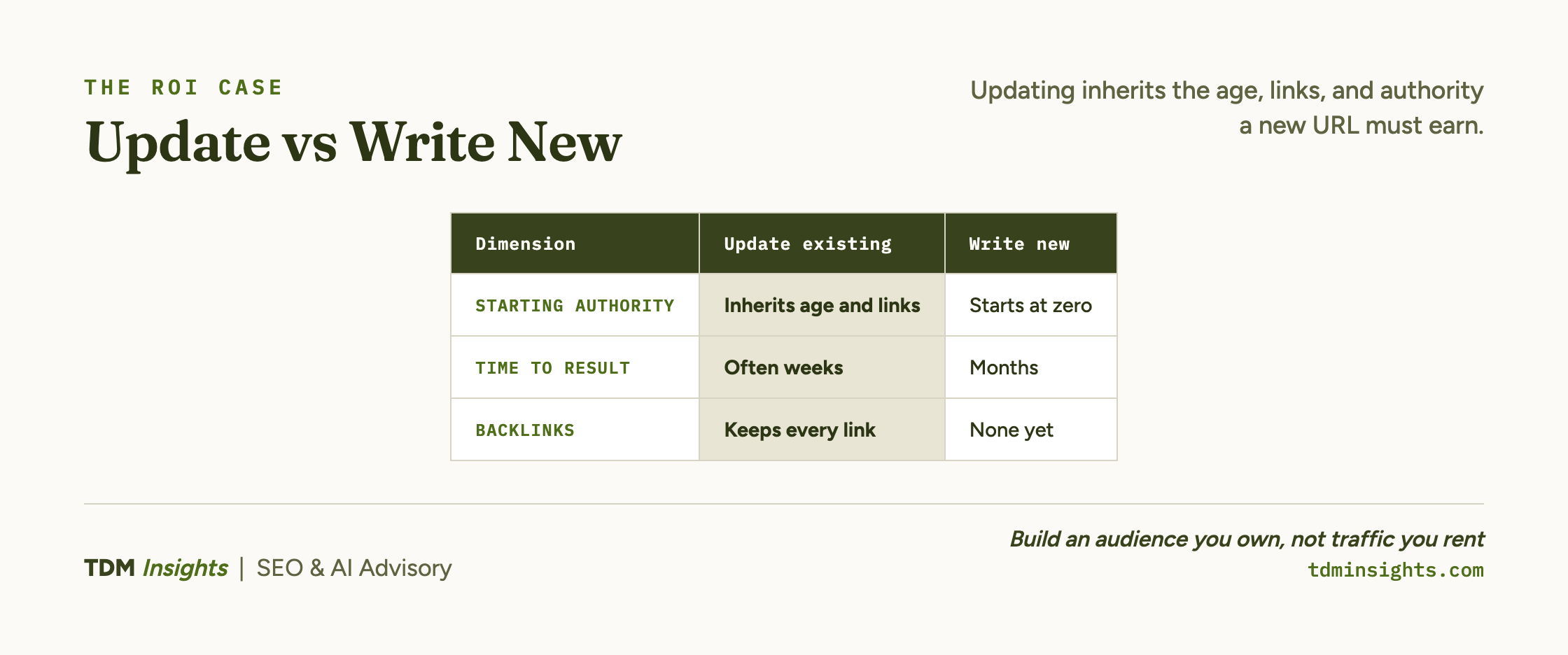
Here is the comparison in plain terms.
Update versus write-new: the ROI comparison
The two paths split on a handful of factors that decide the return.
The single rule that falls out of this table: update when the page still targets the right thing and has just fallen behind.
Write new only when the topic, angle, or intent is genuinely different, because in that case the old page is not a slipping asset, it is a different asset that happens to share a few keywords.
The Content Marketing Institute makes the same case in its content refresh strategy guidance: refreshing is a distinct, higher-ROI discipline from net-new production, not a lesser version of it.
The Refresh Decision Tree: refresh, prune, or merge
Not every decaying page wants the same treatment. Before you touch anything, diagnose which of three moves the page actually needs.
Refresh, prune, and merge solve different problems, and applying the wrong one wastes the effort. Agencies that run maintenance at scale formalize exactly this split; Animalz lays out the same three-way logic in its building a content-refresh strategy framework.
Run each candidate page through these questions in order.
The decision tree as a structure
The logic runs as a short series of yes or no questions, asked in order.
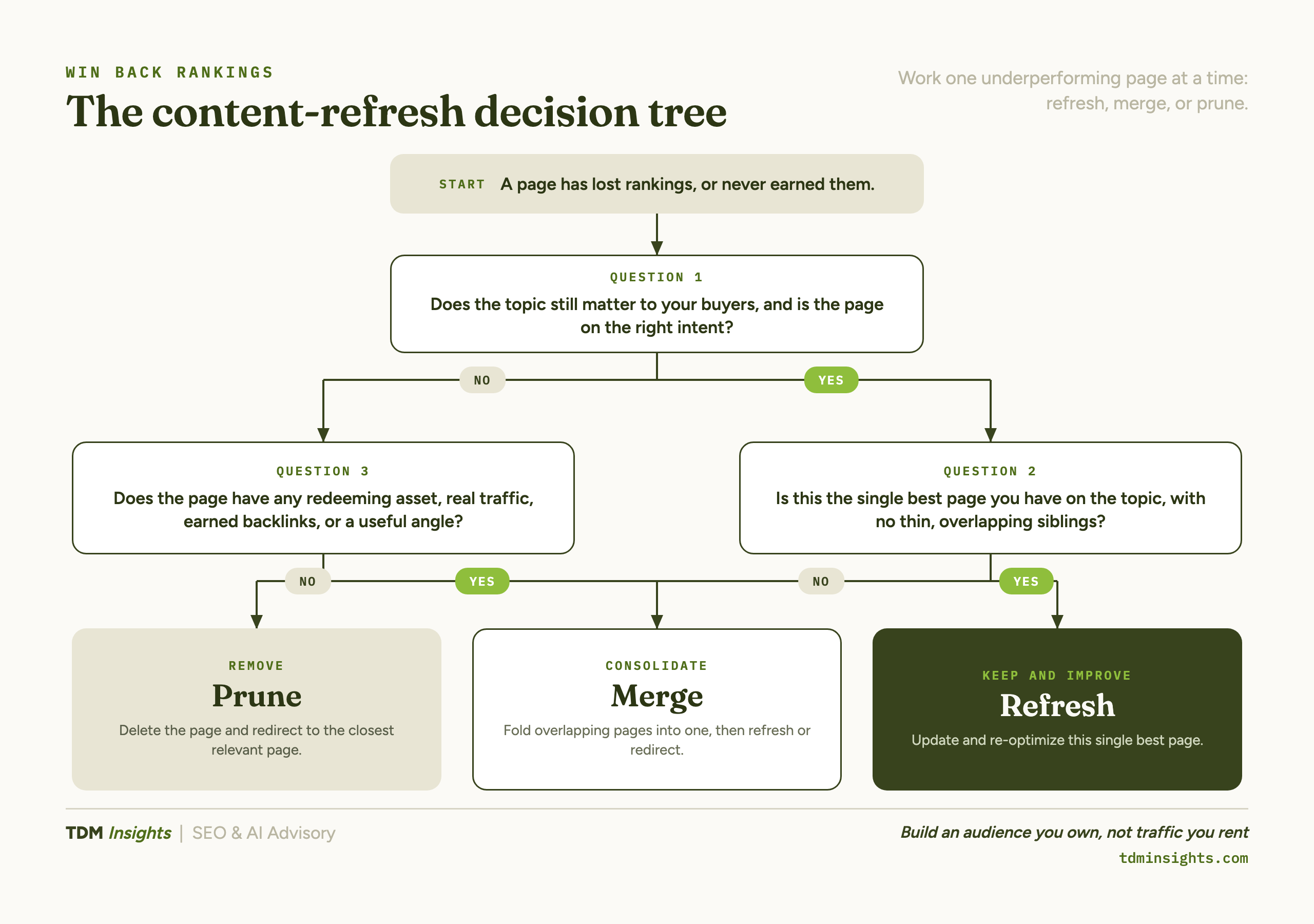
Reading it as a table:
Merge is the move most founders skip, and it is often the one that recovers the most ground. Two thin posts on nearly the same query do not add up: they split clicks and authority and confuse search engines about which one to rank.
Combining them is the same operation as re-architecting a cluster during a merge, and it is the direct inverse of the coverage question. The same logic that sizes your content library tells you when to add a page; the merge branch tells you when to subtract one.
Book a free diagnosis
Telling decay apart from a slipping asset worth rebuilding is the hard call, and the wrong move wastes the refresh budget on pages that never had authority. A free diagnosis reviews your declining pages, sorts them into refresh, prune, or merge, and ranks them by recoverable upside so you start where the return is highest. You leave with a prioritized maintenance list, not a vague sense that the blog needs work.
How to prioritize: which pages to fix first
You cannot refresh everything at once, so sequence by recoverable upside, not by which page annoys you most.
Start with pages that used to perform and have measurably declined. That decline is the strongest signal of recoverable authority: the page proved it could rank, so a refresh is rebuilding on a foundation that already worked.
Semrush frames the same prioritization in its deciding when a post is worth refreshing guidance: fading winners come first.
Next, target pages stuck just below the first page of results, typically positions eight through fifteen. A page sitting at the top of page two is close enough that a substantive refresh can produce an outsized jump in clicks, because the difference in click-through between the bottom of page one and the top of page two is steep.
Small ranking gains there convert to large traffic gains.
Deprioritize, and route to prune or merge, anything that never ranked and has no links. Refreshing a page that never had authority is writing new with extra steps. Save the refresh budget for assets that have something to recover.
To confirm a drop is decay rather than a technical fault or an algorithm shift, diagnose before you rewrite. Google publishes its own method in how Google says to diagnose a traffic drop, which walks through telling a site-wide update apart from a page-specific decline.
Search Engine Journal’s refresh strategies to fight content decay feature pairs that diagnosis with the recovery playbook.
This is also the practical answer to why rankings move over time: they move because the competitive set moves, and the diagnosis tells you whether you are looking at decay you can fix or noise you should ignore.
What a real refresh changes beyond the date
The most common refresh is the one that does nothing: swapping the published date and changing a word or two. That does not recover rankings, and Google has been explicit that a fresh date without fresh substance is not a quality signal.
Worse, it can erode trust if a reader notices a “2026” stamp on plainly outdated content. The date should follow genuine improvement, never replace it.
A real refresh is substantive. Step by step, the way tactical guides like Surfer’s a step-by-step content refresh lay it out:
- Re-check every fact and figure. Update stale statistics, replace dead links, and correct anything the last two years have overturned.
- Deepen the thin sections. Find the questions readers still have after finishing and answer them. Depth is usually why a competitor passed you.
- Add current examples and data. New numbers and recent examples are what make the update genuine rather than cosmetic.
- Fix the answer-first opening. The direct answer to the page’s main question belongs in the first paragraph, for both human readers and the AI engines that extract it. This is also how you start re-earning AI citations after a refresh, because the same answer-first structure that wins a featured snippet is what gets a page quoted by ChatGPT, Perplexity, and AI.
- Refresh the internal links. Point the page to newer related articles and make sure the rest of the cluster links back to it, so the refreshed authority circulates.
- Sharpen the single CTA. Match the one next step to the reader’s stage. A refreshed page that ranks again is wasted if it still asks for nothing.
Then, and only then, update the date. The improvement is the signal. The date just records it.
Where refresh fits in the system
Refresh is not a separate project you run when there is spare time. It is the fifth stage of a content library, the one that defends the compounding the other four stages built.
Architecture, coverage, dual-optimization, and conversion all create the asset. Maintenance is what keeps it from quietly depreciating, which is the whole reason a library appreciates instead of decaying into a pile of old posts.
Built into the calendar, maintenance is low-cost insurance on expensive assets. Skipped, it is the silent leak that gives your hardest-won rankings back to whoever published next. It is also a large part of why the organic investment pays off for a startup: the assets keep working only if you defend them.
Frequently Asked Questions
Why do my old articles lose rankings over time?
Because rankings are not permanent. Competitors publish fresher, deeper coverage, search intent shifts, and facts go stale, so a page that ranked last year quietly slips. This is content decay, and it is normal. It is also why maintenance is a stage of a content system, not an afterthought you get to if there is time.
What is the difference between refreshing, pruning, and merging content?
Refreshing means updating a still-relevant article that is slipping. Pruning means removing a page with no traffic, value, or links. Merging means combining two or more thin, overlapping posts into one strong page. Each move targets a different problem, so the first step is diagnosing which one a given article actually needs.
Is it better to update an old post or write a new one?
For a slipping page on a topic you still want to own, updating usually wins. The existing URL already carries age, backlinks, and accumulated authority a new post lacks, and content marketers who update old posts are far more likely to see strong results. Write new only when the topic, angle, or intent is genuinely different.
Which articles should I refresh first?
Prioritize pages that used to perform and have declined, since that decline signals recoverable authority. Next, target pages stuck just below the first page, where a refresh can produce an outsized jump. Deprioritize pages that never ranked and have no links; those are prune or merge candidates, not refresh candidates.
How much traffic can a refresh actually win back?
It varies, but the upside is real because you are rebuilding on an asset that already has authority. Documented relaunches have produced large short-term traffic gains, and updaters consistently outperform those who only publish new. The exact number depends on how far the page slipped and how substantively you improve it, not on a date change.
What does a real refresh change beyond the date?
A real refresh updates the substance: it re-checks facts, deepens thin sections, adds new examples and current data, improves the answer-first opening, refreshes internal links, and sharpens the CTA. Swapping the published date without improving the content does nothing for rankings and can erode trust. The date should follow genuine improvement, never replace it.
Continue Reading:
More On Content Strategy
- Content Strategy for Founders: A Library That Ranks, Gets Cited, and Pays for Itself
- Topic Clusters and Pillar Pages: How They Work
- How Many Blog Posts Do You Need to Rank?
- Content That Ranks and Gets Cited by AI
- Content That Converts Readers Into Customers
More from TDM Insights
- How Long Does SEO Take? An Honest Timeline
- Is SEO Worth It for a Startup? When to Invest and When to Wait
- Backlinks for Startups: Earn Authority, No Budget
- How to Get Cited by ChatGPT, Perplexity, and AI
- How to Measure AI Traffic With No Referrer
Explore TDM Insights Categories