
Backlinks for Startups: Earn Authority, No Budget
No budget, still linkable. Build assets worth citing and run founder-led PR that actually pulls backlinks to a young site.
 By David Jubé · Apr 13, 2026 · 14 min read
Backlinks still move rankings, and you do not need a budget to earn them. You do need something worth linking to first.
That is why authority is step four of the order of operations, not step one. A founder who chases links before publishing a worth-citing page is paying for traffic to a page that cannot keep it.
The short version: earn links, do not buy them, and start only after step three, once real content exists.
A backlink is simply a link from another website to yours, and search engines read those links as votes of confidence. The rest of this article is the founder-executable method for earning them with time instead of money.
This is the last step in our cluster’s first-90-days order of operations, and it is deliberately last.
Search Engine Optimization (SEO) is a sequence, and link building sits at the end of it for a reason we will make concrete below.
Key takeaways
- Backlinks still move rankings and you do not need a budget to earn them, but you do need a page worth linking to first.
- Earn links, do not buy them, because bought links violate Google’s policies and put your rankings at risk.
- Authority is step four of the order of operations, so sequence it after content rather than chasing links before you have a page worth citing.
- Backlinks still matter in the AI era, because earned mentions now count alongside earned links when an answer engine decides who to cite.
- There is no magic number of backlinks; match the referring-domain profile of the pages already ranking and track referring domains over time as your leading indicator.
The Answer: Earn Links, Do Not Buy Them, and Only After Step Three
Three rules carry the whole strategy.
First, earn, do not buy. Bought links violate Google’s policies and put your rankings at risk.
Earned links, the kind a writer or site owner adds because your page is genuinely worth citing, are the only ones that compound safely. Moz’s free guide to link building lays out the same principle at length: the durable links are the ones you do not have to pay for.
Second, sequence authority after content. Authority is accelerant on the first three steps. It is never a substitute for them.
If your site cannot be crawled and indexed, links do not help, so clear the foundation links sit on top of first. If you have no page worth citing, there is nothing for a link to point at, so write the content that ranks and gets cited before you pitch anyone.
Third, utility earns the link. People link to things that help their own readers: a statistic they can quote, a tool they can recommend, a point of view they want to argue with.
Nobody links to a page because you asked nicely. They link because it makes their own content better.
Hold those three rules and the rest is execution, which a founder can do alone.
Why Backlinks Still Matter: The Honest AI-Era Take
Here is the question every founder is right to ask in 2026: do backlinks still matter now that AI Overviews and chatbots answer queries directly? The honest answer is yes, and arguably more than before. To see where link building fits among the newer disciplines, it helps to compare GEO, SEO, AEO, and LLMO first.
The reasoning is mechanical, not hopeful. Traditional ranking has long treated links as votes: a page that earns links from trusted sites is judged more authoritative, and Google’s own guidance has held this line for two decades.
Answer engines did not throw that out. They layered something on top of it.
When an AI engine such as ChatGPT, Perplexity, or Google’s AI Overviews composes an answer, it looks for corroboration across sources it already trusts, and the signals that built that trust, links and brand mentions, still feed the decision. A startup that is linked to and talked about across credible sites is simply more likely to be one of the sources the engine pulls from.
So the shift is not “links died.” The shift is that earned mentions now count alongside earned links.
A founder quoted by name in an industry article may not always get a clickable backlink, but the mention itself is a trust signal an answer engine can read. This is exactly the territory the answer-engine cluster covers, and it is the practical heart of how to get cited by ChatGPT, Perplexity, and AI.
If you want the full mechanism, read do backlinks still matter in the AI era, and for the deeper layer on how AI engines weigh trust signals when they decide who to cite, that satellite goes step by step.
The practical takeaway for a budgetless startup: keep building real authority, because both Google and the answer engines are reading it. You are not optimizing for one or the other. You are building the same trust both rely on.
The Linkable-Asset Ladder
A budgetless startup cannot buy links and cannot afford a large outreach team. What it can do is build assets that pull links on their own.
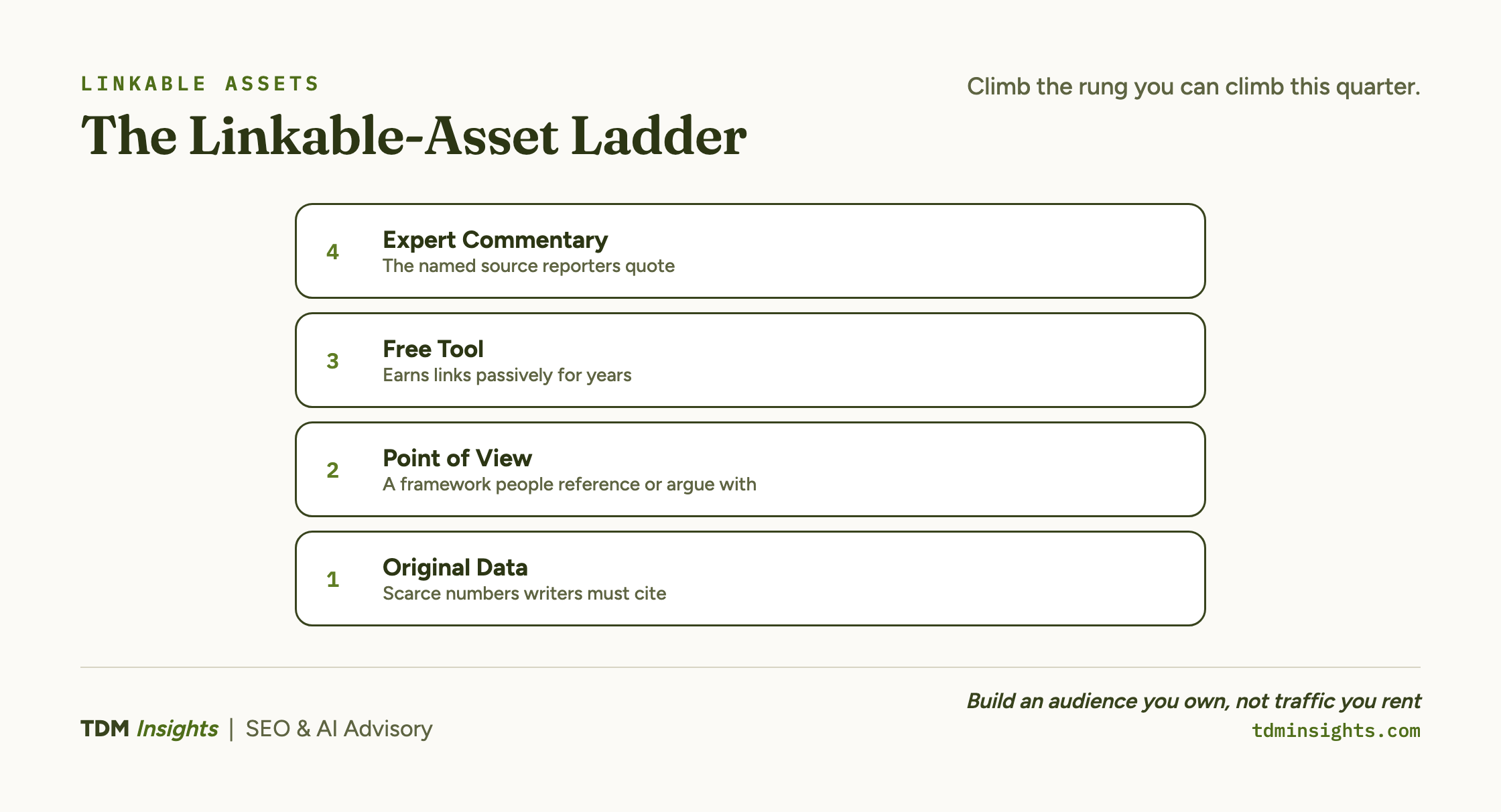
There are four kinds, in rough order of how much effort each takes against how reliably it earns links. Think of it as a ladder you can start climbing at whichever rung fits your week.
Rung one, original data, is the highest-return rung for most startups because it is the scarcest. You do not need a research budget.
You need a number nobody else has, and as a startup you already sit on some: aggregate patterns from your own product, a small customer survey, a before-and-after from your own work.
Pew Research Center’s data pages are the model for why this works. A fact like how many users are mobile gets cited thousands of times precisely because it is a clean, sourceable statistic. Your study will be smaller, but in a narrow niche a small original number is still a magnet.
Rung two, a strong point of view, costs nothing but thinking. A genuinely useful framework, the kind that gives a reader a new way to see a problem, gets referenced because it is convenient shorthand.
The order-of-operations model running through this entire cluster is itself a rung-two asset.
Rung three, a free tool, is the most durable. A useful calculator or checker earns links for years with no further effort, because every new article on the topic that wants to point readers somewhere practical points at the tool.
It takes the most upfront work, which is why it sits high on the ladder.
Rung four, expert commentary, is the fastest to start. You are the named source, and credible named sources are exactly what reporters want.
Nielsen Norman Group’s research is a clean example of how cited expertise compounds: a single well-argued, well-evidenced piece like content people cite becomes a reference other writers reach for again and again.
Climb the rung you can climb this quarter. One real asset beats a hundred pitches with nothing behind them.
Founder-Solo Digital PR
Digital Public Relations (PR) is earning coverage and links by being a useful source for the people who write online. You do not need an agency.
In some ways a solo founder does it better, because reporters want a named, credible person, not an anonymous agency pitch.
Three moves cover most of it.
Respond to journalist requests. Free services connect reporters with sources daily. A founder who answers a relevant request with a sharp, specific quote can earn a link from a publication that would never respond to an unsolicited pitch.
Semrush’s walkthrough of founder-solo digital PR covers the request-response workflow in detail, and it is the single fastest way to start earning mentions with zero budget.
Pitch your original data. Once you have a rung-one asset, find the writers who cover your topic and offer them the number before you publish it, or right after.
You are not asking for a favor. You are handing them a statistic that makes their article stronger. Ahrefs’ guide to digital PR for startups maps the asset-to-outreach loop, which is exactly the linkable-asset ladder put into motion.
Turn customer insight into quotable stories. You see patterns in your market that nobody else sees. Package one into a short, specific story a writer can build on, and you become the source.
The throughline: digital PR is not begging for links. It is making yourself the most useful person a writer can call.
How Many Backlinks You Actually Need
There is no magic number, and any guide that gives you one is guessing.
The number of referring domains on page one varies enormously by niche: a light, underserved topic might show pages ranking on a few dozen referring domains, while a finance or insurance query can demand thousands.
So replace the count with a comparison. Look at the specific pages already ranking for the keyword you want, check how many referring domains each has, and treat that range as your target.
Search Engine Journal’s complete link-building guide frames this competitor-relative approach well: you are not chasing an abstract quota, you are matching the link profile of the pages you intend to outrank, gradually.
The good news for a startup is that the winnable-demand approach from earlier in this cluster does double duty here. If you targeted long-tail terms where the incumbents are weak, the link bar to clear is low, sometimes just a handful of quality referring domains.
That is the point of sequencing keyword research before link building: you chose battles you can win, so the authority you need to win them is achievable.
Tactics to Skip
Some link-building tactics are not just low-value, they are actively dangerous. Avoid them entirely.
- Buying links. Paying for links that pass ranking signals violates Google’s policies and risks penalties.
- Private blog networks. Networks of dummy sites built only to pass links are a well-known spam pattern engines detect and punish.
- Mass directory submissions. Bulk listings on low-quality directories carry no trust and can flag your profile.
- Comment and forum spam. Dropping your link into unrelated comment sections is ignored at best and penalized at worst.
The pattern across all four is the same: they are low-cost and easy to mass-produce, which is exactly why they do not work. Anything you can buy in bulk, Google has seen in bulk and learned to discount or penalize.
Backlinko’s research-backed roundup of proven link-building strategies is built entirely around earned tactics for the same reason, and Ahrefs’ beginner’s guide to link building is explicit that the shortcuts are the fastest way to undo months of legitimate work.
A note on paid placements, because the line confuses founders: advertising is not banned.
Sponsorships, affiliate links, and paid features are fine as long as you mark them with rel=”sponsored” or rel=”nofollow” so they do not pass ranking signals.
The penalty risk comes from disguising a paid link as an editorial endorsement, not from advertising openly. Disclose, tag, and you are clear.
Book a free diagnosis
Earning links is the step founders most often start too early or skip entirely, and either mistake wastes a runway you cannot get back. The right move depends on what you already have to link to and how strong the field is for your terms. A free diagnosis tells you whether your site is ready to earn authority yet, which linkable asset is realistic for you to build first, and how many referring domains the pages you want to outrank actually carry. Straight read, no obligation.
Measuring Authority Growth as a Leading Indicator
Link building is slow, like the rest of SEO, so you measure the leading signal rather than waiting for the lagging one.
The leading indicator for authority is referring domains over time: the count of distinct websites linking to you, tracked monthly.
Watch the trend, not the absolute number. A new domain adding one or two quality referring domains a month is healthy early progress.
You are looking for a line that climbs, not a number that hits a target. Authority growth predicts ranking gains the way rising impressions predicted them earlier in the funnel: it moves first, and the rankings follow.
This closes the loop on the order of operations. Foundation lets you be found. Winnable-demand mapping points you at battles you can win. Coverage gives engines something to choose. Authority accelerates the choosing. Measurement tells you it is working before the revenue does.
Run them in that order, on a runway you have honestly sized, and the curve has every reason to bend the way the discipline predicts: flat for the first several weeks, then climbing and compounding for months as authority accumulates and rankings rise.
Frequently Asked Questions
Do backlinks still matter now that AI Overviews answer queries?
Yes, backlinks still matter and may matter more for AI search. AI systems look for corroboration across trusted sources, so links and brand mentions raise the odds your startup gets cited. Links carry as much weight as they did before. The shift is that earned mentions and citations now count alongside traditional links.
How many backlinks does a new startup actually need to rank?
There is no fixed number; it depends on your industry and your competitors. Page-one results carry a wide range of referring domains, from under a hundred in light niches to thousands in finance. Instead of chasing a target count, analyze the specific competitors ranking for your keyword and aim to match their link profile gradually.
What is a linkable asset and what makes one work?
A linkable asset is content people cite without being asked, usually original data, a strong contrarian point of view, a free tool, or expert commentary. It works when it gives writers something they cannot get elsewhere: a statistic to quote, a calculator to reference, or a quote from a credible founder. Utility and originality drive the links.
Can a solo founder do digital PR without a PR agency?
Yes, a solo founder can run effective digital PR alone. Respond to journalist requests through free services, pitch original data or a sharp opinion to relevant writers, and turn your own customer insights into quotable stories. Founders often outperform agencies because reporters want a named, credible source rather than an anonymous pitch.
Which link-building tactics should startups avoid entirely?
Avoid buying links, private blog networks, mass directory submissions, and comment or forum spam. These violate Google’s link spam policies and risk manual penalties or algorithmic suppression that can erase your rankings. Low-cost, mass-produced link schemes are the fastest way to undo months of legitimate work, so skip them no matter how tempting the shortcut.
Are paid or sponsored links against Google’s rules?
Buying links to pass ranking signals violates Google’s spam policies, but paid placements are allowed if you mark them correctly. Add rel=”sponsored” or rel=”nofollow” to any link you pay for, including affiliates and sponsorships. The penalty risk comes from disguising paid links as editorial endorsements, not from advertising itself when disclosed properly.
Continue Reading:
More On SEO for Startups
- SEO for Startups: What to Do in the First 90 Days
- How Long Does SEO Take? An Honest Timeline
- Is SEO Worth It for a Startup? When to Invest and When to Wait
- Technical SEO Checklist for Founders, by Severity
- Keyword Research for Startups: Demand You Can Win
More from TDM Insights
- Answer Engine Optimization: What AEO Actually Is
- How AI Answer Engines Choose Their Sources
- How to Get Cited by ChatGPT, Perplexity, and AI
- GEO vs SEO vs AEO vs LLMO: What They Mean
- Content That Ranks and Gets Cited by AI
Explore TDM Insights Categories