
How to Be the Source Claude Recommends
When Claude cites, and what its browsed answers reward. How to earn the recommendation, and check which engines cite you now.
 By David Jubé · Apr 18, 2026 · 10 min read
Claude cites sources when it browses the web and stays silent when it answers from its training, so being the source Claude recommends means winning its browsed answers, where you actually have influence.
The signals that earn it, an answer-first passage, corroboration across independent sources, and clear authority, are the same Evaluation and Citation levers from the source-selection model. That is why a source built to one disciplined standard tends to get named across all five engines, not just one, and it is the standard behind content built to rank and get cited by AI.
Here is the answer-first version: win Claude’s browsed answers by publishing verifiable, well-attributed, documentation-style content that the Claude crawler can reach.
Claude is the most overlooked engine in answer engine optimization content, which is part of why it is worth attention. As an assistant heavily used by professionals and developers, a recommendation from Claude can carry outsized weight in high-consideration B2B decisions.
Everything below maps Claude’s path to Retrieval, Evaluation, and Citation, then steps up to the cross-engine payoff and the one ask that follows from it.
Key takeaways
- Claude attaches citations only when web search or its Citations feature is active; with browsing off it answers from training and shows no live sources, so your influence lives entirely on the browsed path.
- Claude’s retrieval is gated by a family of separate crawlers, so allow Claude-SearchBot and Claude-User in robots.txt even when you block ClaudeBot training, or you will not surface in its browsed answers.
- Claude rewards verifiable, documentation-style content with specific checkable claims, named data, and honest acknowledgment of trade-offs, plus corroboration across independent trusted sources, while it weighs down promotional landing-page copy and unsupported assertions.
- Make passages liftable by leading each section with the direct answer, keeping them self-contained, and citing primary data, because that same discipline also wins citations from ChatGPT, Perplexity, AI Overviews, and Gemini.
When Claude Cites: Web Search vs Training-Data Answers
Claude cites sources when web search or its Citations feature is active, attaching references to the exact passages it draws from. With search off it answers from training, which carries a knowledge cutoff and shows no live citations. Same model, two behaviors, decided by whether it browsed.
Claude uses its own reasoning to decide whether a live search would improve accuracy. Time-sensitive, factual, or niche queries are the ones that most often trigger a live fetch, while stable or general-knowledge questions get answered from training. Neutral reporting on the launch of Claude live browsing with source links and a technical report on Claude’s browse-versus-train decision and citation behavior both document the split.
The strategic consequence matches the other engines. You influence the browsed path; the training-data answer is already written. Put the work where you can move the result.
How Claude Retrieves: Web Search, Connected Tools, and the Crawler
Claude retrieves through web search and connected tools when it chooses to browse, and the gate on that path is the ClaudeBot crawler family. Each agent honors robots.txt independently, so blocking one leaves the others active.
There are distinct agents doing distinct jobs:
- ClaudeBot collects public content for model training.
- Claude-User handles live, user-initiated fetches when someone asks Claude to read or research something.
- Claude-SearchBot handles search indexing for Claude’s browsed answers.
Allowing the search and user agents helps you surface in Claude’s browsed answers even if you restrict training. The official specification for when Claude searches the live web and attaches citations and the help page on how Claude browses and cites sources during research describe the retrieval and attribution flow directly, and a data-backed explainer of how Claude search retrieves and attributes covers it from the outside.
Retrieval rides the same crawlable, indexable foundation as the other engines, so the SEO fundamentals are again the floor, starting with the crawlable, indexable technical base every founder should verify. The primary source on the current model whose browsed answers earn citations is the Claude Opus 4.5 announcement.
What Claude Evaluates and How It Attributes
Claude favors verifiable, balanced, primary, and well-attributed content, then cites the specific passages it used.
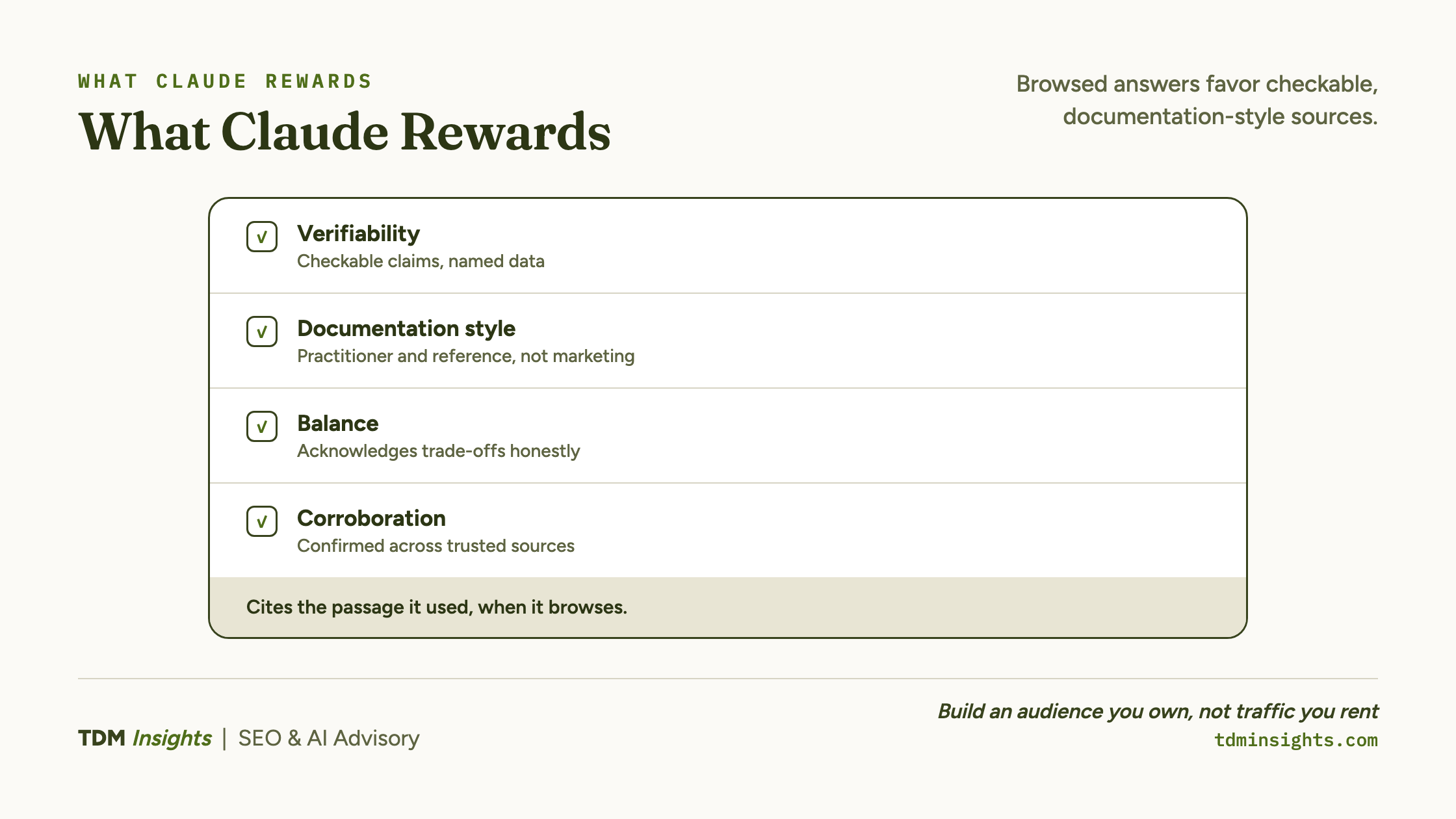
Four evaluation leanings drive what Claude recommends:
- Verifiability. Content with specific, checkable claims and named studies or data outranks vague assertion.
- Documentation-style writing. Claude leans toward practitioner, technical, and reference-style sources over marketing copy.
- Balance and honesty. Content that acknowledges trade-offs earns stronger consideration; promotional landing-page copy and unsupported claims are weighted down.
- Corroboration and authority. Claims confirmed across independent, trusted sources read as more reliable.
Original data on what correlates with getting cited, including by Claude backs the verifiability and corroboration leanings with numbers. To know whether Claude actually names you, you have to watch its browsed answers; an AI search grader that checks whether engines including Claude cite you is a reasonable place to start the measurement.
The practical move for a founder is to write the way Claude rewards: state the claim, cite the source, acknowledge the trade-off, and keep your entity description consistent. The corroboration half of that runs off-page, which is where earning authority and third-party mentions without a budget does the work.
The Claude Checklist, Mapped to Retrieval, Evaluation, Citation
Work this as a procedure. Each item stands alone, so fix the weakest first.
Retrieval (get reachable):
- Allow Claude-SearchBot and Claude-User in robots.txt, even if you restrict ClaudeBot training.
- Keep target pages indexed, fast, and reachable by internal links.
Evaluation (get trusted):
- Write documentation-style: specific, verifiable claims with named sources.
- Acknowledge trade-offs honestly rather than overselling.
- Build third-party validation on review and reference sites.
- Keep your entity description consistent across the web.
Citation (get liftable):
- Put the direct answer in the first sentence of each section.
- Write self-contained passages that resolve one question completely.
- Cite primary data so the claim is checkable on its own.
Actionable tactics for earning citations across LLM engines including Claude and a cross-engine answer-first strategy covering the discipline that wins Claude’s browsed answers both land on the same shape: reachable, then trusted, then liftable.
The Cross-Engine Payoff: One Disciplined Source Compounds
The same answer-first, corroborated, authoritative discipline that wins Claude’s browsed answers also wins the other four engines, so the work compounds: do it once, well, and you tend to get named across all five.
This is the unifying point across all five engines. ChatGPT wants corroboration and a liftable passage.
Perplexity wants directness and freshness, which is why a steady content refresh that wins back rankings you lost feeds the browsed answer rather than just the classic result. AI Overviews wants sub-question relevance on an indexed page.
Gemini wants entity clarity and grounding. Claude wants verifiability and balance. Those are different emphases of one underlying standard, not five separate jobs.
That is why a content library built to this standard pays off broadly. The case for a content library that ranks, gets cited, and pays for itself is the strategic version of the same idea.
We refined this exact approach on a site we operate before bringing it to clients. Over a 28-week stretch, that proving-ground site grew search impressions roughly 10.1 times. The point is not the headline number; it is that the same disciplined content compounded across surfaces rather than being rebuilt for each.
The foundation under all of it remains classic SEO. Retrieval on every engine still depends on being crawlable and indexed, which is why this whole layer rides on the SEO fundamentals you set in the first 90 days and extends the universal Retrieval, Evaluation, Citation model rather than replacing either. If you want orientation before the depth, the overview of the three biggest engines is the shorter survey; Google Gemini gets its own deep dive, and Claude gets this one.
Book a free diagnosis
You now have the playbook for all five engines. The one thing the playbooks cannot tell you is which of the five cite you right now, and where the gaps are. We can. Book a free diagnosis and we will map your citation standing across ChatGPT, Perplexity, AI Overviews, Gemini, and Claude, founder to founder, and tell you what to fix first.
How to Find Out Which Engines Cite You Today
Run your core category questions through all five engines with web access on, record whether your brand appears, how it is described, and which competitors show instead, then repeat on a schedule.
The manual baseline is concrete:
- Pick your ten most important category questions.
- Ask each in Claude, ChatGPT, Perplexity, Gemini, and Google AI Overviews, with search or browsing enabled.
- Record three things per engine: do you appear, how are you described, who shows instead.
- Repeat on a cadence, since citation lists shift frequently week to week.
That baseline tells you which engine’s retrieval path you are missing, which is the cheapest thing to fix. If the terminology around all this still feels slippery, the map of how GEO, SEO, AEO, and LLMO relate puts each label in its place. The fuller method, including how to handle AI traffic that arrives with no referrer, is its own discipline; we cover the measurement method behind this check separately.
If you would rather start the per-engine walk from the beginning, the ChatGPT playbook is the first row of the map. And if the honest answer is “I want all five checked for me,” that is exactly what the diagnosis above delivers.
Frequently Asked Questions
Does Claude cite sources, and when?
Yes. When web search or the Citations feature is active, Claude attaches references to the exact passages it draws from, so answers link back to source material. With search off, Claude answers from training and shows no live citations. Citation behavior is feature-dependent, not automatic in every reply.
Does Claude search the live web or answer from training?
Both, depending on context. Claude uses its own reasoning to decide whether a live search would improve accuracy, then browses and cites when it does. For stable or general knowledge it answers from training without searching. Time-sensitive, factual, or niche queries are the ones that most often trigger a live fetch.
How does Claude decide what to recommend?
Claude favors verifiable, balanced, primary, and well-attributed content. It leans toward documentation-style writing, practitioner and technical sources, and content that names specific studies or data. Promotional landing-page copy and unsupported claims are weighted down, while honest content that acknowledges trade-offs tends to earn stronger consideration.
How do I get Claude to mention my site?
Publish documentation-style pages with specific, verifiable claims and named sources, build third-party validation on review and reference sites, keep your entity description consistent, and let ClaudeBot crawl you. Then track a set of category queries in Claude with search on to confirm whether you appear and how you are described.
Does ClaudeBot crawl my site and should I allow it?
ClaudeBot collects public content for model training, while Claude-User and Claude-SearchBot handle live fetches and search indexing. Each honors robots.txt independently, so blocking one leaves the others active. Allowing the search and user agents helps you surface in Claude answers, even if you restrict training.
How do I know which AI engines cite me today?
Run your core category questions through Claude, ChatGPT, Perplexity, Gemini, and Google AI Overviews with web access on, and record whether your brand appears, how it is described, and which competitors show instead. Repeat on a schedule, since citation lists shift frequently week to week.
Continue Reading:
More On Per-Engine Citation Playbooks
- How Each AI Engine Picks Sources to Cite
- How to Get Cited by ChatGPT
- How to Get Cited by Perplexity
- How to Show Up in Google AI Overviews
- How to Get Mentioned by Google Gemini
More from TDM Insights
- SEO for Startups: What to Do in the First 90 Days
- Technical SEO Checklist for Founders, by Severity
- Backlinks for Startups: Earn Authority, No Budget
- Content That Ranks and Gets Cited by AI
- Content Strategy for Founders: A Library That Ranks, Gets Cited, and Pays for Itself
Explore TDM Insights Categories