
How to Get Cited by ChatGPT
It runs a live search, then pulls answer-first passages. The crawler to allow, and the signals that earn a ChatGPT citation.
 By David Jubé · Jun 5, 2026 · 10 min read
ChatGPT cites sources only when it is browsing the live web, not when it answers from training data, so the first thing to know about getting cited by ChatGPT is which of the two is even in play.
Here is the answer-first version: get retrievable on the search ChatGPT leans on, then get liftable with answer-first passages, then get corroborated by third-party sources. Those three map to the Retrieval, Evaluation, and Citation steps in the model for how AI engines find, evaluate, and cite a source, and they are the only game you can actually influence.
The part you cannot influence is ChatGPT answering from training data. That answer is already written, and the next one shifts only when the model and its sources shift. Your leverage lives entirely on the browsed path.
Everything below separates the two behaviors, then walks the browsed path step by step.
Key takeaways
- ChatGPT cites sources only when its search tool browses the live web in real time, so your only leverage lives on that browsed path, never on the fixed training-data answer.
- Allow OAI-SearchBot in your robots.txt to appear in ChatGPT search, because blocking it makes you invisible to the browsed path regardless of page quality, and changes take about 24 hours.
- ChatGPT favors claims confirmed across multiple independent sources, and roughly 95 percent of its citations come from third-party sites, so a rival with more external coverage gets cited even when you outrank them in Google.
- Make your answer liftable by putting the direct answer in the first sentence of each section and writing self-contained passages that still make sense when ChatGPT pulls them out of context.
Two ChatGPTs: Training-Data Answers vs ChatGPT Search
ChatGPT behaves as two different systems depending on the question, and they have opposite implications for citation.
The first is the training-data answer. By default, ChatGPT responds from what it learned during training. That knowledge has a cutoff date, carries no live links, and cannot be changed by anything you publish today.
You can influence the next training run only indirectly, by being widely and credibly referenced across the web over time.
The second is ChatGPT search. When the question is recent, specific, or fact-checkable, ChatGPT’s search tool activates and browses the live web in real time, returning an answer with inline citations to the pages it used. This is the path you can move, and it is the practical core of what answer engine optimization actually is: not a new channel, but a discipline aimed at the browsed answer.
This distinction is the whole reason ranking-style intuition fails on ChatGPT. The two systems pick sources by different logic, and only one of them picks live.
How ChatGPT Search Retrieves: The Live Path and the Crawler
ChatGPT search retrieves candidates by running a live web search and fetching pages, and the gate on that path is its crawler. If the crawler cannot reach you, you are not a candidate.
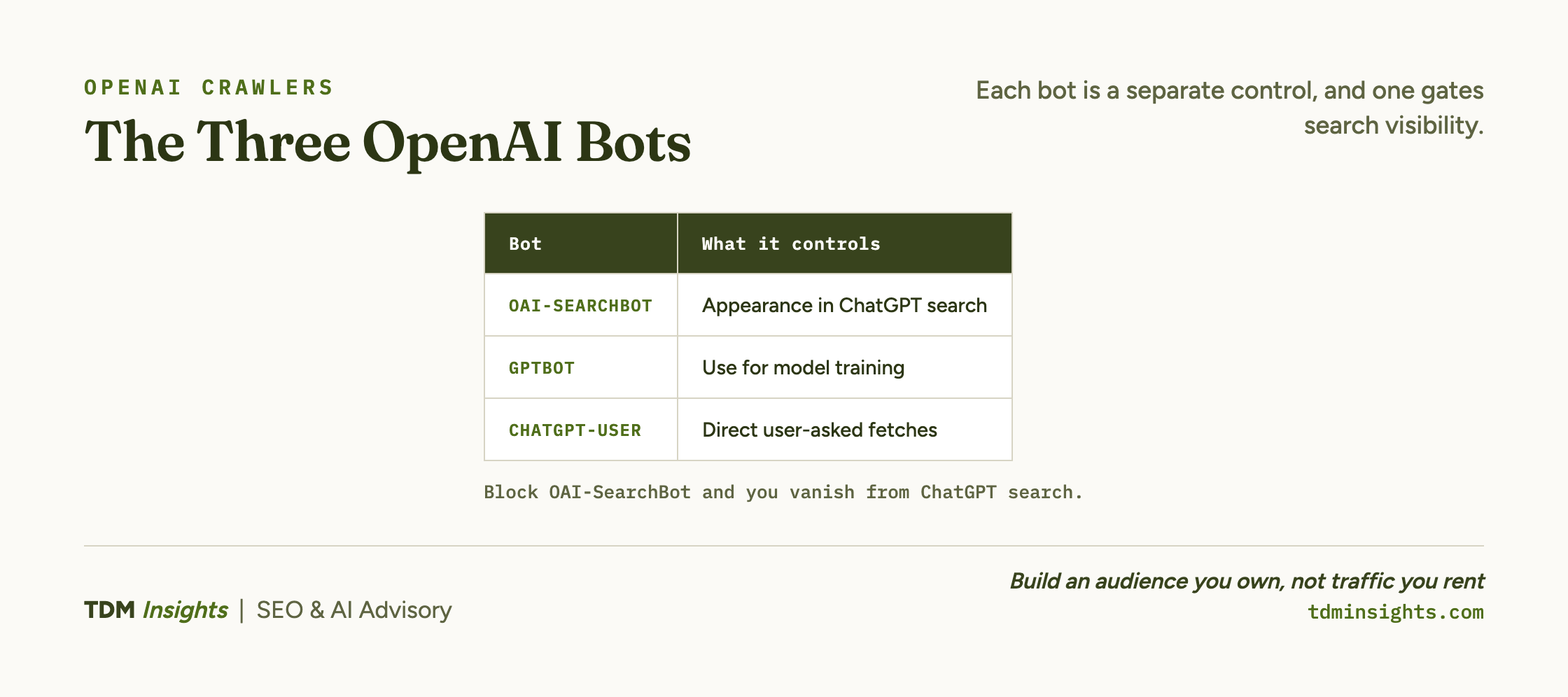
Control the OpenAI bots independently in your robots.txt file, each named in OpenAI’s published bots documentation. Each one does a different job:
- OAI-SearchBot powers appearance in ChatGPT search answers. Allow it, or you are invisible to the browsed path regardless of page quality.
- GPTBot governs whether your content is used for model training. Allow or block it to opt in or out.
- ChatGPT-User handles direct user-initiated fetches when someone asks ChatGPT to read a specific URL.
Blocking OAI-SearchBot removes you from ChatGPT search entirely, and robots.txt changes take roughly 24 hours to register. The deeper retrieval mechanics are well documented; a data study on ChatGPT citation patterns and its search-trigger rate shows how often the search tool fires and what it pulls, and the GEO chapter of the AI search manual breaks down how generative engines assemble their candidate sets.
Retrieval here sits on the same crawl-and-index foundation classic search uses, which is why the technical SEO work that makes a site crawlable is the floor under any ChatGPT citation, and why this AEO layer rides on top of the SEO fundamentals you set in the first 90 days rather than replacing them.
What ChatGPT Evaluates: Authority, Relevance, and Corroboration
Once ChatGPT search has candidates, it favors pages it judges authoritative, directly relevant, and confirmed by other independent sources. Third-party corroboration is the signal founders most consistently underestimate.
Three evaluation leanings drive the choice:
- Authority and trust. ChatGPT skews toward high-trust domains, encyclopedic references, news outlets, and established community sources. On your own site, that trust is built by depth on a subject, which is exactly what topic clusters and pillar pages are designed to signal.
- Direct relevance. The page has to answer the specific question, not orbit it.
- Cross-source corroboration. ChatGPT favors claims confirmed across multiple independent sources rather than a single page asserting them alone.
That corroboration lean explains the most common frustration. A rival mentioned across review platforms, forums, and industry publications gets cited even if your own page outranks theirs in Google, because ChatGPT is looking for consensus, not a single ranking position.
Roughly 95 percent of its citations come from independent sources rather than the cited site itself. Reporting on how ChatGPT consumes and attributes publisher content and analysis of the AI content licensing market both underline how heavily the system leans on third-party sources it already trusts.
The practical move is to build that external footprint deliberately. The same discipline behind earning authority and third-party mentions without a budget is what feeds the corroboration test, and it compounds when it sits on a content library that ranks, gets cited, and pays for itself.
How ChatGPT Attributes: Named Citation vs Absorption
The two behaviors attribute differently. A browsed answer shows the sources it used as inline links or chips, while a training-data answer states the information with no link back to you, even if your page is where the idea originated.
That gap is why the browsed path is the one to optimize. A training-data answer gives you no attribution and no traffic; a browsed answer can give you both. The stakes are real: independent reporting found ChatGPT referral traffic to publishers has nearly doubled, so a named citation is worth chasing, not just for visibility but for the click it can still send.
To confirm whether you are being named, you have to watch the browsed answers directly. An overview of tools that track whether ChatGPT cites you is a reasonable starting point for the measurement step, and because much of this traffic arrives with no referrer at all, measuring AI traffic when the referrer is missing is its own discipline worth learning early.
Book a free diagnosis
If your pages rank in Google but ChatGPT never names you, the gap is almost always one of three things: OAI-SearchBot cannot reach you, your best answer is not liftable, or you lack the third-party corroboration ChatGPT looks for. We will check your priority pages against all three, founder to founder, and tell you which one is actually costing you the citation. No deck, no retainer pitch.
The ChatGPT Checklist, Mapped to Retrieval, Evaluation, Citation
Work this as a short procedure, one item per step of the model. Each item stands alone, so you can fix the weakest one first.
Retrieval (get reachable):
- Allow OAI-SearchBot in robots.txt and confirm the change took effect.
- Make sure target pages are indexed and load cleanly, so the live fetch succeeds.
- Keep the page reachable by internal links, not orphaned.
Evaluation (get trusted):
- State who you are and what the page is about with consistent entity signals.
- Earn third-party mentions on sources ChatGPT already trusts: review sites, forums, industry press.
- Corroborate your key claims with concrete facts, numbers, and named sources.
Citation (get liftable):
- Put the direct answer in the first sentence of each section, not buried.
- Write self-contained passages that make sense pulled out of context.
- Cover the specific sub-question cleanly, not just the broad topic.
Practitioner guidance on earning brand mentions in ChatGPT answers, an answer-first and extractability tactics breakdown, and a foundational AEO explainer mapping the levers ChatGPT rewards all converge on the same shape: retrievable, then trusted, then liftable.
Why “Ranked But Not Cited” Happens on ChatGPT
Ranking well in Google does not guarantee a ChatGPT citation, because the two systems use different selection logic. You can hold a featured snippet and still be absent from ChatGPT’s answer.
It comes down to the same two leaks already covered: OAI-SearchBot may never reach the page, or a rival with more third-party coverage wins the corroboration test even when you rank higher. Diagnose which one is yours, then fix that one.
The fix follows the diagnosis, and the model tells you where to spend:
- If retrieval is the leak, open the crawler.
- If evaluation is the leak, build the external footprint.
- If citation is the leak, rewrite the answer so it is liftable.
If you want orientation before the depth, the overview of the three biggest engines is the shorter survey; Google Gemini and Claude each get a deep dive too.
ChatGPT is one engine. The other live-search engine, Perplexity, retrieves and cites very differently, and reading them side by side sharpens both. A dedicated playbook covers Perplexity next.
Frequently Asked Questions
How does ChatGPT decide which sources to cite?
ChatGPT cites sources its search tool retrieves when answering, favoring pages it judges authoritative, directly relevant, and easy to extract a clear answer from. It leans heavily on third-party and high-trust domains like Wikipedia, Reddit, and news outlets, plus sites confirmed by multiple independent sources, rather than a single ranking position.
Does ChatGPT search the live web or answer from training?
ChatGPT does both, depending on the question. By default it answers from training data, which has a knowledge cutoff and no live links. When its search tool activates, usually on recent, specific, or fact-checkable queries, it browses the live web in real time and returns answers with inline citations to the pages it used.
How do I get my site to show up in ChatGPT?
Make sure OAI-SearchBot can crawl your site, then earn coverage on sources ChatGPT already trusts. Allow the crawler in robots.txt, publish clear answer-first content with concrete facts and numbers, and build third-party mentions on review sites, forums, and industry publications. ChatGPT cites consensus across independent sources, not just your own pages.
Why does ChatGPT cite competitors but not me?
ChatGPT usually cites competitors because they have more third-party coverage, not better on-page SEO. Roughly 95 percent of ChatGPT citations come from independent sources, so a rival mentioned across review platforms, Reddit, YouTube, and news will be cited even if your own page ranks higher in Google. Build that external footprint to close the gap.
Does being indexed help me get cited by ChatGPT?
Being indexed in Google helps but does not guarantee a ChatGPT citation, because they use different selection logic. You can rank well, even hold a featured snippet, and still be absent from ChatGPT answers. What matters more is whether OAI-SearchBot can access your page and whether trusted third-party sources reinforce your content.
How do I allow or block ChatGPT crawlers?
Control each OpenAI bot independently in your robots.txt file. Allow OAI-SearchBot to appear in ChatGPT search answers, allow or block GPTBot to opt in or out of model training, and manage ChatGPT-User for direct user fetches. Blocking OAI-SearchBot removes your content from ChatGPT search regardless of quality. Changes take about 24 hours.
Continue Reading:
More On Per-Engine Citation Playbooks
- How Each AI Engine Picks Sources to Cite
- How to Get Cited by Perplexity
- How to Show Up in Google AI Overviews
- How to Get Mentioned by Google Gemini
- How to Be the Source Claude Recommends
More from TDM Insights
- SEO for Startups: What to Do in the First 90 Days
- Technical SEO Checklist for Founders, by Severity
- Backlinks for Startups: Earn Authority, No Budget
- Content That Ranks and Gets Cited by AI
- Content Strategy for Founders: A Library That Ranks, Gets Cited, and Pays for Itself
Explore TDM Insights Categories