
How to Get Cited by Perplexity
It cites several sources per answer, so precision wins. What Perplexity rewards, and how to be the on-point passage it links.
 By David Jubé · May 24, 2026 · 10 min read
Perplexity runs a live web search on almost every query and attributes its answers with inline numbered citations, which makes it both the easiest engine to get cited on and the easiest to verify whether you have been.
The lever is not domain authority alone. It is being the single most directly-on-point passage in a wide candidate set, the Citation step from the model for how AI engines find, evaluate, and cite a source taken to its extreme. Winning a narrow query starts with picking the right target, which is the job of keyword research that finds demand you can win.
Because it searches and cites on nearly every query, Perplexity is also the best canary you have for answer engine optimization generally. If a clean, fresh, on-point page cannot get cited here, the problem is the page, not the engine.
Everything below maps Perplexity’s path to Retrieval, Evaluation, and Citation, then turns it into a checklist.
Key takeaways
- Perplexity runs a live web search on nearly every query and answers through retrieval-augmented generation, citing five to eight sources per answer, so each query opens several visible slots you can win.
- The lever is not domain authority alone but directness, so lead each section with the answer in the first 100 words and a clean, on-point page can beat larger sites.
- Perplexity weights freshness unusually hard, drawing roughly half its citations from content published or updated in the current year, and it rewards corroboration across trusted sources plus pages that cite their own references.
- Allow PerplexityBot in your robots.txt and serve the answer in raw HTML rather than JavaScript, then use Perplexity’s transparent numbered citations as the canary that shows whether your answer-first work is landing.
Why Perplexity Cites More Than Any Other Engine
Perplexity cites more sources per answer than any other engine because it generates answers through retrieval-augmented generation, synthesizing one response from several documents and attributing each claim to its origin.
Retrieval-augmented generation means the model does not answer from memory alone. It retrieves live documents, then writes the answer grounded in them, citing each as it goes. Standard answers commonly show five to eight citations, and Pro Search often shows more, because corroboration across independent sources is how the system builds confidence in a statement.
That citation density is good news for a founder. More cited slots per answer means more chances to be one of them. An interview on Perplexity’s publisher partnerships shows attribution is built into how the company thinks about sources, which is why it links aggressively on nearly every answer.
A wide candidate set with several visible slots is exactly the field where a clean, directly-on-point page can win without enormous domain authority.
How Perplexity Retrieves: Live Search and the Crawler
Perplexity retrieves by running a live web search on nearly every query, pulling roughly ten pages, and the gate on that path is its crawler, PerplexityBot.
To be reachable, allow PerplexityBot in your robots.txt. Add a line for “User-agent: PerplexityBot” followed by “Allow: /”, or simply leave it unrestricted.
Note that PerplexityBot is the search-indexing agent, distinct from Perplexity-User, the agent that fetches a page live when a user asks for it, and both are listed in Perplexity’s crawler documentation. Changes can take up to 24 hours to register, and you can verify legitimate crawler traffic against Perplexity’s published IP list to separate real crawls from spoofed ones.
Two retrieval realities follow from the live-search-on-everything design:
- Breadth helps you. Because Perplexity casts a wide net per query, a narrow, well-targeted page can surface even against larger generalist sites.
- Renderability matters. Perplexity penalizes JavaScript-heavy pages it cannot read, so content that only appears after client-side rendering can be invisible to it.
The retrieval foundation is the same crawlable, indexable base classic search rewards, which is why the SEO fundamentals you set up in the first 90 days are the floor under any Perplexity citation, with the crawlable, indexable technical base every founder should verify underneath them. If the crawler cannot read the page, no amount of directness saves it.
What Perplexity Evaluates: Directness, Freshness, Corroboration
Perplexity reranks its candidate set on relevance, freshness, structure, and authority, then cites the strongest few. Directness and freshness are weighted more heavily here than on most engines.
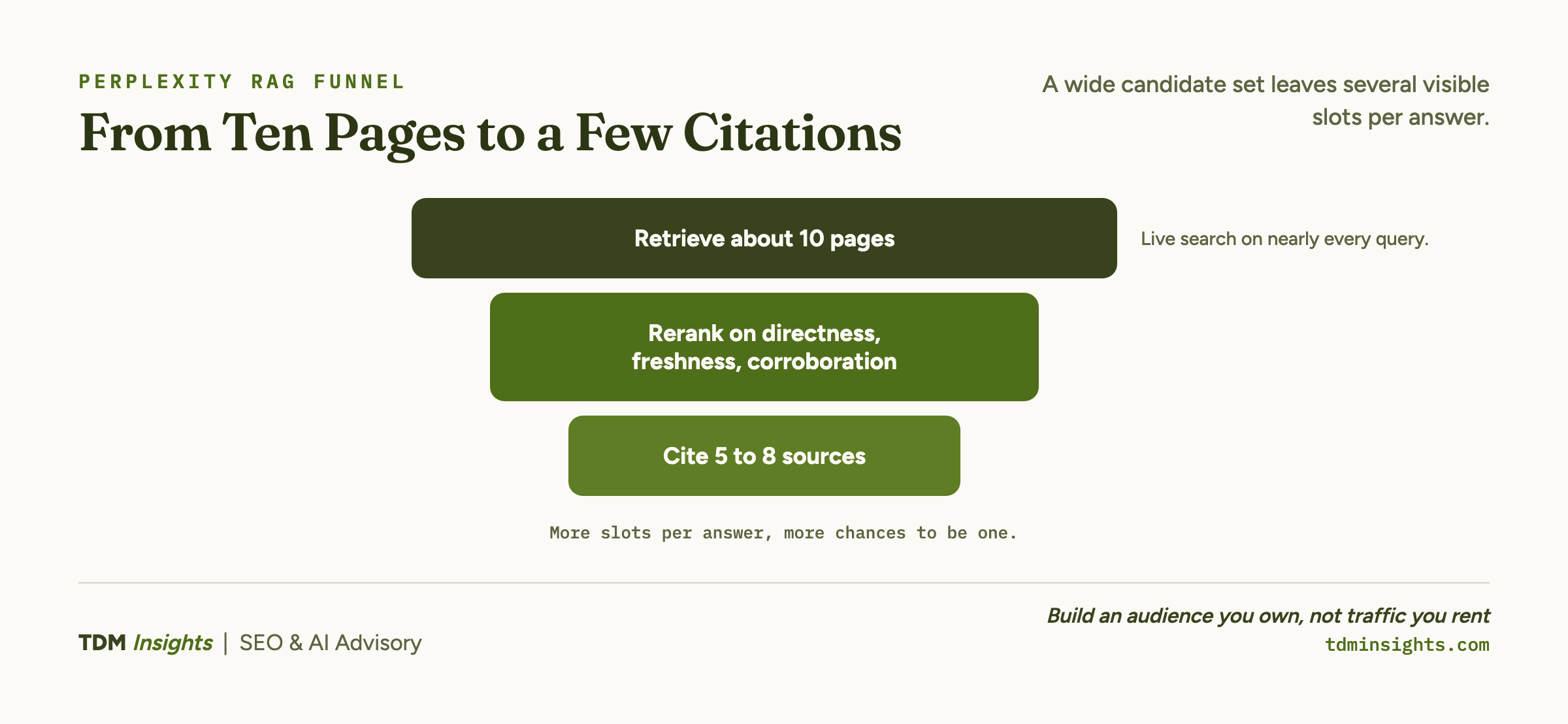
Four evaluation signals decide which candidates make the cut:
- Directness. Pages that answer the query in their first 100 words win over pages that bury the answer.
- Freshness. Roughly half of Perplexity’s citations come from content published or updated in the current year. It weights recency unusually hard.
- Corroboration and source diversity. Claims echoed across several trusted sources earn confidence, and Perplexity favors a varied candidate set.
- Self-citation. Pages that cite their own credible references read as more trustworthy.
The freshness lean is the one founders most often miss. A stale page from a large, established site can lose to a fresh, well-structured page on a narrow subject, which is why a deliberate content refresh that wins back lost rankings doubles as a Perplexity citation play. Updating the date is not enough; the substance has to genuinely change.
The community lean matters too. Analysis of Reddit’s rise in AI citations documents how heavily Perplexity pulls from forums and community content, so the corroboration test often runs through places you do not own. On your own pages, the depth that earns topical authority comes from building out topic clusters and pillar pages around a tight subject.
One caution worth holding: a Tow Center study found AI search engines fail to cite accurately in many tests, so even a strong page can be mis-attributed, which is another reason to measure rather than assume.
How Perplexity Attributes: The Inline Numbered Citation
Perplexity attributes with inline numbered citations next to the claims they support, so you can see exactly which passages it pulled and from where.
That behavior is the most transparent of any engine. Each numbered marker links to a source, and hovering or expanding shows the page.
For a founder, this turns citation from a black box into something checkable: ask Perplexity your core category questions and read the numbered list. Either you are in it or you are not.
A data study on Perplexity’s referral standing among AI engines shows it remains a meaningful referrer even as Google’s surfaces grow, so a citation here is worth earning on its own.
Book a free diagnosis
Perplexity shows you, in numbered links, exactly which sources it trusts for your category questions. If your name is not in that list, the gap is usually directness, freshness, or corroboration. We will run your priority questions through Perplexity, founder to founder, see who it cites instead, and tell you which of the three is keeping you out and the single fix that moves you in.
The Perplexity Checklist, Mapped to Retrieval, Evaluation, Citation
Work this as a short procedure. Each item is independent, so fix the weakest first.
Retrieval (get reachable):
- Allow PerplexityBot in robots.txt and verify the change.
- Make the answer visible in raw HTML, not only after JavaScript renders.
- Keep the page indexed and internally linked.
Evaluation (get trusted):
- Lead each section with the direct answer in the first 100 words.
- Keep content genuinely current; refresh substance, not just dates.
- Cite your own credible references and build corroboration across trusted outlets.
- Earn topical authority on a tight, specific subject.
Citation (get liftable):
- Write self-contained passages that resolve one sub-question each.
- Use clean structure, headings, and lists Perplexity can parse.
- Match the exact phrasing of the question where it is natural to do so.
The same answer-first extractability that wins here is the core of content built to rank and get cited by AI, and a GEO playbook for getting cited by Perplexity lays out the same tactics in practice. Cited pages often earn their first citation within weeks, not months, when the directness and freshness are right.
Using Perplexity as Your AEO Canary
Treat Perplexity as the early-warning system for your whole AEO effort. Its transparent, numbered citations turn it into a live read on whether your answer-first work is landing anywhere.
The routine is simple. Pick your ten most important category questions, ask each in Perplexity with the answer-first version of your page live, and record whether you appear, how you are described, and which competitors show instead. Repeat on a schedule, since citation lists shift week to week.
If you are cited here but not elsewhere, the other engine’s retrieval path is the suspect, not your content. If you are cited nowhere, including here, the page itself needs work first.
Keeping the labels straight helps here, since GEO, SEO, AEO, and LLMO each name a different slice of the same work. An overview of tools to measure whether Perplexity cites you can automate the tracking once you have the manual baseline.
If you want orientation before the depth, the overview of the three biggest engines is the shorter survey; Google Gemini and Claude each get a deep dive too.
Perplexity is the easiest engine to measure. The highest-traffic surface is the next one to learn, and it behaves very differently. A dedicated playbook covers Google AI Overviews next.
Frequently Asked Questions
How does Perplexity choose which sources to cite?
Perplexity runs a multi-stage retrieval pipeline that pulls around ten pages per query, then reranks them on relevance, freshness, structure, and authority before citing the strongest three to five. Pages that answer the query directly in their first 100 words, carry recent dates, and corroborate other trusted sources win citations.
Why does Perplexity cite multiple sources per answer?
Perplexity cites multiple sources because it generates answers through retrieval-augmented generation, synthesizing one response from several documents and attributing each claim to its origin. Standard answers show five to eight citations and Pro Search often shows more, since corroboration across independent sources is how the system builds confidence in a statement.
What does Perplexity reward that other engines do not?
Perplexity rewards freshness more aggressively than most engines, with roughly half of its citations coming from content published or updated in the current year. It also favors direct, extractable answers near the top of a page, cross-source corroboration, and pages that cite their own sources, while penalizing JavaScript-heavy pages it cannot read.
How do I become one of the sources Perplexity links?
Become a Perplexity source by letting PerplexityBot crawl you, then publishing pages that answer a specific question directly in the first 100 words. Keep content current, cite your own credible references, build corroboration across trusted outlets, and earn authority on a tight topic. Cited pages often earn their first citation within weeks, not months.
Does Perplexity favor recent content or established authority?
Perplexity favors both, but it weights recency unusually heavily, with about half of citations drawn from content published or updated in the current year. Authority still matters through backlinks and topical depth, yet a fresh, well-structured page on a narrow subject can outrank a stale page from a larger, more established generalist site.
Does Perplexity crawl my site, and how do I allow it?
Yes, Perplexity crawls sites using PerplexityBot, which respects robots.txt. To allow it, add “User-agent: PerplexityBot” then “Allow: /” to your robots.txt, or simply leave it unrestricted. Changes can take up to 24 hours to register. You can verify legitimate crawler traffic against Perplexity’s published IP list.
Continue Reading:
More On Per-Engine Citation Playbooks
- How Each AI Engine Picks Sources to Cite
- How to Get Cited by ChatGPT
- How to Show Up in Google AI Overviews
- How to Get Mentioned by Google Gemini
- How to Be the Source Claude Recommends
More from TDM Insights
- SEO for Startups: What to Do in the First 90 Days
- Technical SEO Checklist for Founders, by Severity
- Keyword Research for Startups: Demand You Can Win
- Content That Ranks and Gets Cited by AI
- Content Refresh: Win Back Rankings You Lost
Explore TDM Insights Categories