
Internal Linking: The Most Underrated SEO Lever
Internal linking, done on purpose: how each link passes authority and relevance, where to point it, and how to fix orphan pages.
 By David Jubé · May 30, 2026 · 13 min read
Authority does not flow to a page no other page links to. Every internal link on your own site passes two things to its target, ranking authority and relevance, which means the link graph, not the word count, decides which of your pages Google can rank. A deliberate set of links can lift the exact page you most want to rank without a single new backlink.
That is the lever, and it is the cheapest one a founder controls. You do not have to earn it from anyone, approve a budget, or wait for outreach to land. The links already on your site are an asset you can re-point this afternoon.
This article is the per-page mechanics: how a single link works, where to aim it, and how to stop good pages from going orphaned.
Key takeaways
- Every internal link passes two things to its target: ranking authority and relevance. Your link graph, not your word count, decides which of your pages Google can rank.
- Internal linking is the cheapest ranking lever you control. A deliberate set of links can lift the exact page you most want to rank without a single new backlink.
- Concentrate equity on purpose: name your priority page, then link to it from your strongest, most relevant pages. Authority also travels along the whole chain, so the first link placement compounds downstream.
- Anchor text carries the relevance, so make it descriptive and specific, vary it across links to the same target, and never use “click here” or repeat the exact-match keyword everywhere.
- Orphan pages, the ones nothing links to, are the most common and most fixable failure. Give every page worth indexing at least one inbound link from a related page so it is reachable and vouched for.
The short answer: internal links move authority and relevance, on purpose
An internal link is a directed transfer. When page A links to page B, it hands B a share of A’s own ranking authority (the PageRank-style equity Google flows along links) and it tells Google, through the anchor text and the surrounding sentence, what B is about.
Authority is the push. Relevance is the aim. Moz’s definition of an internal link frames the same idea: a link from one page to another on the same domain helps both navigation and the way ranking value spreads.
Both halves matter, and they fail in different ways:
- Authority without a clear anchor. A link from a strong page with a vague anchor (“read this”) passes equity without telling Google what the target deserves to rank for.
- A clear anchor without authority. A perfect anchor from a weak, unlinked page passes a clean signal with almost no force behind it.
You want both: equity from a page that has some, pointed with an anchor that names the target’s topic.
This is also why internal linking sits as the third stage of the page-build model that runs intent, then structure, then links. You wire the graph last, after the page is aimed correctly and built to be read, because a link only amplifies a page that was already right.
How a single link works: the equity and the anchor
Picture a five-page site. Your homepage has earned a few external links, so it holds the most authority. It links to four interior pages.
Each interior page now receives a slice of that authority. Each can pass its own slice onward through the links it carries.
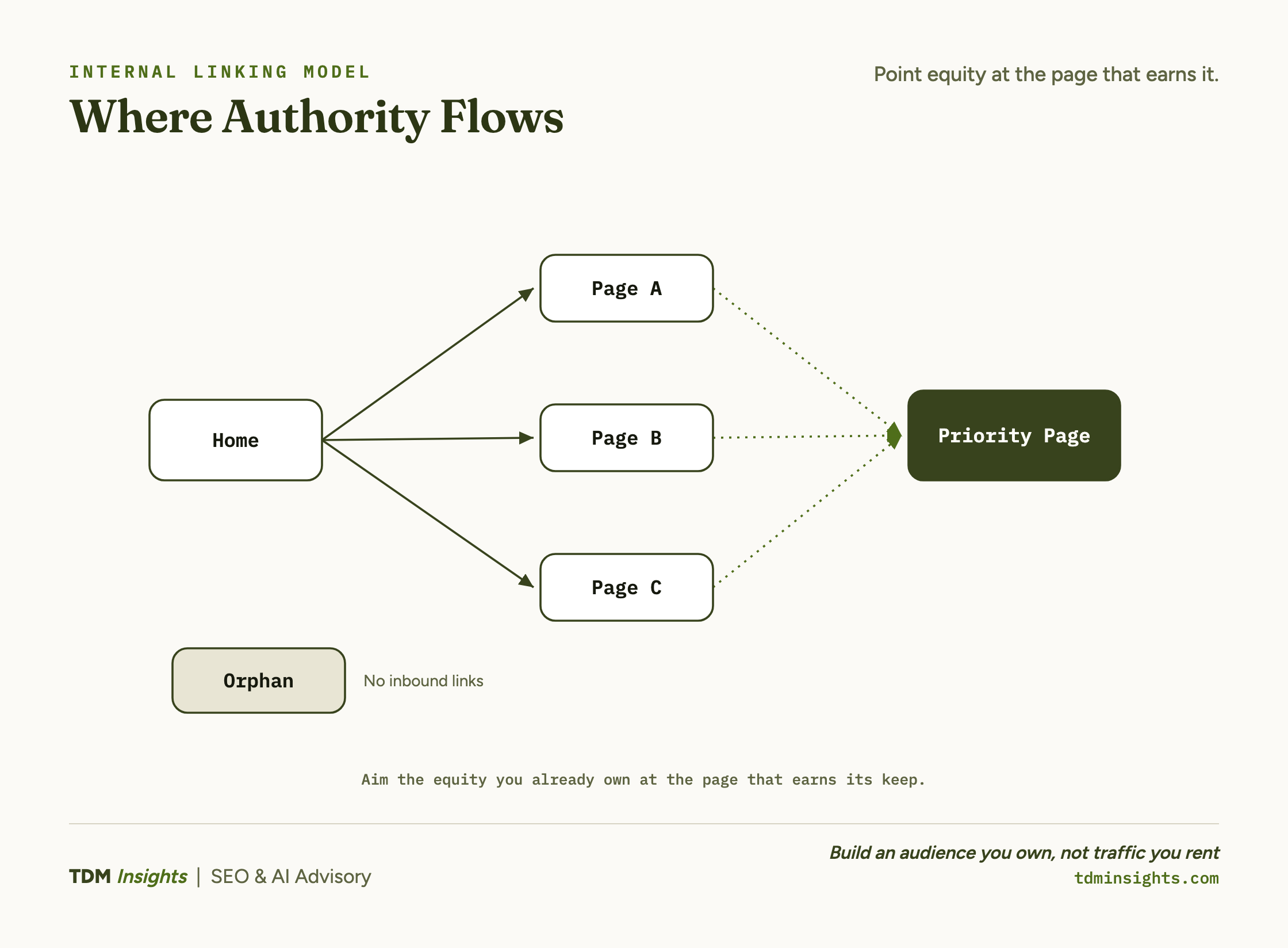
Now suppose one of those four pages is the one you actually want to rank: a service page, or a deep guide that should win its query. If only the homepage links to it, it gets one slice. If the other three interior pages also link to it, with relevant anchors, it collects four streams of equity instead of one.
Nothing else changed. The page did not get longer or better written. You simply re-routed authority you already had toward the page that needed it.
Ahrefs walks through this same flow of link value across a site, showing how interior pages relay equity rather than letting it pool at the top.
There is a second effect. A page that receives more equity also passes more onward, so the gains compound. Link your homepage to a strong guide, and that guide now has more authority to share with the three deeper pages it links to in turn.
Authority does not stop at the first hop. It travels along the whole chain you build, which is why where you place the first link matters as much as how many you add.
That is the mechanism, and it scales. Yoast‘s practitioner reference on why and how internal linking works lays out the same flow: links spread value through the site and signal which pages you treat as most important. The pages you link to most, from your strongest pages, are the pages you are telling Google to take most seriously.
Links also shape discovery, not just authority. Google reaches your pages by following links, and its own guidance on making links crawlable is explicit that Google generally follows only standard <a href> links to find new pages.
So how your pages are linked governs what Google crawls and re-crawls. A page buried three clicks deep with one inbound link is crawled less and trusted less than one reachable from several relevant pages.
Point your links at the page you most want to rank
Once you accept that links concentrate authority, the move is obvious: decide which page you most want to rank, then deliberately link to it from your strongest, most relevant pages.
Run it as a short pass:
- Name the priority page. Pick the one or two pages that carry the most commercial weight, the ones a ranking would actually pay for.
- Find your highest-authority pages, usually the homepage and your best-performing posts.
- Add a contextual link from each of those, inside relevant copy, pointing to the priority page.
You are not adding links everywhere. You are aiming the equity you already hold at the target that earns its keep. Backlinko’s hub on internal links calls this prioritizing your most important pages, and it is the single highest-return move in the whole practice.
The reverse discipline matters just as much. Auditing which pages link out heavily but receive little, and which receive a lot but pass it nowhere useful, is how you keep the graph honest over time. Give it room to show results, because internal-link changes move through crawling and re-ranking on the same unhurried clock SEO actually runs on, so judge the link plan against an honest timeline rather than next week’s rankings.
Anchor text carries the relevance: descriptive, not “click here”
The anchor text is the relevance half of the link, and it is where founders lose the most signal for the least reason.
Take a real choice. You are linking from a blog post to your guide on search intent. The weak version reads: “To learn more about this, click here.”
The link works, a reader can follow it, but the anchor tells Google nothing. The words inside the link are “click here,” so that is the only phrase the link reinforces, and “click here” is not a query anyone searches.
The strong version puts the topic inside the link: “We cover this in the four types of search intent that decide whether a page can rank.” Now the anchor names the target’s subject. Google reads it as a relevance vote for that page on that topic, and a reader knows exactly where the link goes before clicking.
Nielsen Norman Group’s research on writing useful link text is blunt on this: links should be descriptive enough to make sense out of context, because people scan links to decide where to go.
A few rules keep you safe in both directions:
- Make the anchor specific and natural, so it names the target’s topic.
- Vary the wording across the different pages that link to the same target.
- Never paste the exact-match keyword into every link to a page.
Semrush’s guidance on internal links makes the same point: identical exact-match anchors repeated everywhere read as manipulation and help no one. Descriptive and varied beats keyword-stuffed every time.
Book a free diagnosis
You have seen how each link carries authority and relevance now. The hardest part of internal linking is not the theory, it is seeing your own graph clearly, which pages hoard authority and which sit orphaned. A free diagnosis maps your internal-link graph on your real site, finds your orphans, and shows the specific links that would lift the pages you most want to rank. No deck, no retainer pitch, just a clear read.
Orphans and the internal-link floor
An orphan page is one that nothing on your site links to. It is the single most common, most fixable internal-link failure, and it is pure waste: you paid to create the page, Google struggles to discover it, and the authority it could pass and receive never moves. Conductor’s explainer on finding and fixing orphan pages describes the same trap, a page with no inbound internal links that search engines have a hard time reaching at all.
The fix is mechanical. List your pages, find the ones with zero inbound internal links, and add a relevant contextual link to each from a related page that already gets traffic. The point is not to hit a number; it is to make sure every page worth indexing is reachable and vouched for by at least one other page on the topic.
A loose floor of a few relevant inbound links per important page is plenty for a small site. Quality and relevance carry far more weight than raw count.
Orphans accumulate quietly. You publish a post, it earns its links at launch, then the next ten posts go up without anyone circling back to connect them to it. Six months later the page sits unlinked and forgotten, and you cannot understand why a piece you were proud of never ranked.
The cause is rarely the writing. It is that nothing on the site ever pointed Google toward it. Search Engine Journal’s internal-linking best practices reinforce why this matters: a sound internal structure is how you keep every page within reach and distribute value across the site.
The same logic protects the pages that share a subject. When two of your pages cover related topics, linking between pages that share intent and topic tells Google they belong to the same cluster, which strengthens both. Isolated pages, even good ones, ask Google to figure out the relationships on its own.
Per-page mechanics versus the ongoing graph habit
One boundary keeps this article useful instead of overlapping its neighbor. What you have read here is how a single link works and where to point it: the per-page mechanics you apply when you publish or fix one page.
That is a different job from building and maintaining the whole link graph as a continuous practice. The Content Marketing Institute’s guide to getting internal linking right treats it as that ongoing editorial discipline, planned across a library rather than one page at a time.
The site-wide, ongoing version, designing pillars and supporting pages so the entire library reinforces itself as it grows, is its own discipline. That is the work covered in the ongoing habit of building the whole topical graph through clusters and pillar pages.
This article is how a single link works and where to point it. That one is the habit of building the whole graph over time. Use this to fix the page in front of you, and use that to design the system the pages live in.
A page-level internal-link checklist
When you publish or revise a page, run this short pass before you move on:
- Link up to its pillar or parent. Every supporting page should link to the broader page it serves, so authority and context flow between them.
- Add two to four contextual links to closely related pages, inside the copy, with descriptive anchors that name the target’s topic.
- Add at least one inbound link from an existing, relevant page so the new page is not born an orphan.
- Point a link from a strong page at your current priority page when this page is one of your stronger ones.
- Check the anchors: specific, natural, varied across links to the same target, never exact-match repeated everywhere, never “click here.”
That is the lever. It costs nothing, it is fully within your control, and it moves authority toward the pages that earn their place. The pages you connect deliberately are the pages Google can rank.
Frequently Asked Questions
Do internal links help SEO rankings?
Yes. Internal links help Google discover and crawl your pages, show how pages relate, and pass ranking authority between them. A deliberate internal-link plan can lift the exact page you want to rank without any new backlinks. They are one of the few ranking levers you fully control on your own site.
How many internal links per page is too many?
There is no hard cap, but keep links purposeful. Google can crawl pages with many links, yet a page stuffed with dozens of links dilutes the value each one passes and confuses readers. For a typical article, a handful of relevant contextual links plus navigation is plenty. Quality and relevance matter far more than count.
What is the difference between internal links and backlinks?
Internal links connect pages within your own site; backlinks come from other websites. Internal links you control completely and use to route authority and relevance where you want them. Backlinks you earn, and they signal external trust. Both pass ranking value, but internal links are the lever you can pull today at no cost.
What are orphan pages and why do they hurt SEO?
An orphan page is one that nothing else on your site links to. Search engines struggle to find and value orphans because internal links are a primary discovery and authority path. Orphaned pages get crawled less, rank poorly, and waste content you already paid to create. Fixing them means adding relevant internal links from related pages.
How do internal links pass authority to a page?
Each internal link passes a share of the linking page’s ranking authority, the PageRank-style equity Google flows along links, to its target. Pages with more authority can pass more. So linking to your priority page from strong, relevant pages concentrates equity where you most need it, raising that page’s ability to rank.
What anchor text should I use for internal links?
Use descriptive, natural anchor text that tells both readers and Google what the linked page is about, such as “internal linking guide” rather than “click here.” Vary the wording across links to the same page so it reads naturally. Avoid exact-match keyword stuffing, which looks manipulative and helps no one.
Continue Reading:
More On On-Page SEO:
- How to Structure a Page to Rank and Get Cited
- Title Tags and Meta Descriptions That Get Clicks
- Search Intent: The Four Types That Decide Everything
- How to Read the SERP Before You Write a Word
- Free Keyword Research: A Starter Method, No Tools
More from TDM Insights:
- Topic Clusters and Pillar Pages: How They Work
- Crawl Budget and Indexation for Small Sites
- Technical SEO for Founders: What to Fix First
- Why Isn’t My Site Indexed? A Founder’s Diagnostic
- Structured Data for SEO: The Founder’s 80/20
Explore TDM Insights Categories: