
How Long Does SEO Take? An Honest Timeline
First signals in weeks, real lift in months. The honest timeline for SEO, and what to expect at each stage instead of guessing.
 By David Jubé · May 31, 2026 · 14 min read
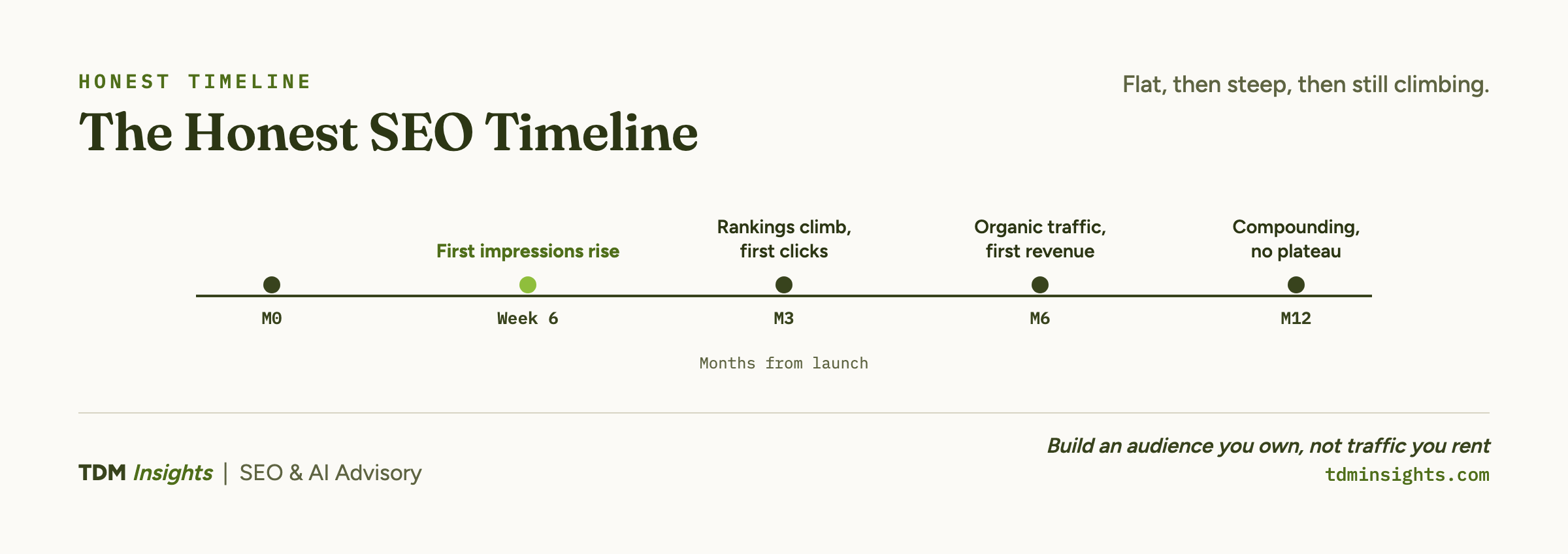
On a healthy new site, the first clear rise in Google impressions tends to show up around week 6, and from there the curve steepens for months rather than days.
It rarely plateaus on the schedule a founder hopes for.
That is the honest shape of an SEO timeline: slow, then steep, then still going.
Key takeaways
- On a healthy new site, the first clear rise in Google impressions tends to show up around week 6, with meaningful traffic taking four to twelve months.
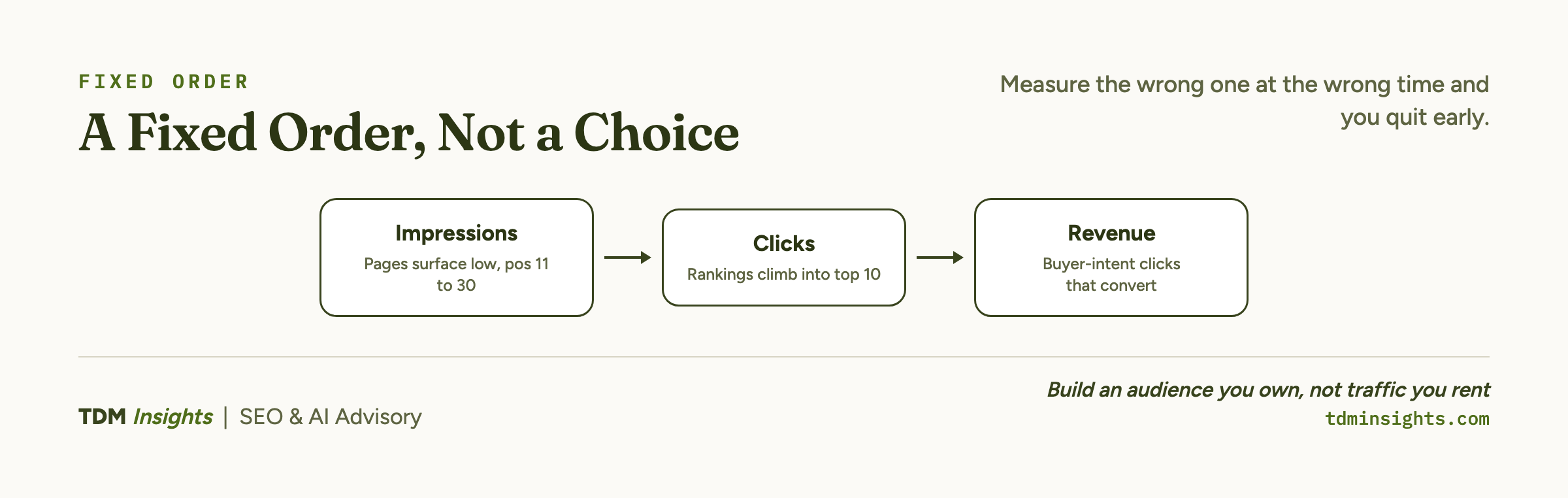
- The metrics turn on in a fixed order, impressions first, then clicks, then revenue, so measuring the wrong one too early makes a working program look failed.
- SEO follows a curve that is nearly flat at the start, bends upward once trust and coverage cross a threshold, and keeps compounding after that.
- The same lag that makes SEO slow to start is its moat, because a page that earns its ranking keeps pulling visitors for months or years with no further spend.
- Watch visibility in month 1, position in month 3, and return in month 6, and you will recognize the curve while it is still flat instead of quitting on it.
The honest answer
Search Engine Optimization (SEO) usually takes a few weeks to show its first faint signal and several months to produce traffic you would call meaningful.
On a healthy new site, the earliest indicator (rising impressions in Google) often appears somewhere around week 6. Clicks lag that by weeks to months. Revenue lags clicks by months again.
So the short answer most founders want, “how many months until it pays,” is honestly four to twelve months for a new site, with the first proof-of-life much sooner.
That range is wide because the timeline depends on three things you control and one you do not.
You control whether the site can be crawled and indexed, whether you target keywords you can actually win, whether you publish content that matches what searchers want, and how much of it you publish, since how many blog posts you need to rank shapes how quickly coverage accumulates.
The one you do not fully control is the trust your domain has accumulated, which on a new site starts near zero and builds slowly.
The point is to give you a real shape to expect, not an “it depends” hedge.
Below is the typical shape of an SEO ramp, plus a month-by-month checklist of what to watch so you do not quit right as the engine starts to turn.
If you want the full context for the sequence that produced this curve, it lives in the first-90-days order of operations. This article is about the timeline that sequence runs on.
The shape of the curve: flat, then steep, then still climbing
A timeline you cannot picture is just another “it depends” in disguise, so it helps to walk the curve a healthy new site actually follows.
For the first several weeks, impressions stay close to flat. Pages are getting indexed and Google is sampling them at low positions, but the headline number barely moves.
Around week 6, the first clear, sustained rise in impressions tends to appear, and from there the curve steepens. Over the following weeks, weekly impressions can multiply several times over as more pages index and existing pages climb.
The important part is that a healthy curve is usually still climbing well past the point most founders expect a plateau. It has not finished. And when a page does eventually slip, a content refresh can win back rankings you lost without starting the timeline over.
The shape matters more than any single number. SEO does not pay in a straight line from day one.
It pays on a curve that is nearly flat at the start, bends upward once trust and coverage cross a threshold, and keeps compounding after that.
If you judge the program at week 4, you are judging the flat part and you will conclude, wrongly, that it failed.
It is worth remembering why the wait is worth outlasting. Search is where buying journeys still start, and the latest evidence says that has not changed: SparkToro and Datos found that traditional search has not dipped even as AI tools have grown, with Google still handling the overwhelming majority of queries.
The demand is real and durable. The only question is the timeline to capture it.
Why impressions move before clicks before revenue
The single most useful thing to understand about an SEO timeline is that the metrics turn on in a fixed order: impressions first, then clicks, then revenue. Miss that order and you will measure the wrong thing at the wrong time.
Impressions move first because Google starts showing your pages while they still rank low, often in positions 11 to 30, the back half of page one and all of page two.
Almost nobody clicks results down there, so impressions can climb sharply while clicks stay near zero. That is not a failure.
It is Google telling you it has found your pages, indexed them, and decided they are relevant enough to surface for real queries. It is the earliest honest signal that the work is landing.
Clicks move next, as those low rankings climb into the top ten. A page sitting at position 18 gets impressions but almost no clicks. The same page at position 6 starts getting them.
So the click curve trails the impression curve by however long it takes your rankings to climb, which is usually weeks to months.
To watch this happen on your own site, you need the About Search Console setup in place from day one, because it is the free tool that records impressions and clicks per query over time.
Clicks also depend on the page itself, not just its position, because content that ranks and gets cited by AI earns the click where a thin page at the same rank does not.
Revenue moves last, because it requires not just clicks but clicks from people with buying intent landing on pages built to convert them.
You can have healthy traffic months before you have healthy revenue, especially if your early-ranking pages are top-of-funnel.
Page speed feeds into this too: a slow Largest Contentful Paint (LCP) hurts both rankings and the conversion rate of the clicks you do earn, so it can quietly delay the revenue turn even when impressions and clicks look fine.
There is a deeper reason indexing has to come before any of this. Google’s own description of how Google crawls, indexes, and serves lays out the pipeline: a page cannot rank until it is crawled and indexed, and it cannot earn an impression until it can rank.
That is the mechanical reason the timeline starts with impressions. There is nothing upstream of them to measure.
If your impressions are climbing but clicks are not, that is the system working as designed, not stalling. The fix is rankings, not panic. And to keep rankings climbing without self-inflicted delays, clear the crawl and indexing blockers first.
Why SEO lags paid (and why that lag is its moat)
Paid search shows results within hours. You fund a campaign, your ads appear, clicks arrive the same day. SEO shows nothing for weeks.
On the surface that makes paid look strictly better, and for a founder who needs revenue this quarter, it sometimes is.
But the lag is not a defect. It is the source of SEO’s durability.
Paid traffic stops the instant you stop paying. The moment the budget runs dry, the clicks go to zero.
SEO traffic keeps arriving after the work is done, because a page that has earned its ranking holds that ranking and keeps pulling visitors for months or years with no further spend.
The same lag that makes SEO slow to start is what makes it compound and persist.
There is a defensibility angle too. Anyone with a credit card can outbid you on paid the day they decide to. The authority that earns an organic ranking cannot be bought overnight.
Part of why a new site lags is that it has not yet built domain authority, why authority takes time being the same reason an established competitor can publish a near-identical page and rank in days while you wait months.
That gap cuts both ways: it is frustrating when you are new, and it is a moat once you are established.
The practical takeaway: SEO and paid are not competitors, they are different instruments.
Paid buys speed and validation now. SEO builds a compounding asset that lowers your cost per visitor over time.
The lag is the price of the moat.
What “fast SEO” usually means
Search the phrase “fast SEO” or “rank in 30 days” and you will find plenty of promises. It is worth knowing what is real and what is a tell.
A measure of speed is legitimate. You genuinely can compress the timeline by targeting low-difficulty long-tail keywords your weak domain can actually rank for, fixing crawl and indexing problems fast, and publishing intent-matched content quickly. Those are real levers.
They do not manufacture authority out of nothing, but they remove the self-inflicted delays, poor targeting and technical blockers, that stretch a six-month timeline into a twelve-month one.
To pull that lever, target winnable terms to shorten the wait.
Some “speed” is a warning sign. If a vendor promises top rankings for competitive head terms in 30 days on a brand-new domain, they are either targeting terms so easy they carry no traffic, or they are using tactics that risk a penalty.
Real authority accumulates on a schedule you cannot rush much. Anyone claiming otherwise is selling either trivial wins dressed up as big ones, or risk.
The honest framing: you can avoid being slow, but you cannot force being instant. The fastest legitimate SEO is mostly the absence of mistakes.
Book a free diagnosis
The hardest part of an SEO timeline is reading it correctly while it is still flat. If you are a few months in and unsure whether your curve is on track or genuinely stalled, we can tell you which it is. A free diagnosis checks whether your pages are indexing, whether impressions are moving the way they should at your stage, and whether the timeline you are on fits your runway. Straight read, no obligation.
Your month 1, month 3, and month 6 checklist
The reason founders quit SEO early is almost always that they judged it by the wrong metric at the wrong time. The fix is to know which metric matters in which month, so a flat number you should expect does not look like failure.
The principle: the metric that matters shifts over time.
Month 1 is about visibility (is Google even seeing you). Month 3 is about position (are rankings climbing). Month 6 is about return (is traffic turning into revenue).
Judging month 1 by revenue is how you talk yourself out of the program right before it works.
For month 1, the only question is whether Google can see and index your pages. Run your key pages through the indexing check so you can check if a page is indexed.
If pages are not indexed by week 4, that is a real problem to fix, not a slow timeline to wait out.
For month 3, watch positions and the first trickle of clicks. You want to see keywords entering positions 11 to 50 and beginning their climb.
This is also where understanding how users move through search helps you read click behavior honestly: people scan, refine, and skip results, so early clicks come unevenly.
For month 6, the question finally becomes revenue. By now you should have organic traffic worth measuring against goals.
And because impressions move first and money moves last, the measuring SEO ROI discipline of tracking leading indicators before lagging ones is what keeps you honest about whether the curve is on track.
One new leading indicator belongs on this list now. Answer Engine Optimization (AEO), how often AI answer engines like ChatGPT, Perplexity, and Google’s AI Overviews cite your pages, is becoming its own early signal of authority, and it helps to understand what answer engine optimization actually is before you start tracking it.
As you build out your measurement, track AI citations as a new leading indicator alongside impressions.
Two reputable outside views line up with this curve, if you want to triangulate. Semrush’s analysis of how long SEO takes to work and Ahrefs’ look at when SEO shows results both land on roughly the same window: signals in weeks, meaningful results in months, with new domains on the slower end.
The curve above is the same pattern those analyses describe, drawn out week by week.
The takeaway is simple. SEO is slow, then steep, then still going.
The first signal is impressions, and it often shows around week 6. Real lift takes months.
If you measure the right thing in the right month, you will recognize the curve while it is still flat, and you will not quit on the part right before it bends.
The next question worth asking is whether that timeline fits your runway.
Frequently Asked Questions
Why do SEO impressions rise before clicks?
Impressions rise before clicks because Google starts showing your pages while they still rank low, often positions 11 to 30, where few people click. Rising impressions mean Google is surfacing and beginning to trust your content. Clicks follow once those rankings climb into the top 10 and your titles match search intent.
What should you measure at month 1, month 3, and month 6 of SEO?
At month 1, measure indexing and impressions. At month 3, measure keyword positions climbing and early clicks. At month 6, measure organic traffic and conversions. The metric that matters shifts over time: visibility first, rankings next, then revenue. Judging month 1 by revenue guarantees a false negative.
Why does SEO take longer for a brand-new website?
A new website takes longer because it has no domain authority, no backlinks, and no historical trust signals, so Google evaluates it cautiously. Established sites publishing similar content often rank in weeks because their authority transfers to new pages. New domains usually need 3 to 6 months for traction and 6 to 12 for competitive terms.
Can you speed up SEO results, and how?
Yes, you can compress the timeline by targeting low-difficulty long-tail keywords, fixing crawl and indexing issues fast, and publishing intent-matched content quickly. These choices let a weak domain rank where it actually can. You cannot speed up authority accumulation much, but you can avoid the self-inflicted delays of poor targeting and technical blockers.
How long until SEO produces revenue, not just traffic?
SEO typically produces revenue later than traffic, often around months 6 to 12, because impressions move first, then clicks, then conversions. Break-even tends to land near month 7, with stronger return by month 12. Early traffic validates that the engine works; revenue arrives once enough ranking pages capture buyer-intent queries.
Is no SEO movement after 3 months a sign something is wrong?
Flat results after 3 months can be normal on a new domain, but check for fixable causes first: pages not indexed, content targeting terms too competitive, or thin intent match. If impressions are completely flat and pages are not indexed, that signals a real problem, not just a slow timeline.
Continue Reading:
More On SEO for Startups
- SEO for Startups: What to Do in the First 90 Days
- Is SEO Worth It for a Startup? When to Invest and When to Wait
- Technical SEO Checklist for Founders, by Severity
- Keyword Research for Startups: Demand You Can Win
- Backlinks for Startups: Earn Authority, No Budget
- Search Intent: The Four Types That Decide Everything
- Title Tags and Meta Descriptions That Get Clicks
More from TDM Insights
- How to Measure AI Traffic With No Referrer
- How Many Blog Posts Do You Need to Rank?
- Content That Ranks and Gets Cited by AI
- Content Refresh: Win Back Rankings You Lost
- Answer Engine Optimization: What AEO Actually Is
Explore TDM Insights Categories