
Search Intent: The Four Types That Decide Everything
Match the intent Google rewards or a well-built page never ranks. The four types of search intent, and how to read each one.
 By David Jubé · Jun 8, 2026 · 13 min read
A page aimed at the wrong search intent does not rank no matter how good it is, because Google already shows in the live results exactly what the searcher wanted, and it will not promote a page that gives them something else.
Search intent (the goal behind a query, what the searcher wants to do) comes in four types: informational, navigational, commercial, and transactional. Each one rewards a different kind of page.
Google’s own guidance on helpful, people-first content is built around this same idea: serve the person behind the query, not a keyword.
Read the intent first, and the rest of your build has a target. Skip it, and you can write the cleanest title, the tightest headings, and the most extractable answer on the internet, and still never crack page one.
This is the failure that looks like bad luck and is actually a targeting error. The page is fine. It is just answering a question nobody who typed that query was asking.
So before you write a word, you read intent: infer it from the query, then confirm it in the results Google is already serving.
Key takeaways
- Search intent decides whether a page can rank at all. Google serves the page type that matches what searchers want, so a page aimed at the wrong intent stays invisible no matter how well it is built.
- There are four intents: informational (learn), navigational (reach a specific site), commercial (compare before buying), and transactional (act now). Each rewards a different page format.
- Keep commercial and transactional separate. “Best” and “vs” queries want a comparison, “buy” and “pricing” queries want a product or checkout page, and confusing the two builds the right page for the wrong moment.
- Read intent in two moves: infer it from the query wording, then confirm it in the live results. When your read and the SERP disagree, the SERP wins every time.
- On a mixed-intent SERP, target the dominant intent by what holds the top three or four slots, and recheck periodically because intent can shift from informational to commercial as a market matures.
Why Intent Decides Whether a Page Can Rank at All
Google’s job is to satisfy the person searching. When it ranks pages for a query, it is not grading writing quality in the abstract. It is choosing the pages that best match what people who type that query want to do next.
That is the whole mechanism. If everyone searching “best project management software” wants to compare options before buying, Google fills page one with comparisons and reviews. A flawless how-to tutorial on project management can be the most useful tutorial ever written and it will still lose, because it answers a question the searcher did not ask.
Intent is the precondition for every other on-page move. Title, meta, headings, internal links, schema: all of it only works once the page type matches the intent.
Search educators converge on this point. Ahrefs frames search intent as the reason behind every query and the first thing a page has to satisfy.
This is why the on-page build runs intent first, structure second, links third. Structuring a page before you have read its intent is decoration on the wrong building.
The consequence for a founder is blunt. The most common reason a well-made page never ranks is not a missing backlink or a slow load time. It is that the page is the wrong type for the query.
The Four Types of Search Intent, With a Real Result for Each
Here are the four intents, each with the kind of query that signals it and the result Google actually serves. The labels are standard across the field, and Moz’s reference on search intent uses the same four buckets. Read these as patterns to recognize, not boxes to memorize.
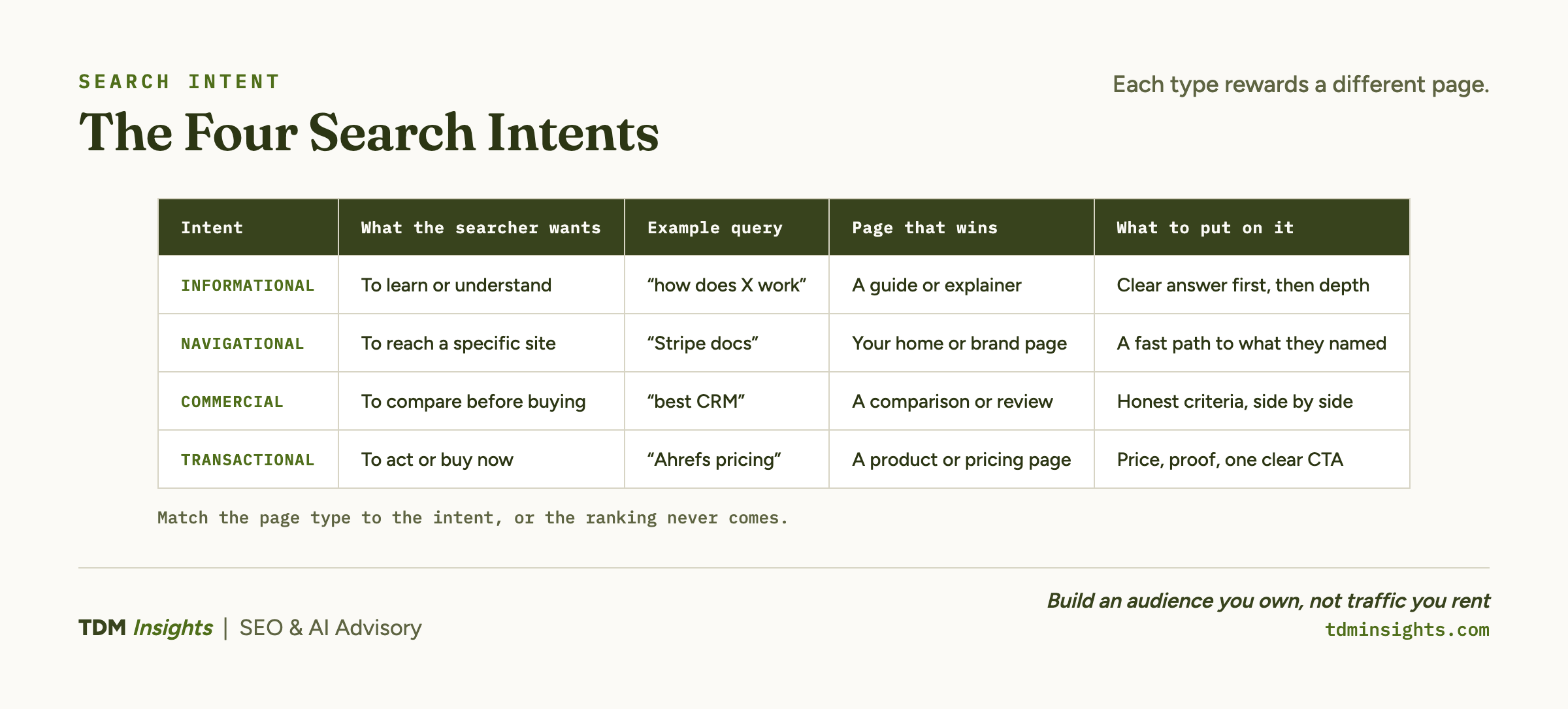
The table below is the whole model on one screen: read down it to match a query to the page type that actually wins.
Informational, the searcher wants to learn. Queries like “how does email deliverability work” or “what is churn rate.” The winning page teaches. A pricing page here has no chance.
Navigational, the searcher wants a specific site or page. Queries like “Notion login” or “Stripe docs.” You do not win a navigational query for someone else’s brand. You win your own by being the obvious, indexable home for it.
Commercial, the searcher is comparing before they decide. Queries with “best,” “top,” “vs,” or “alternatives,” like “best CRM for startups” or “Asana vs Trello.” The searcher is close to buying but still weighing options, so the page that wins lays the options side by side and helps them choose.
Transactional, the searcher is ready to act. Queries with “buy,” “pricing,” “sign up,” “near me,” or a product name, like “Ahrefs pricing” or “buy standing desk.” The searcher wants to transact, so Google serves the page that lets them. An explainer article ranks nowhere near the top here.
Two of these get blurred constantly, so make the cut clean: commercial intent is comparing (“best,” “vs,” “review”), and transactional intent is acting (“buy,” “pricing,” “sign up”). CXL draws the same line between commercial-investigation and transactional queries, and it matters because each rewards a different page.
A query like “best running shoes” is commercial. “Buy Nike Pegasus” is transactional. The page that wins the first is a comparison; the page that wins the second is a product or checkout page.
Aim a comparison article at a transactional query and you have built the right page for the wrong moment.
Read Intent From the Query, Then Confirm It in the SERP
You do not guess intent. You read it, in two moves.
First, read the query wording. The words carry the signal more reliably than anything else, and Yoast’s primer on search intent maps these same modifier patterns to each type:
- “How to” and “what is” signal informational.
- “Best,” “top,” and “vs” signal commercial.
- “Buy,” “pricing,” and “near me” signal transactional.
- A brand or product name on its own usually signals navigational.
Second, confirm it in the live results. Open an incognito window, search the exact query, and study the first page.
The pages Google already ranks are Google telling you, plainly, which intent and which page type it currently rewards for that query. Grow and Convert’s method for reading intent straight off the live SERP works exactly this way.
This is the single most useful SEO check a founder can skip, and it costs thirty seconds.
If the wording says one thing and the SERP (search engine results page, the page of results Google returns) says another, the SERP wins. Always.
Your read of the query is a hypothesis. The live results are the verdict.
This is a search-specific version of an old usability principle, the match between the system and the real world that NN/g documents: meet people where their expectations already are.
When you see ten comparison articles ranking for a query you assumed was informational, the searchers want to compare, and your explainer will not break in.
Book a free diagnosis
Founder to founder: intent mismatches are the quietest kind of wasted work, because the page looks finished and still earns nothing. A free diagnosis checks your top pages’ intent against what is actually ranking for their target queries, and shows you which ones are aimed wrong before you sink another month into them. No deck, no retainer pitch, just a clear read on where your pages and the SERP disagree.
This read-then-confirm habit is the whole of stage one, and it earns its own deeper treatment. For the full method of turning a results page into a build brief, learn to confirm the intent in the live SERP before you commit to a page.
When the SERP Shows Mixed Intent
Not every query resolves to one clean type, and pretending it does will lead you wrong. Some queries reasonably satisfy more than one goal, so Google hedges and serves a blend.
Search “email marketing” and you get guides, tool comparisons, and product pages on the same page one. Google is uncertain what the typical searcher wants, so it covers several bets at once.
Mangools covers this mixed-intent case too: when a SERP blends formats, the query itself is contested. That mixed result is information, not noise. It tells you the query is contested across intents.
When you see a blended SERP, you have two honest options:
- Target the dominant intent. Take the one that takes the most slots and build the best version of that page type.
- Serve the main intent, address the others briefly. Build a page that serves the main intent well while touching the rest, so it can satisfy more than one kind of searcher without losing focus.
What you cannot do is ignore the blend and hope. A page that picks the minority intent on a mixed SERP fights uphill against results Google has already decided to favor.
There is a practical tell for the dominant intent on a blended SERP. Look at which page type takes the top three or four organic slots, not the average across the whole page.
Google weights the top positions toward the intent it is most confident about, so a SERP with comparisons at the top and a stray product page at slot eight is still a commercial query. Build for the top, not the long tail of the results.
Intent can also shift over time. A query that was informational two years ago can turn commercial as a market matures and buyers start comparing.
A founder targeting an evergreen page off a stale read will quietly lose ground as the SERP moves under them. The fix is the same as the original read: recheck the live SERP. The results always reflect current intent, not last year’s.
Match Your Page Type to the Intent Google Rewards
Once you have read and confirmed the intent, matching the page is straightforward, and it decides far more than keyword placement ever will.
Match the page type to what the intent rewards:
- Informational: build a guide or tutorial.
- Commercial: build a comparison or review.
- Transactional: build a product, pricing, or signup page.
- Navigational (your own brand): make sure your destination page is indexable and obviously the official home for that search.
Backlinko’s guide to optimizing for the searcher’s goal lays out the same page-type-per-intent mapping in more depth.
Then mirror what is already winning. If page one is wall-to-wall listicles, a single long essay will struggle to break in, not because the essay is worse but because it is the wrong format for what searchers on that query keep choosing.
A full reference on classifying and matching intent signals is worth keeping handy when a SERP is hard to read. Match the format and the depth of the results that rank, then beat them on quality and clarity inside that format.
This is also where keyword research and page-building meet. Scoring a keyword on volume alone, without reading its intent, is how founders end up targeting terms they cannot rank for with the page type they planned. The smarter move is to score keywords on intent, not just volume before you commit to writing anything.
Get this stage right and everything downstream has something true to aim at. The snippet you write to the matched intent promises the right thing, the body delivers the right page type, and the page finally has a shot at the ranking it deserves.
Intent is the precondition for the whole page-build model this sits at the front of. It is the difference between a page that converts readers into customers and one that quietly never gets seen, which is the same logic that decides whether the intent turns readers into customers further down the funnel.
We refined this exact read-then-confirm habit on a site we operate before bringing it to clients. The Gourmet Host grew Google search impressions from 59,643 to 600,569 in 28 weeks, a 10.1x lift, with the first clear movement around week 1 and the curve still climbing at week 28. A large share of that came from pages aimed at the intent the SERP was already rewarding, instead of the intent we assumed.
Frequently Asked Questions
What are the four types of search intent?
The four types are informational (the searcher wants to learn), navigational (they want a specific site or page), commercial investigation (they are comparing options before buying), and transactional (they are ready to act or purchase). Each type rewards a different page format, so identifying intent decides what kind of page can rank for a query.
How do you determine the search intent of a keyword?
Read the query wording first: “how to” signals informational, “best” or “vs” signals commercial, “buy” or “pricing” signals transactional, a brand name signals navigational. Then confirm by searching the keyword and studying what already ranks. The live results are Google telling you which intent and page type it currently rewards for that exact query.
What is the difference between commercial and transactional intent?
Commercial investigation intent means the searcher is comparing before deciding, using queries like “best CRM for startups” or “Asana vs Trello.” Transactional intent means they are ready to act, using queries like “buy,” “pricing,” “sign up,” or “near me.” Commercial queries reward comparison and review content; transactional queries reward product, pricing, or signup pages.
Why is search intent important for SEO?
Intent decides whether a page can rank at all. Google ranks the page type that matches what searchers want, so a how-to article cannot win a query where everyone wants to buy. Matching intent is the precondition for every other on-page move. Get it wrong and even a perfectly structured, well-linked page stays invisible.
What is mixed or dual search intent?
Mixed intent is when a single query reasonably satisfies more than one goal, so the results page blends formats. “Email marketing,” for example, returns guides, tool comparisons, and product pages together. When you see mixed results, either target the dominant intent or build a page that serves the main one while briefly addressing the others.
How do you match content to search intent?
Match the page type to the intent the SERP shows: a guide or tutorial for informational queries, a comparison or review for commercial ones, a product or pricing page for transactional ones. Then mirror the format and depth of the ranking results. If page one is all listicles, a single deep essay will struggle to break in.
Continue Reading:
More On On-Page SEO:
- How to Structure a Page to Rank and Get Cited
- Title Tags and Meta Descriptions That Get Clicks
- Internal Linking: The Most Underrated SEO Lever
- How to Read the SERP Before You Write a Word
- Free Keyword Research: A Starter Method, No Tools
More from TDM Insights:
- Keyword Research for Startups: Demand You Can Win
- SEO for Startups: What to Do in the First 90 Days
- Topic Clusters and Pillar Pages: How They Work
- How Long Should a Blog Post Be? Intent Over Count
- Content That Converts Readers Into Customers
Explore TDM Insights Categories: