
How to Structure a Page to Rank and Get Cited
Ranking and getting cited come from the same three moves, in order: match intent, make it readable, then wire the links.
 By David Jubé · Jun 26, 2026 · 16 min read
The pages that rank are not the ones with the most on-page SEO tweaks. They are the ones built in the right order: intent read first, structure built second, links wired third. The order is the lever, not the tweak count.
A page ranks because it matches what the searcher wants, is structured so Google and AI answer engines can read it, and is wired into a site that vouches for it. Get those three stages in sequence and you produce the kind of page that took one site from 59,643 to 600,569 Google search impressions in 28 weeks, a 10.1x lift, with the first clear movement around week 1 and the curve still climbing at week 28.
This is on-page SEO (search engine optimization) treated as a build, not a checklist. Three stages, run in order, on one page at a time.
Key takeaways
- A page ranks and gets cited when you run three stages in order: match the intent, structure the page to be read, then wire the internal links. The sequence is the lever, not the number of tweaks.
- Reading intent first is the precondition. A beautifully built page aimed at the wrong intent never ranks, so confirm the page type against the live results before you write.
- The same structural moves win both the ranking and the citation: lead each section with a self-contained answer, keep headings clean and descriptive, and put tabular content in small tables an engine can lift.
- Internal links are the ranking lever you fully control. Point links at your priority page from strong, relevant pages, use descriptive anchors, and clear orphans to flow authority where you want it.
- Running this exact intent then structure then links build took one site from 59,643 to 600,569 Google impressions in 28 weeks, a 10.1x lift, with the curve bending only once earlier pages compounded through their links.
The build, in one pass
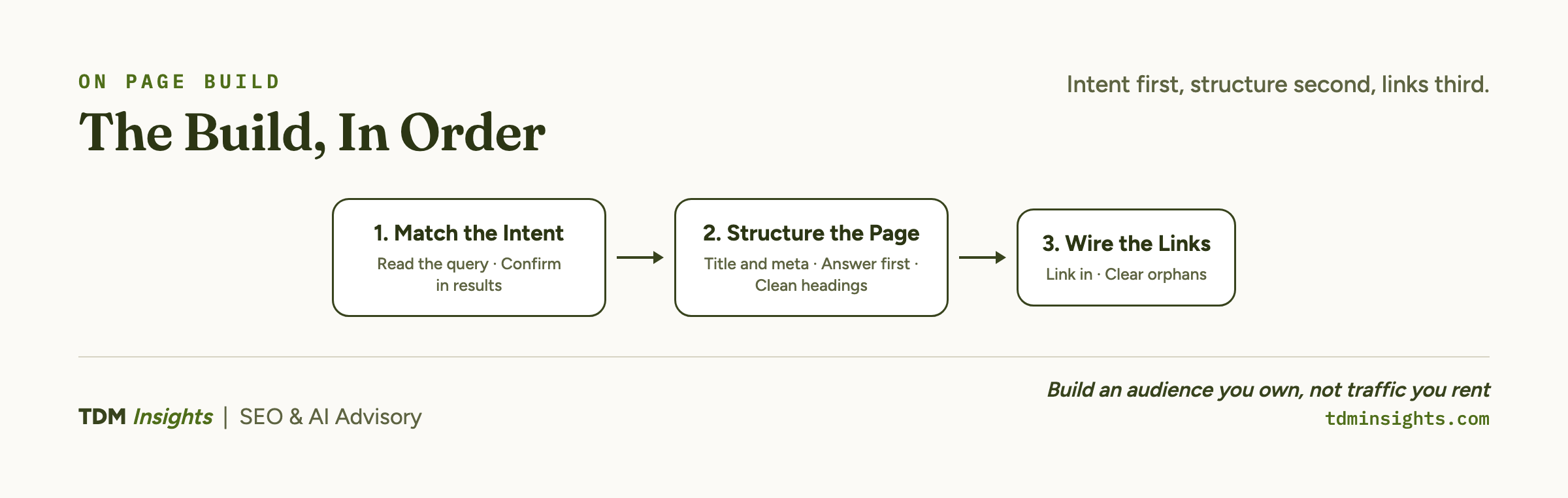
Here is the whole model before the detail. The Intent then Structure then Links page model is three stages, and the order is the differentiation:
- Match the intent. Read what the searcher actually wants, then confirm it in the live results. A page aimed at the wrong intent never ranks, no matter how clean its markup.
- Structure to rank and be cited. Build the page (title, meta, headings, an answer-first opening, extractable blocks) so Google ranks it and AI answer engines can lift it.
- Wire the internal links. Connect the page into your site so authority and relevance flow to and from it.
Read as a build sheet, the same model lays out stage by stage like this:
Competitors publish flat factor lists (“23 on-page factors”) with no sequence. The sequence is what makes the difference.
Structuring a page before you have read its intent is decoration. Wiring links into a page that is aimed wrong just moves authority into a dead end.
The rest of this article runs each stage, shows what it produced on a real site, and ends with a checklist you can run on one page tomorrow.
Stage 1, match the intent: why a page aimed wrong never ranks
Intent is the precondition. Every query carries one of four intents (informational, navigational, commercial investigation, transactional), and Google ranks the page type that matches it. A how-to article will not rank for a query where searchers want to buy, however well it is written.
So the first move on any page is to read the intent. You infer it from the query wording, then confirm it by searching the term and studying what already ranks.
The wording gives you a first read: “how to” leans informational, “best” or “vs” leans commercial investigation, “buy” or “pricing” leans transactional, a brand name leans navigational. The live results give you the confirmation. The pages Google already rewards are Google telling you which intent and page format it currently treats as the right answer.
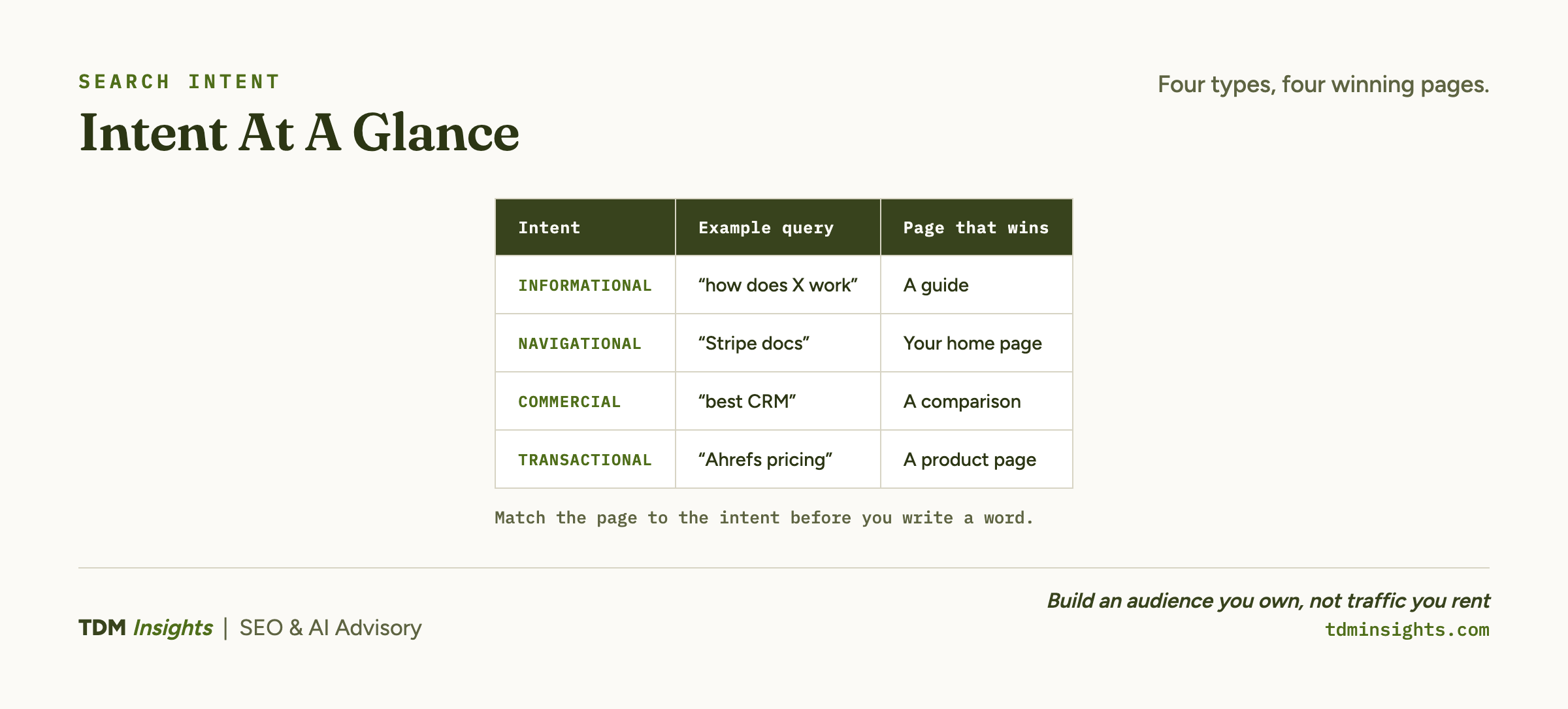
There is a simple discipline for matching the page to what searchers actually want, and it is why you match the intent before you build, and why you read the SERP before you write a word (SERP is the search engine results page).
The consequence for a founder is blunt. If you skip this stage, every later move compounds on a wrong foundation.
A beautifully built page pointed at the wrong intent is a common reason good pages stay invisible. The page can have the cleanest headings on the internet and still not rank, because it answers a question nobody searching that term is asking.
Read intent first and the rest of the build has a target. Skip it and the rest of the build has nowhere to land.
Stage 2, structure to rank: title, meta, headings, the answer-first opening
Once the page is aimed correctly, you build it to be read. Four moves carry most of the weight.
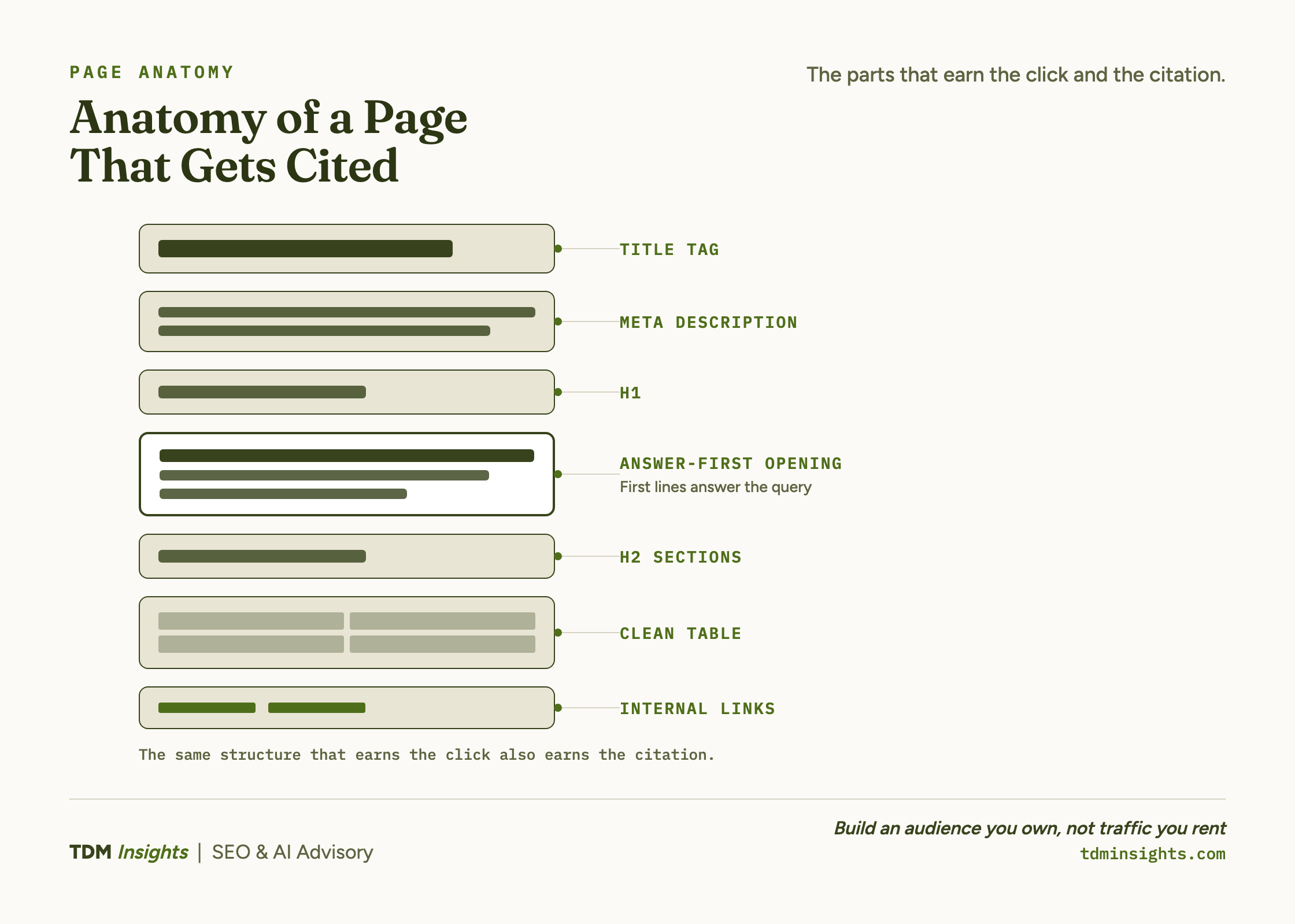
The title tag and meta description are one promise, written for the results page they sit in. They are the only part of your page a searcher sees, and click-through rate (CTR) falls sharply with each position you drop, so the snippet that earns the click has to do more work than the rank suggests.
Google’s own guidance on how it generates the title link is plain: write a concise, descriptive title that matches the page, and it will usually keep yours. The title carries the relevance and the specificity; the meta gives one reason to choose you over the results around it. Write them together, sized so Google does not truncate them, and aimed at the intent you just read.
Headings come next. Use one H1 for the page title, then H2s for the main sections and H3s nested under them, in sequential order without skipping a level. Headings describe the section in plain words; they are not a place to stuff keywords.
Clean hierarchy does two jobs at once. It lets Google understand how the page is organized, and it lets an answer engine find the right block to quote when it is assembling an answer. The plainest reference for the semantics is the spec on the HTML heading elements, and the web platform guidance on building a proper heading hierarchy says the same thing in practice.
The answer-first opening is the move many pages miss. Lead each section with a direct, self-contained answer in the first sentence, then add the depth behind it.
That single habit serves the reader scanning for the one thing they came for, and it is the structural requirement for a page to be quoted by an AI answer engine, which lifts short passages rather than whole pages. A section that opens with three sentences of throat-clearing gives the engine nothing clean to extract.
Keyword placement is simpler than the old playbook claims. Put the primary term in the title, the H1, the first 100 words, and at least one H2, in natural phrasing. Then let related terms appear where they fit.
Modern ranking rewards topic coverage and intent match far more than repeating one phrase, and a reputable overview of on-page ranking factors lands in the same place.
Book a free diagnosis
You have the build sequence now. Knowing which stage your own page is failing, intent, structure, or links, is the part that is hard to see from the inside. We run a free diagnosis on a live page you pick: we apply the intent then structure then links model, tell you which stage is leaking, and show you the single change that moves the most. No deck, no retainer pitch, just a clear read on where the page is losing.
Structure to be cited: the same moves, a harder win
Ranking and citation are related but distinct. A page that ranks gets a spot in the list. A page that is cited gets quoted inside the AI Overview, the ChatGPT answer, or the Perplexity result.
The useful surprise is that the same structural moves serve both. People scan online, they do not read line by line, which decades of UX research on how people read has shown.
AI answer engines behave the same way: they extract short, quotable passages rather than absorbing a whole page. So the structure that helps a scanning human also makes your page liftable by a machine.
Three moves do the work:
- Lead with the answer. Open each section with a self-contained answer the engine can lift without needing the rest of the paragraph for context.
- Keep headings clean and descriptive. Let the engine match a question to a block, the way it matches “what is the right heading structure” to a section actually titled for that question.
- Put tabular content in a small table. A clean table with clear column labels is one of the easiest structures for an engine to extract and reuse.
The discipline is to write each block as if it might be pulled out and shown on its own, because increasingly it will be. Independent analysis of how to structure content to be cited by ChatGPT reaches the same conclusions from the data side, and a complementary look at the content structure ChatGPT prefers puts numbers on the early-answer pattern.
None of this is a separate body of work bolted onto the page. It is the same answer-first opening, the same clean headings, the same tables you already built for the ranking half, now read through a second lens.
The deeper treatment of how answer engines choose what to cite belongs to the answer engine optimization (AEO) cluster; here the point is narrower. The structure that earns the click also earns the quote, which is why one well-built page can win in both places at once.
Stage 3: wire the internal links
The page is aimed and built. The last stage connects it. Every internal link on your own site passes two things to its target: authority, the ranking equity Google flows along links, and relevance, signalled by the anchor text and surrounding context.
That makes internal linking a ranking lever you fully control. Backlinks you have to earn. Internal links you can place today, for free, and point exactly where you want authority to go.
A deliberate plan can lift the exact page you most want to rank without a single new backlink. The mechanics are simple to state:
- Point links from strong pages. Send links to your priority page from strong, relevant pages on your site.
- Use descriptive anchor text. Skip “click here” so both the reader and the engine know what waits on the other side.
- Clear your orphans. Find the pages nothing else links to and connect them.
Google’s own advice on creating helpful, well-connected content treats those links as part of how it discovers and values a page. An orphan gets crawled less and ranks worse, because internal links are a primary path Google uses to discover and value a page. This is how you wire the page into the site graph on purpose.
This is the per-page mechanics view. The ongoing habit of building the whole topical graph over time is a content-strategy discipline that lives in the Content category; the two cross-link and stay in their lanes. Stage 3 here is about one page and where to point links at it.
The on-page SEO elements that actually matter (and the ones that do not)
Strip the long factor lists down and a short set does the heavy lifting:
- Intent match. The page type the live results reward.
- A clear title and meta. One promise, sized to survive truncation.
- An answer-first opening. A direct answer in the first sentence of each section.
- Clean heading hierarchy. One H1, then sequential H2s and H3s.
- Extractable blocks. Short passages and small tables an engine can lift.
- Purposeful internal links. Authority pointed at the page you want to rank.
Those are the moves tied to the curve. If you want one consolidated reference, a practical on-page SEO walkthrough covers the same ground element by element.
What does not deserve a weekend: exact keyword density targets, meta keywords tags (Google ignores them), and chasing a perfect score on any single secondary metric. These are the tweaks that feel like progress and move nothing. Effort spent here is effort not spent on the three stages that do.
What this looked like in practice
The model is not theory. We refined this exact intent then structure then links build on a site we operate before bringing it to clients, and the curve it produced is the proof.
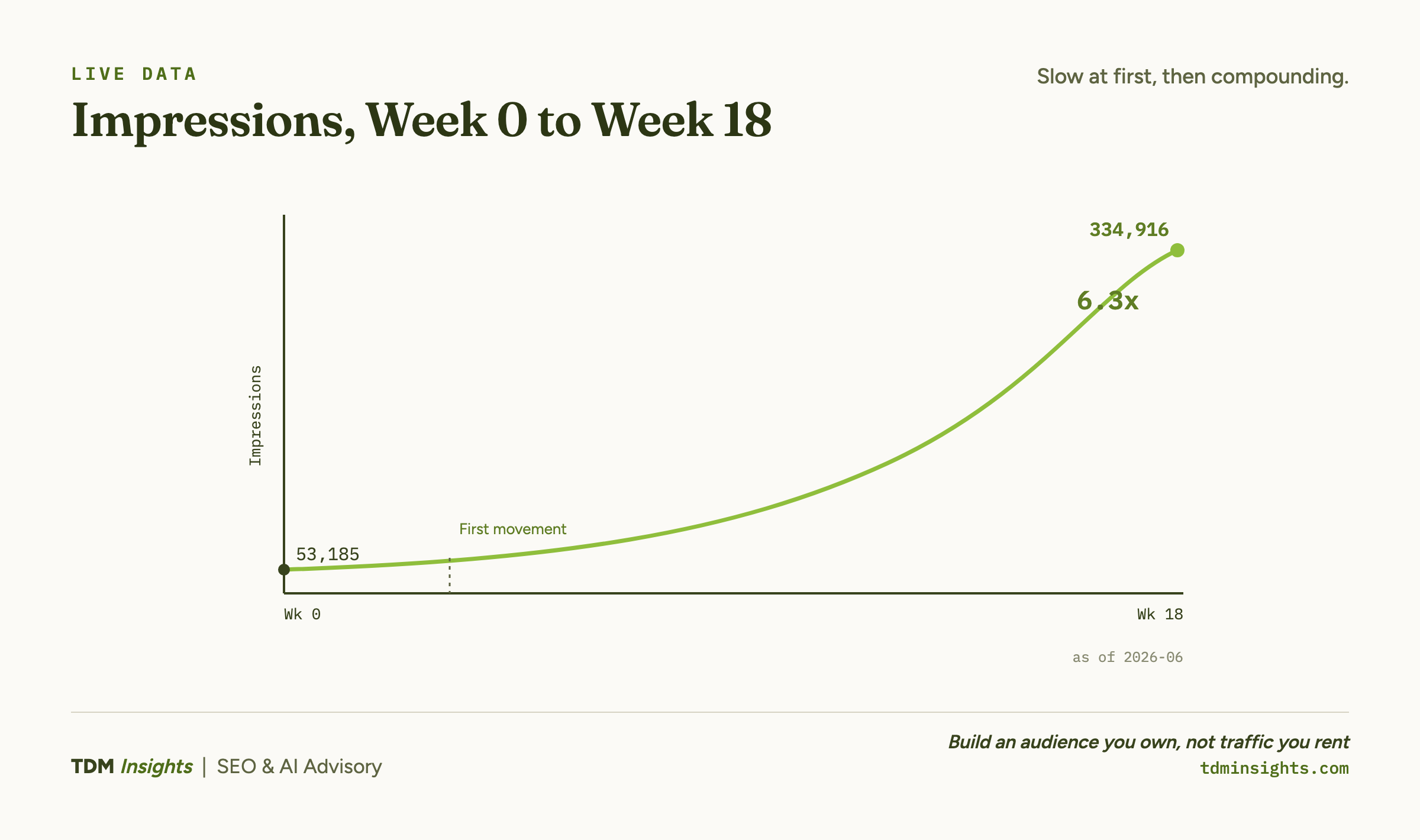
That site grew Google search impressions from 59,643 to 600,569 in 28 weeks. That is a 10.1x lift, with the first clear movement visible around week 1 and the line still climbing at week 28. A large share of the growth came from pages built to this sequence: intent read off the live results first, the page structured answer-first with clean headings, then wired into the rest of the site.
Two things about that curve are the whole lesson. For the early weeks, almost nothing visible happened.
Impressions move first and they move slowly, so a founder watching daily sees flat lines and is tempted to conclude the work is not landing. It was landing. It was just not yet visible.
The second thing is that when the line bent, it bent because the earlier pages had compounded through their internal links, not because anyone suddenly worked harder in week 1. Each new page aimed at a confirmed intent, structured to be read, and wired into the ones before it added a little authority to the whole set.
The order produced the curve. The same pages published out of sequence, structured before their intent was read and linked before they were right, would not have drawn the same line.
A repeatable page-build checklist
Run this on one page at a time, in order:
- Read the intent from the query, then confirm it against the live results before writing.
- Match your page type to the intent the results reward.
- Write the title and meta as one promise, sized to survive truncation.
- Open the page, and each section, with a direct answer in the first sentence.
- Lay out one H1, then sequential H2s and H3s, in plain descriptive words.
- Put genuinely tabular content in a small, clean table for extraction.
- Place the primary term in the title, H1, first 100 words, and one H2, naturally.
- Point internal links at the page from strong, relevant pages, and clear any orphans.
This pillar is itself built to that list, which is the point. It opens with the answer, runs the three stages in order under descriptive headings, and is wired to the rest of the cluster.
The sequence is portable across any page on any platform, because none of it depends on a tool or a plugin. It depends on doing the three stages in order.
Where page-craft sits in the larger picture is covered in the first-90-days order of operations; this article is the single-page build inside it. Run the build on the page you most want to rank, then run it again on the next one. The pages compound, and so does the curve.
Frequently Asked Questions
How do you structure a page so it actually ranks in Google?
Structure it in three stages, in order: match the search intent first, then build the page so Google and AI engines can read it (clear title, answer-first opening, logical headings), then wire internal links to it. Skipping intent is the usual failure. A well-built page aimed at the wrong intent still does not rank.
What is the correct heading structure for an SEO page?
Use one H1 for the page title, then H2s for main sections and H3s nested under them, in sequential order without skipping levels. Headings should describe the section in plain words, not stuff keywords. This clean hierarchy helps Google understand the page and lets AI answer engines extract the right block to cite.
How do you get content cited by AI Overviews and ChatGPT?
Lead each section with a direct, self-contained answer in the first sentence, then add depth. AI engines extract short, quotable passages, so an answer-first opening, clean headings, and small tables make your page liftable. Citation and ranking share the same structural moves, which is why one well-built page can serve both.
Where should you place your target keyword on a page?
Put the primary keyword in the title tag, the H1, the first 100 words, and at least one H2, using natural phrasing. Then let related terms appear where they fit. Do not repeat the exact keyword in every heading. Modern ranking rewards topic coverage and intent match far more than keyword density.
What is the right order: intent, structure, or links first?
Intent first, structure second, links third. Reading intent tells you what page type can win. Structure builds that page so it ranks and can be cited. Links flow authority into it. Doing them out of order wastes effort: structuring before reading intent is decoration, and linking to a page that is wrong just moves authority into a dead end.
Does page structure actually affect Google rankings?
Yes, indirectly but meaningfully. Structure does not rank a page by itself, but clear headings, fast clean markup, and an answer-first layout help Google understand and trust the content, improve how users engage with it, and make the page extractable for AI answers. Poor structure buries good content where neither searchers nor engines can use it.
Continue Reading:
More On On-Page SEO:
- Title Tags and Meta Descriptions That Get Clicks
- Search Intent: The Four Types That Decide Everything
- Internal Linking: The Most Underrated SEO Lever
- How to Read the SERP Before You Write a Word
- Free Keyword Research: A Starter Method, No Tools
More from TDM Insights:
- SEO for Startups: What to Do in the First 90 Days
- Technical SEO for Founders: What to Fix First
- Keyword Research for Startups: Demand You Can Win
- Answer Engine Optimization: What AEO Actually Is
- Topic Clusters and Pillar Pages: How They Work
Explore TDM Insights Categories: