
WordPress vs Shopify vs Wix vs Squarespace, Compared
Use case, strengths, weaknesses, and how common each is. A side-by-side so a founder picks the right platform the first time.
 By David Jubé · Apr 26, 2026 · 11 min read

Pick by what your site is for, not by which name you have heard most. WordPress is the default for a content and SEO led site that wants control and room to scale.
Shopify is the answer when commerce comes first and the checkout has to be flawless. Wix and Squarespace are the fast all-in-one builders for a design-forward site you want live this week.
Those four cover almost every founder’s situation. The differences are not about quality. They are about what each platform was built to optimize for.
WordPress trades some setup effort for flexibility and ownership. Shopify trades content flexibility for the best ecommerce engine available. Wix and Squarespace trade deep control for speed and low maintenance.
This article maps each platform to the founder it fits, with prevalence, use case, strengths, and weaknesses laid out side by side. It ends on the question most founders actually care about: which one is best for content and SEO.
The short version is in the table below. Every section after it explains one idea once, so you can read the whole thing or jump to the platform you are weighing.
Key takeaways
- WordPress is the default for a content and SEO led site, giving full control of templates, taxonomy, and plugins like Yoast with no ceiling on library size, but it demands separate hosting and ongoing maintenance.
- Pick Shopify when selling is the core of the business and the checkout has to be flawless, accepting that its blogging and taxonomy tools are basic and the blog stays secondary.
- Wix and Squarespace are the fast all-in-one builders with hosting included: Wix offers the lowest-maintenance path to a live site, while Squarespace pairs beautiful templates with a genuinely strong native blog.
- For a large content operation WordPress wins because builders constrain technical SEO: Squarespace cannot edit robots.txt and runs schema through code injection on higher plans, while Wix gives less advanced customization control.
How common each platform is
Prevalence is a useful tiebreaker because it tells you how deep the help, talent pool, and integrations run. According to W3Techs CMS usage data, WordPress powers roughly 40 percent of all websites, the most used content management system by a wide margin.
Shopify is the leading hosted ecommerce platform. It accounts for a few percent of all sites, but a large share of all online stores, which is the segment that matters when commerce is the point.
Wix and Squarespace each sit at low-single-digit percentages of all sites. Both are popular do-it-yourself, all-in-one builders rather than open platforms.
The practical read: WordPress has the largest ecosystem and talent pool, Shopify has the deepest commerce-specific one, and the two builders trade ecosystem size for a simpler all-in-one experience.
Who each platform is for
WordPress fits founders building a content and SEO led site who want full control and the ability to scale a large library over time. It rewards the founder who plans to publish a lot and treat content as a long-term asset, the approach laid out in building a content library that ranks, gets cited, and pays for itself.
Shopify fits commerce-first businesses. If your revenue runs through a checkout with inventory and payments, Shopify was built for exactly that and handles it out of the box.
Wix fits a small business that wants an easy, all-in-one site live quickly without managing hosting or technical upkeep. It is the lowest-friction way to get a real site online.
Squarespace fits design-forward founders: creatives, portfolios, and brands that care about how the site looks and also want a genuinely strong built-in blog. It sits between a pure builder and a dedicated content platform.
The strengths of each platform
WordPress leads on flexibility and ownership. Its plugin ecosystem (including SEO tools like Yoast and Rank Math) plus full control over content, taxonomy, and templates means you can shape the site to the strategy rather than the other way around, and you own your content outright. It scales from a one-page site to a library of thousands.
Shopify leads on commerce. The checkout is reliable and conversion-tuned, the managed hosting and CDN are fast, and the inventory and payment plumbing works without you assembling it. For selling, nothing on this list matches it.
Wix leads on ease. It is the fastest to launch, all-in-one with hosting included, low maintenance, and its SEO and performance have improved meaningfully in recent years.
Squarespace leads on design and native blogging. Its templates are genuinely beautiful, its built-in blog is strong, and it stays low maintenance because hosting and updates are handled for you.
The weaknesses of each platform
WordPress asks more of you. You arrange separate hosting and stay on top of maintenance, security, and updates, the trade-off covered in technical SEO for founders, what to fix first. It can also bloat if you over-install plugins, and it has the steepest learning curve of the four.
Shopify is thin on content. Its blogging and content tools are basic, with weak taxonomy and templating, and you pay a monthly plan plus app fees. Content flexibility is the price you pay for commerce strength.
Wix gives you less advanced SEO and customization control than an open platform, and it is proprietary, which makes migrating off it later harder than exporting from WordPress.
Squarespace has no plugin ecosystem, so you cannot extend it the way you can WordPress. Its advanced SEO control is limited: the robots.txt file is not editable, and custom schema runs through code injection on higher plans, which constrains the structured data work that earns rich results. Scaling a very large content operation is harder as a result.
Book a free diagnosis
Most founders pick a platform once and never revisit whether it is helping or quietly limiting their goals. We will look at your current setup and tell you, founder to founder, whether your platform is an asset or a ceiling for your SEO and content plans. No pitch, no migration upsell, just a straight read on whether you are on the right tool for where you are trying to go.
Which platform is best for content and SEO?
All four platforms can run a real content strategy. The difference is friction, not whether it is possible, and that distinction matters more than any platform marketing will tell you.
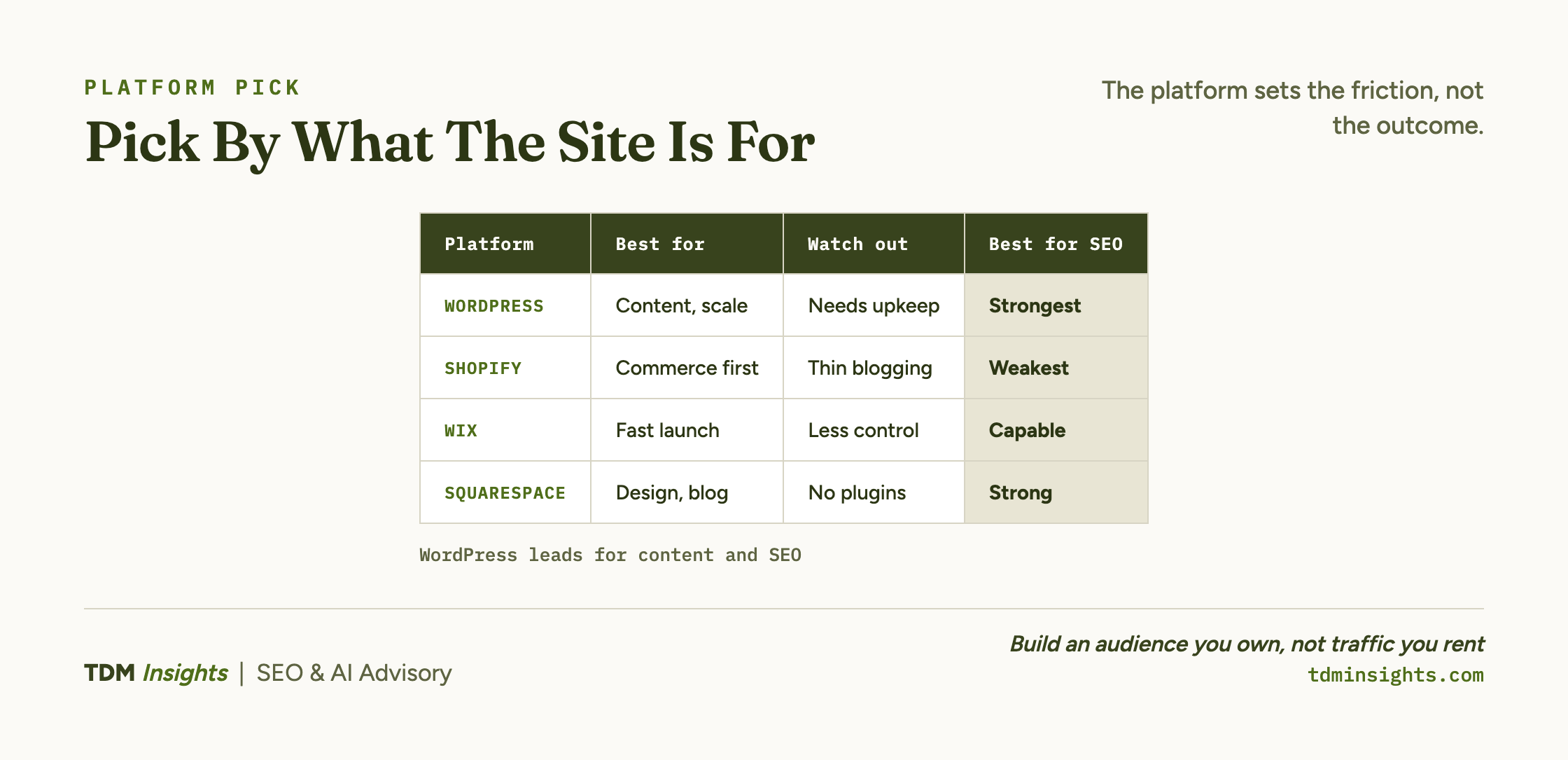
WordPress is the best positioned for content and SEO. Full control of templates and taxonomy, an SEO plugin layer, and no ceiling on library size make it the natural home for a serious publishing effort, including the topic-cluster and pillar-page structure that compounds over time. WordPress’s own search-engine optimization guidance covers the configuration side in plain language.
Squarespace is strong for content. Its native blog is one of the best among the builders, and it handles a focused content operation well, though the lack of plugins and the SEO control limits show up once the library gets large.
Wix is capable. Its SEO has improved and it can support a content strategy, but you have less advanced control than on an open platform, which constrains the more technical optimization work.
Shopify is ecommerce-first and the weakest of the four for a large content library. Its basic blogging and thin taxonomy make a big editorial operation awkward, even though it is unbeatable at the storefront itself. Whichever platform you choose, the content that earns rankings and AI citations is written the same way, since how AI answer engines choose their sources depends on the writing far more than the platform.
How to choose
Start with the job the site has to do, because that single answer settles most of the decision.
Choose WordPress if content and SEO are central, if you want control and ownership, and if you can handle (or hire for) hosting and maintenance. It is the default for a publishing-led site that needs to scale.
Choose Shopify if selling is the core of the business and the checkout has to be excellent. Accept that the blog will be secondary.
Choose Wix if you want the fastest, lowest-maintenance path to a real site and do not need deep technical SEO control. Choose Squarespace if design matters most and you also want a strong blog, knowing the library will not scale endlessly.
Whichever you land on, the platform sets the friction, not the outcome. The outcome comes from how you actually produce content that ranks and gets cited, which is the same work on every platform here. If you do migrate or switch builders, the SEO and AI visibility tracking tools are how you confirm the change actually moved rankings rather than guessing.
Frequently Asked Questions
Which platform is best for SEO?
WordPress is best positioned for SEO because it gives full control of templates, taxonomy, and metadata, plus SEO plugins like Yoast and Rank Math, with no ceiling on site size. Squarespace and Wix are capable for smaller sites, while Shopify is strong for product pages but weaker for a large content library.
Which platform is best for a blog or content?
WordPress is best for a serious blog or large content library thanks to full taxonomy, template control, and plugins. Squarespace has a strong native blog and suits a focused content effort well. Wix is capable, and Shopify is the weakest here because its blogging tools are basic and its taxonomy is thin.
Is WordPress better than Squarespace?
It depends on the goal. WordPress is better for control, scale, and a large content or SEO operation, but it needs hosting and maintenance. Squarespace is better for design-forward sites and a quick, low-maintenance launch with a strong built-in blog. WordPress wins on flexibility, Squarespace wins on ease.
Which platform is most popular?
WordPress is by far the most popular, powering roughly 40 percent of all websites and leading the CMS market by a wide margin, according to W3Techs. Shopify leads hosted ecommerce platforms, while Wix and Squarespace each sit at low-single-digit percentages of all sites as popular all-in-one builders.
Can you do good SEO on Wix or Squarespace?
Yes. Both can support a real SEO and content strategy, and Wix’s SEO has improved notably. The limits are control: Squarespace cannot edit robots.txt and handles schema through code injection on higher plans, and Wix offers less advanced customization than an open platform. Good content matters more than these platform limits in nearly every case.
Should I use Shopify if I also want to blog?
Use Shopify when selling is the primary goal and the blog is secondary, since its commerce engine is best-in-class but its blogging tools are basic. If content and SEO are central to growth, pair Shopify’s store with a stronger content platform or weigh WordPress, which handles both a large blog and commerce plugins.
Continue Reading:
More On Technical SEO for Founders
- Technical SEO for Founders: What to Fix First
- Core Web Vitals Explained for Non-Engineers
- Why Isn’t My Site Indexed? A Founder’s Diagnostic
- Crawl Budget and Indexation for Small Sites
- Site Speed: The Fixes That Actually Move Rankings
- Structured Data for SEO: The Founder’s 80/20
- SEO and AI Visibility Tracking Tools, Compared
More from TDM Insights
- Content Strategy for Founders: A Library That Ranks, Gets Cited, and Pays for Itself
- Topic Clusters and Pillar Pages: How They Work
- Content That Ranks and Gets Cited by AI
- How AI Answer Engines Choose Their Sources
- How to Produce Content That Ranks and Gets Cited
Explore TDM Insights Categories
