
How to Produce Content That Ranks and Gets Cited
A repeatable system for producing content that ranks in Google and gets cited by AI: brief, draft, then proof on the page.
 By David Jubé · Jun 15, 2026 · 11 min read
Two articles can target the same keyword and get opposite results. One ranks on the first page and gets quoted by ChatGPT. The other sits on page four and is never seen by a human or a machine.
Same topic, same length, same effort. The difference is not luck. It is whether each article was produced to a standard or written on instinct.
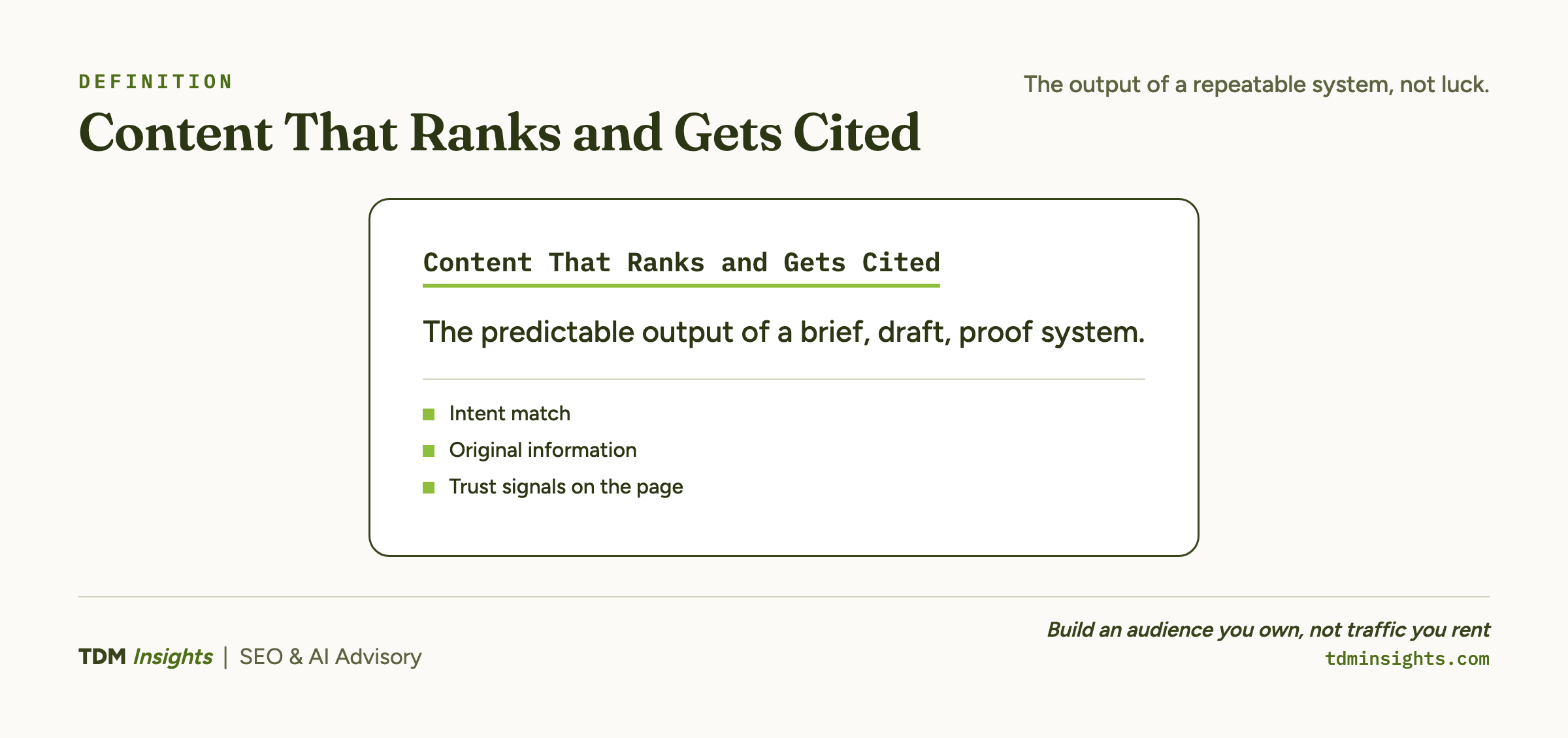
Content that ranks and gets cited is the predictable output of a three-stage system: brief, draft, proof. Run those three stages in order, on every article, and you stop producing lucky drafts.
We built this system on a site we operate before bringing it to clients. A structured library produced this way lifted search impressions 10.1x in 28 weeks, and those articles keep earning impressions with no further spend.
This article walks the whole system end to end, and points to the deeper guide for each stage.
Key takeaways
- Content that ranks and gets cited is the output of a three-stage system run in order on every article: a brief that fixes intent, angle, scope, and required proof, then a human-first draft of the right length, then visible proof on the page.
- Two articles on the same keyword get opposite results because ranking rewards intent match, original information the current results lack, and on-page trust signals, never the topic by itself.
- Earn AI citations by ranking in the organic top results first, then making the page extractable: lead each section with a direct answer, use question-based headings, and add a clean FAQ block.
- A repeatable system beats individual talent because consistency compounds, and running every article through the same brief-draft-proof bar lifted one site’s search impressions 10.1x in 28 weeks.
Why Two Articles on One Topic Get Opposite Results
Ranking rewards three things the topic alone cannot supply: intent match, original information, and trust signals on the page.
The winner answers the actual task behind the search. The loser answers a slightly different question, or the same question in a format searchers did not want.
The winner adds something the current results lack: a number, a first-hand detail, a clearer explanation. The loser restates what already ranks, so an engine has no reason to prefer it.
The winner sits on a page that proves a real person did the work. The loser asserts expertise and shows none. Ranking and citation are only the first half of the job: the page still has to turn the reader who lands on it into a customer, which is a separate discipline that begins with the same standard.
Yoast’s diagnostic on reasons optimized content still does not rank walks the same checklist: indexation, intent, and added value decide the outcome long after the keyword is chosen. The fix is not more keywords. It is a production process that settles intent, originality, and proof before publishing.
The Brief to Draft to Proof System
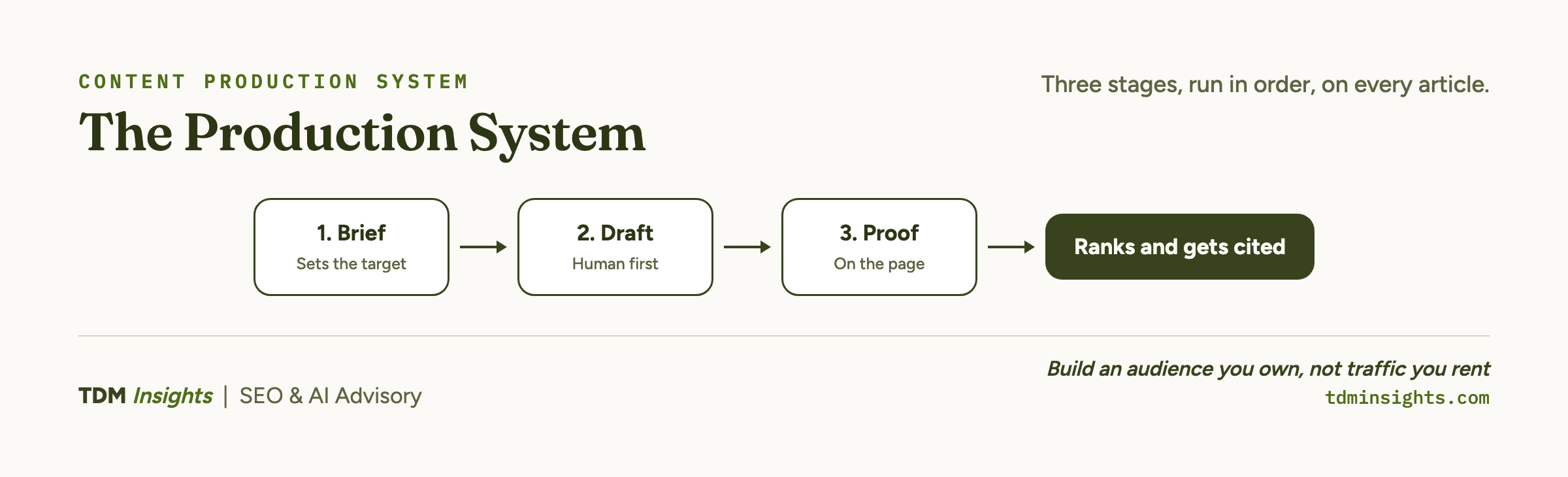
The system has three stages, run in order. Each fights a specific production failure.
The order matters. A draft with no brief answers the wrong question.
Proof added to a generic draft still reads generic. Scope set without intent produces a padded post or a thin one.
Content Marketing Institute’s guide to documenting your content workflow makes the same point from the operations side: named stages with review gates are what keep quality from drifting between pieces.
This system is the execution layer under the strategy stage this work sits beneath. Strategy decides what to build and why it compounds. This system decides how to produce one article so it actually wins, the same discipline the first 90 days of startup SEO puts in place.
The platform you publish on shapes how much friction this system carries. WordPress is purpose-built for a content library, with a full CMS, real taxonomy, and the deepest SEO plugin ecosystem, while Squarespace has a strong native blog, Wix is capable, and Shopify is ecommerce-first and the weakest of the four for a large library (WordPress, Shopify, Wix, and Squarespace compared). All four can execute a content strategy, the friction differs.
Stage 1: The Brief Sets the Target
The brief is where you decide, before a word is written, what the article must do.
Four decisions carry the weight: the search intent (the real task behind the query), the angle (what makes your version beat the current results), the scope (how deep the intent requires you to go), and the proof (the specific evidence the page must show).
You confirm intent by reading the live results, not by guessing. The format Google already rewards (guide, list, comparison, definition) tells you the shape searchers expect.
A brief that settles those four removes the writer’s biggest unknowns. Begin every article where every good article starts, the brief that turns strategy into a single target, before you touch the keyboard.
Intent and angle both trace back to the demand you can actually win, so the brief inherits its target from real keyword research. Writing a content brief covers the four-decision template in full.
Stage 2: The Draft, Human-First
The draft turns the brief into the article itself. The standard is human-first writing of the right length for the intent.
AI belongs in this stage, used as a drafting and research assistant. It is good at outlining, summarizing, and producing first-pass volume. It is bad at judgment, first-hand detail, and voice, which is exactly what a reader remembers.
The failure to avoid is slop: even sentence rhythm, generic transitions, filler words, and abstractions where specifics belong. That output reads competently and says nothing, so engines skip it. HubSpot’s guide to building a content marketing strategy situates one article inside the larger asset, so a single weak draft is never a private problem.
Using AI without sounding like AI names each tell and the fix. The principle here is simple: AI scaffolds, a human supplies the experience, the specifics, and the voice, which is also what gets a page cited by ChatGPT and Perplexity rather than skipped.
Book a free diagnosis
If your articles are well written and still not getting chosen, the gap is usually in the system, not the prose. A free diagnosis runs a sample of your published pages through the brief-to-draft-to-proof check: which ones answer the wrong intent, which read generic, which bury the answer engines would otherwise quote. It is a working session on your real content, and you leave knowing the one stage to fix first.
Stage 3: The Proof on the Page
Proof is the stage that makes a reader and an algorithm trust the source. It is the difference between a competent article and a cited one.
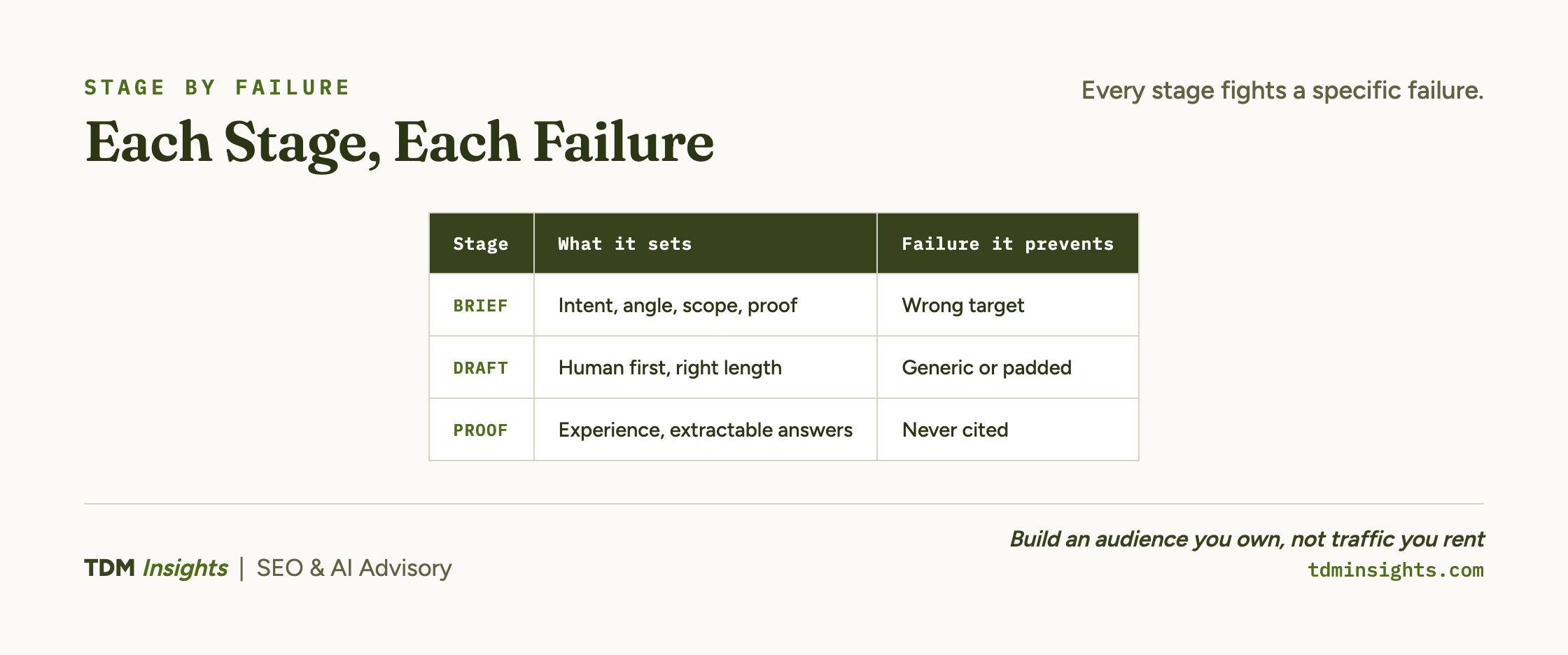
You prove trust with specifics only someone who did the work would include: first-hand detail, real numbers, named sources, a genuine author with credentials, and reasoning a reader can follow. Asserting “we are experts” does nothing. Demonstrated experience does.
This is also where you make the page extractable. Lead each section with a direct answer, use question-based headings, and add a clean FAQ block. Those are the structures answer engines lift into a result.
Two guides cover the two halves of proof: proving experience on the page handles on-page trust signals, and writing FAQs that double as AEO fuel handles the extractable answers. Marking those answers up with schema and answer-first structure makes them easier for an engine to lift. Both feed the trust layer that decides whether you get cited.
Why Length Is Set by Intent, Not a Quota
Scope is a brief decision and a draft constraint, so length threads through stages one and two rather than standing alone. There is no ideal word count: length is an output of intent, not a number you target. How long a blog post should be walks the full classification.
How to Earn the AI Citation
Getting cited by AI Overviews, ChatGPT, and Perplexity starts with ranking in the organic results. The large majority of AI citations come from pages already on the first page, so SEO is the entry ticket, not a separate game.
AI Overviews now reach over a billion people, and Google’s continued expansion of AI Overviews and AI Mode means a growing share of searches resolve inside an answer the user never clicks. Being the source that answer quotes is the new visibility.
The page that earns it is the page the proof stage already produces. This is the same people-first standard Google Search Central asks for, applied to the answer box instead of the blue link.
Keeping those facts current is ongoing work, which is why updating an older post to win back rankings it lost is part of the same standard, not a separate chore. Understanding how answer engines choose their sources is the strategy layer; producing the page that qualifies is the work of this system.
Why the System Beats Talent
A talented writer can produce a great article on a good day. A system produces a great article on every day, because consistency is what compounds.
When every article clears the same bar, weak drafts stop dragging the library down, and the accumulated authority lifts every piece. The lift compounds with coverage, which is its own decision about how many posts a topic actually needs to rank.
The Animalz team frames the same idea as a repeatable quality process, where angle and information gain are deliberate decisions, not accidents.
The 10.1x impression lift on our own site was not one breakout article. It was a library where every piece went through brief, draft, and proof.
The standard repeated, so the result repeated. That is the case for a system over a streak of good drafts.
Frequently Asked Questions
Why do two articles on the same topic get opposite results in search?
Two articles on one topic diverge because ranking rewards intent match, originality, and trust signals, not the topic alone. The winner answers the actual searcher task, adds information the current results lack, and demonstrates real experience. The loser repeats existing content, mismatches intent, or sits on a page with nothing that proves it.
What is the system for producing content that ranks and gets cited?
It is a three-stage workflow run in order: brief, draft, proof. The brief decides intent, angle, scope, and the proof the page must show. The draft produces a human-first article of the right length without AI tells. The proof puts experience and extractable answers on the page so readers and engines trust and cite it.
How do you get content cited by AI Overviews and answer engines?
Get cited by ranking in the organic top results first, since the large majority of AI citations come from pages already there. Then lead with a direct answer, use question-based headings, add specific data and first-hand detail, and keep the page current. Extractable, authoritative answers are what engines lift into a result.
How do you prove an article is trustworthy on the page itself?
Prove trust with specifics only someone who did the work would include: first-hand detail, real numbers, named sources, a genuine author with credentials, and transparent reasoning. Assertions like “we are experts” do nothing. Demonstrated experience, visible sourcing, and concrete examples are what a reader and an algorithm read as trustworthy.
Why is my content not ranking even though it is well written?
Well-written content often fails to rank for reasons beyond the prose: the page may not be indexed cleanly, the format may not match the searcher’s task, or it adds little original value over existing results. Weak internal links, a low-authority site, and thin topical depth also suppress it. Diagnose indexation and intent first.
Does a content production system really make a difference?
Yes, because consistency is what compounds. Articles produced to one repeatable standard clear the same quality bar, so weak drafts stop dragging the library down. A structured library produced this way lifted search impressions 10.1x in 28 weeks at The Gourmet Host, and the standard, not the luck of any single draft, is what made it repeat.
Continue Reading:
More On Content Production and Quality
- How to Write a Content Brief (That Gets It Right)
- Writing for E-E-A-T: Prove Experience on the Page
- Use AI to Write Without Sounding Like AI
- How Long Should a Blog Post Be? Intent Over Count
- How to Write FAQs That Double as AEO Fuel
More from TDM Insights
- SEO for Startups: What to Do in the First 90 Days
- Keyword Research for Startups: Demand You Can Win
- How to Get Cited by ChatGPT, Perplexity, and AI
- Schema Markup for AI: Answer-First Writing Guide
- How AI Answer Engines Choose Their Sources
- Content That Ranks and Gets Cited by AI
Explore TDM Insights Categories