
Why Category Pages Need an Answer Above the Grid
A product grid is a list of names. Twenty-seven words above it moved a category page out of the Partial band, and showed where the ceiling is.
 By David Jubé · Jul 25, 2026 · 6 min read
On a rebuilt retail site, every content page scored in the low eighties for answer-engine readiness. One page did not. The main product category sat at 68, the only page still in the Partial band, and it was the page with the most commercial intent behind it.
The fix was one paragraph. Twenty-seven words, placed above the product grid, and the page moved into the Strong band.
Key takeaways
- A product grid is a list of names. To a machine reading the page, it is not an answer to anything.
- One self-contained sentence above the grid, saying what the category is and how the products are made, is the cheapest answer-engine win available on an ecommerce site.
- It does not lift question coverage, which needs an FAQ block, so a category page has a ceiling until you add one.
What the page looked like to a machine
The page was well built. It had one clean H1, a unique meta description in the right band, breadcrumbs, and a CollectionPage node alongside the site’s local-business graph. By ordinary ecommerce SEO standards there was nothing wrong with it.
The problem was the reading order. After the H1, the next text on the page was a product name in an H2, then another product name, then another. Sixteen of them. A reader understands that instantly, because they can see photographs of chocolates. A language model reading the extracted text sees a heading followed by a list of proper nouns and no statement of what any of it is.
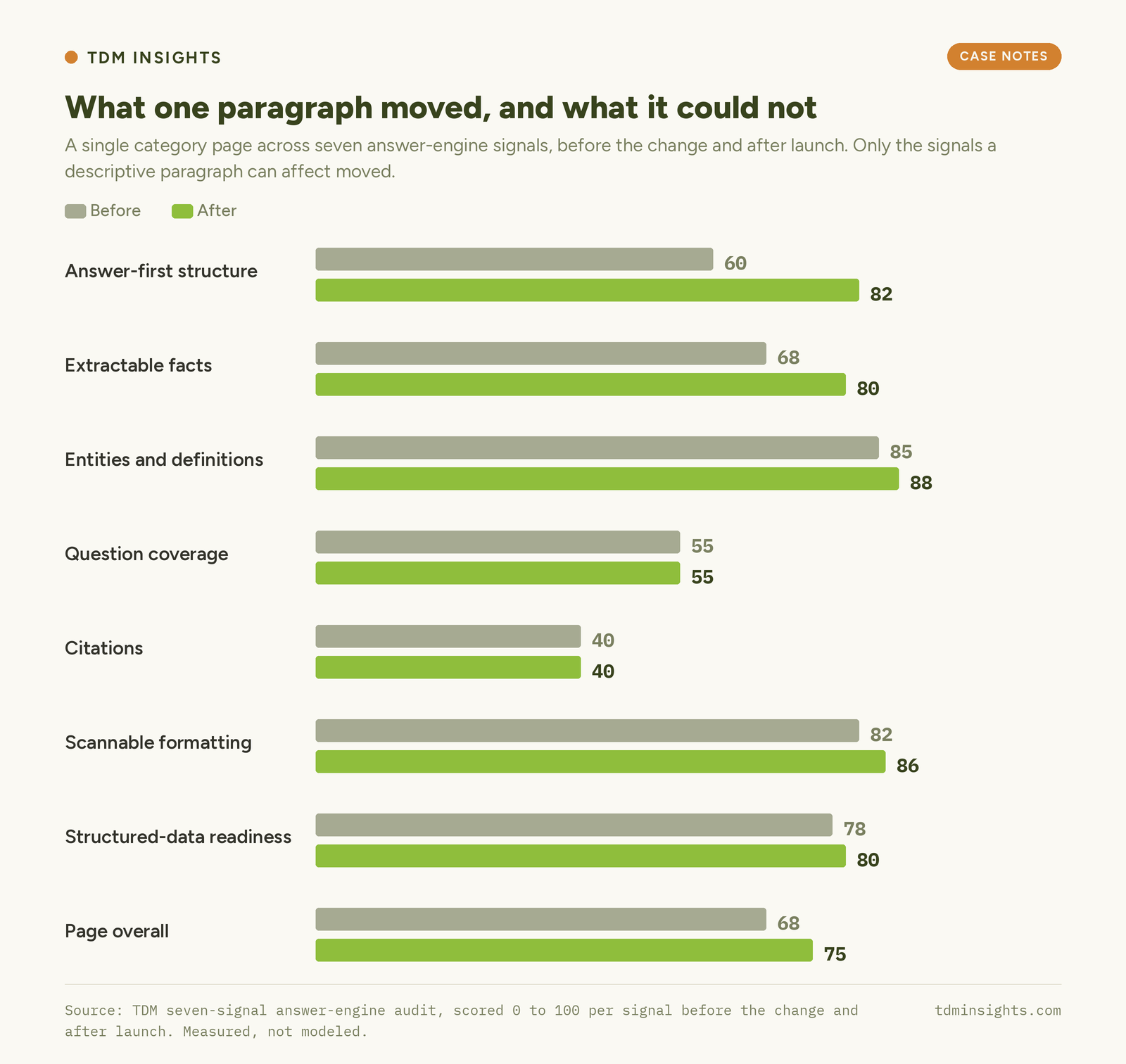
Our answer-engine audit scores seven signals, and the one this page failed is the first: whether a self-contained answer appears near the top. It scored 60 there against 78 to 82 on the site’s content pages. Extractable facts scored 68, for the same reason. There were no facts in prose to extract, only prices attached to names.
The change
One paragraph went in between the H1 and the grid, describing what the category is, how the items are made and where. It names the count, the technique and the place, which is the shape a machine can lift as an answer to “what are these” without needing the rest of the page.
A second, smaller change shipped at the same time: alt text was completed across the grid, from 16 of 30 images to 28 of 28. Alt text on a product grid is usually filed under accessibility, and it is that, but on a page whose only other text is product names it is also a meaningful share of the extractable content.
Nothing else changed. Same products, same photography, same schema, same template.
The read
| Answer-engine signal | Before | After |
|---|---|---|
| Answer-first structure | 60 | 82 |
| Extractable self-contained facts | 68 | 80 |
| Clear entities and definitions | 85 | 88 |
| Question coverage | 55 | 55 |
| Citations to authoritative sources | 40 | 40 |
| Concise scannable formatting | 82 | 86 |
| Structured-data readiness | 78 | 80 |
| Page overall | 68 | 75 |
The detail that proves this was the paragraph and not the launch is which signals moved. Answer-first jumped 22 points and extractable facts 12, which is exactly what one descriptive paragraph should affect. The two signals it cannot touch, question coverage and citations, did not move at all. A general uplift from launching would have nudged everything.
Question coverage staying at 55 is the honest limit. The page has no FAQPage block, so there are no question-shaped passages for an engine to match against a query. That single gap is now the cap on this page, and on the product pages, which sit at 62 for the same reason.
What this teaches
- Read your category pages as extracted text, with the images stripped out. If what remains is a list of product names, the page answers nothing.
- Put one self-contained paragraph above the grid. Say what the category is, how the products are made and where, in the plainest language you have.
- Write it to stand alone. An engine lifts a passage without its surroundings, so a sentence that depends on the heading above it is a sentence that cannot be quoted.
- Complete the alt text. On a page that is mostly photographs it is not housekeeping, it is a real share of the readable content.
- Know the ceiling. Answer-first structure and extractable facts respond to prose; question coverage only responds to an FAQ block, so a category page without one stops improving around the mid-seventies.
- Audit the weakest page, not the average. A site average of 81 hid a commercial page sitting in the Partial band.
Frequently Asked Questions
Do ecommerce category pages need text?
They need one self-contained paragraph, not a wall of keywords. A grid of product names gives a search or answer engine nothing to quote about the category itself. A short opening description of what the products are and how they are made is usually enough to make the page extractable.
Where should category page text go, above or below the grid?
Above the grid, immediately after the H1. Answer engines weight what appears early in the reading order, and text buried under the products is read as an afterthought. Keep it to a few lines so it informs shoppers rather than pushing the products off the screen.
How long should a category page description be?
Short. Around 25 to 50 words is enough to state what the category is, how the items are made and where. The goal is one liftable, self-contained statement, not an essay. Length beyond that adds little and starts to push the products below the fold.
Does alt text help SEO on product listing pages?
It helps on any page, and it matters most where images carry most of the content. On a product grid whose only other text is names and prices, completed alt text is a real share of what a machine can read, as well as being what a screen-reader user relies on.
What is answer engine optimization for ecommerce?
It is structuring product and category pages so an AI assistant can identify, understand and quote them. In practice that means answer-first copy, self-contained facts, complete product structured data, and question-and-answer content that matches how shoppers actually ask.
Should category pages have FAQs?
Yes, if you want them to compete in answer surfaces. Question coverage is scored separately from descriptive copy, so a category page with an opening paragraph but no FAQ block improves and then stops. Four or five genuine questions with matching FAQPage markup lifts that ceiling.
The takeaway in one line: put one plain, self-contained sentence above the product grid, because a list of product names answers nothing that anybody asked.
Wondering what your category pages look like to an AI assistant? Reading them the way a machine does is part of a free diagnosis.
Continue Reading:
More From This Project
- Ten Days Is a Sequencing Problem, Not a Speed One
- Never Run a Bulk Catalogue Job Without a Way Back
- A Setting Can Be Switched On and Still Do Nothing
More from TDM Insights
- How to Show Up in Google AI Overviews
- How to Structure a Page to Rank and Get Cited
- How to Write FAQs That Double as AEO Fuel
- The FAQ Block, Rebuilt for Answer Engines
- Search Intent: The Four Types That Decide Everything
Explore TDM Insights Topics