
How to Write FAQs That Double as AEO Fuel
How to write FAQs for a blog post that serve readers and get cited by AI: real questions, direct answers, written into the draft.
 By David Jubé · Apr 6, 2026 · 10 min read
A good FAQ section is not filler at the bottom of a page. It is one of the most extractable parts of an article, which makes it one of the most useful to write well.
Written right, an FAQ block does two jobs at once. It catches the specific, standalone questions a reader has after the main body, and its question-and-answer format is exactly the shape answer engines lift into a result. The same block serves a human scanning for one detail and a machine looking for a quotable answer.
The way to get both is to write the FAQ as a native part of the article during the draft, not as an SEO afterthought bolted on before publishing.
AEO, answer engine optimization, is the practice of getting your content cited by AI tools like ChatGPT, Perplexity, and Google’s AI Overviews. It is one of a handful of overlapping acronyms, and it helps to know where GEO, SEO, AEO, and LLMO each fit before optimizing for any of them. A well-built FAQ is one of the cleanest AEO surfaces you can produce, because it is already in question-and-answer form.
This article covers where the questions come from, how to write the answers, and how the same block feeds both readers and AI.
Key takeaways
- Write the FAQ into the article during the draft, not as an SEO afterthought, because the same block serves a reader scanning for one detail and an engine seeking a quotable answer.
- Source FAQ questions from real demand, not imagination: Google’s People Also Ask boxes, related searches, your site-search logs, and support tickets, and use the searcher’s own wording in each question heading.
- Keep each answer roughly 40 to 60 words and lead with the direct answer in the first sentence, then add one or two clarifying lines so it stands alone when an engine lifts it.
- FAQs feed AEO because their question-and-answer format mirrors how people query AI tools, self-contained answers are easy to lift, and consistent answers across your pages raise the trust signals AI weighs.
Why a FAQ Block Earns Its Place
The FAQ block exists to handle the questions that would interrupt the main narrative if you forced them into it.
The body of an article carries the argument and the deeper explanation. It flows.
A standalone question, a definition, a pricing quirk, a quick yes-or-no, breaks that flow if you stop to answer it inline. The FAQ is where those questions live without derailing the piece.
That structure also serves the scanning reader, one half of the dual job. NN/g’s research on chunking content for scannability explains why: people read in scans, and self-contained chunks let them find the one thing they came for. A FAQ is chunking in its purest form.
This is the proof and extraction stage of the brief-to-draft-to-proof production system. The FAQ is where the right-length article turns into extractable answers. Get the body length right first, then make the answers easy to lift, the same discipline behind answer-first writing with schema.
Where the Questions Come From
FAQ questions should come from real demand, not from your imagination. An invented question wastes a slot and signals nothing useful to a reader or an engine.
Pull them from the places people actually ask:
- Google’s People Also Ask boxes for your keyword. These are real, related queries.
- Related-search suggestions at the bottom of the results page.
- Your site-search logs, which show what visitors hunt for once they arrive.
- Sales and support tickets, the unfiltered version of what customers do not understand.
- The actual phrasing customers use in calls and emails.
Use the searcher’s own wording in the question heading. “How much does it cost” beats “Pricing considerations,” because it matches how a person types and how they ask an AI tool. Matching that phrasing is half the work of getting the answer surfaced.
How to Write the Answer
A FAQ answer should run roughly 40 to 60 words: long enough to answer fully, short enough to scan or quote.
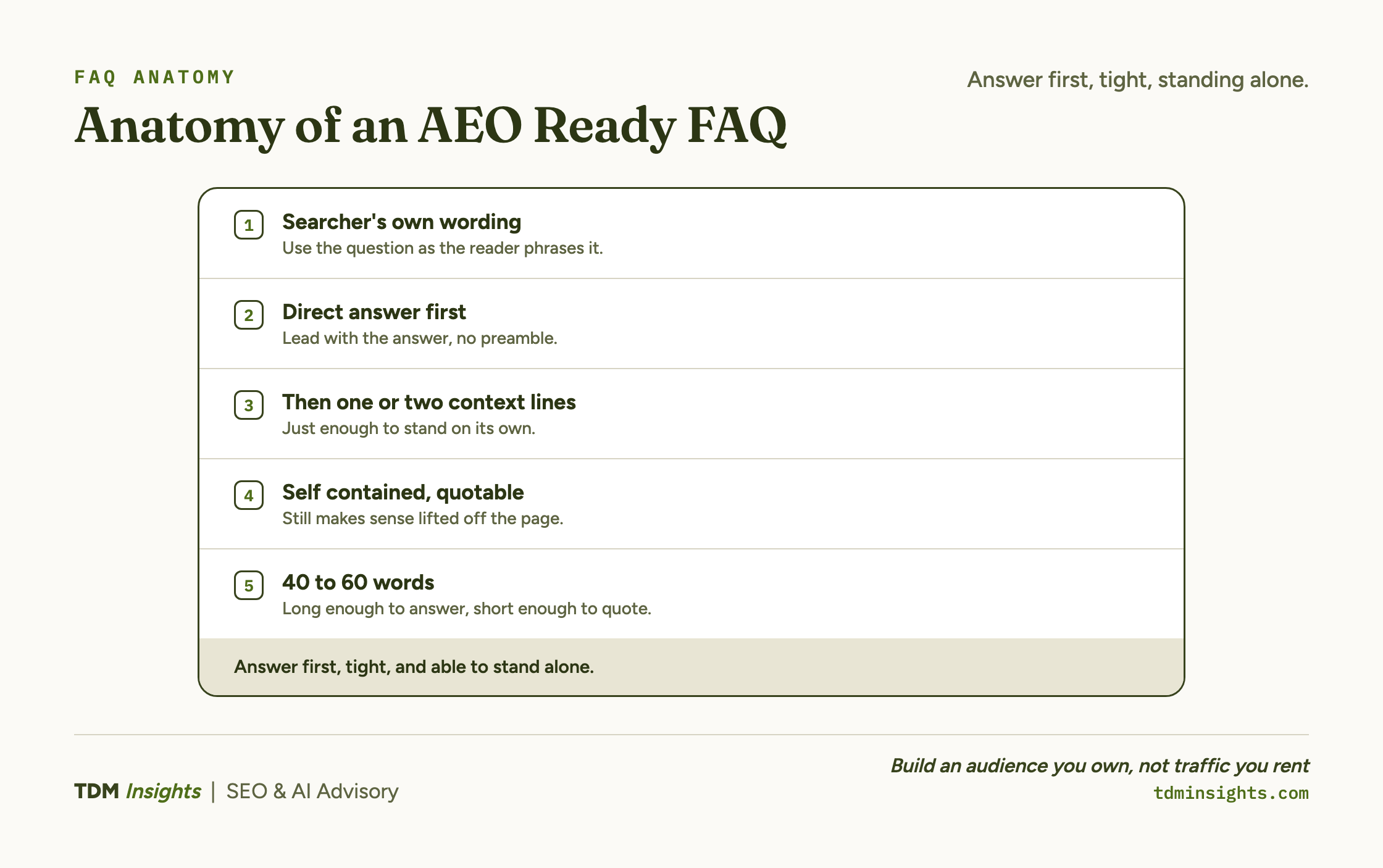
Lead with the direct answer in the first sentence. Do not warm up.
If the question is “how long should an answer be,” the first sentence says “40 to 60 words,” then you add the context. This answer-first structure is the single most important habit, because it is what lets a reader skim and an engine extract.
Then add one or two clarifying lines. Enough to make the answer self-contained, so it makes sense lifted out of the page with no surrounding context.
Yoast’s piece on the psychology of scannable content covers why chunked, front-loaded answers work for readers, and CMI’s guidance on making content more readable reinforces the same Q-and-A pattern. The discipline is consistent: answer first, keep it tight, make it stand alone.
Book a free diagnosis
If your articles rank but rarely get quoted in AI answers, the FAQ block is often where the citations are leaking: questions no one asks, answers buried under a windup, or no FAQ at all. A free diagnosis reviews a sample of your pages for extractable, answer-first FAQs sourced from real demand, and shows exactly where you are leaving citations on the table. It is a working session on your real content, not a sales call.
FAQ Section or More H2 Sections
Use both, for different jobs. They are not competing choices.
The practical division: if a point needs setup and development, it belongs in an H2. If it is a discrete question with a discrete answer, a definition, a quick comparison, a yes-or-no, it belongs in the FAQ.
This lets you target long-tail questions without padding the body or breaking its structure. Those discrete questions are often the objections standing between a reader and a decision, which is exactly the work of turning a reader into a customer.
A good FAQ is also itself on-page proof. A precise, well-sourced answer to a hard question demonstrates experience and expertise, not just convenience for the reader. That makes the FAQ a place to earn a citation and get quoted by ChatGPT, Perplexity, and AI, and a surface worth tracking when you learn how to measure AI traffic with no referrer.
How FAQs Feed AI and AEO
Well-built FAQs help answer-engine optimization for three concrete reasons.
First, the format mirrors how people query AI tools. People ask chatbots full questions, and a page already structured as questions and answers is pre-aligned with that input. HubSpot’s guidance on structuring pages for answer engines makes the case for question-based headings and extractable structure, and its broader answer engine optimization best practices tie question-and-answer content directly to AI discoverability.
Second, the answer-first, self-contained structure covered above is what makes a block easy to lift. An engine finds a quotable sentence faster in a 50-word answer-first block than in a paragraph buried mid-article.
Frase’s overview of FAQs for AI search and AEO covers how the FAQ content itself, not only the Schema.org FAQPage markup, feeds AI citation. If you do add the markup, confirm it parses with Google’s Rich Results Test before you publish.
Third, FAQs consolidate canonical answers in one place. When the same question is answered consistently across your site, you reduce contradictions, which raises the consistency and trust signals AI systems weigh when choosing a source. That consistency gets easier to hold the more deliberately you plan how many posts a topic needs to rank, so each new page reinforces the canonical answer instead of competing with it.
This guide covers writing FAQs as part of the article during the draft. What answer engine optimization actually is covers the schema and AI-Overview extraction side. For the why behind which pages get quoted at all, how AI answer engines choose their sources covers the selection mechanism.
How Many FAQs, and When to Stop
Five to eight FAQs works well for a typical blog post. That is enough to cover the real follow-up questions without bloating the page.
Quality beats count every time. Include only questions readers actually ask that the body does not already answer. Skip filler questions invented to reach a number, because a weak FAQ does the opposite of an extractable one: it signals padding to a reader and gives an engine nothing worth lifting.
The test for each candidate question is simple. Does a real person ask this, and does the article not already answer it cleanly. If both are yes, it earns a slot.
If either is no, cut it. The FAQ block is a production asset, so treat it with the same standard as the rest of the page: real demand, direct answers, nothing wasted.
Frequently Asked Questions
How do you write a good FAQ section for a blog post?
Write FAQs by collecting the real questions readers ask, then answering each one directly in the first sentence before adding brief context. Use the searcher’s own wording in the question heading, keep answers tight at around 40 to 60 words, and cover the edge cases your main article body cannot address cleanly.
Where should FAQ questions come from?
FAQ questions should come from real demand, not guesswork. Pull them from Google’s People Also Ask boxes, related-search suggestions, your site-search logs, sales and support tickets, and the actual phrasing customers use. These sources reveal the exact questions people type, so your answers match live queries instead of questions no one is asking.
How long should a FAQ answer be?
A FAQ answer should be roughly 40 to 60 words, long enough to answer fully and short enough to scan or quote. Lead with the direct answer in the first sentence, then add one or two clarifying lines. Concise, self-contained answers are easier for readers to scan and for AI engines to lift into a result.
Should you use an FAQ section or just add more H2 sections?
Use both, for different jobs. H2 sections carry the main narrative and deeper explanations; an FAQ section catches the specific, standalone questions that would interrupt that flow, such as definitions, pricing quirks, or quick yes-or-no queries. FAQs let you target long-tail questions without padding the body or breaking its structure.
Do FAQ sections help with AI and AEO?
Yes, well-built FAQs help answer-engine optimization. Question-and-answer formatting mirrors how people query AI tools, and self-contained answers are easy for engines to lift and cite. FAQs also consolidate canonical answers in one place, reducing contradictions across your pages, which raises the consistency and trust signals AI systems use when choosing sources to quote.
How many FAQs should a blog post have?
Five to eight FAQs works well for a typical blog post, enough to cover the real follow-up questions without bloating the page. Quality matters more than count: include only questions readers actually ask that the body does not already answer, and skip filler questions invented just to fill an FAQ block.
Continue Reading:
More On Content Production and Quality
- How to Produce Content That Ranks and Gets Cited
- How to Write a Content Brief (That Gets It Right)
- Writing for E-E-A-T: Prove Experience on the Page
- Use AI to Write Without Sounding Like AI
- How Long Should a Blog Post Be? Intent Over Count
More from TDM Insights
- Schema Markup for AI: Answer-First Writing Guide
- How to Get Cited by ChatGPT, Perplexity, and AI
- How to Measure AI Traffic With No Referrer
- Answer Engine Optimization: What AEO Actually Is
- How AI Answer Engines Choose Their Sources
Explore TDM Insights Categories