
The FAQ Block, Rebuilt for Answer Engines
Rebuild your FAQ block for AI extraction. Make each question a real query and each answer a self-contained unit engines can lift.
 By David Jubé · May 18, 2026 · 14 min read
When an answer engine builds a response, it lifts a single self-contained question and its answer as one unit, then drops that unit into the reply it shows the user. It does not read your FAQ block top to bottom and summarize the gist.
It scans for the one question that matches what the user asked, takes that question and its answer as a pair, and discards the rest of the page. That is the whole mechanism, and it changes what an FAQ block is for.
An FAQ written for a human to skim and an FAQ written to be quoted are not the same object, even when they use the same words. The human carries everything they have already read into the next answer.
The engine takes one answer in isolation. Write for the first reader and the second one finds nothing it can use.
Here is the answer-first version you can lift in one line: an FAQ block rebuilt for answer engines is a rack of pre-packaged answers, each one phrased as a real query and written to stand completely alone, so an engine can pull a single answer into a synthesized response and lose no meaning.
The rest of this article shows you the rules, then rebuilds one marketing-style FAQ answer into a liftable unit so you can see the edits.
This is the extraction side of the FAQ. For writing the FAQ answers well, finding the right questions, and shaping them into copy, see the production side in how to write FAQs that double as AEO fuel.
This article does not re-teach question-finding. It teaches the structure that makes a finished answer quotable.
Key takeaways
- An FAQ block rebuilt for answer engines is a rack of pre-packaged answers, each phrased as a real query and written to stand completely alone, so an engine can pull one answer into a synthesized response and lose no meaning.
- An engine lifts a single question-and-answer pair in isolation and discards the rest of the page, so any answer that leans on “as mentioned above,” a bare “yes,” or a “this” collapses the moment it travels.
- A liftable answer passes four rules: the direct answer in sentence one, self-contained with its subject named, roughly 40 to 60 words, and it clears the cold-read test when you read it with the page hidden.
- The question line does retrieval work too, so phrase each question the way a searcher actually types it, not as a marketing prompt like “Why choose us?”
- FAQPage schema still earns its place after Google dropped the visible rich result in May 2026: treat it as an extractability and AI-citation signal, mirror only visible content, and write the answer to pass the cold-read test before you add the markup.
The FAQ Block Is Already the Most Liftable Thing on Your Page
The FAQ block has a structural advantage no other section has. Each question is already phrased the way a person types a search, and each answer is already short.
An engine looking for a self-contained passage to quote finds the shape it wants pre-built. That advantage is also where the block usually wastes it.
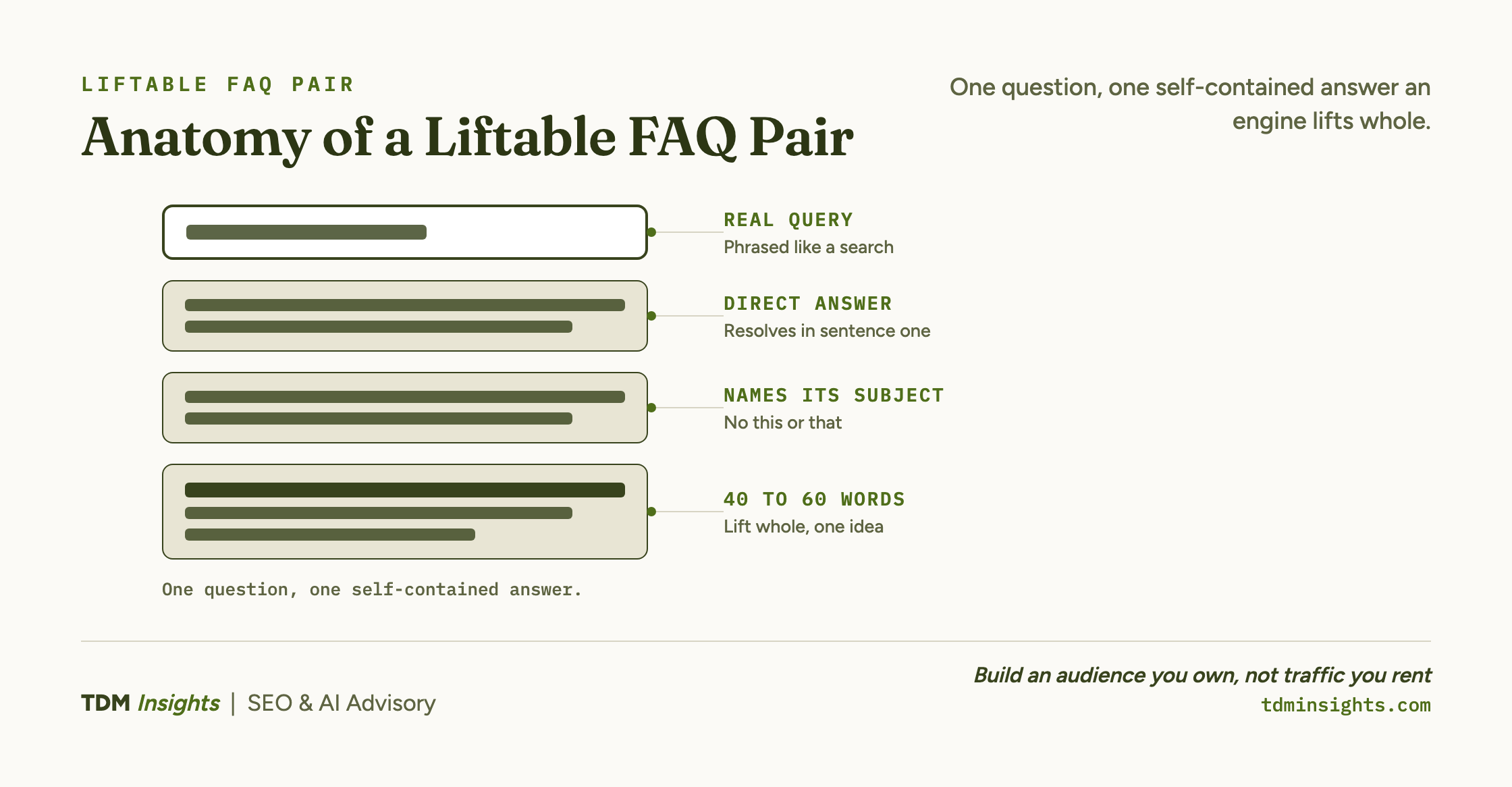
A typical FAQ answer is written to be read in order, top to bottom, by a human who has the rest of the page in their head. So it leans on context the page supplies, in ways that only hold while the answer stays put:
- “As mentioned above” points back at an answer the engine never sees.
- “This also applies here” leans on a “this” that vanishes once the answer travels alone.
- A bare “Yes” never names what the yes is about.
Pull one of those answers out alone and it stops making sense. The engine reaches for someone else’s, written plainly.
The waste is quiet, which is why it goes unfixed. The block looks fine on the page. A human reading it in order gets every answer, because they supply the missing context themselves without noticing.
You read your own block and it reads clean. The failure only shows when a machine takes one answer away from the page and the answer collapses. You are not watching when that happens.
The same front-loading discipline that snippet research has shown for years applies here: passages that resolve the question first get pulled. Ahrefs found in its featured-snippet study that the pages winning extracted passages were already ranking and already answering directly.
This is the Citation step the FAQ block serves, taken down to one question. An engine can find your page and trust your page and still skip your FAQ because no single answer survives being read cold. The block was right there, pre-shaped for quoting, and it lost the citation on the last yard.
Content FAQ vs AEO FAQ: Same Words, Different Job
A content FAQ and an AEO FAQ can read identically and do opposite work, because the job is different.
A content FAQ serves a reader already on the page, scrolling in sequence. It can lean on the question above it, reference the body copy, and trail off into a soft pitch, because the reader carries the context with them.
An AEO FAQ serves a parser that arrives with no context and leaves with one unit. It has to answer the question fully, in the first sentence, with nothing borrowed from the rest of the page.
The reader for an AEO FAQ is a machine that quotes you, then never reads the next line. That front-loaded structure is the same one NN/g calls the inverted pyramid: conclusion first, detail after, because scanners and parsers both read from the top and stop early.
The shift is from “answer the question for someone reading the page” to “package an answer that can be quoted away from the page.” Same six questions, often the same facts, a different finished object.
The difference is not tone or length. It is whether each answer carries its own context or borrows it from the page around it.
The fix costs nothing in reader experience. An answer rebuilt to stand alone reads just as well in sequence as it did before, so you give up nothing for the human and gain the unit a machine can lift. Structuring content so LLMs can extract it follows the same logic across every block on a page, not only the FAQ.
The Liftable-Answer Rules Fit on One Hand
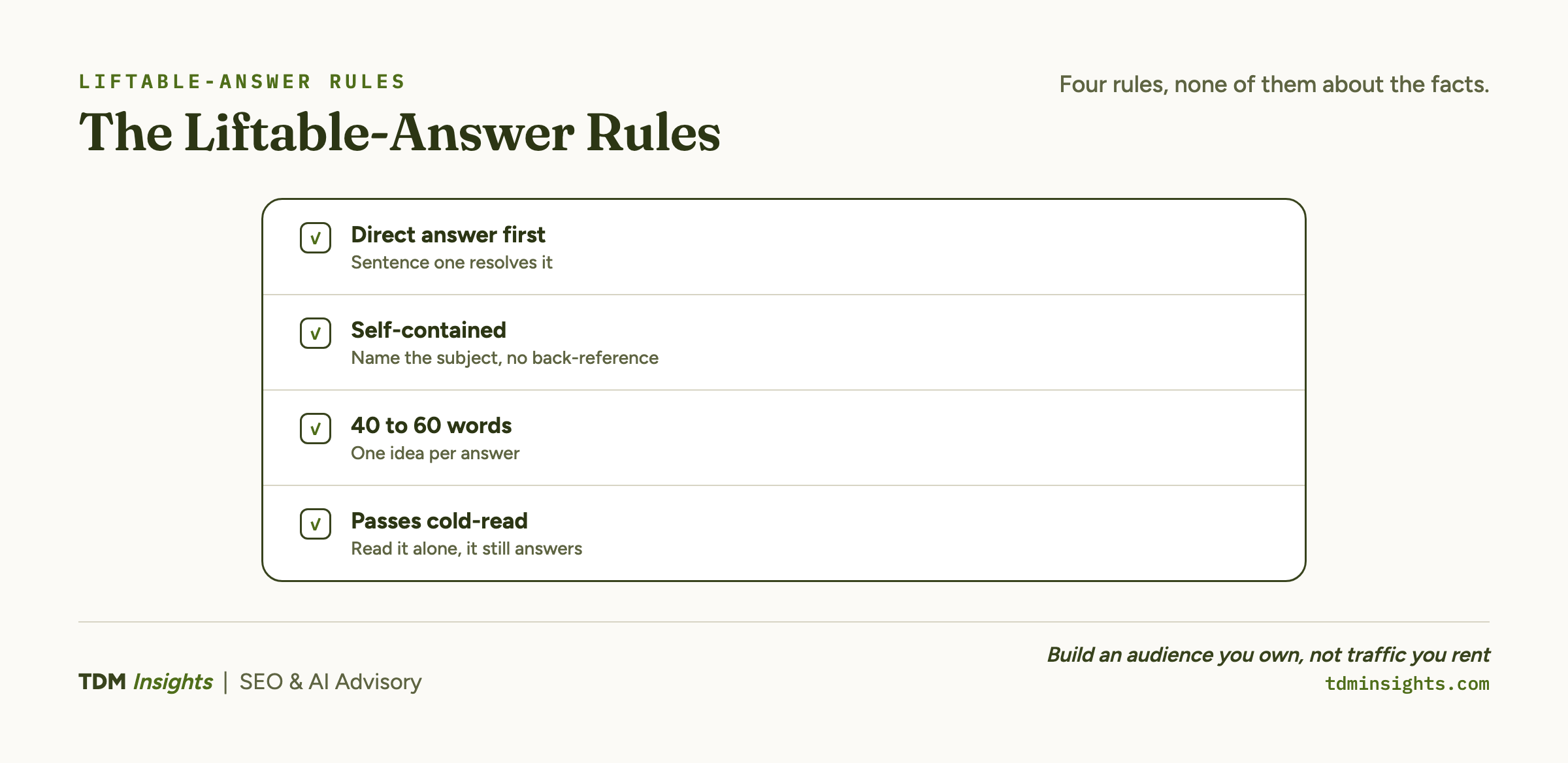
A liftable FAQ answer passes four rules. None of them is about the facts in the answer. All of them are about whether the answer can be read alone and still hold.
Direct answer in sentence one. The first sentence resolves the question. Not setup, not “great question,” not a definition of the topic. The answer. An engine that pulls sentence one alone should already have what the user asked for.
Self-contained. The answer names its own subject instead of pointing at it. No “this,” no “that approach,” no “as mentioned above,” no dependence on the answer before it. If a pronoun in sentence one refers to something outside the answer, replace it with the noun.
Roughly 40 to 60 words. Long enough to answer completely, short enough to lift whole. Featured snippets and AI answers tend to pull passages in this band, and Google’s own featured-snippet guidance describes the extracted passage as a short, self-contained answer rather than a long block. Answers under 30 words often read as incomplete. One idea per answer, so an engine never has to truncate mid-thought.
It passes the cold-read test. Read the answer with the question, out of context, with the rest of the page hidden. If it still fully answers, it is liftable. If you find yourself supplying context from memory, the engine cannot, and it will not.
The cold-read test is the one to keep. Cover the rest of the page, read the question and its answer alone, and ask one thing: did that fully answer the question, or did I fill a gap from memory?
If you filled a gap, the engine has no memory to fill it with, and the answer is not liftable yet. You can run it in ten seconds on any answer you have already written.
Book a free diagnosis
If your pages rank but the AI answers never quote your FAQ, the leak is almost always the cold-read test: each answer makes sense to you because you wrote the page, and not to an engine that sees one answer alone. We will run your priority FAQ blocks through the liftable-answer rules, founder to founder, and hand you the specific answers to rebuild first. No deck, no retainer pitch, just a clear read on which answers an engine can actually lift.
The Question Has to Be a Real Query, Not a Marketing Prompt
The question line does as much retrieval work as the answer. An engine matches the user’s phrasing against your question, so the question has to read like something a person actually types.
“Why choose us for your widget needs?” is a marketing prompt. Nobody searches it.
“How much does widget setup cost?” is a real query, and it is the one an engine can match. Phrase every question the way a searcher would, in their words, not yours.
That is the only point where finding the questions touches this article. The work of sourcing real queries and shaping the wording belongs to the production side of FAQ writing, linked above. Once you have the right questions, this article governs what you do with the answers.
FAQPage Schema Still Earns Its Place, Even After the Rich Result Went Away
Add FAQPage JSON-LD that mirrors your visible questions and answers exactly. The markup still earns its place, even though Google dropped the visible FAQ rich result in May 2026.
The rich result is gone. The schema type is not. It remains a valid schema.org vocabulary, Google has said it keeps parsing it to understand pages, and it labels each question and answer as a discrete unit a parser does not have to guess at.
Treat it as an extractability and AI-citation signal now, not as a play for a snippet that no longer renders. FAQ schema in the AI search era makes the same case for keeping it.
Two rules keep the markup clean:
- Mark up only what is visible. The JSON-LD must mirror the questions and answers a reader sees on the page.
- Use the type only for genuine questions. Never wrap promotional or non-question copy in it.
The structure is two nested entities: a schema.org Question holding one schema.org Answer, repeated per FAQ, all wrapped in a schema.org FAQPage container. Google’s FAQ structured data documentation carries the current handling and the deprecation notice in one place.
For the broader answer-first and schema overview this builds on, see the answer-first writing and schema guide.
The markup is the label, not the answer. Schema tells a parser where the question ends and the answer begins, which spares it from guessing at your HTML.
It does not make a buried or borrowed answer liftable. A valid FAQPage block wrapped around an “as we saw above” answer is still a unit that collapses when it travels. Write the answer to pass the cold-read test first, then add the markup that labels it.
Inside the Block Sits the Sentence Engines Quote
Each answer in a liftable FAQ block carries one sentence doing the real work: the first one, the direct answer. The block is a rack of these sentences, racked by question.
That sentence is its own craft. Writing the single answer engines lift verbatim, the one that gets quoted word for word anywhere on the page, FAQ or not, is the next tactic in this build. The FAQ block is where you practice it six times on one page, against six real queries, with the cold-read test on each.
Watch One Answer Get Rebuilt
Here is a real-shaped FAQ answer from a SaaS onboarding page, the kind written for a reader scrolling in order. The question is fine. The answer is not liftable.
Before:
How long does setup take? As you saw above, it depends on your plan. For most teams it’s pretty quick, and our onboarding specialists are with you the whole way to make sure it goes smoothly. We pride ourselves on a white-glove experience that sets us apart.
Run the cold-read test and it falls apart. “As you saw above” points at context the engine does not have. “It depends on your plan” defers instead of answering.
“Pretty quick” gives no number, and the last sentence is a pitch, not an answer. Pulled alone into an AI response, this unit tells a user nothing about setup time. At 41 words it is the right length and still useless, which is the point: length was never the problem.
Now the rebuild. The edits are mechanical:
- Cut the back-reference.
- Lead with the answer.
- Name the subject.
- Replace the vague claim with the actual range.
- Drop the pitch.
After:
How long does setup take? Setup takes most teams two to five business days, depending on plan tier and how much data you import. A starter workspace can be live the same day; an enterprise migration with custom integrations runs one to two weeks. An onboarding specialist works alongside you through every step, so the timeline holds even on the larger configurations.
Read that answer cold, with the page hidden, and it stands. The first sentence resolves the question with a real range.
It names its subject (“Setup”) instead of pointing back. It runs 52 words, inside the band, and the specialist detail now supports the answer instead of replacing it. Same facts the team already had, racked so an engine can lift this one unit and lose nothing.
That is the whole rebuild. You are not writing new content, you are repackaging answers you already have into units that survive being read alone. Run every answer in your block through the same four edits, then the cold-read test, and the block stops being skimming copy and starts being a citation surface.
Frequently Asked Questions
Does FAQ schema still work now that Google dropped FAQ rich results?
FAQPage schema still has value, even though Google retired the visible FAQ rich result in May 2026. The markup remains a valid schema.org type, and Google has said it will keep parsing it to understand pages. Treat FAQ schema as an extractability and AI-citation signal now, not as a rich-result play.
How is an FAQ for answer engines different from a normal FAQ?
A normal FAQ answers questions for a reader moving through the page in order. An AEO FAQ block is built for extraction: each question is phrased as a real search query, and each answer is self-contained, so an engine can lift one answer alone into a synthesized response without needing the rest of the page for context.
What makes a single FAQ answer liftable by AI?
A liftable answer leads with the direct answer in the first sentence, stays around 40 to 60 words, and stands completely on its own. It names its subject explicitly instead of using “this” or “as mentioned above,” and it does not depend on the answer before it. The cold-read test confirms it: read it alone and it still fully answers.
How long should each FAQ answer be for AI extraction?
Aim for roughly 40 to 60 words per answer, with the direct response in the opening sentence. Featured snippets and AI answers tend to pull passages in this range, and answers under 30 words often read as incomplete. Keep one idea per answer so an engine can lift it cleanly without truncating mid-thought.
How many FAQs should a page have?
There is no fixed number, but six well-chosen questions usually cover the real queries a page should own without padding. Each FAQ should map to a distinct question people actually search, not a restated keyword. Quality and self-containment matter far more than volume; ten thin, overlapping answers extract worse than six sharp ones.
How do I add FAQPage schema correctly?
Add FAQPage JSON-LD that mirrors the questions and answers visible on the page exactly, with each entry as a Question containing one Answer. Do not mark up content that is not visible to users, and do not use FAQ schema for promotional or non-question text. The markup must reflect real on-page FAQs, or it risks being ignored or flagged.
Continue Reading:
More On On-Page AEO:
- The On-Page AEO Playbook: Build Pages AI Quotes
- Entity SEO: How to Become a Known Thing to AI
- llms.txt Explained: Should Your Site Have One?
- How to Write a Definition AI Will Quote Verbatim
- Comparison Tables and Formats LLMs Love to Cite
More from TDM Insights:
- How to Write FAQs That Double as AEO Fuel
- How AI Answer Engines Choose Their Sources
- Schema Markup for AI: Answer-First Writing Guide
- How to Get Cited by ChatGPT, Perplexity, and AI
- Answer Engine Optimization: What AEO Actually Is
Explore TDM Insights Categories: