
Editing an AI First Draft to Match Search Intent
A model drafts the average of what already ranks. Here is how to test a page against its live results and edit it to answer the query.
 By David Jubé · Aug 7, 2026 · 13 min read
Your drafted pages are probably well written, well organised, and answering a question nobody typed into Google.
Before I started opening the live results ahead of the editing pass, I shipped drafts that answered the topic and missed the query. The pages read well and covered the subject fairly. They ranked nowhere, and the reason was the same every time: the draft explained what the thing is, while the searcher wanted to know which one to pick.
That gap closes with a check rather than a rewrite. Open the live results for the query, read what the ranking pages lead with, and edit the draft toward it. Search Intent: The Four Types That Decide Everything sorts out the categories and how to tell them apart. Journey position eleven of eighteen picks up later than that, with a draft already written and a decision to make about it.
Key takeaways
- A model drafts the average of what already ranks, and that average is a topic. A query is narrower, and the gap keeps competent pages invisible.
- The gap is mechanical, not moral. Producing the consensus of its training data is the tool working correctly, and the wrong output for a page that has to beat that consensus.
- Three tells give the diagnosis in a minute: the page defines before it answers, every section runs to the same length, and nowhere does it say which option to choose.
- The test is six steps against the live results and needs no tool. Compare what the top pages answer in their first screen against what your draft answers.
- The edit is a reordering rather than a rewrite, which is why supervising this step beats drafting the page by hand.
Your draft is competent, which is exactly why the problem hides
A bad draft announces itself. A fluent, careful draft pointed at the wrong question passes every review you would think to run, because those reviews grade quality and the quality is genuinely there.
Search grades something else. It grades whether this page is the best answer to one query, and a study of about 14 billion pages and the traffic they get puts a number on what competence alone earns, which is close to nothing. Being well written is the entry fee, not the result.
Journey position 10, Website Content Writer: The Point You Hand It Over, leaves you holding a stack of drafts and a note that a second reader changes the outcome. This is what that second reader looks for, and it is not typos. I draft with a model and have shipped pages carrying this exact fault. What changed was not my instincts. It was moving the check to before the edit rather than after the launch.
A first pass lands on the topic because the average of what ranks is a topic
Ask a model to write about a subject and it returns the consensus shape of everything written about that subject. Averaging contradictory sources produces even coverage and no point of view, and even coverage with no point of view is a topic.
A query is narrower than a topic, and the narrowing is where the reader is standing. “Project management software” is a topic. “Project management software for a two-person studio” is a person with a problem, a budget and a decision to make this week. The first has no answer to give. The second has exactly one, and the page that gives it takes the click.
Averaging also pulls a draft toward the pages that already exist, which is how something newly written reads like something familiar. Search engines have long-settled machinery for how near-duplicate pages are treated, and a page saying what six others said gives that machinery very little to work with. A ranking factors study across 16,298 keywords reads the same way from the other end. Pages at the top differ from the field, and an average sits in the middle of it.
Moving a draft off the average is the whole of the editing pass, and it starts with spotting which way the draft drifted.
Three tells you can see in your own draft in under a minute
The drift leaves three marks, and all three are visible on the screen in front of you without opening a tool. Each one carries its own edit.
Fix the first tell first, because it costs you the part of the page anyone actually reads. Demote the definition rather than deleting it. A tight definition is still the block an answer engine lifts, and How to Write a Definition AI Will Quote Verbatim is where that sentence gets built properly.
The second tell has a measurable shadow. A content study across 912 million blog posts found the great bulk of published posts earn no links at all, which is what evenly weighted coverage looks like from outside. Nothing in it is worth pointing at, so nobody points.
Founders resist the third tell hardest, and understandably, because a position can be wrong in public. A page with no position is safe from that. It is also unrankable for anything a buyer types, because a buyer is searching for somebody willing to say which one.
Book a free diagnosis
If you are holding drafted pages and cannot tell which answer the wrong question, that is the read I run first, against the results those pages have to beat. You get back which need the edit, which are aimed right, and which are two pages wearing one URL.
Testing a page against its live results takes six steps and no tools
The live results for a query are the intent already written down, by the only party that measures it at scale. Reading them takes a few minutes and replaces every guess in the editing pass.
- Name the one query the page is for. If you cannot pick one, the page is two pages, and that is the finding. Two of your pages chasing one query is what happens when two of your pages answer the same query, and splitting them now beats untangling them later.
- Open the live results in a clean window. Signed out, no personalisation, no history, because you want what a stranger sees.
- Record the format of the top results. Guides, comparisons, tools, product pages and forum threads answer different questions, so the dominant format is the one being rewarded.
- Record what the top results answer in their first screen. Not the title or the headings, but the sentence each leads with, because that is what the searcher is asking.
- Read what your draft answers in its first screen. Put the two sentences side by side, because that distance is the edit.
- Note the features on the results page. A definition panel, a block of questions and a shopping row each say what shape of answer wins.
Step 6 rewards slowing down. A block of related questions is intent evidence at no cost, and folding those questions into the page is the move in The FAQ Block, Rebuilt for Answer Engines. How to Read the SERP Before You Write a Word runs the longer version of the same read.
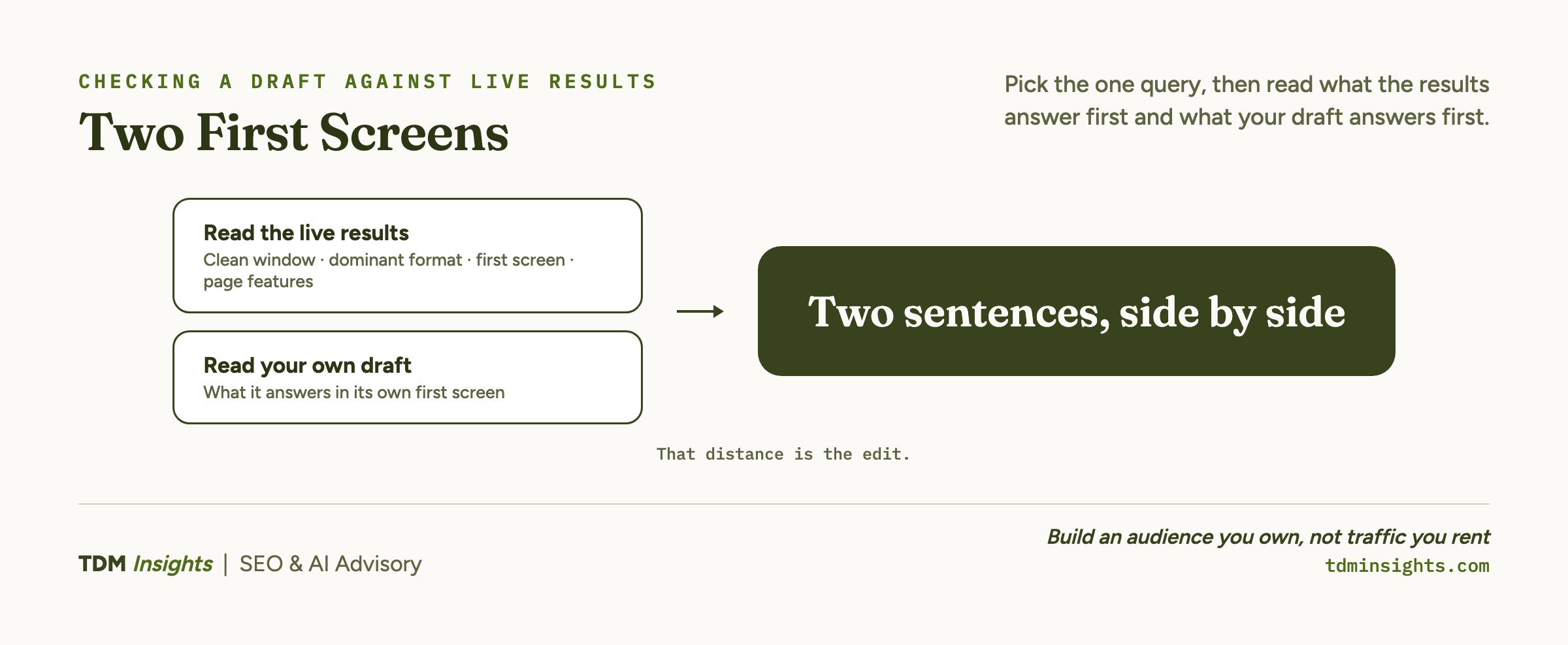
When the time is not there, read the first screen of your draft out loud, then the first screens of the top three live results. If your draft answers a different question from all three, it is aimed at a topic. That comparison also hands you the next thing to look at, because the top three tend to agree on shape before they agree on anything else.
Format is intent made visible, so read it before you read a word of copy
Shape is the fastest read available on a results page. Before you take in a sentence of anybody’s copy, the mix of guides, comparisons, tools and threads has already told you what kind of answer this query asks for.
STAT’s tracking of how the mix of result features shifts with the kind of query makes that concrete: change the modifier on the query and the furniture on the page changes with it. A page in the wrong format has lost before anyone reads it, and that cost is rising, because SparkToro’s measured click behaviour on the results page shows how much of the transaction now happens before a click exists at all.
A drafted page tends to arrive as an article, since articles are what the training material is made of. If the results are comparisons, yours has to become one. If they are landing pages, the copy changes at the level of the sentence, the distinction drawn in Landing Page Copy vs Blog Copy: The Difference. Format is the promise the page makes in its first screen, and no model could know which promise this particular query is asking for.
The edit is smaller than the rewrite you are bracing for
With the two first-screen sentences side by side, the work in front of you is reordering and reweighting rather than writing. Move the answer up. Demote the definition to a clause. Expand the one section that carries the query into the room you take back from the five that were padding the average. Add the position, and the basis it rests on.
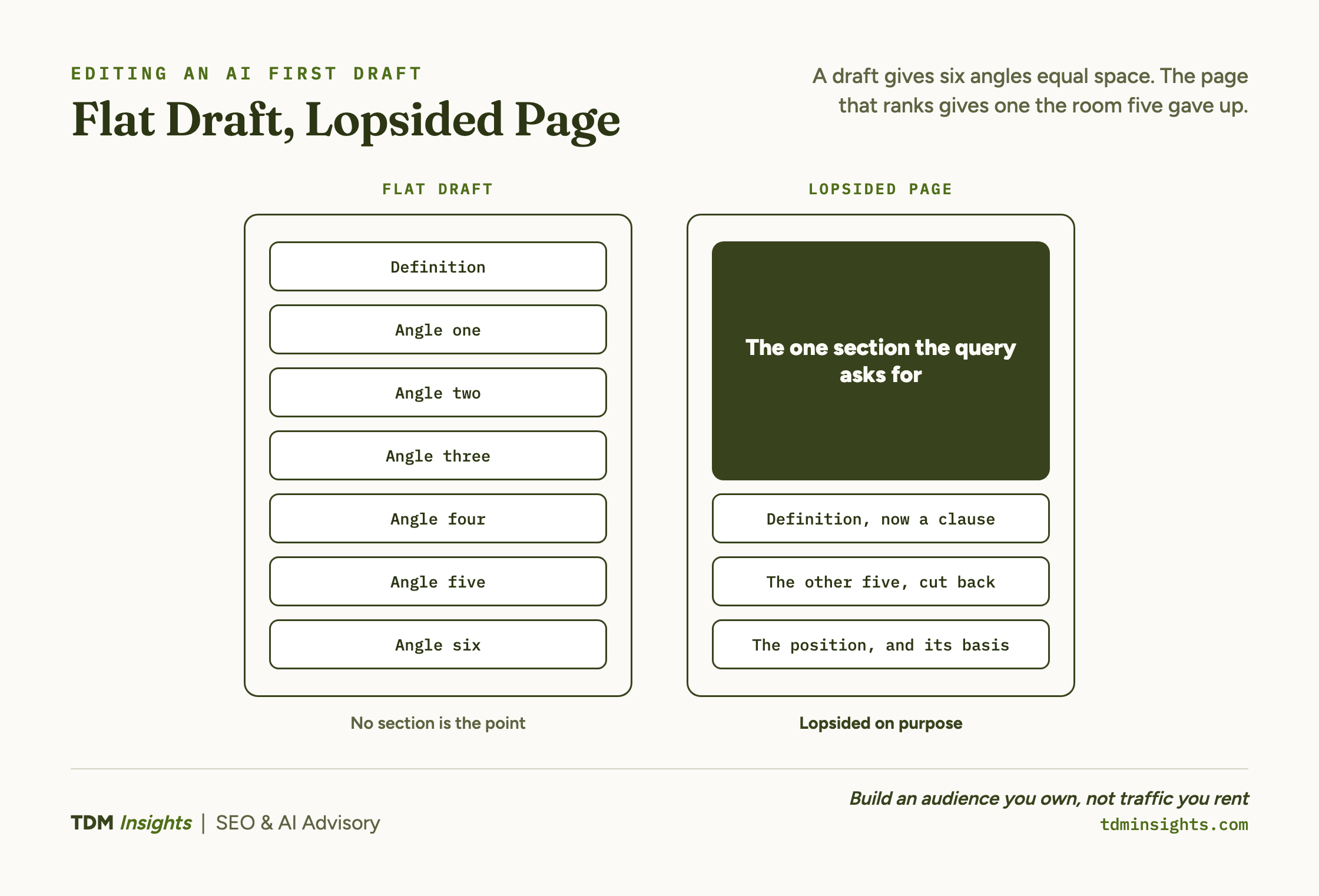
The research, the structure and the phrasing all survive that pass. That is the arithmetic behind supervising a draft instead of writing one from nothing.
Results stay uneven page to page. Organic traffic benchmarks by page show how lopsided page-level performance is on any site, so this edit removes a reason a page cannot rank rather than promising that it will. What it reliably does is put the page in the running for the query it was written for.
Once a page answers the query, being found is handled and being cited is not. Journey position 12, AI SEO: The Five Rungs That Decide If You Get Cited, is the next step, because the edit that satisfies a searcher is also what makes a passage liftable. SparkToro’s analysis of what a page has to earn on the results page is why those two goals have collapsed into one.
Put the intent in the brief and the next draft arrives closer
A model drafts toward whatever the brief points at. A brief naming a topic returns a topic. A brief naming the query, the reader behind it and the format the results reward returns something close to shippable, and journey position 7, AI Website Copy: Which Sentences to Keep and Cut, is where that brief gets written.
Engineering reached this conclusion first. Thoughtworks argues for review gates on generated output rather than unsupervised loops, on the grounds that the stopping point where a person decides is where the value gets added. Writing behaves the same way, and the live results are the cheapest gate available: no licence, no tooling, a few minutes a page.
So the target is not less drafting. It is one named checkpoint between the draft and the publish button. Publishing at volume without that checkpoint ships the average of what everyone else has already published, and the opening you are editing into is the distance between that average and one specific person’s question.
Frequently Asked Questions
How to analyze search intent?
Read the live results for the query rather than classifying the keyword. Open the top five in a clean window, note what format they take, and write down what each one answers in its first screen. That shared first-screen answer is the intent. Compare it against what your draft answers in its own first screen.
What are the three C’s of search intent?
Content type, content format and content angle, a framework Ahrefs published for reading a results page. Treat it as a reading instruction rather than a checklist. Type is the kind of page ranking, format is how that page is laid out, and angle is the promise its title makes. All three are read off the live results.
Why is my page not ranking on Google?
Usually because the page is answering a different question from the one being asked. Technical faults matter and are worth ruling out, but a competent, indexed, properly linked page that goes nowhere is normally aimed at the topic instead of the query. Compare its first screen against the first screen of the top three results.
Is AI-generated content bad for SEO?
No. A generated draft is a legitimate starting point, and a search engine judges the published page rather than how the first pass was produced. What costs the ranking is the draft’s habit of answering the topic instead of the query, because it reproduces the average of pages that already exist. Supervise that step and the draft holds.
How to edit AI-generated content?
Start by moving the answer to the query into the first two sentences and demoting the definition to a clause. Then give the section that genuinely answers the query the room the flat draft spread evenly, and add a position with the basis it rests on. Check the result against the live results before publishing.
How can I optimize my content for search intent?
Make the page lopsided on purpose. Find the one section that answers the query, give it the weight a flat draft spreads across every section, and cut the others back to what a reader still needs. Then match the format the top results take, because format is the first thing a searcher reads as an answer.
Continue Reading:
Previously in this series
- Website Content Writer: The Point You Hand It Over, what stays yours to run after you hand the writing over.
Next in this series
- AI SEO: The Five Rungs That Decide If You Get Cited, the standard a finished page has to clear before an answer engine will quote it.
From the library
- How to Produce Content That Ranks and Gets Cited, where this edit sits inside a brief, draft and proof system.
- How to Structure a Page to Rank and Get Cited, structure, which is the stage straight after this intent check.
- Use AI to Write Without Sounding Like AI, sentence-level tells that a structural edit like this one leaves untouched.
- How Long Should a Blog Post Be? Intent Over Count, each section’s length set by intent instead of a uniform count.
- Content Refresh: Win Back Rankings You Lost, running the same intent check against pages already live and slipping.
Explore TDM Insights Categories