
How to Write a Definition AI Will Quote Verbatim
Engineer the one sentence AI lifts word for word. Name the term, stay self-contained, place it right, and pass the cold-read test.
 By David Jubé · May 6, 2026 · 13 min read
The highest-impact object on a page built for AI is a single sentence: the definition an engine can lift word for word, attribute to you, and lose nothing.
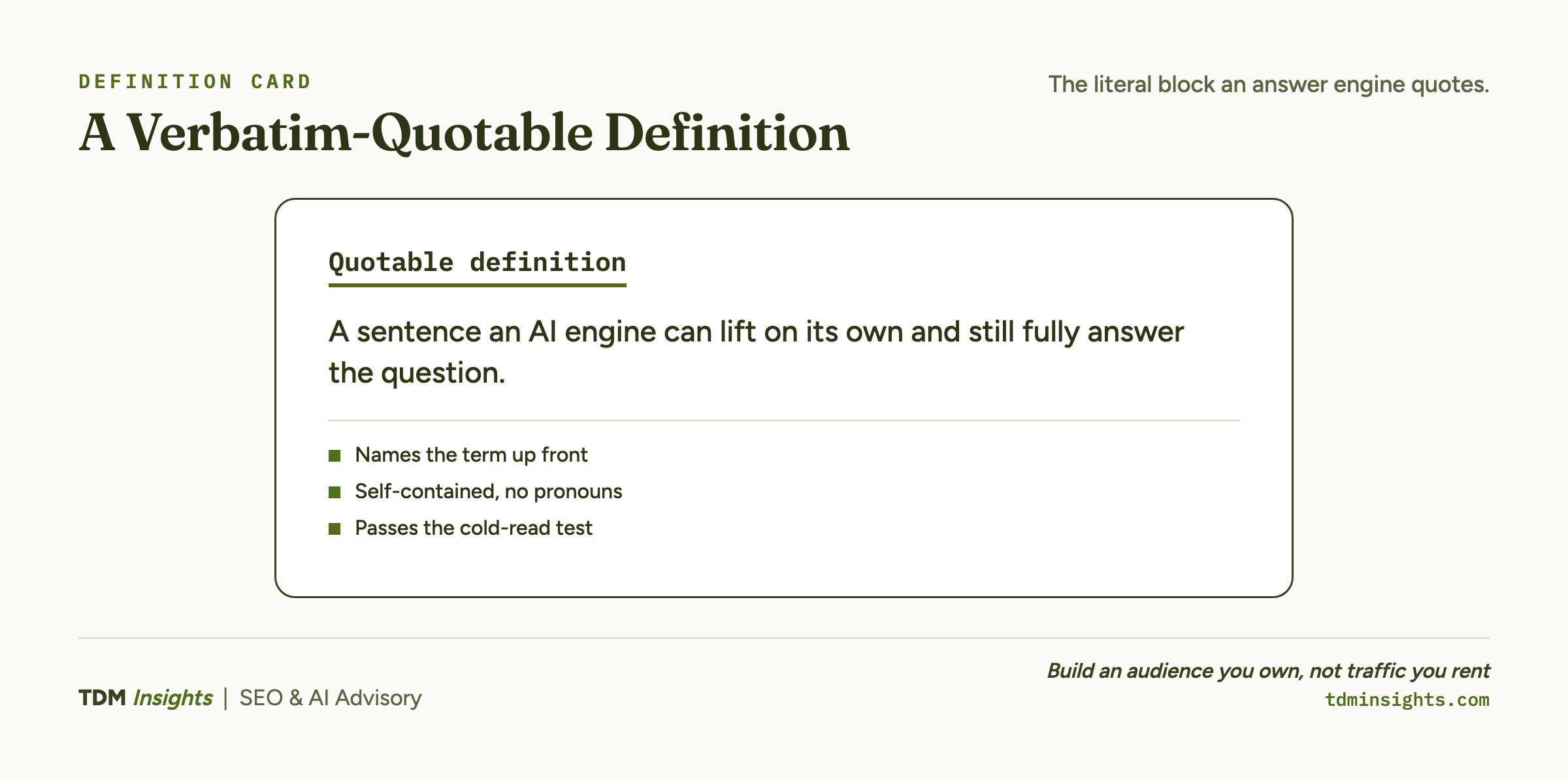
A definition is quotable when it answers the question completely on its own, names the thing explicitly rather than referring back to it, and does not borrow meaning from the sentence before it. That is the whole rule, and the rest of this article is how to write to it.
The test is one move. Read the sentence cold, with nothing around it, and ask whether it still fully answers the question. If it needs the paragraph above it, no engine will lift it.
Everything that follows is a way to pass that test on purpose instead of by luck.
Key takeaways
- A definition is quotable when it answers the question completely on its own, names the thing explicitly instead of referring back to it, and borrows no meaning from the sentence before it.
- The engine quotes a passage, not your page: at the Citation step the unit of selection is a single sentence, sometimes a pair, so the question is whether one line on the page survives being torn out of it.
- A verbatim-quotable definition carries three parts in order: the term named explicitly, the category it belongs to, and the one thing that sets it apart, with no pronoun standing in for the term.
- Hedging, pronouns that lean on prior sentences, and burying the answer below windup all make a correct answer un-liftable; commit to one claim, name the subject again, and front-load the answer in the first clause.
- Place the definition in the first 100 words right after the heading it answers and restate it where the term does its real work, then confirm it with the cold-read test: read it alone and check it still fully answers.
Why the sentence is the unit
An AI answer engine does not quote your page. It quotes a passage.
It retrieves several documents, judges which it trusts, then composes one answer by pulling the specific sentences that resolve the query. That last step is the Citation step from the model for how AI engines find, evaluate, and cite a source, and at the Citation step the unit of selection is small: a sentence, sometimes a pair. Google’s own guidance on how featured snippets are selected describes the same behavior on the classic search side, where a single passage is chosen to stand in for the page.
The engine is not summarizing your argument. It is shopping for a line it can drop into its own answer and stand behind.
So the question is not “is my page good.” It is “is there a sentence on this page that survives being torn out of it.” This is the operational core of the self-contained-claims idea in the answer-first and schema overview this drills into, taken down to the level where the work actually happens: the line itself.
Two pages of equal authority split here. The one whose definition reads cleanly out of context wins the citation. The one whose answer is correct but tangled loses it, and never finds out why.
Anatomy of a line an engine can lift
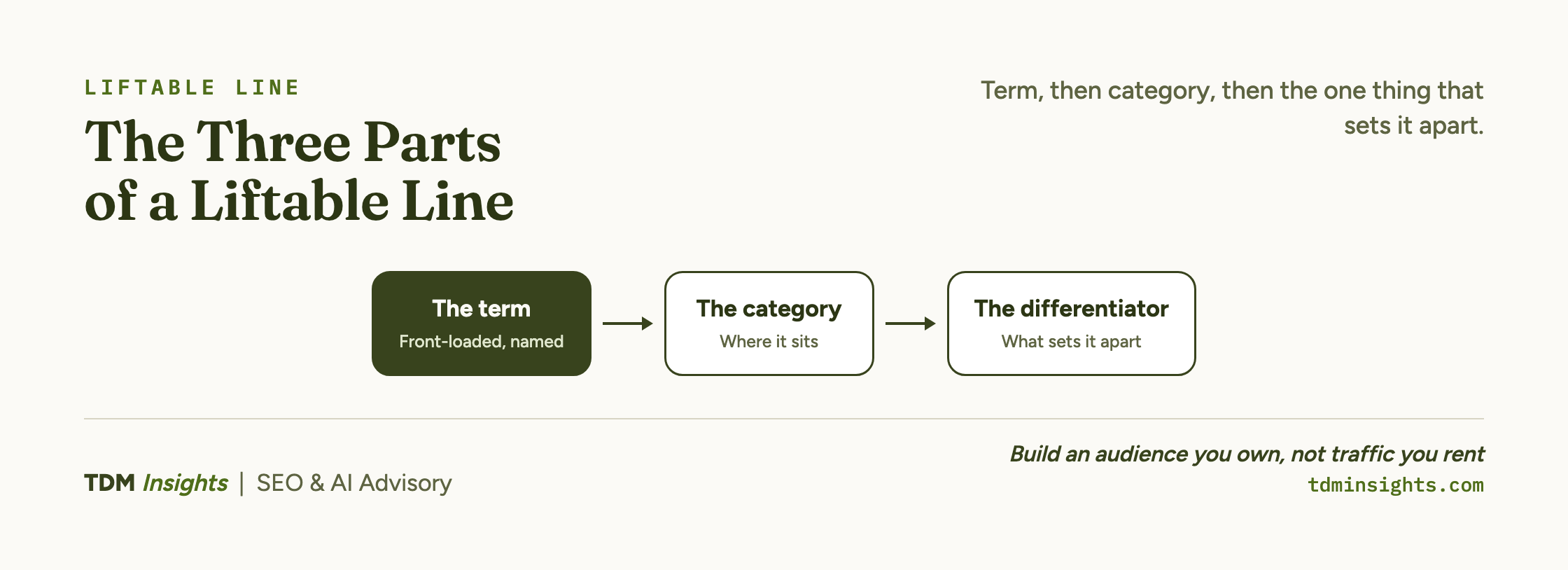
A verbatim-quotable definition carries three parts, in order:
- The term, named explicitly, so the engine knows what the line defines.
- The category it belongs to, so the term has a place to sit.
- The one thing that sets it apart, so the definition is yours and not a generic one.
No pronoun stands in for the term. No “this means,” and no leaning on the paragraph above.
That order is not stylistic. It is what lets a reader, or a parser, resolve the sentence in one pass. The pattern mirrors the inverted pyramid that newsrooms have used for a century: the most important information first, the supporting detail after.
Watch it work on a real before and after.
Hedged (not liftable): “Essentially, it’s kind of an approach that can, in many cases, help your content show up in AI answers, though results vary quite a bit depending on your situation.”
Rewritten (liftable): “Answer engine optimization (AEO) is the practice of structuring a page so an AI engine can lift a self-contained passage from it and cite that passage in its own answer.”
What changed, line by line: the term is front-loaded and named (“Answer engine optimization”) instead of hidden behind “it.” The hedges are gone (“kind of,” “in many cases,” “results vary”), because an engine cannot quote a sentence that refuses to commit.
“It depends” was cut, since a definition that depends on the reader’s situation is not a definition. The sentence now stands alone: it names its category (a practice) and its differentiator (lifting and citing a passage), so it answers in full with nothing around it.
The hedged version was not wrong. It was unquotable, which on an AI surface is the same as being invisible.
The dependency trap
The fastest way to make a good answer un-liftable is to make it lean on the sentence before it.
Pronouns are the usual culprit. “It,” “this,” “they,” “that approach,” “the second one” all point somewhere, and when an engine lifts the sentence, the thing they point at stays behind. The quote arrives meaningless.
Connective phrases do the same. “As we saw above,” “as mentioned,” and “building on the last point” each quietly chain the sentence to context the engine will not carry along.
Here is the trap closing on a correct answer.
Context-dependent (not liftable): “As we covered, this is what makes it so effective: it lets engines pull the passage without needing the rest.”
Read that cold.
What is “this”? What is “it”? The sentence is true on the page and useless off it.
Self-contained (liftable): “A self-contained passage is one that an AI engine can lift and quote without needing any other part of the page to make sense of it.”
The fix is mechanical:
- Name the subject again instead of pointing back at it.
- Keep one idea in the sentence.
- Cut the connective tissue that ties it to its neighbor.
It reads slightly more repetitive to someone going line by line. It reads correctly to the engine, and to the far larger number of people who scan rather than read every word, a behavior Nielsen Norman Group documented in eye-tracking studies of the web.
Burial is the same trap from a different angle: the answer is on the page, just not where the engine looks.
Buried (not liftable): “There are several factors worth weighing before you decide, and once you have thought through your goals and your audience, the right call usually becomes clear on its own.”
That sentence promises an answer and delivers a deferral. An engine scanning the top of the section finds nothing to quote and moves to a page that committed. The same instinct sits behind Google’s advice to write people-first, helpful content that answers the question directly: a page that resolves the query plainly is the page that gets surfaced.
Front-loaded (liftable): “A definition is liftable when an AI engine can quote it on its own and the quote still fully answers the question without the rest of the page.”
The answer now arrives in the first clause, named and complete, with the reasoning free to follow underneath for the reader who wants it. Front-loading is not a stylistic preference here. It is the only order an engine that stops reading the moment it has its answer can reward.
Here is the same set of traps and fixes from this article in one look, drawn straight from the rewrites above.
Where the quotable definition goes
Place the quotable definition in the first 100 words, right after the heading or question it answers, then restate it at the section that earns it.
Engines and featured snippets pull from passages that resolve the question immediately near the top of a page. A definition buried under three paragraphs of windup rarely gets lifted, however well it is written, because the engine has already found a cleaner answer somewhere shallower.
Portent’s study of the passage lengths engines and snippets pull found the lifted text tends to sit in a tight band. Ahrefs‘ large analysis of featured snippets found that snippet-winning pages usually already ranked near the top for the query. Together they make the practical case for one sharp sentence placed high rather than a slow build to the point.
Restating it once, at the H2 where the term does its real work, gives the engine a second clean shot at the same answer in a slightly different context. This page does exactly that: the definition of a quotable line opens the article and resurfaces here, both times built to be torn out.
Book a free diagnosis
The cold-read test is easy to describe and hard to apply to your own pages, because you wrote the paragraph above the sentence and your brain fills the gap an engine never will. If your answers read well in place yet never get lifted into an AI answer, the problem is almost always dependency hiding in plain sight. We will pull a sample of your key passages, run each one cold, founder to founder, and hand you a free diagnosis naming the exact sentences to rewrite first.
Does DefinedTerm schema help?
DefinedTerm schema can help engines recognize and label a term and its formal definition, which supports extraction and disambiguation. It does not force a citation, and it cannot rescue a buried or hedged sentence.
The markup describes a definition. It does not write one. If the sentence underneath the schema.org DefinedTerm type is still vague or context-dependent, the label points an engine at a passage it cannot use, which helps no one.
For a glossary of related terms, the schema.org DefinedTermSet type groups them, but the same rule holds: mark up a line that already passes the cold-read test, then let the schema make a good line easier to find.
This is the same order as the answer-first and schema overview this drills into: content first, label second. Reverse it and you are decorating a sentence no engine will quote.
The cold-read test, run for real
Copy the sentence out of the page. Read it with nothing around it.
If it still fully answers the question and names its subject without “this” or “as mentioned above,” an engine can lift it. If it only makes sense in context, rewrite it until it stands alone.
That is the entire quality gate, and it is worth running on every definition you ship. Conductor’s academy piece on where the quotable passage fits in answer engine optimization frames the same discipline from the engine’s side: the passages that get cited are the ones that resolve the query on their own. Backlinko’s practical guide to winning featured snippets makes the same point for classic search, where a clean, self-contained answer near the top is what gets pulled.
Run it three ways:
- Read the sentence alone for self-containment.
- Read it against the literal question to confirm it answers what was asked, not a nearby question you found easier.
- Read it for hedging, cutting any “can,” “may,” “in some cases,” or “it depends” that lets the sentence dodge the commitment a quote requires.
One quotable sentence is the unit. The next move is packing many of them into the formats that package many quotable units, where a comparison table or ranked list pre-extracts a dozen of these lines at once, and back inside the page itself sits the FAQ block full of these sentences, six questions each answered by a standalone line. All of it assembles into the full liftable-page checklist, the bench this sentence is built on, and all of it serves the Citation step this sentence wins.
Frequently Asked Questions
What makes a sentence quotable by an AI engine?
A sentence is quotable when it answers the question completely on its own, names its subject explicitly instead of using a pronoun, and does not depend on the sentence before it for meaning. Engines lift passages that stand alone, so a self-contained, direct sentence with no backward references is far more likely to be pulled.
How long should a quotable definition be?
Keep it to one sentence of roughly 25 to 50 words, long enough to name the term, its category, and what makes it distinct, but short enough to lift whole. Featured snippets and AI answers favor concise passages in this range. If you need two sentences, make the first one stand alone completely.
Where should I place the definition on the page?
Place the quotable definition in the first 100 words, right after the heading or question it answers, then restate it at the section that earns it. AI engines and snippets pull from passages that resolve the question immediately near the top, so a buried definition rarely gets lifted no matter how well written.
Does DefinedTerm schema help my definition get quoted?
DefinedTerm schema can help engines recognize and label a term and its formal definition, which supports extraction and disambiguation. It does not force a citation, though, and it cannot rescue a buried or hedged sentence. Mark up a definition that is already self-contained and answer-first on the page; the markup describes, it does not replace.
How do I test whether my definition is actually liftable?
Run the cold-read test: copy the sentence out of the page and read it with nothing around it. If it still fully answers the question and names its subject without “this” or “as mentioned above,” an engine can lift it. If it only makes sense in context, rewrite it to stand alone.
Why does answer-first writing matter for AI citation?
Answer-first writing puts the direct answer in the opening sentence, before context or backstory, mirroring the inverted pyramid. People scan rather than read, and parsers extract the same way, so front-loading the conclusion is what gets a passage pulled into a snippet or an AI answer. A buried answer is invisible to both.
Continue Reading:
More On On-Page AEO:
- The On-Page AEO Playbook: Build Pages AI Quotes
- Entity SEO: How to Become a Known Thing to AI
- llms.txt Explained: Should Your Site Have One?
- The FAQ Block, Rebuilt for Answer Engines
- Comparison Tables and Formats LLMs Love to Cite
More from TDM Insights:
- How AI Answer Engines Choose Their Sources
- Schema Markup for AI: Answer-First Writing Guide
- How to Get Cited by Perplexity
- Content That Ranks and Gets Cited by AI
- Answer Engine Optimization: What AEO Actually Is
Explore TDM Insights Categories: