
AI SEO: The Five Rungs That Decide If You Get Cited
AI SEO has two halves. Production is solved, citation is a design standard. See the four conditions a new site has to satisfy first.
 By David Jubé · Aug 4, 2026 · 16 min read
AI SEO is two jobs wearing one name, and only one of them is solved.
Production is the first job: drafting, generating, outlining, filling meta fields, shipping a whole site in a weekend. Production is solved. It is cheap, it is fast, and it is still improving.
Citation is the second job. Being the source an answer engine names when somebody asks a question in your category. Nothing you install produces it, because it rests on evidence sitting outside your site and on facts only you can supply.
Google’s guidance says to make content for people first, and answer engines behave the same way in what they lift to quote. AI shortens the distance to that standard. It does not lower the standard, and it does not tell you when you have met it.
Journey position twelve of eighteen opens the BE CITED stage, where the question changes from whether your pages are good to whether anything will name them.
Key takeaways
- AI SEO covers two jobs. Production is finished work, and citation is a standard that work has to clear.
- Production is genuinely good now, and saying otherwise wastes the largest cost reduction a new site has.
- Citation runs on four conditions in fixed order: Existence, Corroboration, Distinctiveness, Structure. Call it the Citability Ladder.
- Rungs one and four are mechanical. Rungs two and three need a person who knows things the tooling cannot look up.
- Every rung fails with the same symptom, which is nothing citing you. Diagnosing the wrong one costs a season.
What the two AI SEO jobs each produce on a new site
Say the term to two founders and one pictures a draft appearing in thirty seconds while the other pictures their own name inside somebody else’s answer. The pages ranking for the term serve the first founder a tool list and leave the second one standing there.
The second job matters more than it used to, because the surface where answers appear has grown. Pew’s data on how many people use AI chatbots puts chatbot use in the mainstream of American adults, and that surface keeps moving underneath everyone. There is reporting on how often AI Overviews appear tracking Google dialling their frequency back after an earlier expansion, which is why What the AEO Evidence Actually Shows Right Now is the posture to read any of this in.
The job underneath does not move. When an engine answers, it names sources, and the only question that matters for a new site is whether anything gives it a reason to name yours. The tool you buy is not that reason. SEO and AI Visibility Tracking Tools, Compared sorts the trackers out, and on a site with no history a tracker measures an absence you can already describe from memory.
Production is genuinely good now, and pretending otherwise costs you
Generated drafting is not a compromise you tolerate. On a new site it is the largest available reduction in cost-to-publish, and treating it as second best throws that reduction away for nothing in return.
What generation reliably does well
A model handles the work that is structural rather than evidential. Outlines against a brief. First drafts of pages you have written twenty versions of before. Meta fields, alt text, internal link suggestions, schema scaffolding, comparison tables rebuilt from your notes. It does those consistently, at a standard that clears publication after a review pass.
That review pass separates two activities people keep filing under one word. Supervised use puts a person between the output and the reader, and unsupervised automation at scale does not. The risk attaches to the second one.
Why the means of production is not what gets judged
Google’s stated position on AI-generated content says the reward goes to content produced for people, however it was produced, and that automation used to game rankings is what the spam policies address.
That cuts both ways. It removes the anxiety about drafting with a model, and it removes the hope that drafting with a model is itself a ranking strategy.
The quality question was never about the keyboard. It is whether the finished page is worth a person’s time, and a yes to that gets you a good page rather than a cited one. Use the tools hard on production, then start the second job, which nothing you installed has touched.
Citation is a standard rather than a feature, and standards do not move when supply gets cheap
A feature is something you buy and switch on. A standard is a bar the finished thing clears, and it does not lower itself because clearing it got easier for everybody at once.
Cheap production made the pool of competent pages much larger, which raises the value of whatever separates one page from the rest of that pool. Web.dev on the page-level signals Search uses describes ranking as a judgement about which page best serves the person behind the query, and nothing in that judgement is satisfied by volume. SparkToro’s zero-click search data shows fewer than a third of Google searches ending in a click, so the answer itself has become the destination and being named inside it is the win.
If you arrived from journey position 11, Editing an AI First Draft to Match Search Intent, you have just made a drafted page answer the query somebody typed. That work is rung zero: necessary, and no predictor of whether anything names you. A page matching no intent never reaches the ladder at all, so do that first if it is still outstanding.
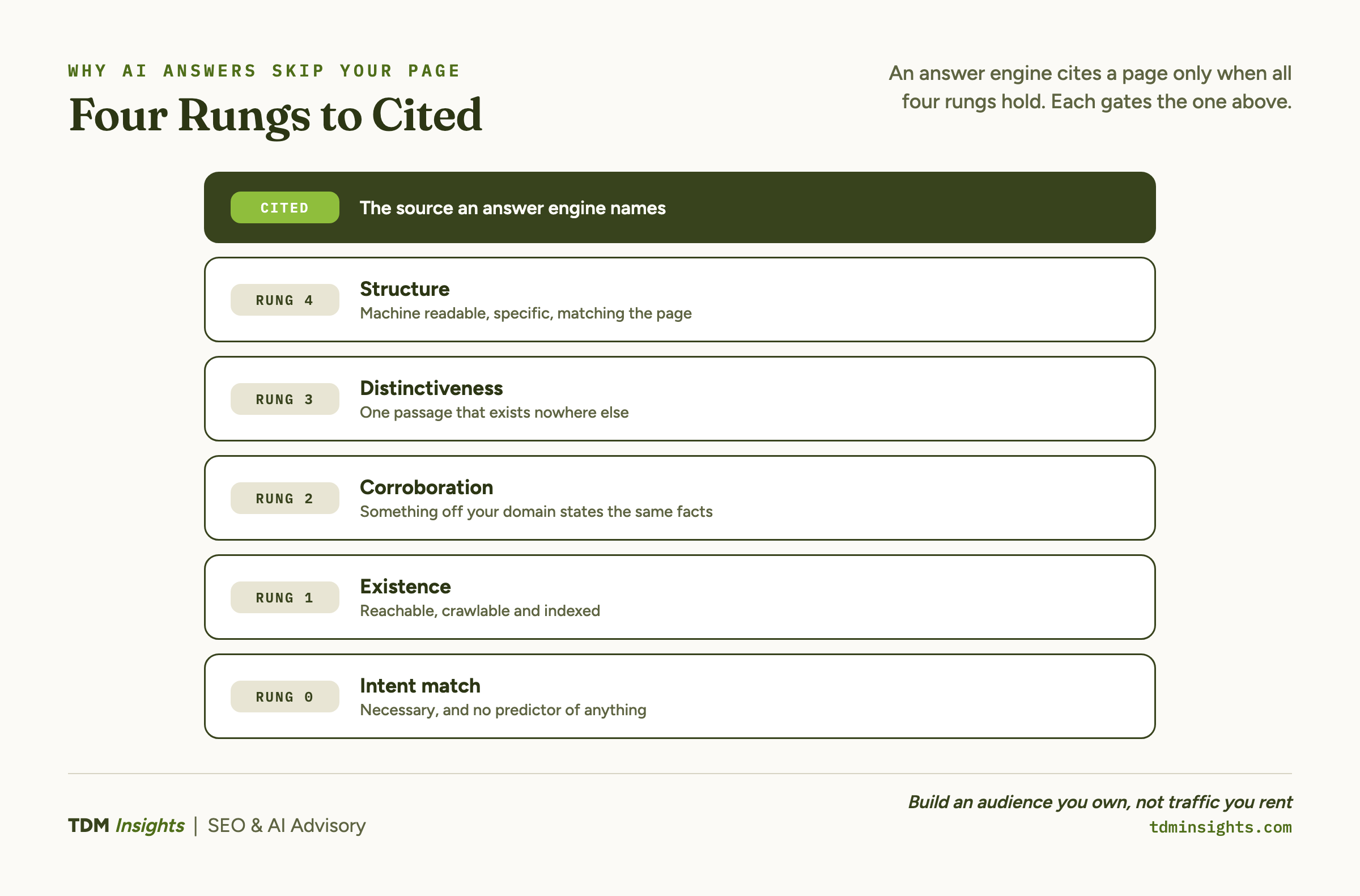
Four conditions sit on top of intent matching, in order, each observable on your own site today.
- Existence. The page is reachable, crawlable and indexed, and you are not blocking the crawlers that feed answer engines.
- Corroboration. Something outside your domain states the same facts about you that your site states.
- Distinctiveness. The page contains at least one passage that exists nowhere else.
- Structure. The facts on the page are machine readable, specific, and consistent with what a reader sees.
Call it the Citability Ladder. Each rung gates the one above it, which is why the order is not a preference, and the five articles that finish the BE CITED stage take one rung each.
None of it turns on which label you file the work under. Answer Engine Optimization: What AEO Actually Is defines the category, and GEO vs SEO vs AEO vs LLMO: What They Mean sorts the names out.
Existence is the cheapest rung, and your build has probably cleared it already
Rung one is binary and boring, which is why it gets skipped, and occasionally why it turns out to be the whole answer.
What passing looks like
The page returns a 200, it is not blocked in robots.txt, it carries a self-referencing canonical, and Search Console shows it indexed rather than discovered or excluded.
Then there is the check that did not exist five years ago: whether the crawlers feeding answer engines are allowed through. Cloudflare Radar’s data on AI crawler activity breaks that traffic out by purpose and industry, and shows it arriving under distinct user agents from the classic search crawlers. A blanket block or an over-eager firewall rule shuts those agents out while your Google indexing looks perfectly healthy, so the dashboard you check every week reports nothing wrong.
Reading the coverage state
Open Search Console, filter to the page, read the coverage state.
If the page is not indexed, stop there. No evidence, distinctiveness or markup will be read by anything until that changes.
If it is indexed, rung one is done and stays done, and the next rung is the one that does not live on your site at all.
Corroboration is the rung a new site fails first, and no amount of writing touches it
Here is the arithmetic of a brand new site. Exactly one source on the public web asserts that your business exists, does what it says, and is any good at it, and that source is you. An engine assembling an answer wants facts it can hold with confidence, and a single self-asserted source is the weakest available basis for that.
Why better copy cannot fix this rung
Rewrite the page as well as you like. The claim still comes from the domain that made it the first time, and phrasing does not change the count of independent sources.
Production cannot help on this rung, because the work sits off your site. Directory records, an industry association listing, a supplier or partner page, a local press mention, a founder quoted somewhere with the business named, a review platform filled in. Consistency across them does the real work, because the same business name, the same address format and the same URL are what let an engine treat six scattered records as one company rather than six near-matches.
What being named is actually worth
Semrush’s study of AI search visitors tracks how the traffic mix is shifting and what visitors arriving from AI surfaces do differently once they land. A reader who arrives having already seen you named arrives further along, and that head start is what makes a season of unglamorous listing work pay for itself.
Start with the rung that breaks first
Corroboration is the rung a new site fails before any other, and the one founders diagnose last, because it does not live on their site. Journey position 14, SEO for AI Search When Nothing Else Mentions You Yet, takes that rung on its own and gives you the order to work it in.
If you would rather have somebody name the failing rung before you spend the season, that is the read I run first.
Accurate is not the same as quotable, and the gap between them is distinctiveness
Rung three surprises people, because a page failing it is not wrong about anything. It is correct, well organised, and interchangeable with forty others.
An unreviewed draft defaults to the accurate general statement. Consensus is what averaging sources produces, and the consensus is the part that is already everywhere. The specifics are the part nobody supplied.
Two ways a page ends up interchangeable
The first failure is at sentence level. Nobody attached the number, the date, the named constraint or the first-hand result, so every claim is one anyone in the category could have made. Journey position 13, AI Generated Content SEO: Four Kinds of Evidence, takes that failure apart on its own.
The second failure is at template level. The copy carries specifics and the frame around it does not, because the section order, the headings, the layout and the schema are a tooling default shared with every other site built the same way. Both failures end in the same place: nothing an engine could lift and attribute to you rather than to the field.
The passage test
NN/g’s research on reading behavior in AI answers describes how people move through generated answers and what makes them follow a source rather than stop at the summary. Applied to your own page, that comes down to one question.
Find the passage a stranger would quote, then ask whether the sentence around it could run unchanged on a competitor’s site. If it could, the page is accurate and not quotable, and the fix is a person adding what only they know. Getting those specifics onto the page is half the job, and stating them in a form a machine can read is the other half.
Structure fails quietly, because present markup and specific markup look identical from outside
Every modern build emits structured data. That is the trap on rung four: the validator goes green, the dashboard says schema is handled, and the markup describes a category rather than a business.
An Organization block naming your business and nothing else is present. One carrying your real address, your actual URL, your verified profiles and the services you sell is specific. Only the second gives an engine anything it can attach to you.
What a default emits versus what a description contains
Defaults populate the required fields, because required is what a template can safely guess. They leave the optional fields empty, and the optional fields are where the description lives.
The same holds for article, product, service, review and FAQ markup. The type is right, the identifying detail is missing, and no validator flags it, because a validator checks syntax rather than substance.
Consistency between markup and page
OpenAI’s documentation on how ChatGPT search sources answers describes retrieval that returns sources alongside the answer and cites them back to the reader, and How AI Answer Engines Choose Their Sources covers the selection side of the same behaviour. What follows for your markup is short. It has to match what a person reads on the page, and it has to say something nobody could guess from your category alone.
Which rung is actually failing, and why guessing wrong costs you a season
All four failures present the same symptom. Nothing cites you.
Read that symptom as corroboration when the real gap is distinctiveness, and you spend months chasing mentions for a page with nothing quotable in it. Read it as distinctiveness when the page was never indexed, and you write excellent evidence that nothing ever crawls. The diagnosis is worth more than any single fix it points to.
What to run on your own page
Work them in that order, because each rung gates the next. There is no point supplying evidence to a page nothing crawls, or chasing mentions for a page that bores the reader those mentions send.
Which page to run this against first
Run the ladder page by page, because a site-level verdict hides the places where the answer differs. Start with the pages carrying demand rather than the posts creating it, the dependency order set out in journey position 5, Website Content Writing for SEO: The Four Rung Ladder.
Then set expectations for what clearing the ladder produces. Ahrefs’ measurement of AI referral traffic reports AI referrals arriving in small volumes and converting at a notably higher rate than organic search. That is not a firehose. It is a steady stream of people who arrive already told that you are the answer, and getting the diagnosis right is what decides whether the season behind it is the one that pays.
Frequently Asked Questions
What is AI SEO called now?
AI SEO travels under several labels: generative engine optimization, answer engine optimization, LLM optimization, and AI visibility. None has won, and the argument over naming changes nothing operational. Whichever label you adopt, the page still has to be reachable, corroborated off your own domain, specific, and marked up. Pick one and move on.
Which AI is best for SEO?
Tool choice is not the binding constraint on a site with no history. Any current assistant drafts, outlines and fills structured fields well enough to clear the production job. What decides citation is whether anything off your domain corroborates you and whether your pages carry specifics. Compare tools once those two hold.
Does AI SEO really work?
AI SEO works for production and does not, on its own, produce citation. Generation reliably gets pages drafted, structured and shipped faster than writing them by hand. Being named as a source is a standard the finished page has to meet, and it turns on evidence and specificity rather than on how the draft was produced.
Is AI making SEO obsolete?
AI is not making SEO obsolete, judging by what the engines actually output. Generated answers still name their sources, still link them, and still send readers through. What changed is that fewer results end in a click, so the value moved toward being the source named inside the answer rather than a listing under it.
How is AI changing SEO?
AI changed the supply side of SEO for a new site rather than the standard. Drafting, structuring and shipping pages got cheap, so a site with no history can now publish at a volume that used to need a team. The bar for being cited did not move, which is why competent new sites still go unnamed.
How much time does Google take to index a new website?
Google publishes no fixed timeline for indexing a new website. What you can observe is your own Search Console coverage report, which tells you which URLs are discovered, crawled and indexed. Watch that rather than counting days. Indexing is rung one of four, and clearing it predicts nothing about being cited.
Continue Reading:
Previously in this series
- Editing an AI First Draft to Match Search Intent, the intent edit that gets a page ranking, which comes before citation is worth thinking about.
Next in this series
- AI Generated Content SEO: Four Kinds of Evidence, the evidence a passage has to carry, which is the part of the ladder you cannot automate.
From the library
- The On-Page AEO Playbook: Build Pages AI Quotes, turning these rungs into a single build checklist.
- How to Get Cited by ChatGPT, Perplexity, and AI, per-engine tactics worth running once every rung is cleared.
- How Each AI Engine Picks Sources to Cite, how retrieval and evaluation differ from one engine to the next.
- Comparison Tables and Formats LLMs Love to Cite, a table format that clears the Structure rung in practice.
Explore TDM Insights Categories