
How Many Blog Posts Do You Need to Rank?
Post count is the wrong target. Coverage equals your distinct buyer questions. Here is how to find your actual number.
 By David Jubé · May 16, 2026 · 13 min read
There is no universal number.
The count of blog posts you need to rank is not a quota you hit. It equals the number of distinct questions your buyers actually ask on the way to choosing you, and that figure is different for every business.
A narrow niche can be covered in twenty thorough articles. A wide one can require well over a hundred.
The honest answer that most ranking pages avoid is that the number is an output of mapping your topic, never a target you pick first and chase.
That reframe matters because the wrong question leads to wasted work. Founders ask “how many posts,” get told “publish ten to fifteen and you’ll start ranking,” follow it, and rank for nothing.
The articles answered no real question, covered no topic completely, and sat in isolation.
Below is the method that works instead. Call it the Coverage Map: it derives your real number from your buyers rather than from a borrowed benchmark.
Key takeaways
- There is no universal number of blog posts; the count you need equals the distinct questions your buyers actually ask on the way to choosing you.
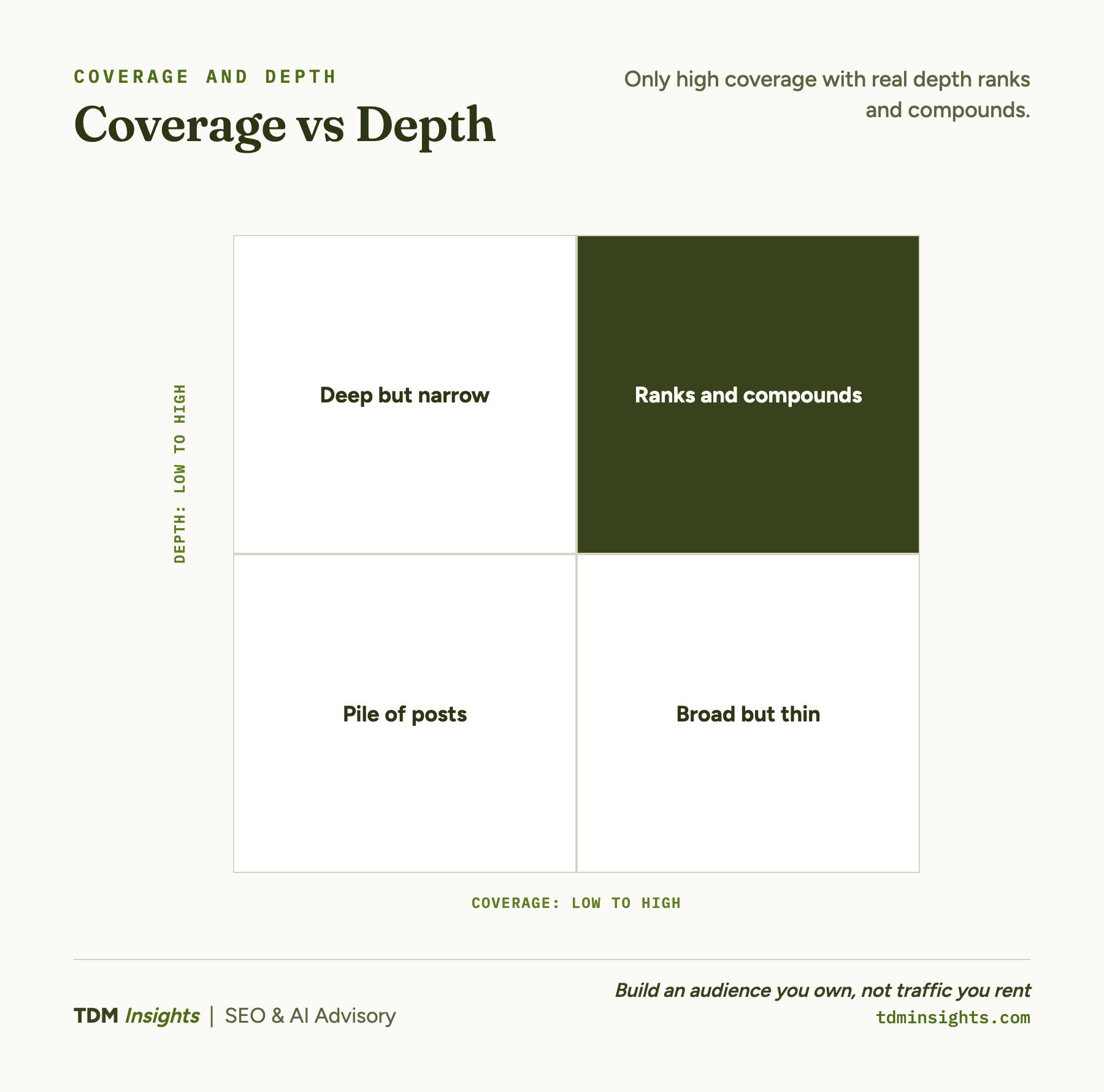
- Rankings are driven by coverage and depth, not raw volume, so ten thorough articles that answer real questions beat fifty thin ones chasing a count.
- The Coverage Map derives your number from buyers: list every distinct buyer question, group the questions into clusters, plan one article per genuine question, and count what is left.
- A narrow niche can be covered in twenty thorough articles while a wide one can require well over a hundred, because the figure describes the size of your question-space.
- The post count is an output of mapping your topic, never a target you pick first and chase.
Why “how many posts” is the wrong question
The premise behind the question is that ranking is a function of volume: publish enough and you win. It is not.
Ranking is a function of coverage and depth. Google rewards the site that answers a topic most completely and most helpfully, not the one that posted the most.
This is visible in the data. Backlinko’s analysis of 912 million blog posts found that the typical post gets very little traffic or links, and that the pieces that perform are the thorough, well-promoted ones, not the high-frequency ones. Raw output is not the lever.
The same conclusion shows up when you look at what actually ranks over time: Ahrefs’ study on how long ranking takes found that the vast majority of pages never reach the top of Google at all, and the ones that do are usually older and have accumulated authority. Volume alone does not move them there.
So the question “how many posts do I need” quietly smuggles in a false model of how search works.
The better question is “how many distinct buyer questions exist in my topic, and have I answered each one well?” Answer that, and the post count falls out of the work. It is derived, not guessed.
What actually drives rankings: coverage and depth
Two things drive organic rankings far more than count: coverage and depth.
Coverage is breadth. It means you have an article for every distinct question a buyer asks across your topic, so a searcher with any of those questions can find you.
When whole question-spaces are missing, whole segments of demand never see you, no matter how many posts you have published on the parts you did cover.
Depth is how completely and credibly each article answers its question. A thin 400-word post that skims a question loses to a thorough one that resolves it, adds context, and demonstrates real experience.
This is the helpfulness signal Google leans on, and it is why ten thorough articles that cover real questions outperform fifty thin ones chasing volume.
Coverage and depth reinforce each other. As you cover more of a topic with genuinely deep articles, you build topical authority, the accumulated signal that you are a credible source on the whole subject.
That authority then makes each new article on the topic easier to rank than the last, and it is reinforced by the earned backlinks a deep library attracts. The library starts to compound.
This is also why structure matters as much as count: the articles need to sit inside the architecture these articles fill, so authority flows between them instead of each post competing alone.
The Coverage Map: deriving your number from buyer questions
The Coverage Map is a four-step method that turns “how many posts” into a number you can defend, because you built it from your buyers rather than borrowed it from a benchmark.
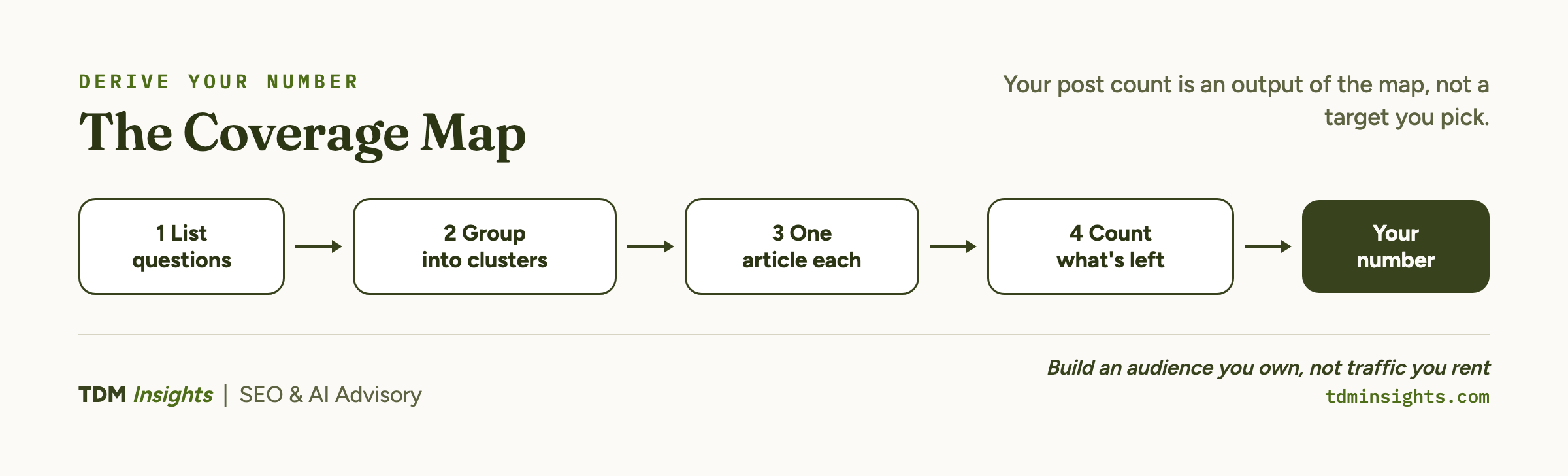
Step 1. List every distinct buyer question.
Write down every real question a buyer asks on the path from first awareness to choosing you. Pull them from sales calls, support tickets, the “People also ask” boxes on your core searches, Reddit and community threads, and keyword research that surfaces the demand you can win.
The goal is the actual question-space, in the buyer’s words, not a keyword list.
Step 2. Group the questions into topic clusters.
Cluster the questions by subject. Each cluster becomes a pillar topic with its supporting questions underneath it.
This is where the raw list turns into a structure you can build against.
Step 3. Plan one article per genuine question.
Map one article to each distinct question. Merge near-duplicates so two articles never target the same query and split each other’s authority.
What remains is your coverage requirement: the count of articles your topic genuinely needs.
Step 4. Count what’s left.
The total is your number. It is an output of the map, which is exactly why it differs so much between businesses and why off-the-shelf “publish ten posts” advice rarely fits any specific one.
Run this and the count stops being a mystery. It becomes a list.
That list is also your build order and the backbone of coverage as one stage of the content library.
A worked example: how the map produces a real number
Here is what the method produces in practice. Run the full Coverage Map across a topic and the count surfaces on its own.
You pull every distinct buyer question from sales conversations, search data, and the questions real people are already asking the engines. You group those questions into clusters, plan one article per genuine question, and merge the overlaps.
What falls out is a number nobody set as a target.
No one decides “we should publish a hundred posts.” The figure is simply how many distinct, real questions exist in that buyer’s world once you stop guessing and count.
A business in a narrow niche might map to twenty. A broader one might map to two hundred.
The point is the same: the figure is descriptive, not aspirational. It describes the size of the question-space, and the question-space is set by your buyers, not by a content-calendar template. If that count looks daunting, it is worth weighing whether the organic investment is right for your stage at all before committing the writing time.
This is also why “how many posts” is unanswerable in the abstract and very answerable in the specific. The abstract answer is “it depends.”
The specific answer, once you map, is a real integer you can plan, budget, and sequence against.
Book a free diagnosis
Mapping your real question-space is the hard part, and it is easy to undercount or to mistake keyword variants for distinct questions. A free diagnosis works through your topic with you, separates the genuine buyer questions from the noise, and gives you a defensible article count plus the cluster order to build it in. You leave knowing your number and where to start, not a generic publishing quota.
Quality beats quantity: the scaled-content trap
The instinct, once you see a number like 120, is to publish fast. Resist the version of that instinct that trades quality for speed.
Publishing low-value content at scale is now an explicit risk, not just a soft inefficiency.
Google’s spam crackdown named scaled content abuse directly, and its policy on scaled content abuse makes the guardrail concrete: producing pages at scale primarily to manipulate rankings, with little value to readers, can get them demoted or removed.
Mass-producing thin articles to hit a count is the exact behavior the policy targets, and those pages rarely rank anyway.
There is a reader-side reason too. People do not read pages, they scan them.
Nielsen Norman Group’s eyetracking on how people scan, they do not read shows readers move through content in an F-shaped pattern, skimming for the answer.
Thin, padded posts fail that scan because there is nothing to find. Thorough, well-structured ones reward it. So depth is not just a ranking signal, it is what makes a page usable at all.
The takeaway: pace is a resource question, but quality is non-negotiable. Publish at whatever steady cadence your resources allow, because thin coverage wins nothing regardless of how much of it you produce.
As you build, make sure each article is built to win two channels, so the depth you invest earns both a Google ranking and an AI citation.
Pace, timeline, and what “covered” looks like
Coverage takes time to pay off, so set the expectation correctly before you start.
On cadence, the honest framing is the one the Content Marketing Institute uses in its guidance on how to decide your publishing frequency: pick a frequency you can sustain at quality, not the highest number you can theoretically hit.
Independent benchmarks back the same point. Semrush’s blogging statistics consistently show that consistency and depth, not raw frequency, separate the sites that get results from the ones that do not.
On timeline, expect months, not weeks. Organic content compounds over quarters as authority accumulates across the cluster.
A realistic read is early movement in three to six months and durable traffic by six to twelve, provided you keep publishing and the articles link into a real architecture. For the full mechanics of why organic takes the time it does, see a realistic timeline for ranking, and if you are starting from nothing, the first ninety days of SEO for a startup covers the groundwork that has to be in place for any of this to compound.
And on the question of when you are done: you have covered enough when new article ideas start repeating questions you already answered well, and the remaining gaps are low-intent edge cases.
That diminishing-returns signal is the moment the work changes character. Your effort shifts from adding new coverage to defending it.
At that point, pruning is the inverse of how many: you stop counting up and start refreshing what slips and merging anything thin or overlapping. The library has reached its coverage, and maintenance keeps it there.
What this looks like when it works
When the method runs end to end, no one picks a post count. You map the question-space, build the clusters, and publish thorough articles against each real question, structured so authority flows between them.
The lift in search impressions follows from the structure, not from the raw volume. The number of posts is an output of that work, not the input to it.
That is the whole argument in one line: stop asking how many posts you need, and start asking how many questions your buyers ask.
Map those, answer each one well, link them into a structure, and the count answers itself.
Frequently Asked Questions
How many blog posts do I need before I see organic traffic?
There is no universal number. The count you need equals the distinct questions your buyers actually ask, not an arbitrary quota. A narrow niche can need twenty articles, a wide one over a hundred. The total is whatever a fully mapped question-space comes to, because that is how many real questions exist.
Is it about the number of posts, or something else?
It is about coverage and depth, not raw count. Search rewards the site that answers a topic most completely and helpfully, so ten thorough articles that cover real questions beat fifty thin ones chasing volume. The number is an output of mapping your question-space, never the goal you chase directly.
How do I figure out how many articles my topic actually requires?
List every distinct question a buyer asks on the path to choosing you, group those questions into topic clusters, then plan one article per genuine question. That total is your real number. It is derived, not guessed, which is why off-the-shelf “publish ten to fifteen posts” advice rarely fits any specific business.
Should I publish a lot fast, or fewer and better?
Favor depth over speed. Publishing low-value content at scale can trigger Google’s scaled-content guidance and rarely ranks anyway. A steady cadence of thorough, genuinely useful articles compounds; a burst of thin posts does not. Pace is a resource question. Quality is non-negotiable, because thin coverage wins nothing regardless of count.
How long until a content library starts ranking?
Expect months, not weeks. Ranking accrues with authority, and a library compounds over quarters as that authority accumulates across the cluster. A realistic read is early movement in three to six months and durable traffic by six to twelve, provided you keep publishing and the articles link into a real architecture.
How do I know when I have covered enough?
You have covered enough when new article ideas start repeating questions you already answered well, and when the remaining gaps are low-intent edge cases. That diminishing-returns signal means your effort shifts from new coverage to maintenance: refreshing what slips and merging anything thin or overlapping rather than adding more posts.
Continue Reading:
More On Content Strategy
- Content Strategy for Founders: A Library That Ranks, Gets Cited, and Pays for Itself
- Topic Clusters and Pillar Pages: How They Work
- Content That Ranks and Gets Cited by AI
- Content That Converts Readers Into Customers
- Content Refresh: Win Back Rankings You Lost
- Landing Page Copy vs Blog Copy: The Difference
More from TDM Insights
- SEO for Startups: What to Do in the First 90 Days
- How Long Does SEO Take? An Honest Timeline
- Is SEO Worth It for a Startup? When to Invest and When to Wait
- Keyword Research for Startups: Demand You Can Win
- Backlinks for Startups: Earn Authority, No Budget
Explore TDM Insights Categories