
Content That Converts Readers Into Customers
Content that converts is a structure, not a slogan: the content funnel plus one CTA per page that turns readers into customers.
 By David Jubé · Apr 22, 2026 · 16 min read
A page that ranks but converts no one is a leak, not a win. It has done the hard part, earning the impression and the click, and then it gives the reader nothing to do next.
The fix is not better writing or a louder button. It is structure: a content funnel that matches each article to where the reader actually is, and one call to action (CTA) per page that fits that stage.
This article shows you both, and names the single most common mistake founders make when they finally try to convert their traffic.
The premise is simple. Traffic is worthless if it does not move the reader to the next stage. There is drop-off at every handoff in the journey: an impression that never becomes a click, a click that never becomes an engaged read, an engaged read that never becomes an action.
You have already worked to get found and get chosen, the groundwork the first ninety days of SEO for a startup lays out. Conversion is the third job, and it is where most organic content quietly fails. Not because the content is bad, but because nobody designed what happens after the read.
Key takeaways
- A page that ranks but converts no one is a leak, not a win, because it earned the impression and the click and then gave the reader nothing to do next.
- The fix is not better writing or a louder button, it is structure: a content funnel that matches each article to the reader’s stage and one call to action per page that fits that stage.
- Every additional ask on a page lowers the odds the reader takes any of them, so a page with four competing CTAs often converts worse than the same page with one.
- The most common founder mistake is putting a “book a call” ask on a top-of-funnel article, where it converts almost no one and signals you misread where the reader was.
- Measure conversion per article, not per site, because a site-wide average hides the high-traffic page with near-zero next-step completion that is your biggest leak.
Why content gets traffic but no customers
Most under-converting pages share one of two problems, and they are opposites.
The first is asking for nothing. The article delivers real value, the reader nods along, finishes, and leaves, because the page never told them what to do with what they just learned.
The visit ends. Whatever interest the article built evaporates by the time they close the tab.
The second is asking for everything at once: subscribe to the newsletter, download the guide, book a call, follow on LinkedIn.
Each ask competes with the others, and competing asks split the reader’s attention until they make no decision at all. A page with four CTAs often converts worse than the same page with one.
Both failures look like a content problem and are actually a structure problem. The words earned the read. The structure failed to use it.
This matters because conversion compounds the same way the rest of the library does. If you have already built the compounding content library this conversion stage sits inside, every article that converts feeds the next, and every article that leaks throws away authority you paid for in research and writing time.
There is a measurement trap hiding here too. Readers do not study a web page top to bottom. Eyetracking research from the Nielsen Norman Group shows how users scan in an F-pattern, skimming the top, glancing down the left edge, and reading less the further down they go.
A CTA buried at the bottom of a long article reaches a fraction of the people who arrived. Placement is not decoration. It is conversion.
The content funnel: TOFU, MOFU, BOFU
A content funnel maps each article to the reader’s stage of decision. It is not about your sales process; it is about where the reader’s head is when they land on the page. Three stages cover it.
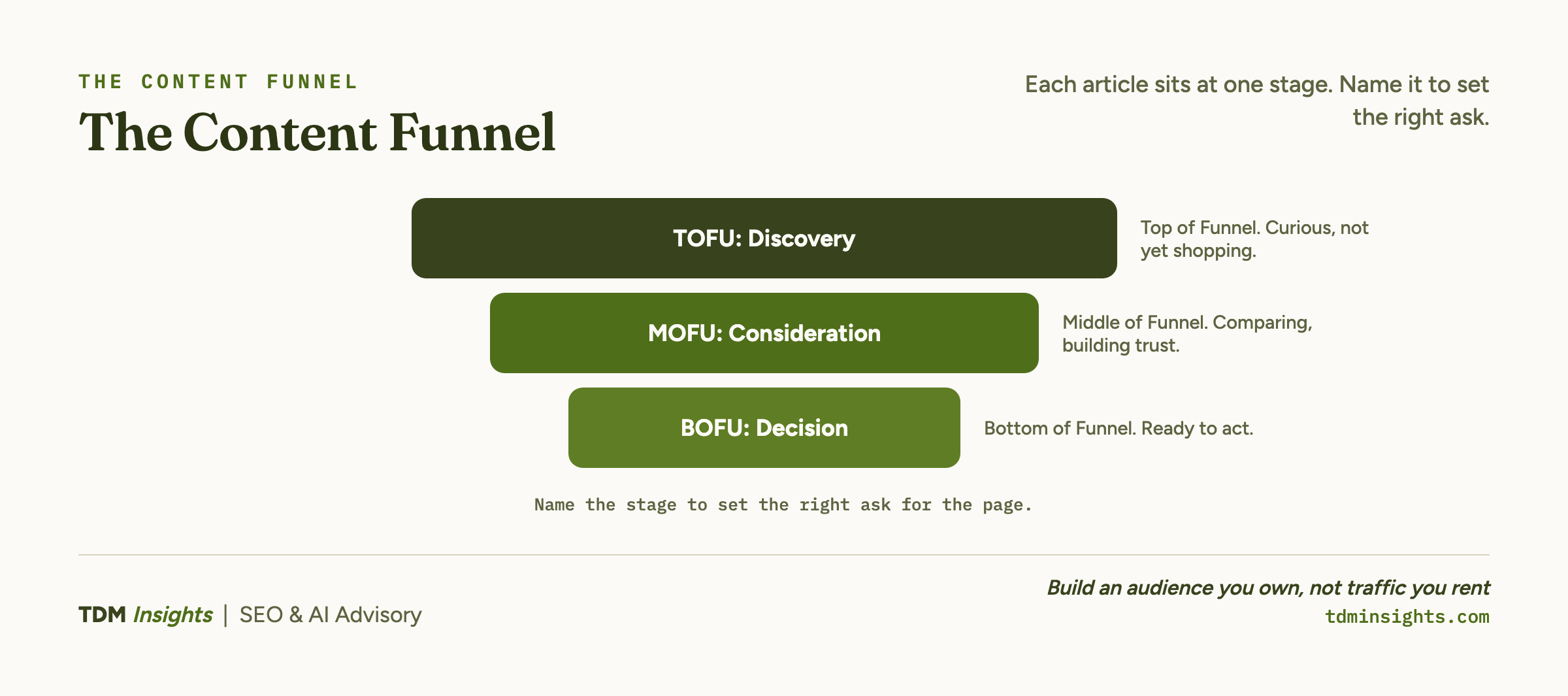
Top of funnel (TOFU). The reader has a problem or a question but is not yet shopping for a solution. They searched something broad and educational, often the kind of high-intent term keyword research for a startup is built to surface, so their stage in the journey is discovery. They want to understand, not to buy.
A TOFU article’s job is to teach well enough that the reader stays in your orbit. The handoff it fights is the one where a curious reader leaves and never comes back.
Middle of funnel (MOFU). The reader now knows they have a problem worth solving and is weighing approaches. They are comparing, evaluating, building trust.
A MOFU article’s job is to be the source they believe, the one that makes your way of thinking feel like the right way. The handoff it fights is the one where a reader trusts the idea but not yet you.
Bottom of funnel (BOFU). The reader is close to acting. They are evaluating you specifically, or someone like you, and they need the final reasons and a clear path.
A BOFU article’s job is to remove the last friction and make the next step obvious. The handoff it fights is the one where a ready buyer is engaged but never actually asked.
The article you are reading is a BOFU piece. You are not browsing for general content tips. You are trying to fix a specific gap, your content does not convert, which is why the ask at the end of this article is direct.
The funnel framing is well established in marketing practice. If you want the wider map of how educational, consideration, and decision content fit together, beehiiv’s breakdown of the content marketing funnel lays out the stages and the content types that serve each one.
The point for a founder is narrower: every article you publish already sits at one of these stages, whether you planned it or not. Naming the stage is what lets you give the page the right ask.
The One-CTA Rule
One article, one call to action. That is the rule, and it is not a stylistic preference.
Every additional ask on a page lowers the odds the reader takes any of them, because each one adds a decision and decisions cost attention. The reader who might have subscribed now has to choose between subscribing, downloading, and booking, and choosing is harder than acting, so many choose nothing.
HubSpot Research found the same pattern in the data on focused CTAs: targeted, single calls to action outperformed vague and stacked ones by a wide margin. A focused ask beats a busy page.
The One-CTA Rule has three parts.
- One ask per page. Choose the single next step that fits the reader’s stage. Everything else, even genuinely useful next steps, becomes a distraction.
- Match the ask to the stage. A TOFU reader is not ready to book a call, and asking anyway converts almost no one while signalling you misread them. The right TOFU ask keeps them close: subscribe, or read the next article you hand them.
- Place it where the reader decides. Put the CTA at the natural decision point, which is right after you have delivered the value the headline promised, not before it and not buried three scrolls past it.
This does not mean a page can only contain one link. Internal links that guide the reader deeper into your library are navigation, not conversion asks.
The rule governs the conversion ask: the one moment where you tell the reader to do the thing that moves them toward becoming a customer. There is one of those per page.
The stage-to-CTA map
Here is the rule made concrete. Each funnel stage gets one type of ask. The drop-off column names the leak that ask is designed to shrink.
Read the map as a sequence, not a menu. The TOFU ask earns the right to make the MOFU ask, which earns the right to make the BOFU ask. You do not skip stages.
A reader who arrived on a broad educational article and got a “book a call” button did not get asked too clearly. They got asked too soon, which is the error we turn to next.
The error that kills conversion: asking too soon
The most common founder conversion mistake is putting a “book a call” ask on a top-of-funnel article.
It is easy to see why it happens. The founder finally decides to take conversion seriously, reads that every page should have a CTA, and adds the one ask that actually matters to the business, the sales call, to every article on the site.
The broad, high-traffic educational posts now all say “book a call.” It feels like progress. It is the opposite.
A TOFU reader searched a broad question. They are learning, not buying. Dropping a sales-call ask in front of someone in discovery mode does two things, both bad. It converts almost no one, because the ask does not match the stage.
And it tells the reader you misjudged where they were, which costs you the trust that would have earned the call later, after a MOFU article did its job.
The page that should carry “book a call” is the BOFU page, the one a ready reader lands on. The high-traffic TOFU article should carry the ask that fits discovery: subscribe, or here is the next article.
That smaller ask is not a weaker ask. It is the ask that actually moves a discovery-stage reader to the next stage, which is the entire point of the funnel.
So the fix for a TOFU page is not to remove the CTA. It is to right-size it. Keep the reader in your orbit so a later, more relevant article can make the bigger ask when the reader is ready for it.
Asking for the sale is not aggressive. Asking for it at the wrong stage is just ineffective.
Book a free diagnosis
A page that gets traffic but no customers is almost always a structure problem you can fix without writing a new word: a mismatched ask, four competing asks, or a CTA buried below where readers stop. A free diagnosis reviews your highest-traffic pages, names the stage each one serves, and points to the exact asks to right-size and reposition first. You leave with a prioritized fix list for the content you already have.
Measuring conversion per article, not per site
You cannot fix what you measure in aggregate. A site-wide conversion rate tells you almost nothing useful, because it averages your best-converting pages with your worst and hides which is which.
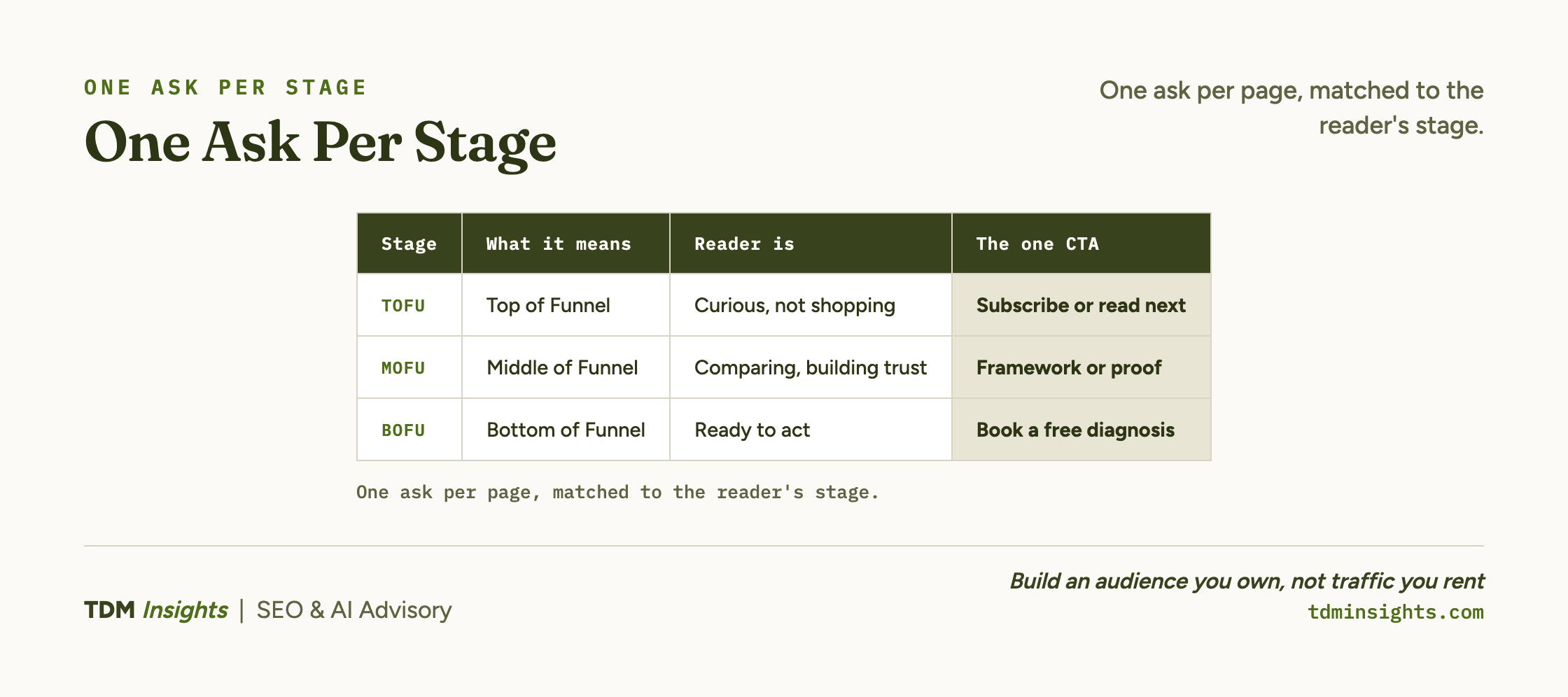
Measure conversion per article. For each page, track the completion of its one stage-appropriate next step: subscribes from a TOFU page, downloads from a MOFU page, diagnosis bookings from a BOFU page. The trickier visits to attribute are the ones that arrive through AI answers, which is where measuring AI traffic that carries no referrer closes a real gap in this view.
That per-article view surfaces the thing you actually act on, the high-traffic page with near-zero next-step completion. That page is your biggest leak, and the site-wide average was hiding it.
This is where the funnel and the measurement meet. A high-traffic page that converts no one is almost never a traffic problem. It is a mismatch (a sales ask on a discovery page) or an overload (four competing asks) or a placement failure (the CTA sits below where most readers stopped reading).
All three are structural, and all three are fixable without writing a single new word, which is why conversion is the first stage of the library worth auditing.
For the broader business case, that content investment is supposed to pay back. Semrush’s content marketing ROI benchmarks and the Content Marketing Institute’s annual content-marketing benchmarks both track how organic content ties to lead generation and revenue across thousands of businesses.
The pattern is consistent: the programs that measure outcomes and optimize for them outperform the ones that measure publishing volume. If you are still weighing whether the whole organic motion earns its keep, the honest answer to whether the organic investment pays off depends almost entirely on whether the content converts, which is the variable this article is about. It also depends on patience, since the timeline organic actually takes means conversion gains compound over quarters, not weeks.
How to fix a high-traffic page that converts no one
You have a page with traffic and no conversions. Here is the sequence to fix it.
- Identify the reader’s stage. What did they search to get here? Broad and educational is TOFU. Comparing approaches is MOFU. Evaluating you specifically is BOFU. The query and the article’s angle tell you.
- Give it the one matching CTA and remove the rest. Apply the stage-to-CTA map above. If it is a TOFU page currently asking for a call, swap the ask for subscribe or the next article. If it is a BOFU page with four competing asks, cut three.
- Place the CTA where the reader decides. Move it to right after you have delivered the value the headline promised. Given how readers scan, that placement reaches far more people than a CTA stranded at the very bottom.
- Lower the friction. One field instead of five. A clear label instead of a vague one. The smallest possible step toward the next stage.
- Watch that page’s per-article conversion. Not the site average. The specific page. Then iterate on the next-biggest leak.
The technical layer matters too, because a page can only convert readers it actually surfaces to. Marking up your content with structured data, the Article schema type chief among them, helps search and AI engines understand and surface the page, which is upstream of any conversion.
This is also where deeper conversion craft lives. If you want the full discipline of moving visitors to action, Backlinko’s definitive guide to conversion rate optimization covers the testing and friction-reduction work that turns a structurally sound page into a measurably better one.
None of this works in isolation, though. Conversion is the fourth stage of a system, and it only has readers to convert because the earlier stages did their jobs. Getting found and chosen comes first: an article has to rank in Google and get cited by AI engines before there is any traffic to convert.
And once a page is converting, you protect it. Rankings decay, and a converting page that slips off the first results page converts no one, so protect the library that is now converting with regular maintenance.
The conversion stage is the payoff of the whole compounding library, which is exactly why it deserves its own deliberate structure rather than a button bolted on at the end.
A library that converts is built stage by stage, with one ask per page matched to the reader, not a wall of competing buttons. The structure is what turns earned traffic into customers rather than just visits.
Book a free content diagnosis
If your content gets traffic but not customers, you have a leak you can locate and close.
A free diagnosis looks at your highest-traffic pages, identifies the stage each one serves, finds the mismatched and overloaded asks, and lays out the specific structural fixes in priority order.
Book a free diagnosis. One conversation, your actual pages, a clear read on where the leaks are and what to fix first. No deck, no pitch, just a diagnosis of the content you already have.
Frequently Asked Questions
Why does my content get traffic but no leads or customers?
Usually because the page earns the read and then asks for nothing, or asks for everything at once. Traffic without conversion is a leak, not a win; it just moves the drop-off downstream. Conversion is a structure: each page needs one clear next step matched to where the reader actually is in their decision.
What is a content funnel and how do TOFU, MOFU, and BOFU articles differ?
A content funnel maps articles to a reader’s stage. Top of funnel (TOFU) articles attract and educate, so their job is to keep the reader in your orbit. Middle (MOFU) articles build trust and comparison. Bottom (BOFU) articles serve someone ready to act. Each stage needs a different ask, never the same one.
How many CTAs should one article have?
One. A single, stage-appropriate call to action converts better than several competing ones, because every extra ask splits the reader’s attention and dilutes the decision. The common founder mistake is stacking subscribe, download, and book-a-call on one page. Pick the one next step that fits the reader’s stage and commit to it.
What makes a reader take the next step?
Relevance and timing. The ask has to match where the reader is: a TOFU reader will subscribe or read on but rarely book a call, while a BOFU reader is ready for the direct ask. Beyond fit, a clear single CTA, visible at the natural decision point, with low friction, earns far more action than a buried or competing one.
How do I measure whether content is actually converting?
Measure conversion per article, not per site. Track each page’s next-step completion: subscribes, downloads, or bookings attributable to that page. A high-traffic page with near-zero next-step completion is your biggest leak. Site-wide averages hide which specific articles convert and which just collect visits, so the per-article view is what you act on.
How do I fix a high-traffic page that converts no one?
Start by identifying the reader’s stage, then give the page one matching CTA and remove the rest. Place it where the reader naturally decides, usually after you have delivered the value the headline promised. Then watch that page’s per-article conversion. Most low-converting pages are mismatched or overloaded, not low-traffic.
Continue Reading:
More On Content Strategy
- Content Strategy for Founders: A Library That Ranks, Gets Cited, and Pays for Itself
- Topic Clusters and Pillar Pages: How They Work
- How Many Blog Posts Do You Need to Rank?
- Content That Ranks and Gets Cited by AI
- Content Refresh: Win Back Rankings You Lost
More from TDM Insights
- Is SEO Worth It for a Startup? When to Invest and When to Wait
- SEO for Startups: What to Do in the First 90 Days
- How Long Does SEO Take? An Honest Timeline
- Keyword Research for Startups: Demand You Can Win
- How to Measure AI Traffic With No Referrer
Explore TDM Insights Categories