
Content Strategy for Founders: A Library That Ranks, Gets Cited, and Pays for Itself
A library that ranks, gets cited by AI, and pays for itself. The content approach that compounds instead of resetting monthly.
 By David Jubé · Jun 9, 2026 · 17 min read
Paid traffic stops the hour the budget does. The moment you pause the ads, the visitors stop, and you are back to zero with nothing to show for the spend.
A content library does the opposite: it keeps earning impressions long after each article publishes, and every new piece raises the authority of everything already there.
We refined this approach on a site we operate before bringing it to clients, and a structured library built on the principle keeps earning long after each piece publishes, with no additional spend.
A content strategy is your plan for turning published articles into an owned asset that brings in buyers without ongoing ad spend. For a founder, it answers three questions: which buyer questions to cover, how those articles link together, and what each one asks the reader to do next.
That is the whole job. It is not a content calendar, and it is not a list of post ideas.
It is asset allocation. You are deciding where to put a scarce resource (your writing time) so that it appreciates instead of evaporating.
This article makes the economic case for treating content as an asset, then hands you the five-stage model that turns a pile of posts into a library that compounds.
Key takeaways
- Paid traffic stops the hour the budget does, while a content library keeps earning impressions long after each article publishes.
- A content strategy is your plan for turning published articles into an owned asset that brings in buyers without ongoing ad spend.
- Content compounds through two mechanisms: durability, because a published article does not expire on a schedule, and topical authority, because each new article raises the ceiling on every article already there.
- A library beats a blog because its posts are grouped into linked clusters, so authority flows between them instead of each post competing alone.
- Five stages run in order turn a pile of posts into a compounding asset: architecture, coverage, dual-optimization, conversion, and maintenance.
Rented Traffic Versus Owned Assets
Every founder allocating a marketing budget is making the same underlying choice without always naming it: rent attention, or own it.
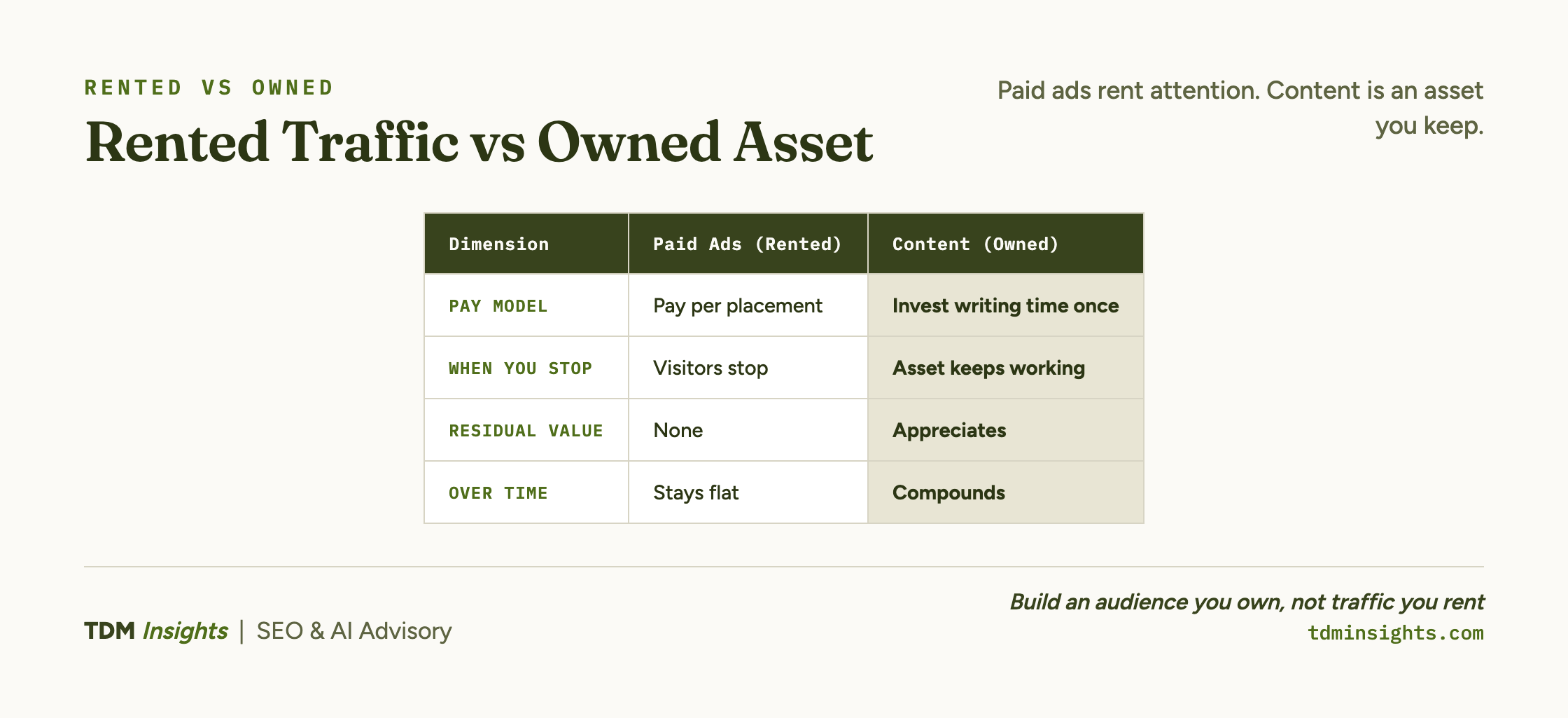
Paid advertising rents attention. You pay for placement, you get visitors, and the relationship ends when the invoice does.
There is nothing wrong with renting. It is fast, it is measurable, and for some launches it is exactly right.
But rented traffic has no residual value. The hundredth dollar you spend works no harder than the first, because nothing you bought yesterday makes today’s ads cheaper.
Content is an owned asset. You invest writing time once, the article publishes, and it keeps working.
Six months later that same article is still being found, still being read, and (this is the part that matters) it is now making your newer articles easier to rank, because search engines read your growing coverage as evidence that you know the subject.
The investment does not just persist. It appreciates.
And the channel that keeps finding that asset is not fading. SparkToro and Datos’ clickstream research shows that search activity is pervasive across the web, which is exactly why prepared, well-structured content keeps compounding in discovery long after you hit publish.
The closest financial parallel is leasing a storefront versus buying the building. Both put you in front of customers. Only one is worth something the day you stop paying.
A documented plan that treats content as an owned property is what most founders skip, and it is why their blog feels like a cost center instead of an asset. Harvard Business School’s own teaching frames content strategy as a business asset rather than a marketing line item, which is the reframe this whole approach depends on.
None of this means content is free or fast. The real cost is consistent production over months, because organic results compound slowly.
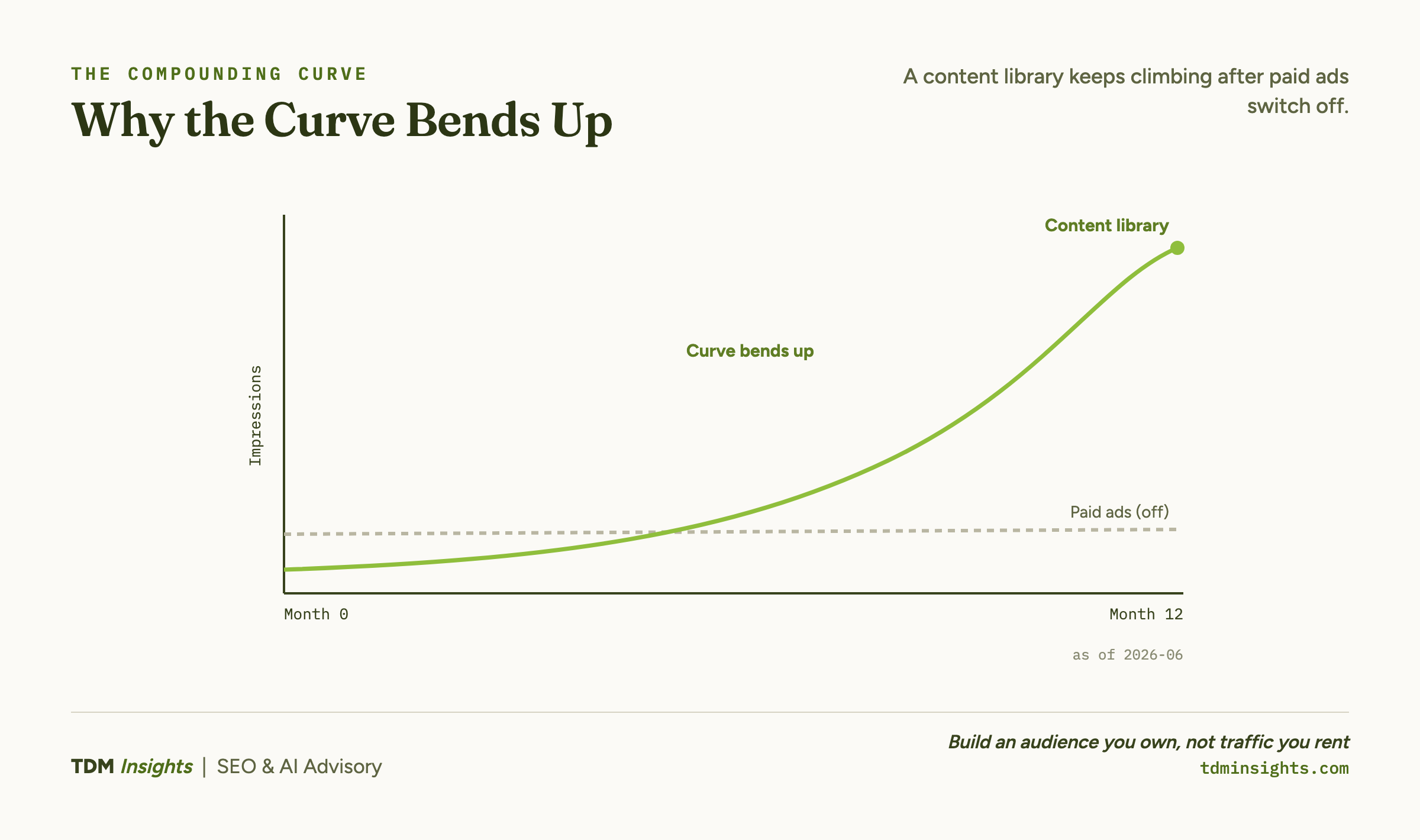
The payoff arrives when accumulated authority makes each new article cheaper to rank and traffic keeps arriving after you stop publishing. The curve typically bends upward somewhere in the six-to-twelve-month range, which is roughly the timeline organic results actually take.
The point is not that content beats ads on speed. It does not. The point is that at the end of a year of ads you own nothing, and at the end of a year of content you own an appreciating library.
Why Content Compounds and Ads Do Not
The compounding is not a metaphor. It is a mechanism, and it has two parts.
The first part is durability. A published article does not expire on a schedule.
It keeps appearing in search results and AI answers as long as it stays relevant, so the impressions it earns accumulate rather than reset. An ad campaign resets to zero the day you turn it off.
The second part, the more powerful one, is topical authority. Search engines try to surface the source that covers a subject most thoroughly and credibly.
When you publish one article on a topic, you are one voice among many. When you publish twelve well-linked articles that cover that topic from every angle a buyer cares about, search engines begin treating your site as an authority on it, and they rank all twelve higher than any one of them would rank alone.
Each new article raises the ceiling on every article already there. That is why the curve bends upward instead of flattening.
The connective tissue that makes this work is internal linking. When your articles link to each other with descriptive anchor text, they pass authority between themselves and tell search engines how your coverage fits together.
Moz’s explainer on how internal links build authority lays out the mechanism in detail, and it is the single most underused lever founders have. Search Engine Journal’s breakdown of how topical authority works shows why depth across a subject, not a single viral post, is what moves rankings durably.
This is exactly what produces a durable lift in impressions. It is not one breakout article.
It is a structured set of articles, linked into clusters, that together earn a site authority on its subject. The individual posts are unremarkable on their own. The structure makes them compound.
The Compounding Content Library: Five Stages
A pile of posts depreciates. A library compounds.
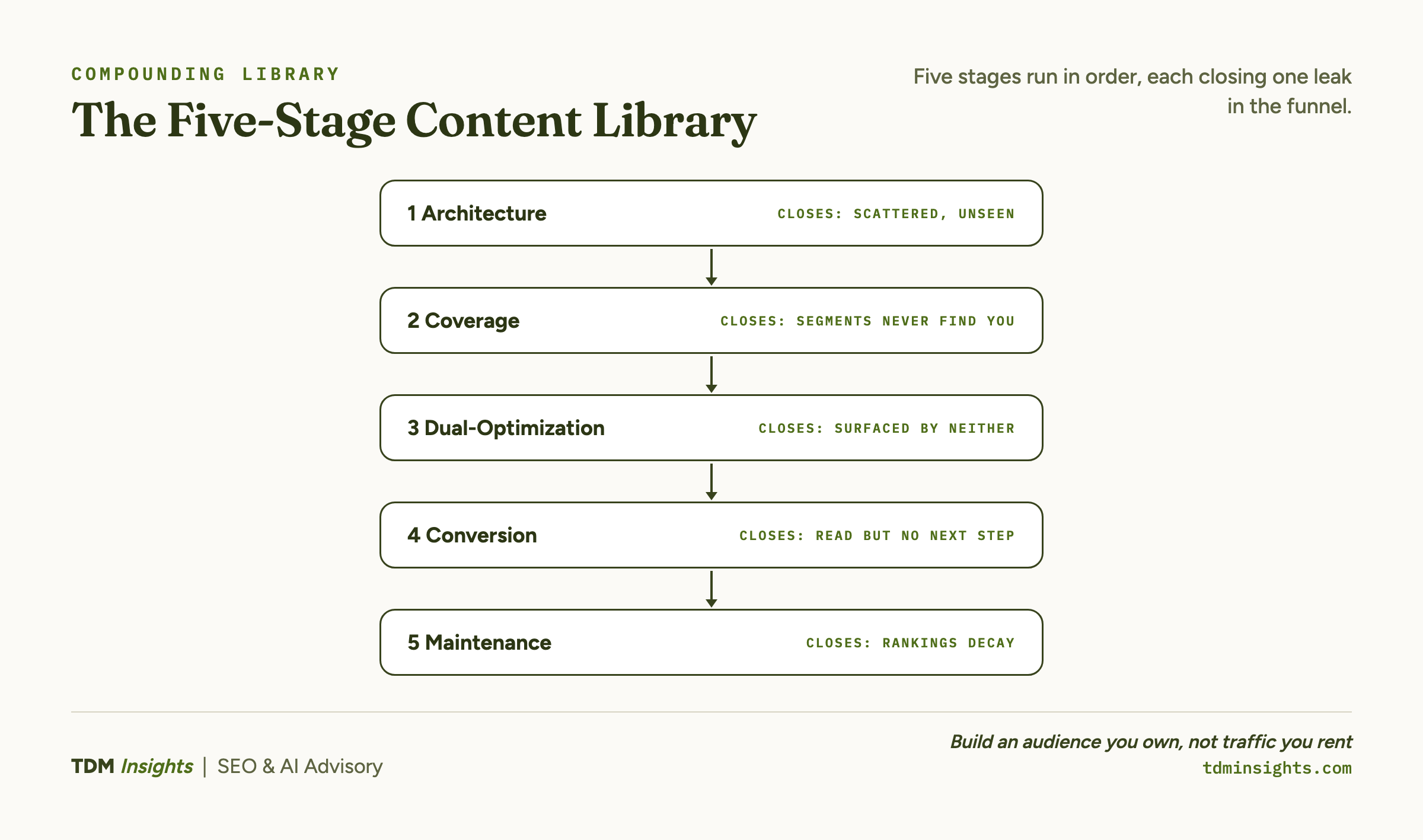
The difference is five stages, run in order, each one fighting a specific leak in the funnel from “never heard of you” to “paying customer.” Here is the whole model.
The stages are sequential for a reason. Coverage without architecture is just a bigger pile. Optimization without coverage polishes articles nobody can find.
Conversion without traffic converts no one. And all of it depreciates without maintenance.
Run them as a system and a content library becomes a compounding asset rather than a pile of posts.
If a five-stage model feels heavier than you expected, that is the point: a real plan has structure. For a marketing-team angle on the same ground, see a content strategy framework and the content strategy framework explained.
This one is built for a founder allocating scarce writing time, so it leads with the economics and orders the stages around the funnel leaks. The rest of this article walks each stage in turn.
Stage 1: Architecture
Architecture is the structure that decides whether your writing time compounds or scatters.
The unit is the topic cluster: one comprehensive pillar page on a broad subject, surrounded by satellite articles that each answer one specific buyer question and link back up to the pillar.
The pillar links down to every satellite. The satellites link to each other where they relate. That hub-and-spoke shape concentrates authority on the page you most want to rank and circulates it through the rest.
This is the difference between a blog and a library. Blogging produces posts that each compete alone.
A library groups those same posts into clusters so authority flows between them. The words can be identical. The structure is what makes the library appreciate.
You choose pillars from your biggest buyer questions, not from keyword volume alone. A good pillar is broad enough to support five or more satellites but narrow enough that you can genuinely become the most useful source on it.
If you cannot list five real sub-questions, you have a satellite, not a pillar. Get this stage right and everything downstream gets easier, which is why you start with the architecture that makes it compound before you write a single satellite.
Stage 2: Coverage
Once you have the architecture, the question becomes how much to fill it. Founders want a number, and the honest answer is that there is no universal one.
The count you need equals the distinct questions your buyers actually ask, not an arbitrary quota.
A narrow niche may be covered in twenty articles, while a deeper one needs more than a hundred. The total is whatever the mapped question-space comes to, because that is how many real questions exist under the subject.
You derive the number rather than guess it. List every distinct question a buyer asks on the path to choosing you, which is where keyword research that surfaces winnable demand earns its keep, then group those questions into clusters and plan one article per genuine question.
The total is your coverage target. This is why one-size-fits-all “publish ten to fifteen posts” advice rarely fits any real business: the right number is an output of your buyers, not an input you pick.
Coverage rewards depth over speed. Publishing thin content at scale can trigger Google’s scaled-content guidance and rarely ranks anyway, so ten thorough articles beat fifty shallow ones.
Map your question-space first and the count answers itself. When you are ready to size your own, derive the article count your topic actually needs from the question-space rather than from a template.
Stage 3: Dual-Optimization
With architecture and coverage in place, each article has to win where buyers actually look, and buyers now look in two places: Google’s results and AI answer engines like ChatGPT, Perplexity, and Google’s AI Overviews.
The good news is that you do not have to choose. The same well-structured page can do both.
SEO earns the click: depth, internal links, and demonstrated experience get a page ranked so a human visits.
AEO, answer engine optimization, earns the citation: an answer-first structure and clean, extractable blocks let an AI engine quote your page directly.
These are not competing builds. They are one structure with two payoffs. An answer-first opening that an AI engine can lift is also exactly what wins a featured snippet, and the depth and trust that rank a page are the same signals that make an AI engine willing to cite it.
The trust layer underneath both is what Google calls E-E-A-T (experience, expertise, authoritativeness, and trustworthiness). Google’s E-E-A-T framework describes the signals that make a page worth ranking and quoting, and they are the same signals in both channels.
The practical move is to write one genuinely good page, lead with the answer, and add the structure both channels can use. That is how you make every article win Google and AI engines instead of optimizing for one and losing the other.
If the AI-citation half of this is new to you, start with the basics of getting cited by AI answer engines and build from there.
Book a free diagnosis
If you have published for a while and the blog still feels like a cost center, the problem is usually structure, not effort. A free diagnosis maps your existing posts against these five stages, shows where the library is leaking authority or readers, and points to the stage to fix first. It is a working session on your actual content, not a pitch, and you leave with a clear read on where your writing time is appreciating and where it is evaporating.
Stage 4: Conversion
A page that ranks but converts no one is a leak, not a win.
Visibility only matters if it moves the reader to the next stage, and there is a drop-off at every handoff: impression to click, click to engaged read, engaged read to action.
Conversion is the stage that shrinks the last and most expensive of those leaks.
The mechanism is the content funnel plus one rule. Map each article to the reader’s stage.
Top-of-funnel articles attract and educate, so their job is to keep the reader in your orbit (subscribe, or read the next article). Middle-of-funnel articles build trust and comparison. Bottom-of-funnel articles serve someone ready to act, and only there does the direct ask belong.
Then give each page exactly one call to action matched to that stage. One.
The most common founder mistake is stacking three asks on one page (subscribe, download, and book a call) or putting a “book a call” button on a top-of-funnel article a reader is not ready to act on. Every extra ask splits attention and dilutes the decision.
Measure conversion per article, not per site, because site-wide averages hide which specific pages convert and which just collect visits. This is the stage where the library starts paying for itself, so it is worth getting the mapping right.
Stage 5: Maintenance
Rankings are not permanent. Competitors publish fresher coverage, search intent shifts, and facts go stale, so a page that ranked last year quietly slips.
This is content decay, and it is normal. Maintenance is the stage that defends the asset against it, and it is why a library keeps compounding instead of plateauing.
Maintenance is not “update the date.” It is three distinct moves, and the first job is diagnosing which one a given article needs.
Refresh a still-relevant page that is slipping: re-check facts, deepen thin sections, add current data, sharpen the opening, and improve the internal links.
Prune a page with no traffic, value, or links. Merge two or more thin, overlapping posts into one strong page.
The economics favor maintenance heavily: updating an already-indexed article usually beats writing net-new, because the existing URL already carries age, the authority that earned backlinks bring, and accumulated topical signal a new post lacks.
A rigorous study of quantifying the payoff of an owned property from Nielsen Norman Group shows why an asset with existing equity is worth defending rather than abandoning. Maintenance is the stage that keeps your compounding curve pointed up over years instead of letting it sag.
What This Looks Like When It Works
When the five stages run as a system, the result is a compounding curve: search impressions that climb steadily, built not on one breakout post but on a structured library where each article raises the ceiling on the rest.
Backlinko’s analysis of 11.8 million search results found the same pattern at scale: depth, authority, and a strong link profile, not isolated posts, are what correlate with ranking. The library is the asset that produces that depth.
The economic claim at the start of this article is the one to keep. Ads rent attention and own nothing.
A content library is an owned asset that appreciates while you sleep, and a documented plan is what turns scattered posts into that asset.
HubSpot’s guide to building a documented content strategy makes the same case from the planning side: marketers who document the plan consistently outperform those who wing it. The structure is the strategy.
If you have ten random posts and no plan today, you do not start by writing more. You start by grouping what you have into the buyer questions each post answers, mapping the questions you have not covered, and turning that map into your architecture.
Founders who want this assessed for their own site can book a free diagnosis that maps existing content against the five stages and shows where the library is leaking. Before either, it helps to have the SEO foundation a founder needs first in place, so the library has solid ground to compound on.
Frequently Asked Questions
What is a content strategy for a founder with no marketing team?
A content strategy is your plan for turning published articles into an owned asset that brings in buyers without ongoing ad spend. For a founder, it answers three things: which buyer questions to cover, how those articles link together, and what each one asks the reader to do next. It is asset allocation, not a calendar.
Why does content marketing compound when paid ads do not?
Paid traffic stops the hour your budget does. Content keeps earning impressions after it publishes, and each new article on a topic raises the authority of every related article you already have. That accumulation is why a structured library keeps lifting impressions with no further spend.
How is a content library different from just blogging?
Blogging produces a pile of posts that each compete alone. A library is structured: articles are grouped into topic clusters, linked so authority flows between them, and each one is built to convert the reader to the next step. The posts are the same words. The structure is what makes the library appreciate instead of depreciate.
What does a content strategy cost and when does it pay for itself?
The real cost is consistent production over months, not a one-time spend, because organic results compound slowly. The payoff arrives when accumulated authority makes each new article cheaper to rank and traffic keeps arriving after you stop publishing. The curve typically bends up somewhere in the six-to-twelve-month range.
Where do I start if I have ten random posts and no plan?
Start by grouping what you have into the buyer questions each post answers, then map the questions you have not covered yet. That map becomes your architecture. Keep the posts that fit a cluster, merge thin overlapping ones, and fill the gaps in order of buyer intent rather than by what is easy to write.
How long before a content strategy actually works?
Organic content rarely pays off in weeks. A page takes months to rank, and a library compounds over quarters as authority accumulates. A realistic expectation is early movement in three to six months and meaningful, durable traffic by six to twelve, assuming consistent publishing and a real cluster architecture rather than scattered posts.
Continue Reading:
More On Content Strategy
- Topic Clusters and Pillar Pages: How They Work
- How Many Blog Posts Do You Need to Rank?
- Content That Ranks and Gets Cited by AI
- Content That Converts Readers Into Customers
- Content Refresh: Win Back Rankings You Lost
- Content-Market Fit: Earn Customers, Not Traffic
- Content ROI: How to Calculate It vs Ad Spend
More from TDM Insights
- SEO for Startups: What to Do in the First 90 Days
- Answer Engine Optimization: What AEO Actually Is
- Keyword Research for Startups: Demand You Can Win
- How Long Does SEO Take? An Honest Timeline
- Backlinks for Startups: Earn Authority, No Budget
Explore TDM Insights Categories