
Keyword Research for Startups: Demand You Can Win
Volume alone lies. Score intent and attainable difficulty too, and find the demand a brand-new site can realistically win.
 By David Jubé · Apr 25, 2026 · 15 min read
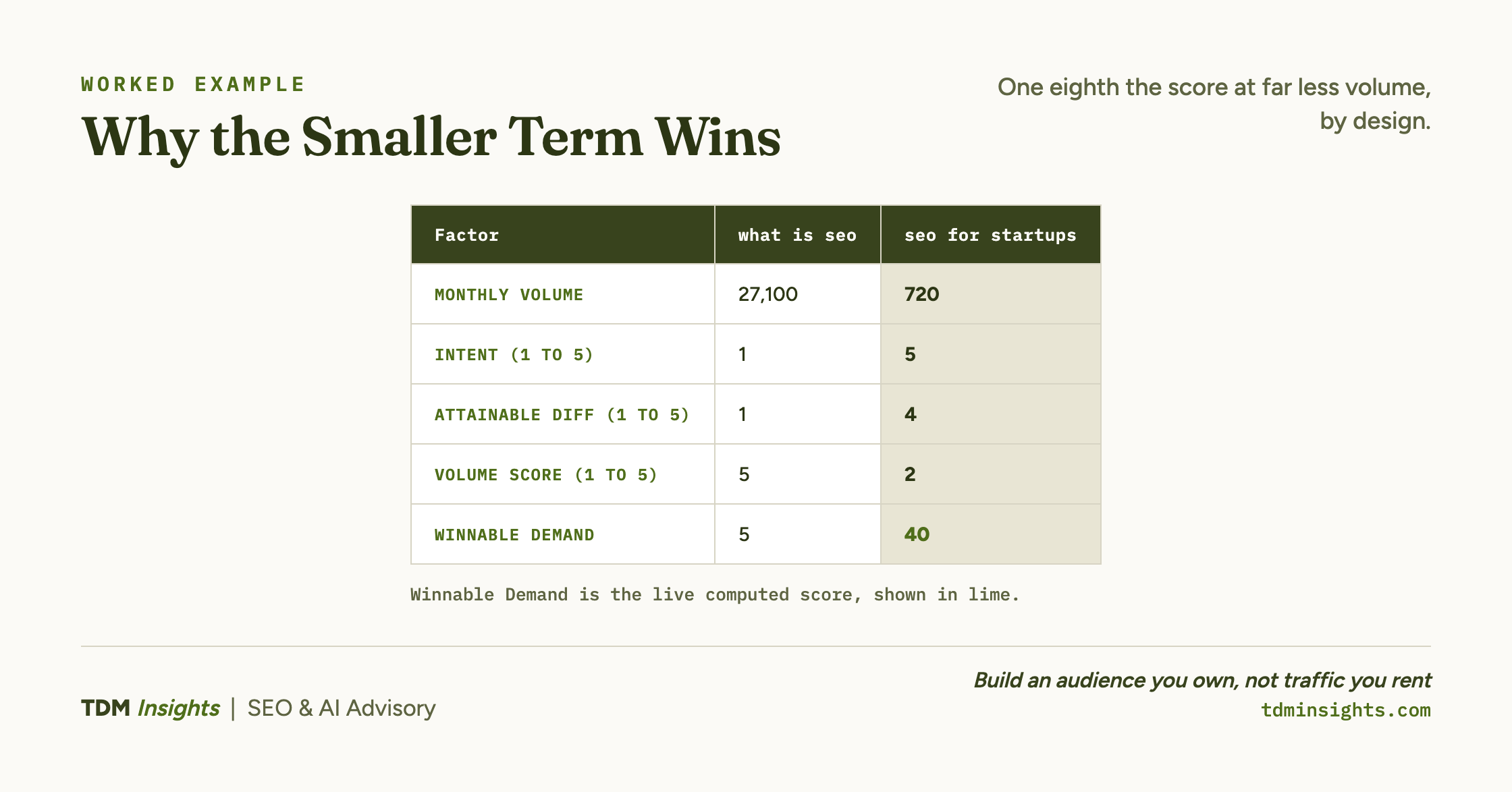
There are 27,100 monthly searches for “what is seo” and 720 for “seo for startups.” A new startup should target the smaller one on purpose.
Volume is the least useful number in startup keyword research, because you cannot bank a ranking you cannot win. This article is the method for finding the demand you actually can.
The short version: a startup should pick keywords by scoring three things together, not one.
Score each candidate on volume, intent, and attainable difficulty, where “attainable” is measured against your own site’s current authority. The keyword that wins early is rarely the one with the most searches. It is the one where the searcher is close to buying and the pages already ranking are weak enough that a new site can pass them.
Get those two right and volume sorts itself out as you grow.
Key takeaways
- Score every keyword on volume, intent, and attainable difficulty together, not on search volume alone.
- Winnable Demand multiplies the three factors, so if any one is near zero the whole score collapses no matter how strong the other two are.
- Read a difficulty score relative to your own site’s authority, never as an absolute, because the same KD can mean easy for an established site and impossible for a week-old one.
- Long-tail terms of roughly four or more words win early for a startup because they carry higher intent and thinner competition at the same time.
- Sequence your first ninety days by Winnable Demand score and publish the most winnable, highest-intent pages first, because the lift comes from winning the winnable terms, not chasing the biggest ones.
The answer: win on intent and attainability, not volume
Winnable Demand starts where search volume stops. The instinct is to open a tool, sort by monthly searches descending, and pick the biggest numbers you can stomach.
That is exactly backwards for a startup.
A new domain has no stored trust, so Google ranks it cautiously while it gathers signal. In that period, the only queries a new site can realistically reach page one for are the ones strong sites are not defending well.
Big head terms are defended hardest, so the highest-volume keywords are, almost by definition, the ones a startup is least able to win in its first quarter.
That is why we score three dimensions, not one:
- Volume: how many people search the term each month. Useful as a ceiling, useless as a sole filter.
- Intent: how close the searcher is to the action you want. A term searched by buyers beats a term searched by the merely curious.
- Attainable difficulty: not the raw difficulty score, but the difficulty relative to your authority right now. The same score means “easy” for an established site and “impossible” for a week-old one.
Volume tells you how big the prize could be. Intent tells you whether the prize is worth anything to your business. Attainable difficulty tells you whether you can actually reach it this quarter.
Only the keywords that clear all three are worth your first ninety days of writing. This is step two of the order of operations, the targeting step that decides whether everything you publish afterward compounds or stalls.
The Winnable Demand formula
Here is the model in one line:
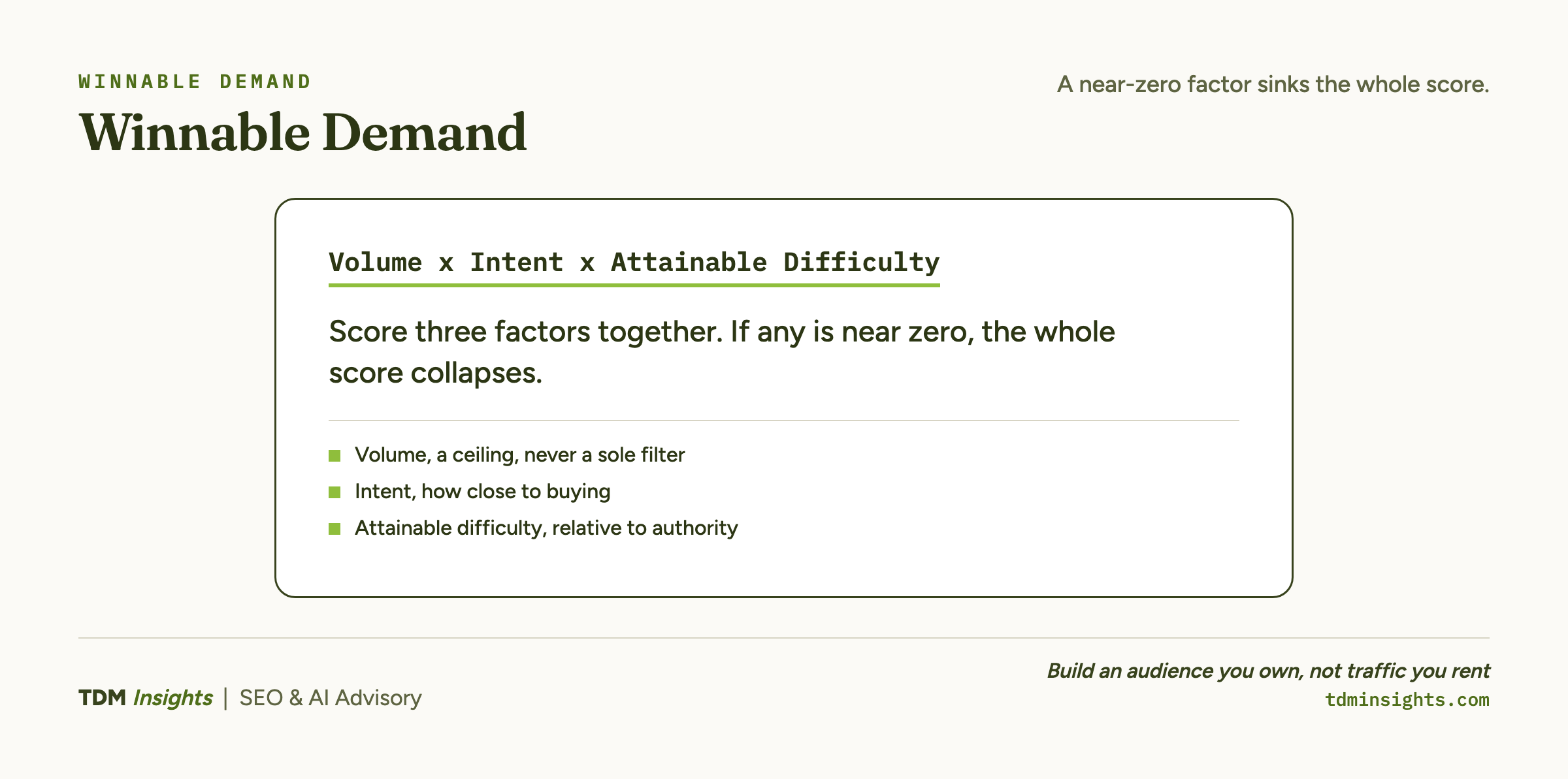
Winnable Demand = Volume x Intent x Attainable Difficulty
It is a multiplication, not an addition, and that matters. If any one factor is near zero, the whole score collapses, no matter how strong the other two are.
A 27,100-volume term with high intent is worthless to a new site if attainable difficulty is zero, because you will never rank for it. A trivially winnable term with no buyer intent is also worthless, because ranking changes nothing for the business.
The multiplication forces you to respect all three at once.
Score each factor on a simple 1 to 5 scale so you can compare candidates fast:
- Volume (1 to 5): Higher monthly searches score higher. But cap the influence. A 5 here does not rescue a 1 elsewhere.
- Intent (1 to 5): Informational and “what is” queries score low (1 to 2). Comparison and “best X for Y” queries score mid (3). Commercial and “buy / hire / pricing / for [your niche]” queries score high (4 to 5).
- Attainable difficulty (1 to 5): This is the inverted, authority-relative difficulty. A term you can plausibly win at your current authority scores 5. A term where every page-one result outranks you on authority scores 1.
Multiply the three. The candidates with the highest products are your first publishing targets.
You will notice the winners are almost never the biggest-volume terms. They are mid-volume, high-intent, genuinely winnable terms. That is the point.
Moz’s beginner’s guide to keyword research lays out the foundational mechanics of demand discovery; the Winnable Demand formula is the startup-specific filter you run on top of it once you have your candidate list.
Reading difficulty relative to your authority
The single most expensive mistake in startup keyword research is reading a difficulty score as an absolute. It is not. It is relative to you.
Every major tool publishes a keyword difficulty score, usually called KD (keyword difficulty), on a 0 to 100 scale. The score estimates how hard it is to rank on page one, mostly by looking at the backlink strength of the sites already there.
The trap is that the same KD means completely different things depending on your own site’s authority. A KD of 30 is unwinnable at a domain rating of 5 and close to trivial at a domain rating of 50.
The number on the screen did not change. Your ability to act on it did.
Ahrefs explains the mechanics well in its breakdown of how to read keyword difficulty, and the founder takeaway is the relativity: read the score through the lens of your own authority, never in isolation.
So do not stop at the score. Open the actual page-one results for the term and look at who is there. Two questions decide it:
- What is the authority of the sites ranking? If the top ten are all high-authority domains with deep link profiles, the printed KD understates your real difficulty. You are weaker than the field.
- How strong is the weakest result on page one? This is the one you have to beat to get a foothold. If the weakest page-one result is a thin article on a no-name site, a forum thread, or an off-topic post, the term is winnable for you even if the headline KD looks intimidating.
A new site wins by finding terms where the weakest defender is genuinely weak. That gap between the printed difficulty and the real strength of the field is where a startup’s early rankings live, provided the page you publish there is genuinely content that ranks and gets cited rather than a thin placeholder.
Once you have found those terms and built pages for them, the next job is to make the site able to rank for it: a winnable target does nothing if a crawl or indexing problem keeps your page out of the results entirely.
Why long-tail wins early: the worked example
The clearest way to see all of this is a concrete decision a startup faces constantly: two candidate terms in the same topic, one with massive volume and one with a fraction of it.
The small one is the right pick, and here is the scoring that makes the call.
The head term has nearly 38 times the search volume and one eighth of the Winnable Demand score. The math is not close.
A 27,100-volume definitional term, where the searcher is learning rather than buying and where a new site cannot rank, scores a 5. A 720-volume commercial term, where the searcher is a founder weighing a decision and where the field is beatable, scores a 40.
This is why long-tail keywords win early for startups. Long-tail terms (longer, more specific phrases of roughly four or more words) tend to carry higher intent and thinner competition at the same time.
The person searching “seo services for startups” is far closer to action than the person searching “what is seo,” and far fewer strong sites fight for that specific phrase.
Backlinko’s guide to finding long-tail keywords is a good tactical companion: its discovery patterns surface exactly the specific, high-intent phrases the Winnable Demand formula then ranks. You trade raw volume for the two things a new site can actually use, intent and attainability, and the trade pays.
Mapping demand to the buyer journey
Scoring keywords one at a time tells you which to write. Mapping them to the buyer journey tells you what each page is for, and stops you from publishing ten pages that all serve the same moment.
Every keyword sits somewhere on the path from “I have a problem” to “I am ready to buy.” Group your scored candidates into three stages:
- Top of funnel (awareness): broad, informational queries. The searcher is defining the problem. These build reach and trust but rarely convert directly.
- Middle of funnel (consideration): comparison and “how to choose” queries. The searcher is evaluating approaches and options. These warm a reader toward your solution.
- Bottom of funnel (decision): commercial queries with clear buying or hiring intent: “services,” “pricing,” “for [your specific niche].” These convert.
For a startup with limited runway, weight your first publishing toward the bottom and middle of the funnel, where intent scores highest and a page can produce a customer while your authority is still small. Those bottom-funnel pages only pay off when the writing does its job, which is the whole point of content that converts readers into customers. You can backfill awareness content later, once the pages that pay the bills are live.
Reading the intent behind a query is its own skill; Semrush’s breakdown of mapping keyword intent helps you classify each term, and its overview of mapping demand to the buyer journey helps you sort the classified terms into stages.
The discipline is simple: know what stage each page serves, and do not let an awareness keyword masquerade as a conversion target.
Affordable and free tools
You do not need a paid subscription to do real keyword research before you have traffic.
The free layer is enough to find your first winnable targets, and you should exhaust it before paying for anything.
Start inside the search engine itself:
- Google autocomplete. Type your seed phrase and read the suggestions. These are real queries people search, ranked roughly by frequency.
- “People also ask.” The expandable question box on the results page surfaces the exact questions searchers have around your topic. Each one is a candidate.
- Related searches. Scroll to the bottom of the results page for the lateral phrases Google associates with your term.
Then layer in the free tools:
- Google Search Console. Once you have any traffic, this shows the real queries you already appear for, including ones you never targeted. It is the highest-signal free source you have. Backlinko’s walkthrough of free demand discovery in Search Console covers how to mine the Performance report for terms you are close to ranking on.
- Free tiers of paid tools. Ahrefs Webmaster Tools, Google Keyword Planner, and the limited free searches most platforms offer will get you volume estimates and difficulty signals without a subscription. Ahrefs maintains a current rundown of free keyword research tools worth working through before you commit budget.
A startup can run its entire first ninety days of keyword research on the free layer. Pay for a tool when the volume of research justifies the speed, not before.
Book a free diagnosis
The whole game in startup keyword research is reading difficulty against your own authority, and that is the judgment call founders get wrong most often. A term that looks winnable on a tool can be defended by sites you cannot pass yet. A free diagnosis includes a first pass at the keywords your site can realistically win this quarter: which terms have soft enough competition, where the buyer intent is, and what to publish first. No obligation, just a winnable-demand shortlist.
From keyword map to publishing plan
A scored, journey-mapped keyword list is not a strategy yet. It becomes one when you decide how the terms group into pages, and what to publish in what order.
Two rules keep the plan clean.
First, one page targets one primary keyword plus its close variants and questions that share the same intent. Do not split near-identical terms across separate pages; they will compete with each other and dilute both.
Second, build in clusters, not scattered one-offs. Grouping related terms into a pillar-and-satellite structure lets a set of pages reinforce each other’s authority on a topic, which also informs how many blog posts you need to rank for the topic as a whole. That is how you turn the keyword map into topic clusters, and it is the bridge from a spreadsheet of keywords to a real editorial roadmap.
From there, sequence by Winnable Demand score. Publish your highest-scoring, most-winnable, highest-intent pages first, so your earliest rankings land on terms that both convert and prove the engine works.
Save the harder, bigger-volume terms for later, once early wins have started to build the authority that makes them attainable. To put the whole map on a calendar with cadence and ownership, build the publishing plan from your map.
The keyword research decides what to write. The publishing plan decides when, and in what order, so the runway is spent on the demand you can actually win.
The discipline pays off on a curve. Run this targeting step inside a full order of operations, and impressions tend to stay flat for the first several weeks, then climb and compound for months once the winnable pages start ranking.
The lift does not come from chasing the biggest keywords. It comes from winning the winnable ones first.
Once content is live on those terms, the next job is to earn the authority to win harder terms, which moves your attainable-difficulty ceiling up over time.
Frequently Asked Questions
Can a brand-new site with no backlinks rank for any keyword?
Yes, a brand-new site can rank, but only for long-tail keywords with low difficulty and weak incumbents. Target phrases of four or more words where the current page-one results are forums, thin pages, or off-topic posts. These winnable terms compound into authority that later unlocks harder keywords.
How do I read keyword difficulty relative to my own site’s authority?
Treat difficulty scores as relative, not absolute. A keyword difficulty of 25 is easy for an established site and hard for a week-old one. Compare your domain rating to the sites already ranking on page one. If every result outranks you on authority and backlinks, the score understates your real difficulty.
What is the cheapest way to do real keyword research with no paid tools?
Start with Google autocomplete, the “People also ask” box, and the related searches at the bottom of the results page. Layer in Google Search Console once you have traffic, plus the free tiers of Ahrefs Webmaster Tools and Google Keyword Planner. These cover demand discovery before any paid subscription.
Should startups target search volume or buyer intent first?
Target intent first, then volume. A keyword with 90 monthly searches from people ready to buy beats one with 9,000 searches from people merely curious. Map each term to a buyer-journey stage and prioritize bottom-funnel commercial phrases early, since they convert while your authority is still small.
How many keywords should one page target?
One page should target one primary keyword plus a small cluster of close variants and questions that share the same search intent. Splitting near-identical terms across multiple pages causes them to compete with each other. Group by intent, write one strong page per intent, and let it rank for dozens of related phrases.
How long until keyword research turns into actual traffic?
Expect three to six months before new content earns meaningful organic traffic, longer for competitive terms. New sites sit in a trust-building period where Google samples rankings cautiously. Publishing consistently against winnable long-tail terms shortens the wait, because early wins send positive engagement signals that speed up later rankings.
Continue Reading:
More On SEO for Startups
- SEO for Startups: What to Do in the First 90 Days
- How Long Does SEO Take? An Honest Timeline
- Is SEO Worth It for a Startup? When to Invest and When to Wait
- Technical SEO Checklist for Founders, by Severity
- Backlinks for Startups: Earn Authority, No Budget
- Free Keyword Research: A Starter Method, No Tools
More from TDM Insights
- Topic Clusters and Pillar Pages: How They Work
- Content Strategy for Founders: A Library That Ranks, Gets Cited, and Pays for Itself
- Content That Converts Readers Into Customers
- How Many Blog Posts Do You Need to Rank?
- Content That Ranks and Gets Cited by AI
Explore TDM Insights Categories