
How to Read the SERP Before You Write a Word
Good pages lose before drafting. A four-pass scan of the SERP for intent, format, features, and whether you can win it.
 By David Jubé · May 21, 2026 · 14 min read
The search engine results page (SERP) for your target query is the brief. It already tells you the intent Google rewards, the format that wins page one, the features you have to structure for, and whether you can realistically compete, all before you write a word.
Read the SERP in four passes: intent, format, features, winnability. That scan is the difference between a page built to match what Google already pays out and a page written blind. A page written blind usually loses before it is drafted.
The acronym matters less than the habit. A SERP is the results screen Google returns for a query, and reading it is the cheapest reconnaissance in search.
The pages that took one site from 59,643 to 600,569 Google impressions in 28 weeks were almost never the first draft of an idea. They were the second move, made after the first move was reading the results the idea would have to beat.
Key takeaways
- The live SERP for your target query is the brief. It already shows the intent Google rewards, the format that wins, the features you must structure for, and whether you can compete, all before you write a word.
- Read it in four passes: intent, format and depth, features, and winnability. Skipping the scan means writing blind, and a page written blind usually loses before it is drafted.
- SERP features are signals, not noise. An AI Overview means you compete to be cited, a featured snippet rewards an answer-first paragraph built to be lifted, and People Also Ask hands you section headings for free.
- Winnability is the pass that saves the most effort. Treat a wall of established brands as a “not yet” and chase queries where forums, thin pages, or dated results leave you daylight.
- The scan turns a results page into a page plan. A worked read of “best email marketing software for startups” produces a table-driven comparison, an answer-first capsule, PAA-seeded headings, and a startups-only narrowing, all read off the screen.
The short answer: the SERP is a brief, read it in four passes
Open the live results for your exact target query and read them in this order, before you draft anything.
- Intent. What kind of page is winning? A guide, a list, a tool, a product page, a comparison. That tells you what the searcher actually wants.
- Format and depth. How long are the ranking pages, and how are they built? Long essays, short answers, tables, step lists, video.
- Features. Which non-standard blocks does Google show? AI Overview, People Also Ask, featured snippet, image or video pack, local pack.
- Winnability. Who already ranks, and how strong are they? This is the honest pass where you decide whether to write the page or pick a different query.
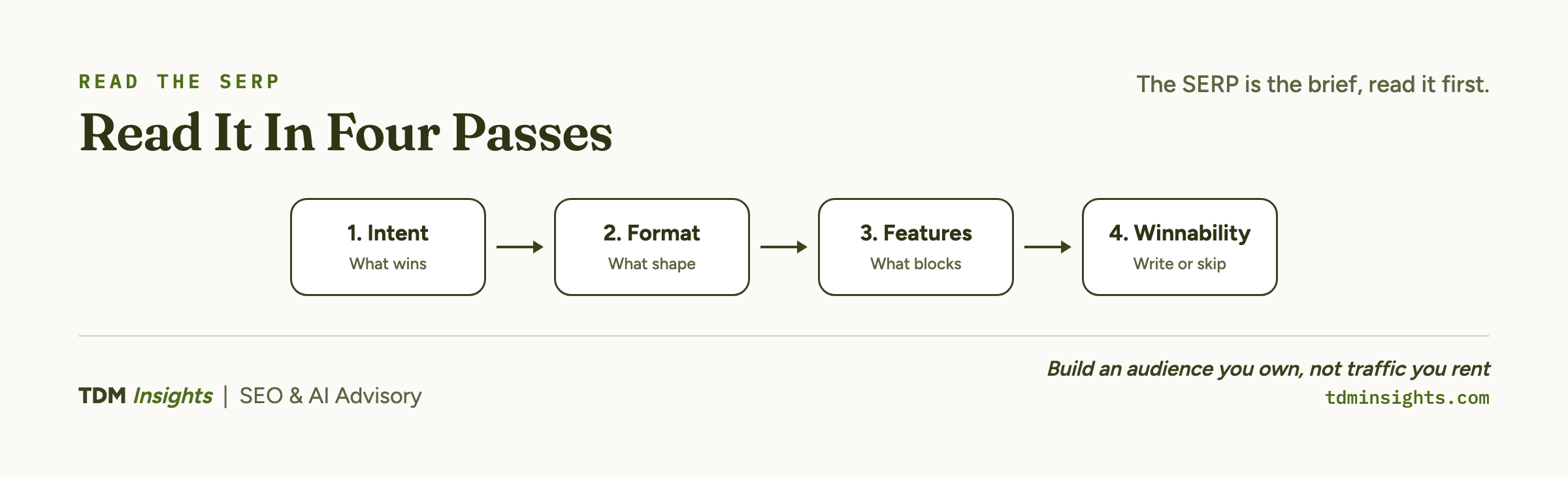
Each pass is a question with a free answer sitting on the screen. The four together are the page plan.
Several published methods, such as Rank Math’s SERP analysis in five steps, formalize the same idea into a repeatable workflow. They feed the intent the SERP confirms and the winning snippets you just saw before writing your own, which is why both of those satellites point back here.
The rest of this article runs each pass, then walks a worked read of one real query so you can see the scan produce an actual page plan.
Pass 1: read the intent off the page
Intent is the first thing the SERP confirms, and the cheapest mistake to avoid.
You can guess intent from the query wording:
- “How to” leans informational.
- “Best” or “vs” leans commercial.
- “Buy” or “pricing” leans transactional.
- A brand name leans navigational.
The guess is a hypothesis. The live results are the verdict.
If page one for your query is all step-by-step guides, Google has decided the query is informational, and a product page will not rank for it no matter how well you build it. If page one is all product and pricing pages, the reverse is true and your 3,000-word explainer is aimed at an intent the SERP is not paying out.
Reading the SERP is how you stop arguing with Google about what the searcher wants. Google has already told you, in the ten results it chose to rank. The full breakdown of the four intent types, and how to match a page to each, is in search intent: the four types that decide everything.
Pass 2: read the format and depth
Once you know the intent, the same results tell you the shape the winning page takes.
Open the top three or four results and look at how they are built, not just what they say. Are they long-form guides or tight answer pages? Do they lead with a definition, a table, a numbered list, a tool?
Is there a clear pattern, or does the page-one set mix formats? Google rewards the format that satisfies the query, and the ranking pages are a live sample of what that format is.
Nightwatch’s walkthrough on reading and using SERP data is a useful companion for judging both competition and format from the same screen.
This pass is short on purpose, because the instruction is simple: match the dominant format, then earn the win on depth or clarity inside it. If page one is wall-to-wall listicles, a single deep essay will struggle to break the pattern. If the top results are thin and dated, depth is your opening.
Pass 3: which SERP features are present, and what they tell you
This is the pass founders skip most often, and the one that has changed the fastest. The ten blue links are no longer the whole results page. Around them, and increasingly above them, Google shows features that change how much attention the organic results get and signal exactly what structure it rewards.
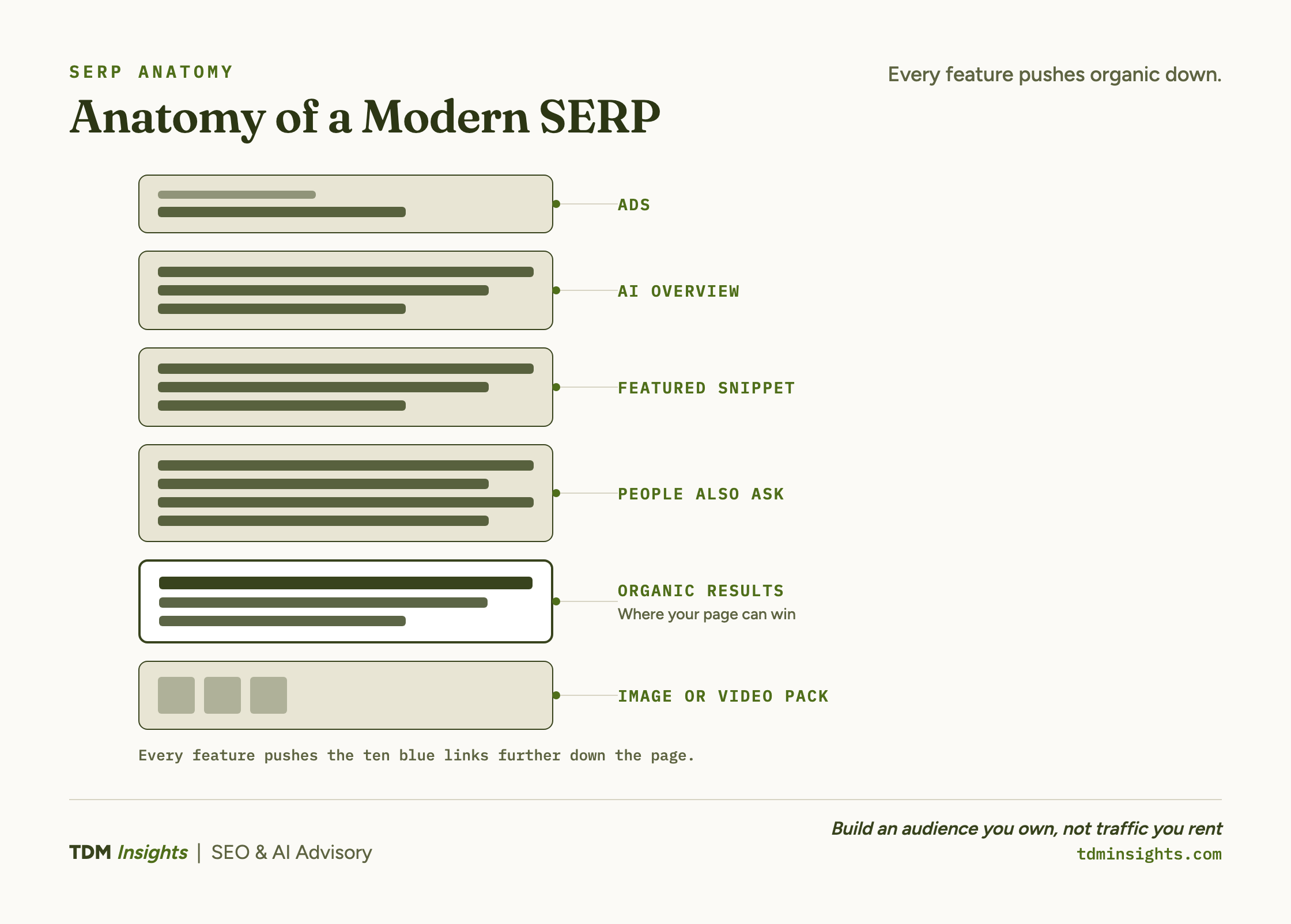
Log which of these are present for your query:
- AI Overview. A synthesized answer Google generates from multiple sources and cites several pages beneath. When one appears, plain ranking is no longer enough: you are now competing to be a cited source inside the answer, not just a link below it. Google’s own explainer on how AI Overviews appear in Search covers when and why one is generated, and Botify’s breakdown of what AI Overviews are and how they work explains the mechanics behind which sources get pulled.
- Featured snippet. A single extract Google lifts from one ranking page and shows at the top. It quotes one page verbatim, so an answer-first paragraph written to be lifted is how you win it. Google’s how featured snippets work documents what it pulls and why, and Advanced Web Ranking’s reference on featured-snippet formats and triggers maps the paragraph, list, and table types you can target.
- People Also Ask. An expandable box of related questions. Every question is a subtopic real searchers want, which makes it a free source of section headings and FAQ entries for the page you are planning.
- Packs (image, video, local). These tell you the query has a visual or local dimension. A local pack means location matters and a page of national content will not satisfy it; a video pack means Google thinks searchers want to watch, not read.
The honest read on features is that each one is a piece of the page above the organic results. The more features Google stacks, the harder the open web works to earn the click. A clear taxonomy of every SERP feature and what each signals sits in Moz‘s guide to SERP features.
Your job is not to fear them. It is to read which are present and structure your page to be the thing each one pulls from.
Here is the whole four-pass scan in one look, each signal next to what it tells you and how to respond.
Book a free diagnosis
The four-pass scan is simple to run once, harder to run honestly on the ten queries you most want to win, where it is tempting to talk yourself into a fight you cannot finish. A free diagnosis runs the intent, format, features, and winnability read on your real target keywords, and hands you a plain list: which queries are worth a page, what format each one demands, and which to leave alone for now. No deck, no retainer pitch, just a clear read.
Pass 4: be honest about winnability
The last pass is the one that saves the most wasted effort, because it decides whether the page is worth writing at all.
Look at who already ranks. If page one is dominated by high-authority sites with deep, well-linked pages on the exact topic, a new domain will struggle no matter how good the draft is, and your hours are better spent on a query where the gap is smaller.
If page one includes forums, thin pages, dated posts, or results that only loosely match the query, that is daylight. Compare the authority of the ranking sites to your own, and target the queries where the distance is short enough to close this quarter.
Winnability is also where the AI Overview reshapes the math. When an AI Overview answers the query directly above the links, even a number-one ranking earns fewer clicks, so a heavily summarized query can be a poor target even when it looks winnable on authority alone. SE Ranking’s piece on strategies to appear in AI Overviews is a good read on deciding when an AIO-dominated query is still worth chasing.
Winnability is where reading the SERP turns from research into a decision. The two passes before it tell you how to build the page; this one tells you whether to.
Treat a wall of established brands as a “not yet,” not a “never,” and move to the next candidate. The deeper method for qualifying the keyword’s winnability against your own site’s strength is in the startup keyword-research guide.
A worked read: “best email marketing software for startups”
Run the four passes on one query and watch a page plan fall out of the screen.
Intent. Page one is comparison roundups and “best tools” pages, with a few vendor pages mixed in. The dominant intent is commercial investigation: the searcher is comparing before buying, not learning what email marketing is and not ready to sign up yet. A pure how-to guide is aimed wrong here.
Format and depth. The winners are long comparison articles with named tools, feature breakdowns, and pricing, usually built around a table or a scannable per-tool section. The depth bar is real: short opinion posts are not on page one. So the plan is a comparison page with a genuine table, not a 600-word take.
Features. There is an AI Overview summarizing two or three tools and citing a handful of pages, a People Also Ask box (“is there a free email marketing tool,” “which is better for ecommerce”), and no local pack. The AI Overview means an answer-first capsule near the top, written to be quoted, is now part of the job, and the People Also Ask questions hand you three section headings for free. The deeper method for structuring to be the AI Overview’s cited source is in the AI Overviews guide.
Winnability. The ranking pages are a mix of established review sites and a couple of mid-authority blogs that broke in with sharper, more startup-specific takes. The presence of mid-authority winners is the tell: this is winnable for a focused page that out-specifics the generalist roundups by narrowing hard to startups.
The plan, read entirely off the SERP before writing a word: a comparison page, built on a table, with an answer-first capsule for the AI Overview, three headings seeded from People Also Ask, narrowed to startups to beat the generalist incumbents. That is a brief, and the SERP wrote it. A trade-press step-by-step SERP analysis guide from Search Engine Journal walks the same read on different query types if you want a second worked example.
From SERP read to page plan
The four passes are not a separate exercise from building the page. They are its first stage.
- Intent from Pass 1 sets the page type and feeds the search-intent decision.
- Format from Pass 2 sets the structure.
- Features from Pass 3 tell you what to build to be pulled into the answer, and winning the snippet itself is a discipline of its own, as Kinsta’s guide on capturing featured snippets lays out.
- Winnability from Pass 4 tells you whether to proceed.
What you do next, turning that read into the snippet that earns the click, is the job of the winning snippets you just studied, and turning the whole thing into a page Google ranks and engines cite is the page-build model the SERP read feeds.
This is reconnaissance, and reconnaissance is cheap relative to the cost of writing the wrong page well. We ran this exact read before publishing on the proving ground, and the pages that earned the climb from 59,643 to 600,569 impressions were the ones aimed by the SERP, not by a hunch.
Read the results first. The page almost writes its own brief.
Frequently Asked Questions
What is SERP analysis?
SERP analysis is studying the live search results for a keyword before you write, to learn what Google already rewards. You read the intent the ranking pages serve, the content format and depth that win, the SERP features present, and whether you can realistically rank. It turns the results page into a brief for the page you are about to build.
How do you analyze a SERP before writing content?
Run four passes. First, read intent from what ranks. Second, note the dominant format and depth (guide, list, tool, comparison). Third, log the SERP features present, such as AI Overviews, People Also Ask, and featured snippets. Fourth, judge winnability by the authority of the ranking sites. Then build to match what the SERP shows.
What are SERP features?
SERP features are the non-standard elements Google shows beyond the ten blue links: AI Overviews, featured snippets, People Also Ask boxes, image and video packs, local packs, knowledge panels, and sitelinks. Each one changes how much attention organic results get and signals what format and structure Google rewards for that query, so you structure your page to target them.
What is the difference between AI Overviews and featured snippets?
A featured snippet pulls one short extract from a single ranking page and shows it at the top of the results. An AI Overview generates a synthesized answer from multiple sources and cites several pages. Snippets quote one page verbatim; AI Overviews compose an answer and link out. Both reward clear, answer-first, well-structured content.
How does Google’s People Also Ask work?
People Also Ask is an expandable box of related questions Google generates around your query. Clicking one reveals a short answer pulled from a ranking page and loads more related questions. It tells you the subtopics searchers care about, so it is a free source of section headings and FAQ questions for the page you are planning.
How do you tell if a keyword is winnable?
Judge winnability by who already ranks. If page one is dominated by high-authority sites with deep, well-linked pages, a new domain will struggle. If it includes forums, thin pages, or off-topic results, there is an opening. Compare the ranking sites’ authority to yours, and target queries where the gap is small enough to close.
Continue Reading:
More On On-Page SEO:
- How to Structure a Page to Rank and Get Cited
- Search Intent: The Four Types That Decide Everything
- Title Tags and Meta Descriptions That Get Clicks
- Internal Linking: The Most Underrated SEO Lever
- Free Keyword Research: A Starter Method, No Tools
More from TDM Insights:
- How to Show Up in Google AI Overviews
- Keyword Research for Startups: Demand You Can Win
- How AI Answer Engines Choose Their Sources
- Content That Ranks and Gets Cited by AI
- Structured Data for SEO: The Founder’s 80/20
Explore TDM Insights Categories: