
How Long Should a Blog Post Be? Intent Over Count
There is no magic word count. Length follows search intent, not a target. How to set it, article by article.
 By David Jubé · Apr 20, 2026 · 9 min read
There is no ideal blog post length. A post should be as long as it takes to answer the reader’s question completely, then it should stop.
In practice that usually lands between 1,000 and 2,500 words, but the range is a description, not a target. A quick how-to may need 800 words.
An in-depth pillar guide may run past 3,000. The number is an output of the intent, not an input you pick.
What satisfies a searcher is completeness, not length. A 600-word answer that resolves the query fast can outrank a 3,000-word article that buries the same answer under filler.
This article gives you the method: classify the query’s intent, let the intent and the best current results set the depth, write complete, then stop.
Key takeaways
- There is no magic word count for a blog post; length follows search intent, so write until you have answered the reader’s question completely and then stop.
- Longer content does not rank better on its own; the real lever is comprehensiveness, which earns more backlinks, so padding a post adds words without adding links or value.
- The average post near 1,300 to 1,400 words is context, not a target; classify the query’s intent and read the live results to set a depth that matches both.
- Padding does active damage: it buries the answer, raises bounce rates, signals lower quality, and costs conversions, which is also how AI bloat creeps in when you write to a word count.
Why Longer Does Not Mean Better
The “longer ranks better” belief comes from a misread of the data. Large-scale analyses keep finding no clean link between word count and rankings, and pages of many lengths rank on the first page for the same query.
The real relationship runs through backlinks. Comprehensive content tends to attract more links because there is more to reference, and links help rankings.
So the correlation is real, but the lever is the comprehensiveness, not the word count. Add 800 words of padding and you get a longer page with the same number of links and a worse reading experience.
Semrush’s data-backed guidance on how long should a blog post be lands in the same place: length should follow the topic and intent, and there is no universal magic number to chase.
This is the scope question inside the brief-to-draft-to-proof production system. Brief and draft both touch it, because scope is decided in the brief and held in the draft. Right-sizing each article starts upstream with finding the demand you can actually win instead of guessing at a quota.
The Average Is Not a Target
The average blog post runs roughly 1,300 to 1,400 words. Orbit Media’s long-running annual blogging survey has put it near 1,400, up from about 800 a decade earlier.
That number describes a norm. It does not prescribe your topic. MarketingProfs’ chart of the 2025 blogging benchmarks shows the trend line, and Andy Crestodina’s read on the same data, in his interview on blog performance, makes the point that the bloggers reporting strong results are the ones writing thoroughly, not the ones hitting a quota.
Treat the average as context. It tells you what is normal across all topics, which says nothing about the depth your specific query demands.
Length by Intent
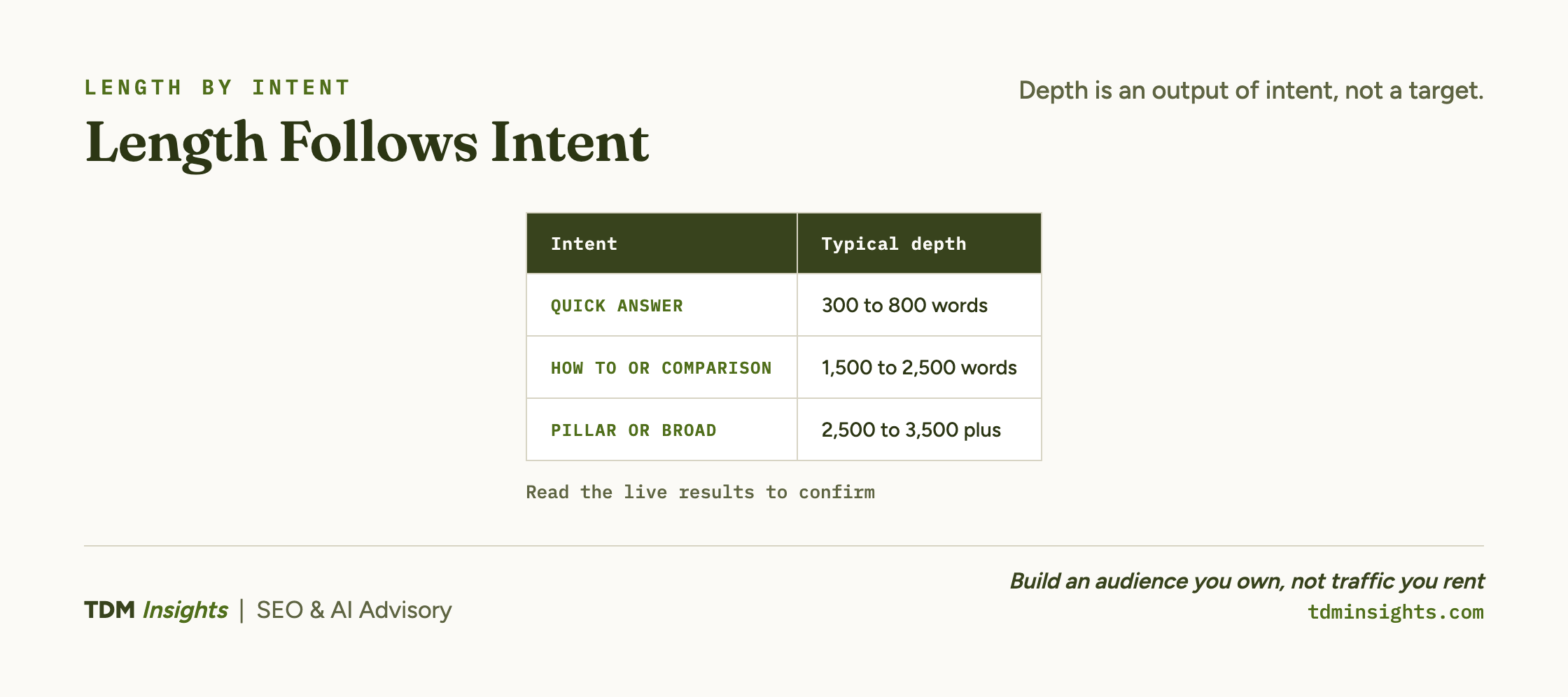
Classify the query first, then size the article to what that intent requires.
The table is a starting estimate, not a rule. The way to confirm it is to read the live results for your keyword.
If the first page is full of 2,000-word guides, a 500-word post will read as thin against the expected depth, and a 4,000-word essay will overshoot what the searcher wanted. A worked example: “best time to post on instagram” is a quick-answer query that the top results settle in roughly 1,200 words, while “how to do keyword research” is a how-to whose page-one pages run 2,500 to 3,000 because the task has more steps. Same content type, different depth, set by the task behind each query.
The expected depth drifts as the results change, so an older post that has slipped often needs a refresh to win back the rankings it lost once a competitor went deeper.
HubSpot’s breakdown in the anatomy of a blog post gives ideal-length data with the same caveat: the figures are averages, and the topic decides. The discipline is to classify the intent, check the SERP, and pick a target that matches both.
Book a free diagnosis
If your posts all land around the same length regardless of topic, that is usually a sign they are written to a quota instead of to intent, and some are padded while others are thin. A free diagnosis checks a sample of your articles against the depth their queries actually demand, flags the ones bloated past their intent and the ones too shallow to compete, and shows where right-sizing would win the most ground. It is a working session, not a pitch.
Why Padding Hurts
Padding does active damage. Filler added to reach a word count buries the answer, raises bounce rates, and signals lower quality to readers and engines, both of which reward content that satisfies intent efficiently.
The mechanism is straightforward. A reader who has to scroll past three throat-clearing paragraphs to reach the answer is a reader more likely to leave.
That behavior is observable in Google Search Console: a page that ranks but loses clicks to a tighter competitor is often one that buried its answer under padding. A reader who bounces also never reaches the point where a page can turn them into a customer, so padding costs the conversion too.
Padding is also how AI bloat creeps in. Ask a model for “a 2,000-word article” and it will produce 2,000 words whether the topic needs them or not.
Using AI without sounding like AI covers the tells; the fix here is the same: write to intent, not to a number, so the model is not filling space to hit a target. Efficient, intent-matched answers are also what shape how AI answer engines choose their sources rather than getting skimmed.
CMI’s readability primer makes the broader case that clarity beats bulk. The data points the same way: quality markers, not raw length, correlate with strong results. Cut anything that does not add value.
How to Set the Length for One Article
Here is the method, in order, for any single post.
- Read the brief and confirm the intent. Scope is a brief decision, settled before you draft, not after.
- Classify the query: transactional, how-to or comparison, or broad informational.
- Read the live SERP. Note the depth the ranking pages actually carry.
- Set a target range that matches the intent and the SERP, not the average.
- Write to answer the question completely. Cover what the intent requires, including the edge cases the body should address.
- Stop. When the question is answered, the article is done, regardless of the count.
There is a related but separate question founders conflate with this one: how many articles a topic needs, versus how long each should be. The number of posts a topic needs and the length of each are two different decisions, and both depend on a realistic SEO timeline before results compound.
That timeline is also what decides whether SEO is worth it for a startup right now, since the payoff is paced, not instant. Both also sit inside the first 90 days of SEO for a startup when its pages are right-sized and well linked.
Once the length is right, the next production move is making the answers inside it extractable, which is the job of a well-built FAQ block. Right length first, then make the answers easy to lift, so a ranked page also feeds what answer engine optimization actually is instead of leaking the visit.
Frequently Asked Questions
How long should a blog post be?
A blog post should be as long as it takes to fully answer the reader’s question, which usually lands between 1,000 and 2,500 words depending on intent. A quick how-to may need 800 words; an in-depth pillar guide may run 3,000 or more. Match length to the search intent, not to an arbitrary target.
Does longer content rank better on Google?
Not directly. Large-scale analyses found no straightforward link between word count and rankings; pages of many lengths rank on page one. Longer content does tend to earn more backlinks, which help indirectly, but padding a thin post to hit a number does not improve its position. Completeness, not length, is what satisfies intent.
What is the ideal blog post length for SEO?
There is no single ideal length; the right count is whatever satisfies the query most completely without padding. Industry data clusters around 1,500 to 2,500 words for competitive informational topics, but a 600-word answer can outrank a 3,000-word one if it serves the searcher faster and more clearly. Read the live results to gauge expected depth.
What is the average blog post length?
The average blog post runs roughly 1,300 to 1,400 words. Orbit Media’s annual blogging survey has put the average near 1,400 words, up from about 800 a decade earlier. Averages describe norms, not the right length for your specific topic, so treat them as context rather than a target to copy.
Should blog post length depend on search intent?
Yes, intent should drive length. Transactional and quick-answer queries want short, direct content; comparison and how-to queries want moderate depth around 1,500 to 2,500 words; broad informational and pillar topics justify 3,000-plus words. Checking what already ranks for your keyword shows the depth searchers expect for that intent.
Does padding a blog post hurt SEO?
Yes, padding hurts. Filler added to reach a word count buries the answer, raises bounce rates, and signals lower quality to readers and engines, both of which reward content that satisfies intent efficiently. The data shows quality markers, not raw length alone, correlate with strong results, so cut anything that does not add value.
Continue Reading:
More On Content Production and Quality
- How to Produce Content That Ranks and Gets Cited
- How to Write a Content Brief (That Gets It Right)
- Writing for E-E-A-T: Prove Experience on the Page
- Use AI to Write Without Sounding Like AI
- How to Write FAQs That Double as AEO Fuel
More from TDM Insights
- Keyword Research for Startups: Demand You Can Win
- How AI Answer Engines Choose Their Sources
- How Long Does SEO Take? An Honest Timeline
- SEO for Startups: What to Do in the First 90 Days
- Answer Engine Optimization: What AEO Actually Is
Explore TDM Insights Categories