
Writing for E-E-A-T: Prove Experience on the Page
Trust is shown, not claimed. The on-page signals readers and Google both read as real experience, E-E-A-T made concrete.
 By David Jubé · May 18, 2026 · 10 min read
E-E-A-T stands for Experience, Expertise, Authoritativeness, and Trustworthiness. It is the framework Google’s human quality raters use to judge how credible a page and its creator are.
Writing for E-E-A-T is not chasing a score. There is no E-E-A-T score, and it is not a dial you turn. It is proof you put on the page so a reader and an algorithm both conclude a real, qualified person did the work.
The practical version is simple: replace assertions with evidence. “We are experts in this” does nothing. A dated process note, an original screenshot, the actual numbers you got, and a named author with credentials do the work that the assertion only claims.
Google added the first E, Experience, in December 2022 to reward genuine first-hand knowledge. That addition is the whole shift: it is no longer enough to be informed about a topic, the best pages show they have actually done the thing.
This article makes E-E-A-T operational. It covers what each letter means, why trust sits at the center, and the on-page checklist that turns trust from a claim into something visible.
Key takeaways
- Writing for E-E-A-T means replacing assertions with evidence, because there is no E-E-A-T score; proof you put on the page convinces both a reader and Google’s systems a qualified person did the work.
- The on-page proof checklist is first-hand specifics like original photos and dated process notes, real numbers, named sources, an identified author with relevant credentials, and transparent reasoning that shows the trade-offs.
- Trust sits at the center of the four signals because Google states an untrustworthy page has low E-E-A-T regardless, built through accurate content, clear authorship, transparent sourcing, and a secure, well-maintained site.
- Test every proof line by deletion: a claim stays true if you remove the work, a fact does not, so ‘years of experience’ fails while ‘ran this process across 40 client articles in 2024’ passes.
What E-E-A-T Actually Means
The four letters describe four kinds of credibility, and they are not interchangeable.
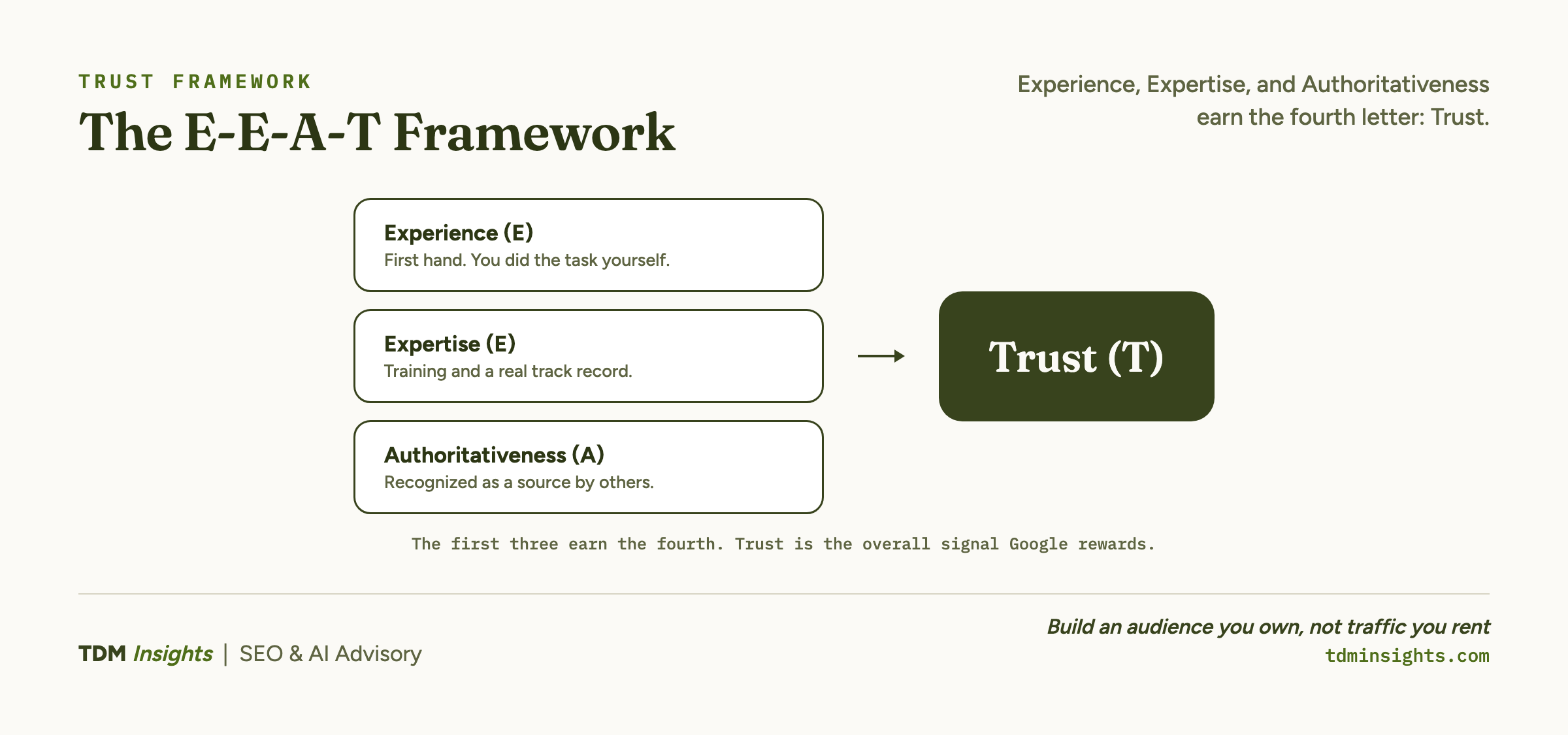
- Experience. First-hand or life experience with the topic: you used the product, visited the place, did the task.
- Expertise. Formal or demonstrated knowledge: training, qualifications, a track record in the field.
- Authoritativeness. Recognition by others: the field treats you, or your site, as a go-to source.
- Trustworthiness. Accuracy, honesty, and safety: the page and the site can be relied on.
The framework lives in Google’s Search Quality Rater Guidelines, the document raters use to assess pages. You can read the source: Google’s Search Quality Rater Guidelines is published in full, and it is worth reading the actual definitions rather than secondhand summaries.
Experience and expertise differ in a way that matters for writing. A doctor has expertise on a medication. A patient who took it for two years has experience with it.
The strongest pages often need both, and many topics now reward the experience signal that summaries cannot fake. Lumar’s explainer on why the new Experience signal matters in content covers why Google added it.
This is the proof stage of the brief-to-draft-to-proof production system. Brief and draft get the article written. Proof is what makes it trusted, which is the same trust layer that decides how AI answer engines choose their sources.
Why E-E-A-T Is Not a Ranking Factor (and Why It Still Matters)
E-E-A-T is not a direct ranking factor. There is no signal in the algorithm labeled “E-E-A-T,” and Google Search Central has said so directly.
What exists is a set of ranking systems that use many signals aligning with the concepts. Pages that demonstrate real experience, expertise, and trust tend to perform better because the signals that produce that impression are the signals the systems reward.
So the correct way to write for E-E-A-T is to build it into the page, not to hunt for a switch. Building proof into every article is also how a site earns authority through earned links, even with no budget rather than relying on one trusted post among many untrusted ones.
This matters because the proof you decide on belongs in the brief. Writing a content brief makes the proof a planned input, so the writer is not improvising credibility at the end. The same trust signals are what make a page worth quoting when you work on getting cited by ChatGPT, Perplexity, and AI rather than leaving a pile of unconvincing posts.
Why Trust Sits at the Center
Trust is the most important of the four, and Google says so explicitly: an untrustworthy page has low E-E-A-T no matter how experienced, expert, or authoritative it appears.
Experience, expertise, and authority all feed trust. They are the inputs. Trust is the output the reader and the rater actually act on, and it is the same trust a reader has to feel before a page can turn them into a customer.
You build trust with accurate content, clear authorship, transparent sourcing, working contact details, and a secure, well-maintained site. Nielsen Norman Group’s research on four factors that communicate trustworthiness names the on-page elements users read as credible, and they map almost one-to-one onto what raters look for.
A page can be technically expert and still fail on trust: no author, no sources, claims that do not check out. When that happens, the expertise is wasted, because nothing on the page lets a reader believe it.
The On-Page Proof Checklist
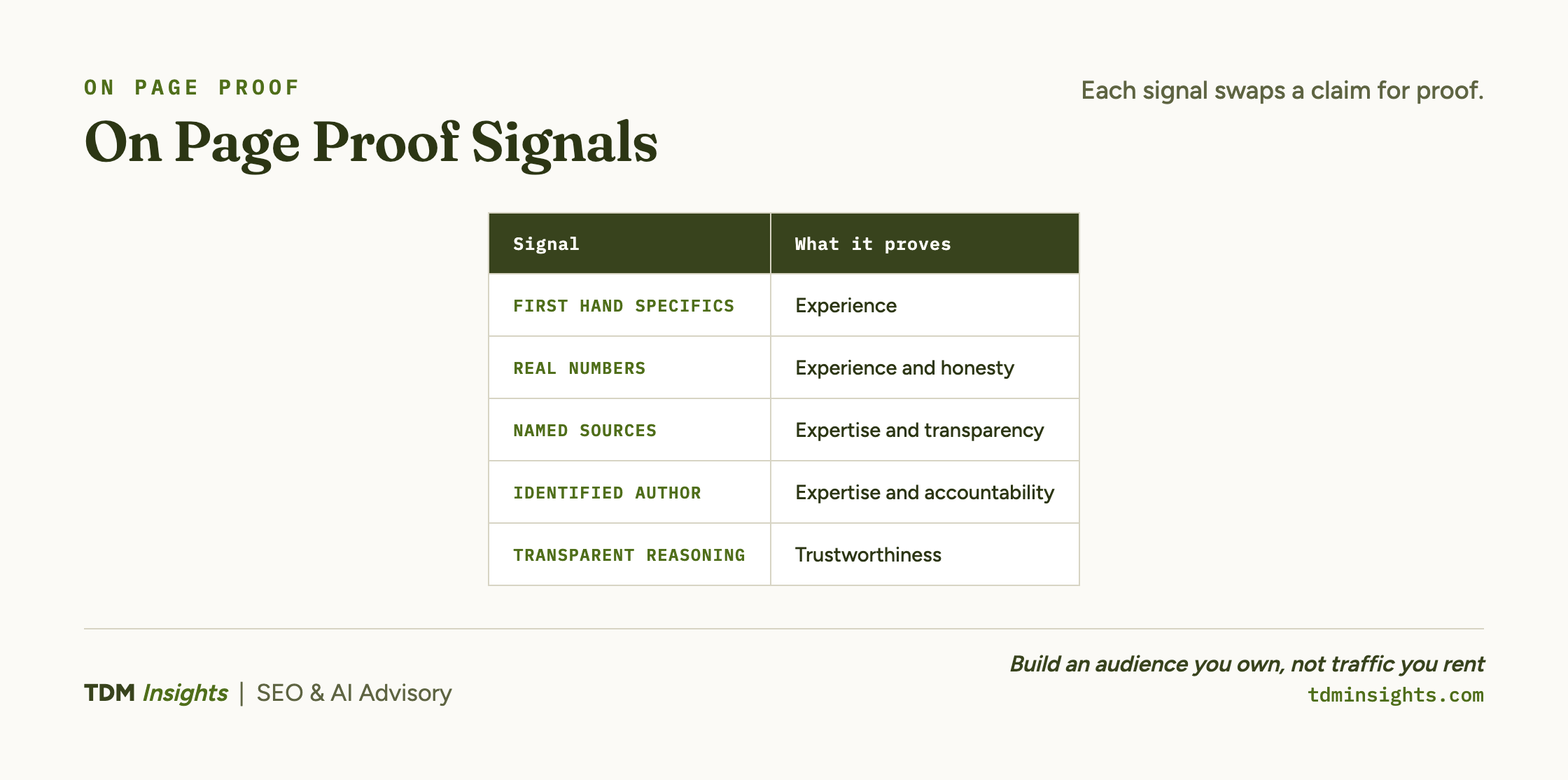
Proof is concrete. Here is what to put on the page, in order of how much it moves the needle.
The author bio is the cheapest high-value move, and an easy one to add. Search Engine Journal’s guide to how to write an author bio for E-E-A-T covers what a credible bio carries: relevant credentials, a real photo, and a link to the author’s track record.
The pattern across the table is the same. Each signal swaps a claim anyone could write for proof only the person who did the work could supply.
Book a free diagnosis
Plenty of well-researched articles still read as undifferentiated because nothing on the page proves a real practitioner wrote them. A free diagnosis runs a sample of your published pages through the on-page proof checklist: which ones assert expertise without showing it, which lack an author, which could have been written by anyone. You leave with the specific proof each page is missing and where to add it first. It is a working session, not a pitch.
Drafting Proof Without It Reading Generic
There is a trap in the proof stage. You add the right elements, an author box, a few sources, a results line, and the page still reads as generic, because the proof itself is generic.
The fix is specificity. “We saw strong results” proves nothing. “Impressions rose 10.1x over 28 weeks” proves something a reader can test against their own experience.
Run that test on every proof line: a claim is anything that stays true if you delete the work, a fact is anything that does not. “Our team has years of experience” survives deletion; “we ran this process across 40 client articles in 2024” does not.
Confident-but-empty proof language is worse than none, and it is the default a model produces unprompted. Using AI without sounding like AI covers how to keep the human-supplied specifics in while using AI for the scaffolding.
On-page proof is also what makes an answer extractable: the same credibility that ranks a page is what answer-first writing with schema puts in front of an engine. And proof is one of the strongest of the citation signals behind what AEO actually is rather than a cosmetic afterthought.
Building E-E-A-T on a Brand-New Site
A new site has no authority yet, which feels like a wall. It is not. Of the four signals, experience and trust are the two you can show from day one, on every page.
That is the same proof checklist applied without waiting: first-hand content, named author bios, cited sources, a clear About page, working contact details. None of it depends on a reputation you have not built yet.
Authority, the recognition part, comes later and from outside. It is earned through mentions and links from respected sites in your niche, and through the topical depth that organizing your content into clusters and pillar pages signals, both of which compound over time. CMI’s piece on earned media and authority in search covers how off-page reputation builds the A in E-E-A-T, and NN/g’s work on communicating trustworthiness in web design covers the on-page half you control immediately.
Reputation and trust compound, so consistency over time beats a burst of effort. Older pages do not keep their trust forever, which is why refreshing a post to win back the rankings it lost is part of holding the trust you built. A new site cannot buy authority, but it can prove experience on every page from the first one, and that is the part you control.
Frequently Asked Questions
What does E-E-A-T stand for in SEO?
E-E-A-T stands for Experience, Expertise, Authoritativeness, and Trustworthiness. It is the framework in Google’s Search Quality Rater Guidelines that human raters use to judge how credible a page and its creator are. Google added the first E, Experience, in December 2022 to reward genuine first-hand knowledge of a topic.
Is E-E-A-T a Google ranking factor?
No, E-E-A-T is not a direct ranking factor, and there is no E-E-A-T score. Google’s ranking systems use many signals that align with the concepts, so content showing real experience, expertise, and trust tends to perform better. Treat E-E-A-T as a quality framework to build into the page, not a switch you flip.
What is the extra E (Experience) in E-E-A-T?
Experience means the content creator has genuine first-hand or life experience with the topic, such as actually using the product, visiting the place, or doing the task. Google added it in December 2022 because firsthand accounts are often more useful and trustworthy than secondhand summaries. It sits alongside expertise, not in place of it.
How do you show experience on a page?
Show experience with specifics only a real user would know: original photos or video you captured, dated process notes, exact results, the mistakes you hit, and concrete detail instead of generic advice. Add a clear byline linking to an author bio with credentials. These signals tell readers and raters a real person did the work.
Why is trust the most important part of E-E-A-T?
Trust is the most important part because Google states that untrustworthy pages have low E-E-A-T no matter how experienced, expert, or authoritative they seem. Experience, expertise, and authority all feed into trust. Build it with accurate content, clear authorship and contact details, transparent sourcing, and a secure, well-maintained site.
How do you build E-E-A-T on a brand-new website?
Build E-E-A-T on a new site by publishing genuinely first-hand content, adding detailed author bios with real credentials, and citing reputable sources. Create a clear About page and contact details, then earn mentions and links from respected sites in your niche. Reputation and trust compound, so consistency over time matters more than speed.
Continue Reading:
More On Content Production and Quality
- How to Produce Content That Ranks and Gets Cited
- How to Write a Content Brief (That Gets It Right)
- Use AI to Write Without Sounding Like AI
- How Long Should a Blog Post Be? Intent Over Count
- How to Write FAQs That Double as AEO Fuel
- The One-CTA Rule: One Ask Per Page Wins
More from TDM Insights
- How AI Answer Engines Choose Their Sources
- Backlinks for Startups: Earn Authority, No Budget
- How to Get Cited by ChatGPT, Perplexity, and AI
- Schema Markup for AI: Answer-First Writing Guide
- Answer Engine Optimization: What AEO Actually Is
Explore TDM Insights Categories