
How to Write a Content Brief (That Gets It Right)
Four decisions before you write (intent, angle, scope, proof) keep you from shipping the wrong article. How to brief it right.
 By David Jubé · Jun 1, 2026 · 10 min read
The most expensive content mistake is not a typo. It is writing the wrong article, all the way to a finished draft, before anyone notices it answers a question no one was asking.
A content brief prevents that. It is a short planning document, usually one to two pages, that decides what to produce and why before a word is written.
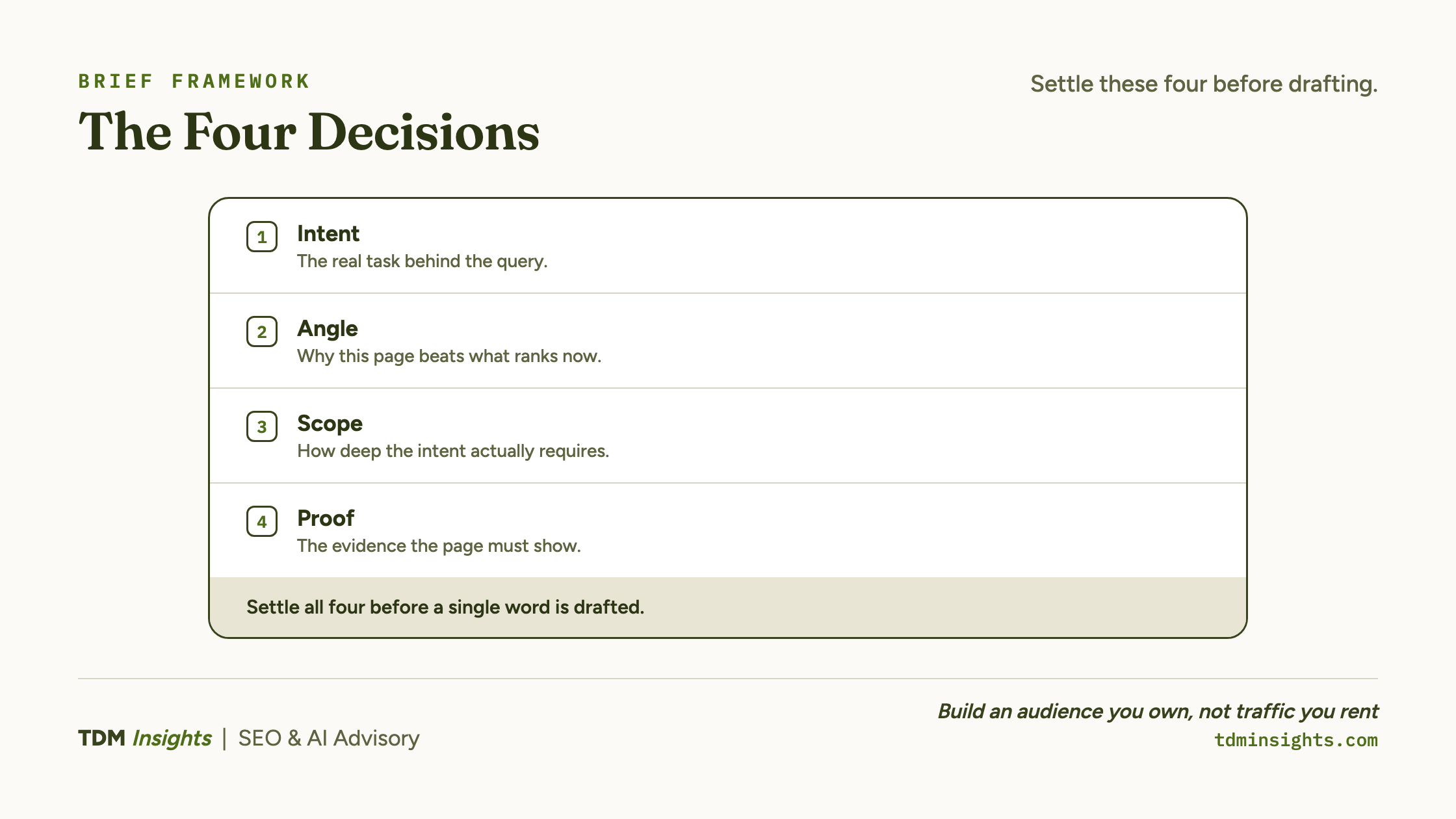
The good brief is not a formatting exercise. It is a set of decisions: the search intent, the angle that beats the current results, the scope the intent requires, and the proof the page must show. Settle those four and the first draft lands right instead of needing a rewrite.
Briefs feel like overhead until you count the rewrites they prevent. The four decisions take minutes. A wrong-intent draft costs hours, and sometimes never ranks at all.
This article walks the four decisions and shows what a usable brief contains.
Key takeaways
- A content brief is not a formatting exercise but four decisions you settle before drafting: intent, the angle that beats current results, the scope the intent requires, and the proof the page must show.
- Confirm search intent by reading the live results for your keyword rather than guessing, since the format Google already rewards tells you whether searchers want a how-to, comparison, or explainer.
- The angle is the gap the current results miss, so name in one sentence why your version beats them, and if you cannot finish that sentence the article is not yet ready to write.
- Proof is the specific evidence the page must show, such as original screenshots, real benchmark numbers, or a named expert quote, and it is the decision briefs skip entirely.
What a Content Brief Is, and What It Is Not
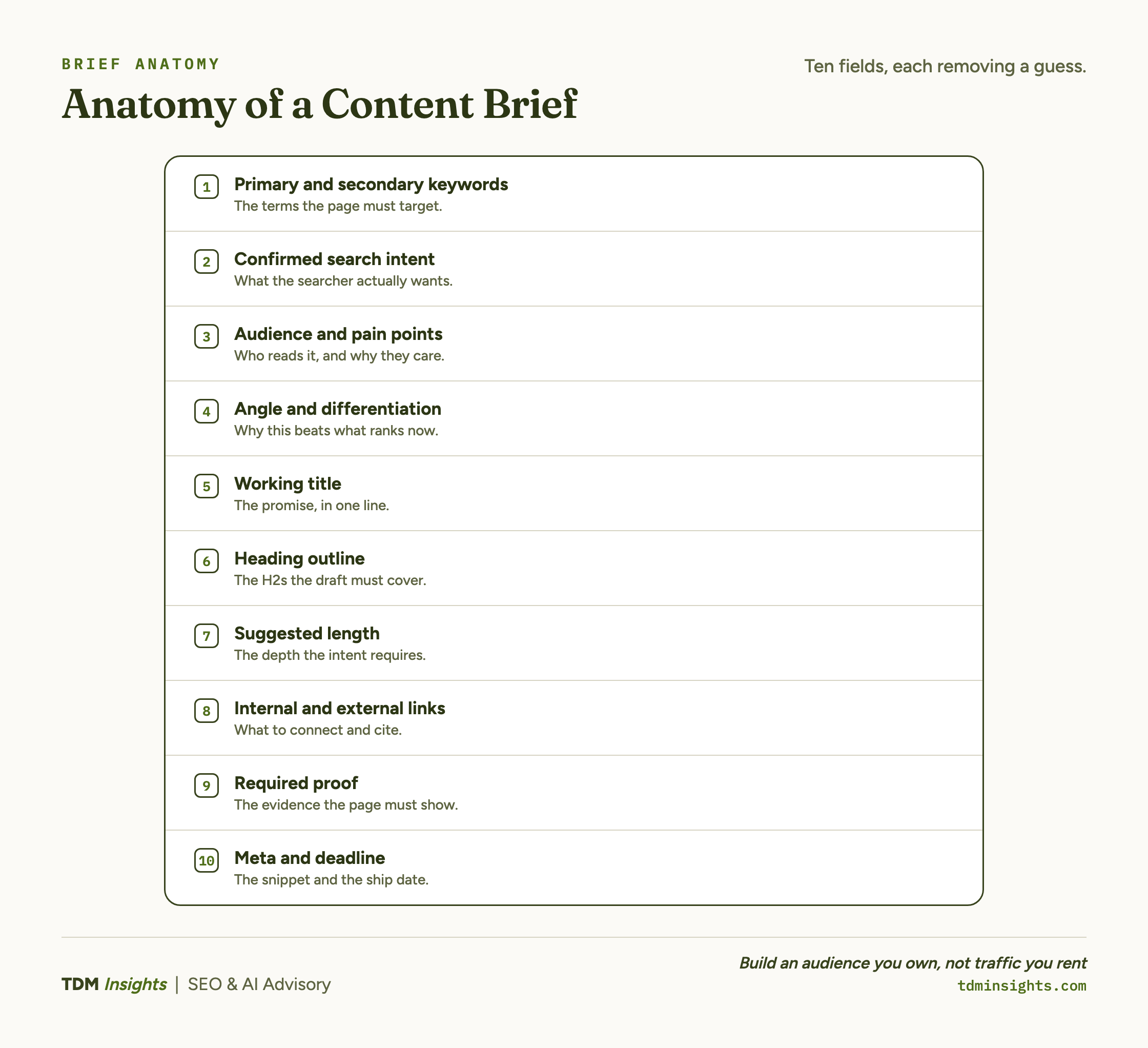
A content brief tells a writer exactly what to produce. It defines the topic, the primary keyword, the confirmed search intent, the audience, the angle, a working title, a suggested length, the required headings, and the link targets.
Clearscope’s explainer on what a content brief is and why it matters ties each field back to keywords, links, and intent, which is the right frame.
A brief is broader than an outline. The outline is one part of the brief, the heading-level skeleton showing how the piece flows.
MarketMuse puts it plainly in why a content brief is not just an outline: the brief is the compass, the outline is the roadmap inside it. Confuse the two and you produce a well-structured article that answers the wrong question.
This brief is the first stage of the brief-to-draft-to-proof system, which carries an article from target to published page. It turns a strategy decision into a single target a writer can hit, the way a clear plan starts with finding the demand you can actually win one query at a time. A single brief also has to know where its article sits in the larger map of topic clusters and pillar pages, so it links up and down to the right neighbors.
Decision One: Intent
Intent is the real task behind the search. Confirm it by reading the live results for your keyword, not by guessing.
The format Google already rewards tells you the shape searchers expect. If the first page is all step-by-step guides, the searcher wants a how-to, and a long opinion essay will bounce no matter how good it is.
Intent falls into four types: informational (learn something), navigational (find a specific page), commercial (compare before buying), and transactional (act now). Matching it is a core ranking factor, and Google Search Central treats meeting the searcher’s need as the baseline its helpful-content guidance is built on.
The four types of search intent in detail covers each. Siege Media’s breakdown of how search intent shapes content shows how the same keyword can demand a completely different article depending on the intent behind it.
Write down the confirmed intent in one sentence. If a writer can read it and know what task the reader is trying to finish, this decision is done.
Decision Two: Angle
Angle is what makes your version worth ranking over the results already there.
An article that restates the top five results gives an engine no reason to prefer it. The angle is the gap: the data point the current results miss, the clearer explanation, the first-hand experience, the contrarian-but-correct take.
You find it by reading what ranks and naming what is absent. Right Side Up’s breakdown of the anatomy of an effective content brief treats the differentiation statement as a required field, not a nice-to-have, because a draft with no angle is a draft with no reason to exist.
Write the angle as one sentence: “Ours beats the current results because it ___.” If you cannot finish that sentence, the article is not ready to write.
Decision Three: Scope
Scope is how deep the intent requires you to go, expressed as a suggested length and a heading outline.
Scope is set by intent, not by a quota, which how long a blog post should be works through in full. For the brief, capture it as a word range plus a one-line reason read from the live results.
Scope sizes one article; a separate decision is how many posts a topic needs to rank, and the brief should know which of the two it is answering. The brief names the target so the writer does not pad a thin topic or rush a deep one, and the scope should reflect the technical groundwork that lets a page get crawled and indexed before depth even matters.
The heading-level outline lives here. Superpath’s practitioner walkthrough on how to create a content brief shows the outline as one section among intent, audience, and links, which is the correct proportion.
Give a suggested word range and the H2-level headings. The writer fills the prose; the brief decides the shape.
Book a free diagnosis
If your articles read fine on their own but never rank, the issue is often upstream of the writing: a missing or wrong intent decided before anyone typed a word. A free diagnosis looks at a sample of your published pages against the four brief decisions, intent, angle, scope, and proof, and shows where the brief failed and the draft inherited it. It is a working session on your real content, not a sales call.
Decision Four: Proof
Proof is the specific evidence the page must show, and it is the decision most briefs skip entirely.
A brief that names “two original screenshots, the actual benchmark numbers, and a named expert quote” forces the draft to carry trust signals. A brief that says nothing about proof gets an article full of confident claims and nothing to back them.
The proof decision sets up the proof stage of production: proving experience on the page shows how to put that proof on the page so it reads as real experience. It is also what answer engines weigh when deciding how AI answer engines choose their sources rather than just which page ranks.
Bynder’s overview of creative brief examples and fields lists evidence and reference material as standard brief fields. Treat proof the same way: a required input, decided before drafting, not a thing the writer scrambles for at the end.
What a Usable Brief Contains
The four decisions translate into a one-page document. Keep it to a page so it actually gets used.
Clearscope’s step-by-step on how to create an SEO content brief and CMI’s practical guide to writing a brief both land on a similar set of fields. The form matters less than the discipline: every field removes a guess.
When to Use a Brief, and How Heavy
Use a brief on any article that more than one person touches, and a lightweight one even when you write solo.
A competitive head term justifies a full one-page brief with a researched outline. A quick supporting post still benefits from a confirmed intent and an angle, even if you scribble them in three lines.
CMI’s guide to building a content operations workflow shows where the brief sits in production: at the front, as the gate every piece passes through before drafting. That is the point of the brief. It moves the hardest decisions to the cheapest moment to make them, before the writing starts.
A confirmed intent is also what lets the page get cited by ChatGPT, Perplexity, and AI, not just ranked, because both reward an article that answers the real task. And naming the audience and their pain points up front is what later lets the finished page turn a reader into a customer instead of just informing them.
Frequently Asked Questions
What is a content brief?
A content brief is a short planning document, usually one to two pages, that tells a writer exactly what to produce and why. It defines the topic, primary keyword, search intent, audience, angle, working title, suggested length, required headings, and link targets, so the first draft lands right instead of needing a full rewrite.
What should a content brief template include?
A content brief template should include the primary and secondary keywords, the confirmed search intent, the target audience and their pain points, a working title, a heading-level outline, a suggested length, internal and external links to cite, the meta title and description, and the deadline. Keep it to about one page so it gets used.
How do you figure out search intent before writing?
Confirm search intent by reading the live results for your keyword, not by guessing. Note the format Google already rewards (guide, list, comparison, definition) and the questions the top pages answer. Intent is informational, navigational, commercial, or transactional, and matching it is a core ranking factor. Write to the wrong intent and the page bounces.
What is the difference between a content brief and an outline?
A content brief is broader than an outline. The brief defines what the piece covers and why: intent, audience, keywords, angle, links, and constraints. The outline is one part of the brief, the heading-level skeleton showing how the piece flows. Put simply, the brief is the compass and the outline is the roadmap inside it.
Do you need a brief for every article, or only big ones?
Use a brief on any article that more than one person touches, and a lightweight one even when you write solo. The four decisions (intent, angle, scope, proof) take minutes and prevent hours of rework. Bigger or more competitive pieces justify more detail; a quick post still benefits from a confirmed intent and angle.
What makes a brief good enough that the first draft is usable?
A brief is good enough when it removes the writer’s biggest unknowns: the exact intent, the angle that beats the current results, the scope that intent requires, and the specific proof the page must show. If a writer can start without asking “who is this for and what is the point,” the brief has done its job.
Continue Reading:
More On Content Production and Quality
- How to Produce Content That Ranks and Gets Cited
- Writing for E-E-A-T: Prove Experience on the Page
- Use AI to Write Without Sounding Like AI
- How Long Should a Blog Post Be? Intent Over Count
- How to Write FAQs That Double as AEO Fuel
More from TDM Insights
- Keyword Research for Startups: Demand You Can Win
- SEO for Startups: What to Do in the First 90 Days
- Technical SEO Checklist for Founders, by Severity
- How AI Answer Engines Choose Their Sources
- How to Get Cited by ChatGPT, Perplexity, and AI
Explore TDM Insights Categories