
SEO and AI Visibility Tracking Tools, Compared
Track AEO, GEO, and LLM citations without guessing. The tools compared on what each tracks, who it fits, and what it costs.
 By David Jubé · Apr 17, 2026 · 12 min read
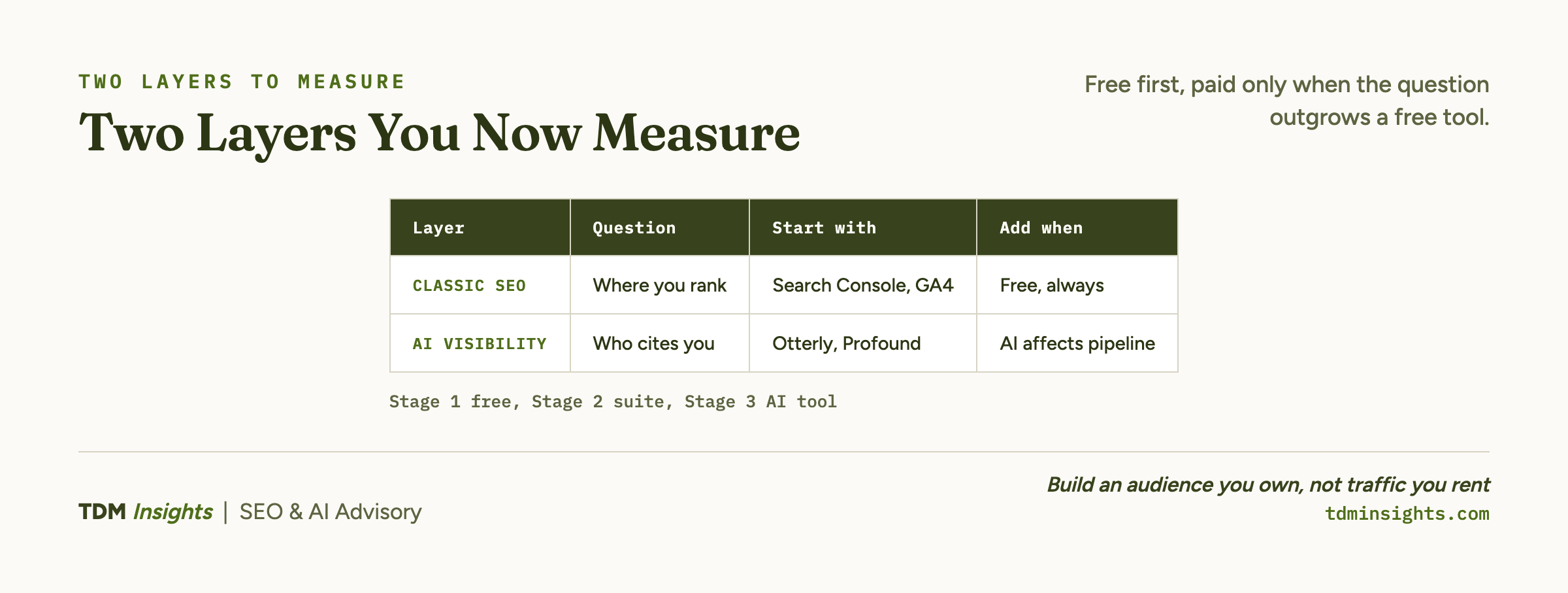
You now need two layers of measurement, not one. The classic SEO layer tracks rankings, clicks, impressions, and technical health. The new AI-visibility layer tracks whether AI engines cite you.
Those AI engines are ChatGPT, Perplexity, Google AI Overviews, Gemini, and Copilot. Search Console will not tell you when one of them quotes your page, so a second class of tool has appeared to watch that surface.
Start free. Google Search Console plus Google Analytics 4 cover the classic layer at zero cost, and they are non-negotiable. Add paid tools only as the stakes rise.
Graduate to a paid SEO suite when you are competing for real keywords and need backlinks, rank tracking, and audits in one place. Add a dedicated AI-visibility tool when citations in AI answers start to matter to your pipeline.
The table below is the short version. Every section after it explains one idea once, so you can read it all or jump to the layer you are weighing.
Prices and features change fast in this space, so treat the cost column as a band and verify before you buy.
Key takeaways
- You now measure two separate layers: a classic SEO layer that tracks rankings, clicks, and technical health, and an AI-visibility layer that tracks whether ChatGPT, Perplexity, and AI Overviews cite you.
- Start free and non-negotiable: Google Search Console, Google Analytics 4, Google Trends, and Bing Webmaster Tools cover the classic SEO layer at zero cost, so add paid tools only as the stakes rise.
- Graduate to one paid SEO suite like Ahrefs, Semrush, Moz, or SE Ranking when you compete for real keywords, and run a crawler like Screaming Frog or Sitebulb only for technical audits.
- Dedicated AI-visibility tools such as Profound, Otterly.ai, and Peec AI run scheduled prompts to record which brands AI answers cite, though suites you already pay for can fold that tracking in cheaply.
The two layers you now measure
The classic SEO layer answers an old question: where do you rank in Google, and what does that earn you? It covers clicks, impressions, average position, and the technical health that lets a page get indexed at all.
The AI-visibility layer answers a new one: when someone asks an AI engine a question, does the answer cite you? This surface is invisible to Search Console, because an AI answer is not a Google search result.
Both matter now because buyers research in both places. The same person types a query into Google one minute and asks ChatGPT or Perplexity the next, acting on whatever it tells them, which is why measuring AI traffic that arrives with no referrer has become its own discipline.
The tools split cleanly along that line. One set watches the ten blue links and the technical machinery behind them. The other set watches the generated answer and the handful of sources it names.
You do not have to choose between the two layers. You phase into them, free first, paid only when the question you are asking outgrows what a free tool can show.
Free essentials every founder should run
Start here, always. Google Search Console is the baseline: it reports your own clicks, impressions, average position, indexing status, and Core Web Vitals, and it now surfaces some AI-feature appearances too. Skipping it is not an option.
Google Analytics 4 sits next to it and shows what people do once they land: behavior, traffic by channel, and conversions. Note one quirk: AI-referred visits often arrive as direct traffic with no referrer, so they can hide in plain sight.
Google Trends is free and useful for sizing relative search interest and spotting seasonality before you commit to a topic. It tells you whether demand is rising, flat, or fading.
Bing Webmaster Tools rounds out the free set. Bing matters more than its market share suggests, because ChatGPT search has drawn on Bing’s index, so your standing there can shape whether an AI engine finds you.
Book a free diagnosis
Most founders either buy too many tools or fly blind on the AI-visibility layer entirely. We will look at your stage, your traffic, and your goals, then tell you which tools you actually need right now and which you can skip. We will also help you set up the free baseline so you are measuring both layers from day one. Founder to founder, no pitch, no upsell.
Paid SEO suites
Graduate to a paid suite when free tools stop answering your questions. The signal is competition: you are chasing keywords other people want, and you need backlinks, rank tracking, keyword research, and site audits in one workspace.
Ahrefs is the deep end for backlinks, keywords, rank tracking, and site audits, and it added Brand Radar to track AI mentions inside the same tool. Semrush is the broad all-in-one, pairing classic SEO with a toolkit for AI and AI-Overviews visibility.
Moz is the approachable option, known for a gentler learning curve and its Domain Authority metric. SE Ranking is the value pick: a more affordable suite that still includes rank tracking and an AI-results tracker.
You rarely need more than one suite. Pick the one whose pricing and depth match where you are, and remember that the suite you already pay for may now cover AI tracking too, as covered in how AI answer engines choose their sources.
A suite earns its monthly cost in two ways. It shows you what competitors rank for so you can find winnable gaps, and it audits your own site so you stop bleeding rankings to fixable errors. Neither job is something the free tools do well.
Treat the trial periods seriously before you commit. The interfaces differ a lot, and the one that fits your habits is the one you will actually open each week.
Technical crawlers
A crawler walks your whole site the way a search engine does and reports what is broken: dead links, redirect chains, missing titles, duplicate content, and indexation problems. Run one when technical issues are the thing holding rankings back.
Screaming Frog is the desktop standard. It crawls up to 500 URLs free, then moves to a paid license for larger sites and advanced features. It is hands-on and fast, but it assumes you know what to fix.
Sitebulb is the gentler counterpart. It runs a paid technical audit and, crucially, explains and prioritizes each recommendation, which suits a founder who wants the audit translated into a to-do list.
A crawler is not a weekly tool for a small site. Run one before a relaunch, after a migration between website platforms like WordPress, Shopify, Wix, and Squarespace, or when rankings drop for no obvious reason, the kind of work covered in technical SEO for founders.
The new layer: AI visibility / AEO / GEO / LLM tracking
These tools all do one thing: track whether and where you are cited across the AI engines, meaning ChatGPT, Perplexity, Google AI Overviews, Gemini, and Copilot. The labels AEO, GEO, and LLM tracking describe the same goal, which is showing up inside AI answers, as explained in answer engine optimization, what AEO actually is.
They work by running prompts against the AI engines on a schedule and recording which brands and URLs the answers cite. That gives you a visibility score, the prompts you appear in, and who is appearing instead of you.
Profound leads the enterprise end with answer-engine analytics and prompt-level visibility. Evertune and Scrunch AI also serve larger teams, with Evertune focused on brand presence across models and Scrunch AI covering AI search and agent visibility.
Otterly.ai is the SMB-friendly entry point for tracking brand mentions and links across AI search. Peec AI adds competitor benchmarking, and Rankscale focuses on your rank and visibility inside AI answers. The lever these tools inform is editorial: getting cited by ChatGPT, Perplexity, and AI comes from the writing, not the dashboard.
Note that you may not need a standalone tool at all. Ahrefs (Brand Radar) and Semrush now fold AI-mention tracking into suites you might already pay for, which is the cheapest way to start watching this layer.
The market here is young and moving fast. New tools launch every few months, pricing shifts, and features that are paid today may be bundled tomorrow, so confirm the current state before you sign up.
Read the numbers as direction, not gospel. An AI-visibility score tells you whether you are trending into or out of the answers, which is the signal that should shape your next round of content.
A founder’s starter stack
Stage one is free and mandatory. Run Search Console, GA4, Google Trends, and Bing Webmaster Tools, and actually read them. This covers the classic layer and gives you a first read on AI-feature appearances.
Stage two arrives when you are competing for keywords. Add one paid SEO suite (Ahrefs, Semrush, Moz, or SE Ranking) for backlinks, rank tracking, and audits in one place. Run a crawler like Screaming Frog or Sitebulb when technical issues surface.
Stage three is the AI-visibility layer. If your suite already includes AI-mention tracking, start there. If AI citations are becoming a real channel, add a dedicated tool, Otterly.ai or Peec AI for smaller teams, Profound or Evertune for enterprise.
The work that moves both layers is the same. Tools measure visibility, but content that ranks and gets cited by AI is what earns it, and a content library built to rank, get cited, and pay for itself is the asset every tool here is ultimately measuring.
Frequently Asked Questions
What is the difference between SEO tools and AI visibility tools?
SEO tools track your standing in classic search: rankings, clicks, impressions, backlinks, and technical health in Google and Bing. AI visibility tools track whether AI engines like ChatGPT, Perplexity, and Google AI Overviews cite you in their answers. They measure two different surfaces, and most founders now need both.
Do I need a paid SEO tool or is Search Console enough?
Search Console is enough at the start, and it is mandatory. Add a paid suite once you are competing for keywords and need backlink data, rank tracking, and site audits in one place. The trigger is competition, not company size, so free tools answer most early questions.
How do I track if ChatGPT or Perplexity cite me?
Use a dedicated AI-visibility tool such as Otterly.ai, Peec AI, or Profound, which run prompts against the AI engines and record which brands they cite. Ahrefs Brand Radar and Semrush now include AI-mention tracking in their suites, so check those first if you already subscribe. Search Console alone cannot show this.
What is the best free SEO tool?
Google Search Console is the best free SEO tool and the non-negotiable baseline. It reports your clicks, impressions, average position, indexing status, and Core Web Vitals straight from Google. Pair it with Google Analytics 4 for on-site behavior, Google Trends for demand, and Bing Webmaster Tools for the index behind ChatGPT search.
Are AI visibility tools worth it yet?
They are worth it once AI citations affect your pipeline, not before. If buyers are finding you through ChatGPT or Perplexity, a tracking tool tells you where you stand and who is winning the prompts you want. If AI traffic is still negligible, start with the free AI-mention features inside Search Console or your SEO suite.
Can one tool do both SEO and AI visibility?
Increasingly yes, since Ahrefs added Brand Radar for AI mentions, Semrush has an AI and AI-Overviews toolkit, and SE Ranking includes an AI-results tracker alongside classic SEO. A combined suite is the cheapest way to watch both layers. Dedicated AI tools still go deeper, so enterprise teams often run both.
Continue Reading:
More On Technical SEO for Founders
- Technical SEO for Founders: What to Fix First
- Core Web Vitals Explained for Non-Engineers
- Why Isn’t My Site Indexed? A Founder’s Diagnostic
- Crawl Budget and Indexation for Small Sites
- Site Speed: The Fixes That Actually Move Rankings
- Structured Data for SEO: The Founder’s 80/20
- WordPress vs Shopify vs Wix vs Squarespace, Compared
More from TDM Insights
- How to Measure AI Traffic With No Referrer
- How AI Answer Engines Choose Their Sources
- Answer Engine Optimization: What AEO Actually Is
- How to Get Cited by ChatGPT, Perplexity, and AI
- Content That Ranks and Gets Cited by AI
Explore TDM Insights Categories