
Content-Market Fit: Earn Customers, Not Traffic
The biggest keywords convert worst. Write for buyers over browsers, and choose topics by intent instead of raw volume.
 By David Jubé · May 11, 2026 · 12 min read
Your highest-traffic article can earn you zero customers, and that is not a failure of the writing. The question that decides whether a topic pays is not how many people read it. It is whether the people who read it could ever buy from you.
Content-market fit is the match between what you publish and the readers who can actually become customers. A page has it when the audience it pulls in is also the audience your offer is for, and when it frames the question those readers ask near a decision. Keyword size has nothing to do with it.
That distinction is the whole article. A topic can rank, draw thousands of visits, and still sit at the wrong end of the funnel, attracting people who will never buy what you sell.
So the lens shifts. Before you ask “how much search volume does this topic have,” you ask “how close is this topic to the moment someone becomes my customer.”
Volume is reach. Proximity to the buy is revenue.
Key takeaways
- Content-market fit is the match between what you publish and the readers who can actually become customers, and keyword volume has nothing to do with it.
- Traffic and customers are two different scoreboards: a page can rank first, pull thousands of visits, and convert almost no one because the topic selected an audience that was never shopping.
- Score topics by buyer proximity, not search volume: name the searcher, read the query intent, measure how adjacent the topic is to your offer, and ask whether that reader could buy this quarter.
- Qualifying traffic takes the next step while vanity traffic arrives and leaves, so measure per-article next-step completion instead of a site-wide average.
- Build the high-intent, offer-adjacent converting layer first, then add broad awareness pieces on top to feed readers into it rather than to convert on their own.
Traffic and customers are two different scoreboards
A page produces traffic when it answers a question many people search. It produces customers when the people searching that question are close to buying what you sell. Those two things come apart far more often than founders expect.
The reason is mechanical. Conversion rate measures action, not interest, and broad informational queries draw researchers, students, and the merely curious alongside the occasional buyer. A page can rank first, pull 4,000 visits a month, and convert almost no one, because the topic itself selected for an audience that was never shopping.
This is where the traffic and conversions gap shows up in plain numbers. High visits with near-flat conversion is rarely a CTA problem you can fix with a better button. It is a targeting result baked in the moment you chose the topic.
The borrowed lens here is product-market fit. A product has it when it matches a market that wants it.
Content has it one layer earlier, when a piece matches the people who can become customers rather than just any reader. The team at Grow and Convert formalized this as customer-content fit, and it is the spine of this article: write for the buyer your offer serves, not for the largest possible crowd.
Judge a topic by how close it sits to the buy
Stop scoring topics by search volume and start scoring them by buyer proximity. Buyer proximity is one question: when someone types this query, how close are they to a decision your offer fits?
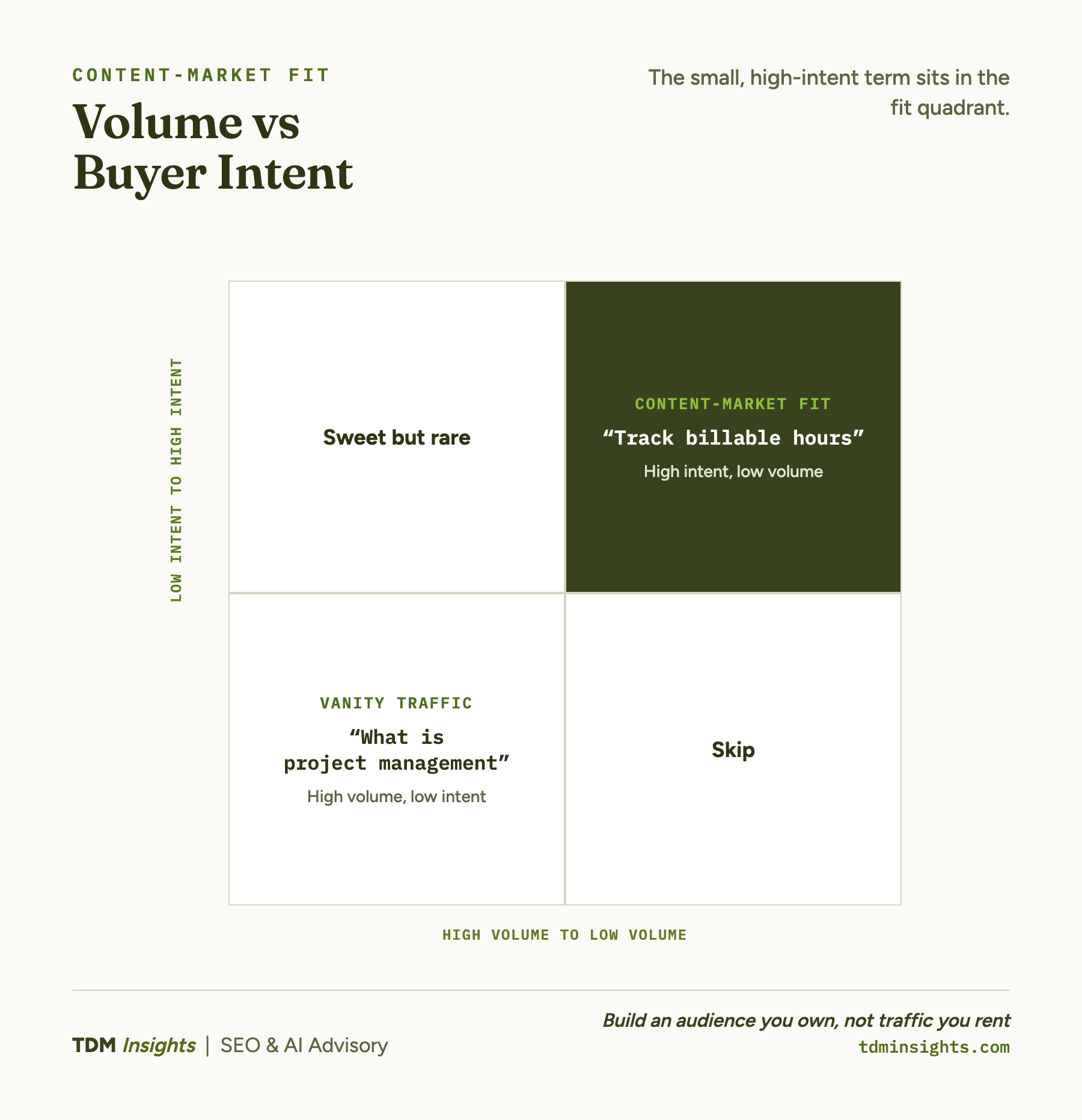
Run each candidate topic through four reads.
- Who is the searcher? Name them. A founder pricing a tool, a student writing an essay, and a competitor doing research can all search the same broad term. If the dominant searcher is not someone your offer serves, the volume is borrowed, not yours.
- What is the intent behind the query? A definitional “what is X” sits far from a purchase. A “how do I fix X,” a comparison, a pricing question, or a use-case question sits close to one. The wording of the query tells you where the reader’s head is, which is exactly what search intent analysis is built to surface.
- How adjacent is the topic to your offer? A topic one short step from what you sell converts; a topic three steps removed informs but rarely sells. The test is whether your product is a natural next sentence after the answer.
- Could this reader buy this quarter? Not this year, not in theory. If the honest answer is no, the topic belongs at the top of the funnel for reach, not in the layer you build first to earn customers.
A topic that clears all four has content-market fit. It will usually carry less search volume than the head term you were tempted by, and it will produce more customers per visit by a wide margin. That tradeoff is the entire point: the demand-capture end of the funnel is smaller and richer than the demand-generation end, a split the team at Ruler Analytics maps cleanly in their breakdown of demand generation versus demand capture.
A worked example: the big term that does not pay, the small one that does
Take a founder selling project-management software for agencies.
The high-volume temptation is “what is project management.” Real demand, tens of thousands of searches a month, a clean definitional query. Run it through the four reads and it falls apart.
- The searcher is often a student or a brand-new manager.
- The intent is definitional, miles from a purchase.
- The topic is several steps from the product.
- The buy cannot happen this quarter, because the reader is not shopping.
You can rank first and the page will still convert close to no one. Real cost in research and writing time, no customers at the other end.
Now take “how to track billable hours across agency projects.” A fraction of the volume, maybe a few hundred searches a month. But the searcher is an agency operator with a live problem.
The intent is a how-do-I-solve-this, sitting right next to a decision. The topic is one step from the product, because the honest answer to that query includes a tool that does exactly this.
The reader could buy this quarter, because they are feeling the pain now. A topic that close maps to a real customer pain point, which is what makes it convert.
The second topic wins on every read except the one founders fixate on. It carries a tiny fraction of the traffic and produces more customers, because every visit is a person your offer was built for. That is content-market fit in one comparison: the smaller term maps to the buyer, so it earns the customer the head term never could.
Book a free diagnosis
If you have pages with strong traffic and almost no customers, the leak is usually upstream of the page itself, in the topic you chose. A free diagnosis reads your highest-traffic articles, scores each one for buyer proximity, and separates the pieces pulling in qualified readers from the ones drawing a crowd that will never buy. You leave with a ranked list of which topics to write next and which existing pages are reach, not revenue. It is a working session, not a sales pitch.
Vanity traffic and qualifying traffic behave differently
You can tell the two apart without guessing, and not by the size of the number. You tell them apart by what the traffic does after it arrives.
Qualifying traffic moves. It subscribes, it downloads, it books, or it comes back. It takes the next step the page hands it, because the reader had real intent when they searched.
That intent shows in the query wording itself, which is why mapping the four types of search intent tells you so much before a visitor ever lands.
Vanity traffic arrives, reads, and leaves. No next step, no return visit, no orbit. The page got its impression and its click, and the journey ended there.
So measure next-step completion per article, not a site-wide average that blends your best pages with your worst and hides which is which. The page with high traffic and near-zero next-step completion is your clearest vanity signal, and it is usually the one you were proudest of. The underlying behavior is well documented in Nielsen Norman Group’s work on how users read on the web: readers scan, decide fast, and leave the moment a page stops being relevant to what they actually came for.
This is the read that reframes a “successful” post. Thousands of visits with no completions is not a win waiting for a better CTA. It is a topic that was never close enough to the buy.
Build the converting layer first, then add reach
None of this means high-volume content is wrong. It means it has a different job, and the order matters.
High-volume awareness content belongs at the top of the funnel, building reach and brand and feeding the stages below it. The mistake is treating it as a conversion engine and then wondering why the customers never come. The danger runs the other way too: lean only on the lowest, most commercial terms and you starve the funnel of the reach that fills it, a tradeoff the team at INFUSE lays out in their piece on the dangers of only chasing bottom-of-funnel leads.
The order of operations is what fixes it. Build the high-intent, offer-adjacent layer first, the topics that pass all four reads, so the funnel has something that actually earns customers.
Then add the broad awareness pieces on top, written to hand readers forward into the converting layer rather than to convert on their own. The benchmark data in First Page Sage’s content marketing ROI by industry shows how wide the gap between those two layers can run.
A library built in that order has a floor under it. The converting pages exist before the reach pages, so every burst of traffic the awareness content earns has somewhere to go. Reading the search intent behind a query before you write is what tells you which layer a topic belongs in, and where each topic sits in the full content funnel decides the one job that page is allowed to do.
We refined this exact order on a site we operate before bringing it to clients. The pages that earned customers in our own case notes were never the highest-traffic ones. They were the offer-adjacent pieces that answered a buying question, which is the proof behind every claim in this article.
Once the converting layer is built, the next job is to measure the customers that content earned so you can prove it paid, and to make sure placement converts the right traffic once the fit is correct.
What content-market fit changes about your next topic decision
The keyword tool will keep showing you the biggest number on the screen, and the biggest number will keep being the wrong target much of the time. Content-market fit is the discipline of choosing against that instinct.
Before you commit a topic, run the four reads: name the searcher, read the intent, measure how adjacent the topic is to your offer, and ask whether that reader could buy this quarter. Write the topics that clear all four first. Add the big-volume awareness pieces second, and only as reach that feeds the converting layer.
Volume is reach. Intent is revenue. The article that earns customers is the one written for the person who can become one, even when the search bar tells you a different topic is bigger.
Frequently Asked Questions
Why does my high-traffic content produce no customers?
Because most of that traffic was never trying to buy. Conversion rate measures action, not buyer interest, and broad informational content draws researchers, not purchasers. High traffic with near-zero conversion is a targeting problem: the topics attract a wide audience with little commercial intent, so the visitors arrive, read, and leave without ever considering your offer.
What is content-market fit and how is it different from product-market fit?
Content-market fit is the match between what you publish and the people who can actually become customers, framing their real buying questions. Product-market fit is the match between your product and a market that wants it. Content-market fit applies the same idea one layer earlier: writing content that attracts qualified buyers, not just any reader.
How do I choose topics that attract buyers, not just readers?
Score each topic by buyer intent and proximity to your offer, not by search volume. Favor questions a reader asks when they are close to a decision: comparisons, “how do I solve X,” pricing, and use-case questions. Write those high-intent, offer-adjacent topics first, then add broader awareness pieces once the converting layer exists.
Should I chase high search volume or high buyer intent?
Favor intent. The biggest keywords are usually the lowest-intent because broad demand is mostly browsers, so they bring traffic that rarely buys. A smaller, high-intent term that maps to your offer can produce more customers than a head term with ten times the volume. Volume is reach; intent is revenue, and revenue is the goal.
How do I tell vanity traffic from qualifying traffic?
Look at what the traffic does, not how big it is. Qualifying traffic moves to the next step: it subscribes, downloads, books, or returns. Vanity traffic arrives, reads, and leaves with no next action and no repeat visit. Measure per-article next-step completion, and a page with high traffic but no completions is your clearest vanity signal.
Does this mean I should stop writing high-volume content?
No. High-volume awareness content still has a role at the top of the funnel, building reach and brand. The mistake is treating it as a conversion engine. Build the high-intent, offer-adjacent layer first so the funnel has something that earns customers, then add broad awareness pieces that hand readers forward into it.
Continue Reading:
More On Content Conversion:
- How to Build a Content Funnel (TOFU to BOFU)
- The One-CTA Rule: One Ask Per Page Wins
- Landing Page Copy vs Blog Copy: The Difference
- Where to Place a CTA So It Gets Clicked
- Content ROI: How to Calculate It vs Ad Spend
More from TDM Insights:
- Content That Converts Readers Into Customers
- Content Strategy for Founders
- Keyword Research for Startups: Demand You Can Win
- How to Produce Content That Ranks and Gets Cited
- Content Refresh: Win Back Rankings You Lost
Explore TDM Insights Categories: