
How to Build a Content Funnel (TOFU to BOFU)
Every stage-to-stage handoff leaks readers. Map TOFU to BOFU, find the drop-off, and the single ask that plugs it.
 By David Jubé · Jun 20, 2026 · 14 min read
A content funnel does not lose customers in one place. Of 1,000 people who see you in a search result or an AI answer, a few hundred click, a fraction of those finish reading, and a smaller fraction act. The customers leak out at every handoff, and the job is to find the one that is bleeding worst.
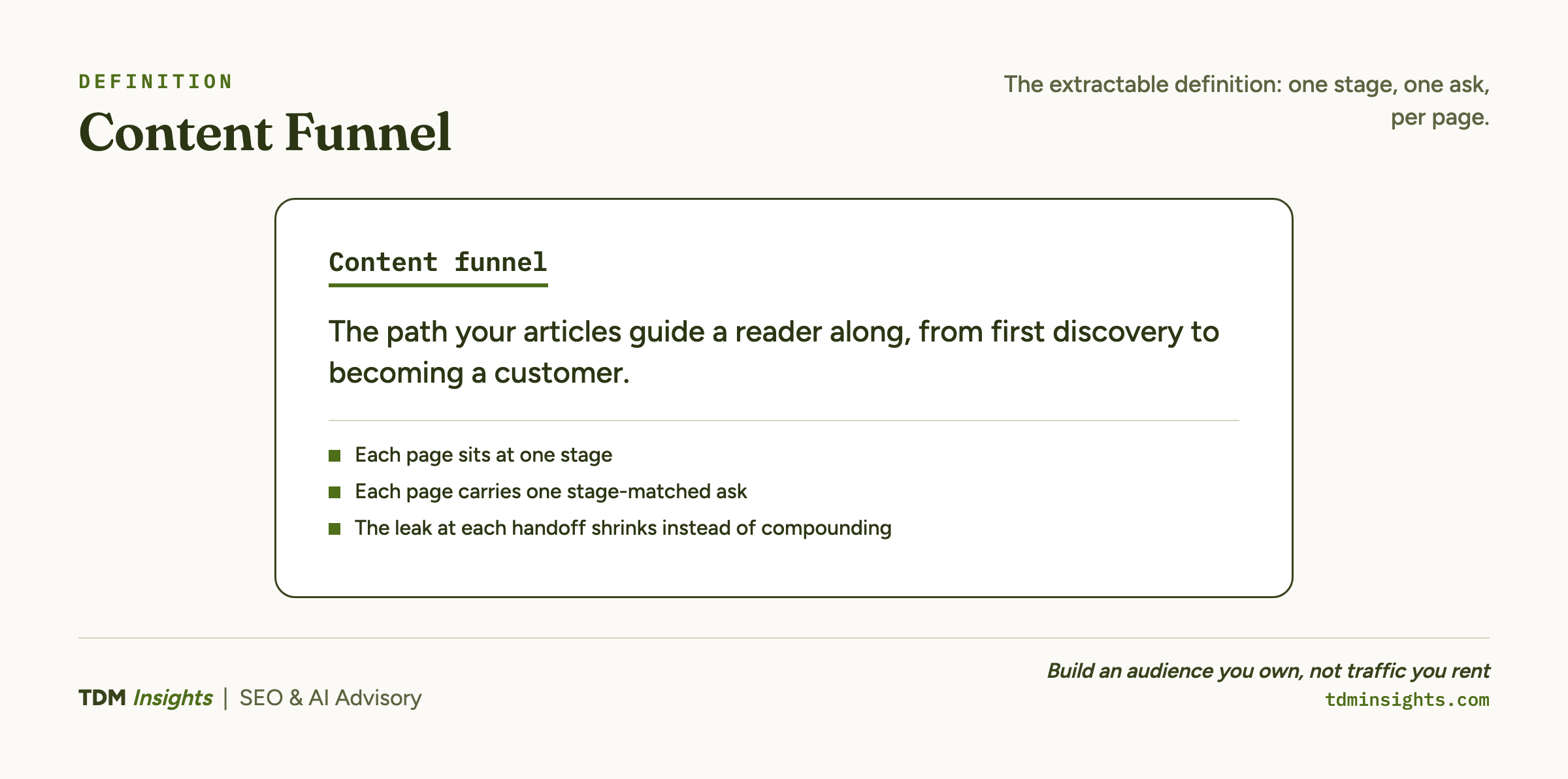
A content funnel is the path your articles guide a reader along, from first discovery to becoming a customer, with each page matched to one stage and carrying one stage-matched ask. That is the whole definition. The build is harder than the picture.
The triangle you have seen a hundred times is a shape, not a system. The version that actually earns customers is a series of handoffs, and a reader is lost at every handoff you do not deliberately plug.
We refined this exact model on a site we operate before bringing it to clients. The articles that converted were never the ones with the most traffic. They were the ones where every page did one job and asked for one thing.
This is the full build. If you want the conceptual case for converting readers first, the conceptual case for converting readers sits in the overview (this is the full build). Here we put real numbers on the leak.
Key takeaways
- A content funnel converts when every page does one stage-matched job and carries one stage-matched ask, so the leak at each handoff shrinks instead of compounding.
- A funnel leaks at every handoff, not just the bottom: impression to click, click to engaged read, and engaged read to action.
- Put a real number on each handoff for one article, and the steepest single drop is usually the snippet at the top of funnel, not the closing ask founders fixate on.
- Match the ask to the stage: top of funnel asks for a subscribe or the next read, middle of funnel asks for a trust step, bottom of funnel makes the direct ask.
- Map your existing library to stages first, because tagging posts you already paid for turns a pile of content into a path and names the missing handoff costing you the most.
Start With the Math, Not the Diagram
Pick a real article and run the numbers backward from the goal.
Say a top-of-funnel post earns 1,000 impressions in a month. Click-through on a mid-page organic result runs in the low single digits, so call it 30 clicks.
Of those 30 readers, scroll-depth data puts the share who reach the end of a long page well under half, so maybe 12 genuinely read it. And of those 12, the number who take any next step, a subscribe, a download, a click deeper into the site, is often one or two.
So 1,000 became one. That is not a failure of effort. It is four handoffs, each shaving the number down, and nobody measured which cut was the deepest.
The instinct is to blame the bottom: the page did not “ask for the sale.” Look at the math again.
The steepest single drop above was 1,000 to 30, the impression-to-click handoff, a 97 percent loss before the reader ever met your words. The way people read on the web is the second-steepest cut, and how users read on the web explains why: readers scan, skim, and leave long before a closing ask.
The point of the math is not the exact percentages. It is that you cannot fix a leak you have not located. Attach a number to each handoff for one real article, and the bleeding stage usually names itself.
TOFU, MOFU, BOFU: What Each Stage Owes the Reader
Each stage exists to convert the reader to the next one, never to skip ahead to the sale.
- TOFU, the top of the funnel, is discovery. A stranger arrives with a broad question, and the page’s only job is to answer it well and hand over the next question.
- MOFU, the middle, is the bridge. It deepens trust and helps a reader compare before they are ready to commit.
- BOFU, the bottom, serves a reader close to a decision. Only there does the direct ask belong.
If the three stages still blur together, the content marketing funnel mapped stage by stage lays out what each one is built to do.
The content each stage publishes follows from its job. A guide to the content types that fit each funnel stage is a useful gut-check: if every post you own is a broad explainer, your funnel has a top and no bottom.
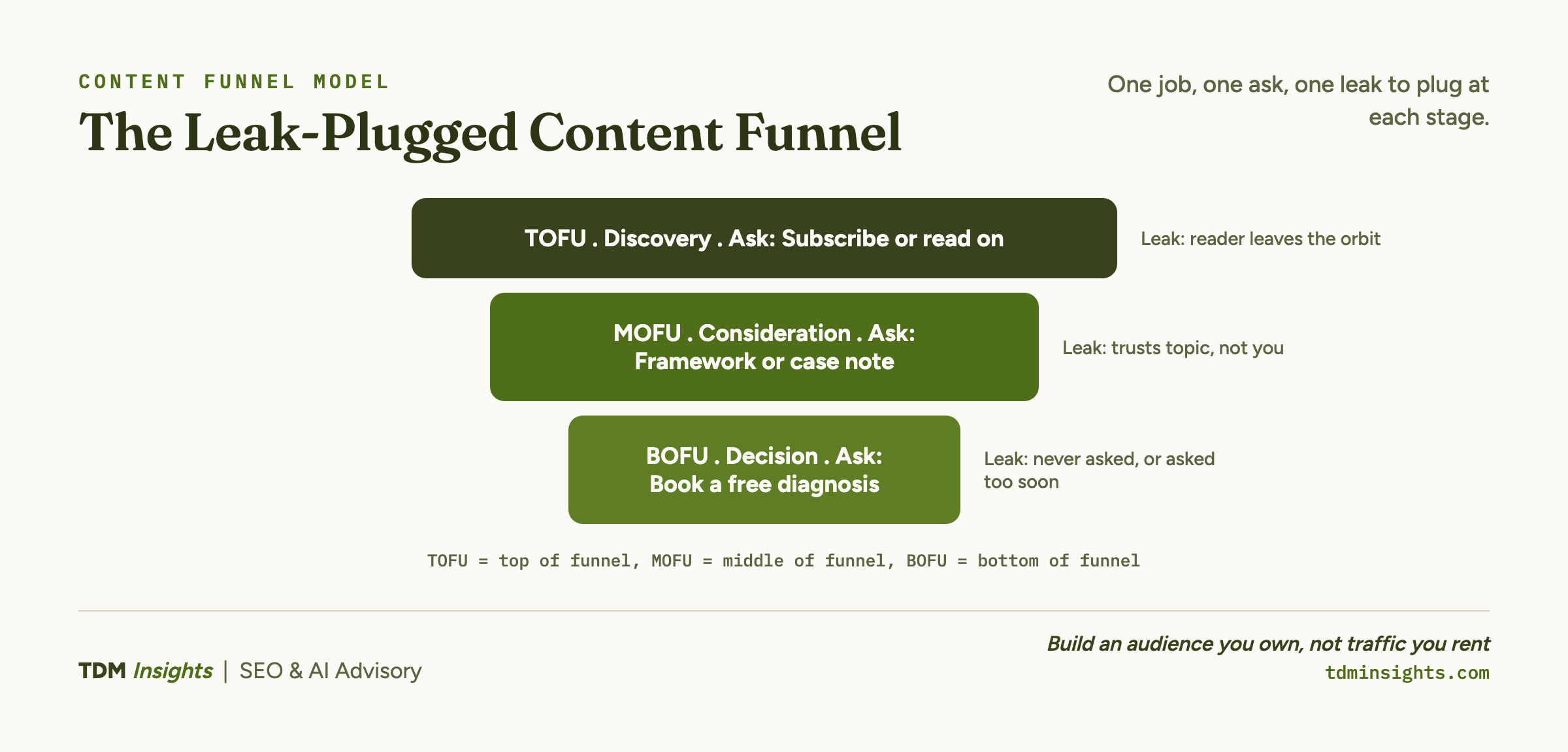
The leak at each stage is specific. At TOFU, a reader arrives, learns something, and leaves your orbit forever.
At MOFU, they trust the topic but not yet you. At BOFU, an engaged reader is never asked, or asked far too early on a page they landed on to learn, not to buy.
Name the stage of every page you publish. A page that does not know its stage tries to do all three jobs at once, which is the same as doing none of them.
The Leak-Plugged Content Funnel
A funnel is two halves working together. The first is the content funnel itself: every page sits at a stage and converts the reader to the next stage. The second is the one-CTA rule: each page carries exactly one ask, matched to that stage, because stacking three asks splits attention and lowers the take rate on all of them.
Here is the whole model in one table.
The takeaway is one sentence. A content library converts when every page does exactly one stage-matched job and one stage-matched ask, so the leak at each handoff shrinks instead of compounding.
That single ask is the lever the rest of the cluster turns. Picking it is its own discipline, and the one stage-matched ask that plugs each leak covers how the funnel stage decides which ask a given page is allowed to make.
Book a free diagnosis
If your content earns traffic but few customers, the leak is almost never where you think. A free diagnosis runs your real pages through this funnel: we put numbers on each handoff, find the stage bleeding the most, and tell you whether the fix is the topic, the page type, or the ask. It is a working session on your actual content, founder to founder. No deck, no retainer pitch, just a clear read on where your funnel is leaking and the one handoff to fix first.
Work the Drop-Off: Where a Real Funnel Bleeds
Run the 1,000-impression example all the way down and the leaks sort themselves into a priority order.
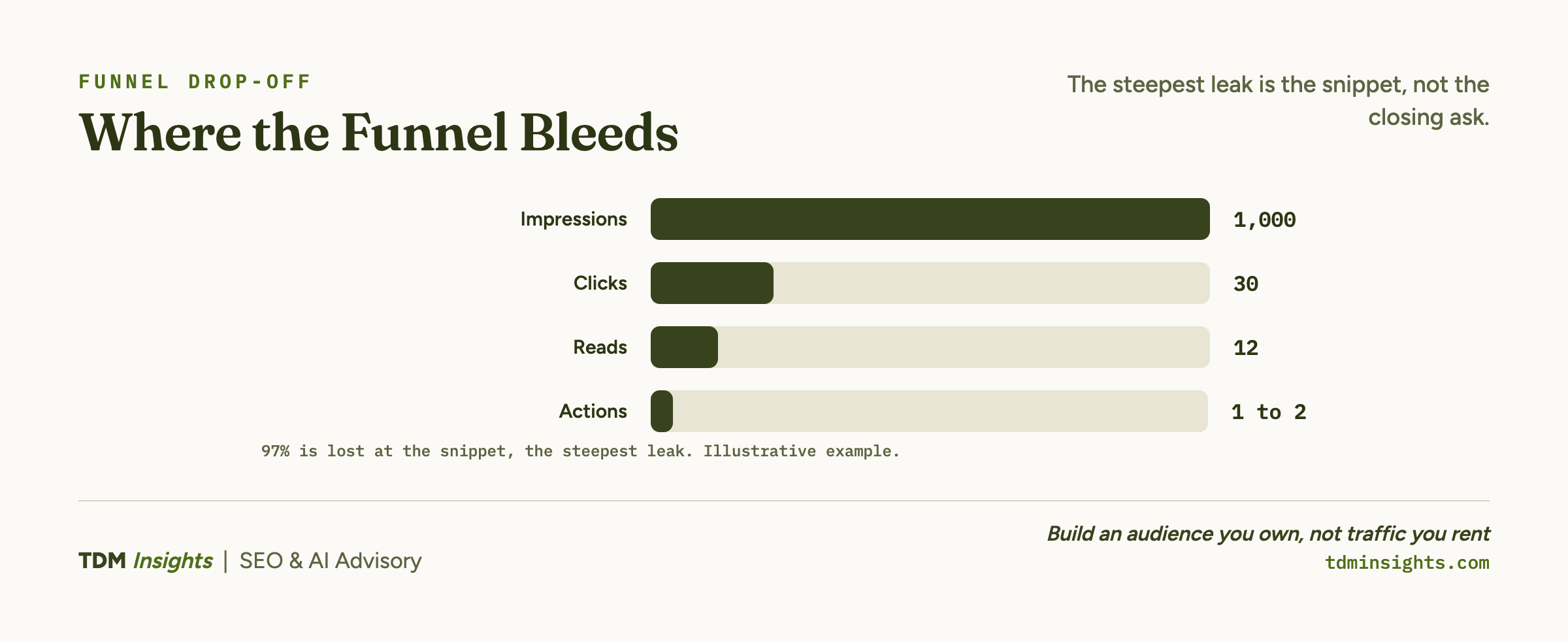
- Impression to click. You earned 1,000 impressions and got 30 clicks, and the lever is the snippet: the title and the meta description that decide whether anyone clicks before the page even loads. A three percent click-through doubling to six turns 30 clicks into 60, and every downstream number doubles with it. This is the highest-return fix in the whole funnel, and it happens before the reader arrives.
- Click to engaged read. Sixty readers land, and the page has seconds to prove it answers the question they came with. A mismatch between the headline and the body sends them back to the results. An answer-first opening that delivers the promised value in the first screen keeps a scanner reading, so the fix here is intent and structure, not more words.
- Engaged read to action. Now the reader is convinced, and the page either asks for the right next step or wastes the moment. A TOFU page that asks for a sales call gets ignored because the reader is not there yet, while the same page asking them to subscribe or read on keeps them in the orbit, and the next article makes the harder ask. The direct ask belongs further down, on the pages where bottom-of-funnel content earns the customer, and it works best when the reader arrived on a term that already signals buying intent.
Now watch what one fix at the top does to the whole chain. Hold every downstream rate steady and lift only the click-through, from three percent to six, and the funnel reads: 1,000 impressions, 60 clicks, 24 engaged reads, three or four actions.
You did nothing to the page itself. You roughly doubled customers by changing two lines of snippet text. That is the return on fixing the steepest leak first.
Compare that to the founder’s usual move: rewrite the closing call to action to lift the final handoff from two actions to three. Real work, real gain, but it moved the bottom number by one while the top of the funnel was quietly throwing away 970 impressions. Same effort, a fraction of the return.
Notice what the worked numbers expose. The bottom of the funnel, the part founders fixate on, was never the worst leak in this example.
The deepest single cut was the snippet, and the second was how people read. A founder who pours energy into the closing call to action while ignoring a two percent click-through rate is bailing water at the wrong end of the boat.
This is also why a high-traffic page can produce zero customers. If the traffic itself is the wrong traffic, no amount of plugging the lower handoffs helps.
That is a separate, upstream fix: writing for traffic that can actually become customers is about choosing topics that attract buyers, not browsers, so the readers who survive the funnel are the ones who can actually convert. It is also why the bottom of the funnel deserves its own deliberate pages rather than a single line tacked onto a discovery post.
The order of operations is blunt. Find the steepest single drop, fix that one, re-measure, and move to the next.
You do not optimize a funnel evenly. You optimize the worst leak first, then re-run the numbers, because plugging one handoff changes which handoff is now the worst.
Map Your Existing Library to Stages
You do not need new articles to start. You need to know what you already have.
Read each published piece and ask one question: what does the reader already know when they land here?
- Broad “what is” and “how does” pieces are TOFU.
- Comparisons, frameworks, and how-to guides are MOFU.
- Pricing, proof, and decision pieces are BOFU.
Tag every article with its stage.
Then check two things. First, does each stage have enough coverage, or is one stage nearly empty? A library that is all TOFU attracts strangers and converts none of them.
Second, does each page hand off to the next stage, or does it dead-end? A TOFU article with no link forward leaks every reader it earns.
Many founders find the same pattern: plenty of top-of-funnel posts, almost nothing at the bottom, and no links connecting the two. The funnel is not broken. It was never built.
Mapping is the cheapest fix you have, because it turns a pile of posts into a path using content you already paid to produce. If you are starting closer to scratch, a step-by-step walkthrough of how to build a content marketing funnel covers the same stages from the other direction, and a stage-by-stage funnel map is a clean reference for what to publish where.
Once the stages are tagged, the gaps become a to-do list instead of a guess. A thin BOFU layer tells you to write the decision and proof pieces a ready buyer needs. A dead-ending TOFU post tells you exactly which forward link to add, and to which article.
You are no longer asking “what should I write next” in the abstract. You are reading the answer off your own funnel, ranked by which missing handoff is costing you the most readers today.
Prove It Pays: Closing the Loop
A funnel you cannot measure is a funnel you cannot improve. The whole model assumes you can see the drop-off at each handoff, which means instrumenting the funnel, not just publishing into it.
You need two layers of measurement. The leading indicators are the per-handoff rates: impression-to-click, click-to-read, read-to-action.
The lagging indicator is the one that pays the bills: customers and revenue traced back to content. The leading and lagging metrics behind each handoff covers how to trace credit back to content even when the signals predict the dollar figure rather than confirm it after the fact.
Once the funnel is measured, the case for content gets concrete. A paid campaign stops the hour the budget does.
A funnel built from owned articles keeps converting after the cost is sunk, and each new article raises the authority of the others. Proving the funnel pays for itself puts that on a timeline against ad spend.
The discipline is the same one that built the library in the first place. Ahrefs makes the case that a mapped content marketing funnel precedes any publishing plan, because you cannot plug leaks in a path you never mapped.
The reason any of this matters is the reason content keeps depreciating quietly when it is not measured: visibility that does not convert is a cost, not an asset. Ahrefs’ study found that a large share of pages get little or no search traffic, which is the same lesson one stage up, visibility alone does not survive the next handoff.
Build the funnel, measure each handoff, fix the worst leak first, and the library stops collecting visits and starts earning customers.
Frequently Asked Questions
What is a content funnel and how is it different from a sales funnel?
A content funnel is the path your articles guide a reader along, from first discovery to becoming a customer, with content matched to each stage. A sales funnel tracks the buying steps inside your pipeline. The content funnel feeds the sales funnel: it earns attention and trust before a salesperson or a checkout is ever involved.
What do TOFU, MOFU, and BOFU mean for a founder with a blog?
TOFU, MOFU, and BOFU are the top, middle, and bottom of the funnel. TOFU content attracts strangers with answers to broad questions. MOFU content builds trust and helps people compare options. BOFU content serves a reader ready to act. Each stage carries a different next step, never the same one, so attention is not wasted.
How do I map my existing articles to funnel stages?
Read each article and ask what the reader already knows when they land on it. Broad “what is” and “how does” pieces are TOFU. Comparison, framework, and how-to pieces are MOFU. Pricing, case proof, and decision pieces are BOFU. Tag each one, then check that each stage has enough coverage and hands off to the next.
Where does a content funnel actually leak?
A funnel leaks at every handoff, not in one place: impression to click, click to engaged read, engaged read to action. The bottom gets the attention, but the biggest leak is often earlier. Attach real numbers to each handoff and the bleeding stage usually reveals itself as the one with the steepest single drop.
What is the one next step each stage should ask for?
Match the ask to the stage. TOFU asks the reader to subscribe or read the next article, keeping them in your orbit. MOFU asks for a deeper-trust step like a framework or a case note. BOFU makes the direct ask. One ask per page, never three stacked, so the single decision stays clear.
Why does content get traffic but no customers?
Usually because every page tries to do everything at once or asks for nothing. Traffic that does not convert to the next stage is a leak, not a win. The fix is structural: give each page one stage-matched job and one stage-matched ask, so readers move forward instead of arriving, browsing, and leaving the orbit forever.
Continue Reading:
More On Content Conversion:
- The One-CTA Rule: One Ask Per Page Wins
- Landing Page Copy vs Blog Copy: The Difference
- Where to Place a CTA So It Gets Clicked
- Content-Market Fit: Earn Customers, Not Traffic
- Content ROI: How to Calculate It vs Ad Spend
More from TDM Insights:
- Content That Converts Readers Into Customers
- Content Strategy for Founders
- How to Produce Content That Ranks and Gets Cited
- Topic Clusters and Pillar Pages: How They Work
- How Long Should a Blog Post Be? Intent Over Count
Explore TDM Insights Categories: