
SEO for AI Search When Nothing Else Mentions You Yet
SEO for AI search starts with corroboration: something outside your domain saying you exist. Here is the build order for a brand new site.
 By David Jubé · Jul 29, 2026 · 15 min read
Nothing outside your own domain says your business exists yet, and that one fact explains more about your AI search visibility than anything on your pages.
Every claim an answer engine can find about you traces back to a single source, and that source is the site you wrote. Your name, what you do, where you work, who is behind it: all of it asserted once, by you, with nothing to check it against. Editing those pages raises the quality of the assertion without changing the number of sources making it.
That is the cold start problem, and it is not thin content or weak keywords wearing a new name. No amount of production touches it, because the asset that resolves it sits on somebody else’s domain.
Corroboration is the name for that asset, meaning something you do not control stating the same facts your homepage states. Nobody can tell you how long it takes an answer engine to register a new brand, and anyone quoting you a number is guessing. The build order is knowable even when the timing is not.
Four conditions decide whether a page gets cited at all. It has to exist and be reachable, something outside your domain has to corroborate it, it has to say something found nowhere else, and its facts have to be machine readable. A new site clears the first easily and stalls on the second, and while it stalls there the other two never get tested.
Key takeaways
- Cold start is a counting problem, not a content problem. One source asserts you exist, it is your site, and revising the site never changes the count.
- Corroboration is a match, and a match needs two records. Google’s knowledge panel patent specifies a content item from a first resource and one from a second, different resource.
- Backlinks and mentions are different assets. A link signals something about a page, a mention states a fact about a company, and only the mention corroborates.
- Three tiers supply it: properties you control are fast and weak, verified listings cheap and narrow, earned mentions slow and heavy.
- The judgement is which sources corroborate you in your vertical. A directory nobody in your category reads can absorb a season and corroborate nothing.
Cold start is a counting problem, and no edit to your site changes the count
Separate cold start from the mechanical failures first, because those are binary and they announce themselves. A noindex tag left on from staging, a robots.txt block, a sitemap nobody submitted: each has a state you can read and a fix you can apply in an afternoon, and Bing’s webmaster guidance on discovery covers that list.
Cold start behaves nothing like that. Your pages index, they render, they read well, and nothing cites them, so there is no error state to find and no setting to correct.
Part of the reason is when these systems learned about the web. Common Crawl’s published crawl statistics describe a corpus assembled at crawl time, so a site launched afterwards appears thinly in it or not at all. Live retrieval closes some of that gap, and Cloudflare Radar on crawler coverage shows how much crawler traffic now moves across the web, but retrieval returns only what is there to return.
So run the count before you touch a line of copy. Search your business name and read what comes back that you did not write. If the answer is your homepage, your own profiles, and nothing else, the count is one, and raising that count is the whole job.
Corroboration is a match, and a match needs two records
Volume is the visible part of corroboration. A match between two records describing the same thing is the mechanism underneath it, and you already hold one of the two. Your site states your name, what you do, where you are, and who is behind it. Nothing in it is disputed and nothing is confirmed, because it has no counterpart to be measured against.
A close reading of how a knowledge panel gets triggered for an entity walks through Google’s patent filing, which specifies a panel assembled from a content item received from a first resource and a content item received from a second, different resource. A patent describes a method rather than a shipping product, and the structural point holds either way: a second, different resource is by definition not your own domain.
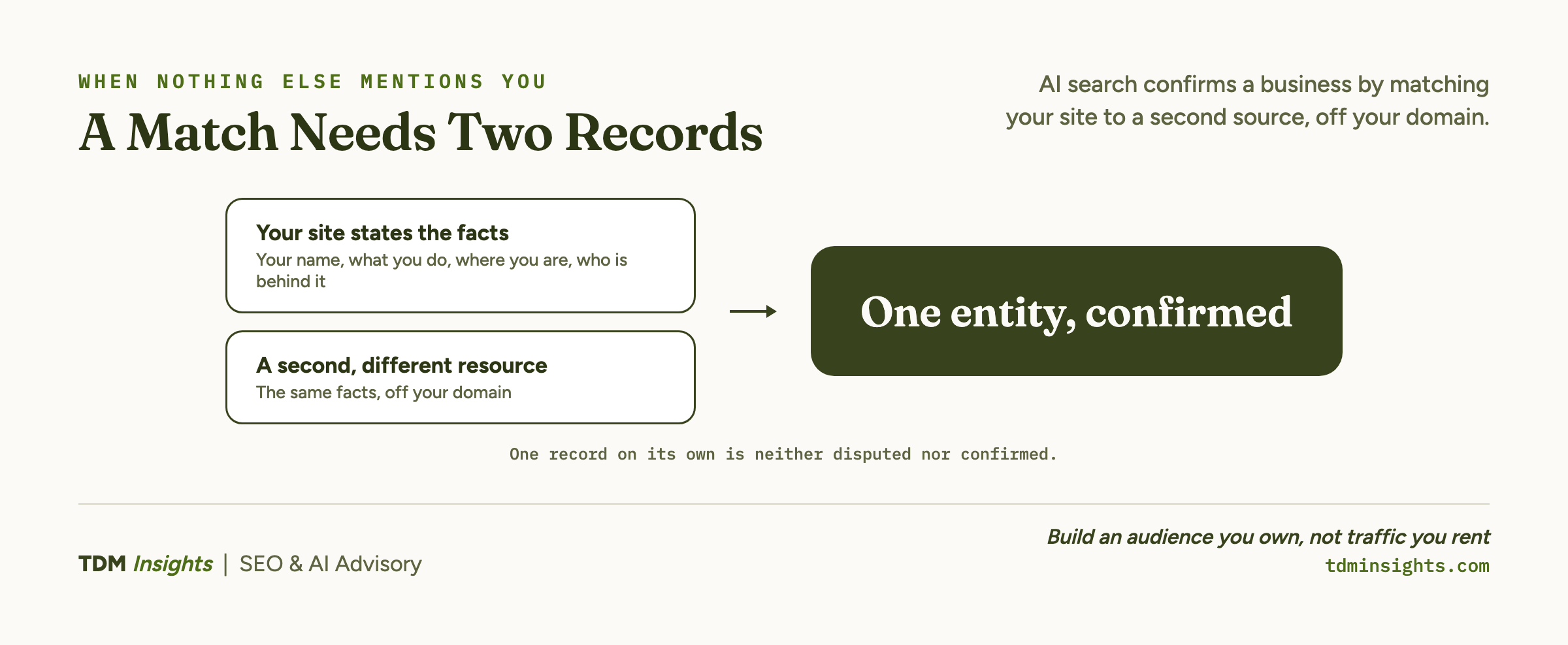
Which puts real load on the record you do hold. If yours is vague, an outside mention has nothing precise to agree with, and the two never resolve into a single entity. Records that disagree on your legal name, your category, or the person behind the work read as two entities to a parser rather than one entity with a discrepancy.
That is why the About page does heavy lifting this early. Journey position 8, About Page Content and What Actually Belongs on It, builds it as a record instead of a story: who is behind the work, what they did before, how long they have done it. A mention landing against a specific record confirms something. The same mention landing against a thin one confirms that a company with that name exists.
Make the record machine readable while you are in there. The schema.org Organization type exists for this, and its sameAs property tells a parser that a profile elsewhere and a page of yours describe one entity rather than two.
Entity SEO, How to Become a Known Thing to AI covers the general case, where some presence already exists to build on. Cold start is the harder version of the same problem, with none.
Backlinks and independent mentions are different assets, and the difference decides your first month
Ask about corroboration and a link building plan comes back. The two overlap without being the same asset.
A backlink points from one page to another and carries a signal about the target page. An independent mention is a sentence somewhere else asserting a fact about your company, and it corroborates whether or not a link is attached.
Ahrefs’ analysis of mentions and citations set brand signals against AI Overview appearances, and Semrush’s data on brand mentions documents how often a brand surfaces in a generated answer with no link attached at all. The unlinked assertion does work that a link building frame has no column for, and Brand Mentions Beat Backlinks in Ahrefs’ Own Data takes that comparison apart.
So the definition of a win in month one changes. Chasing links first means chasing the harder asset while the cheaper one that satisfies this rung sits untouched. A supplier page naming you in a sentence, with no link, is a win. A directory link from a page nobody reads is not.
Engines differ in what they assemble and what they attribute, and How Each AI Engine Picks Sources to Cite sets out what is observable per engine. The precondition is common to all of them, and it is the sentence you want somebody else to write.
The one-sentence test
Write the sentence you want an outside source to say about you, then check whether your own site states every fact in it plainly enough to be matched. If it carries a claim your pages only imply, that is the record to fix before any outreach.
Three tiers of corroboration, and only the slow one carries real weight
Corroboration arrives in three tiers, and they are not interchangeable. Each buys something specific, each has a ceiling, and the cheap ones stop being useful at a point you can see coming.
Tier one is fast, weak, and non-negotiable
Tier one fixes the fact set: company name, address format, category description, founder name, stated identically everywhere they appear. Two spellings are two entities to a parser, and reconciling them a year later is slower than getting them right the first time.
A model does the heavy lifting here. Hand it your About and service pages, ask for one canonical fact set plus the length variants each platform wants, then read the output against the source before anything gets published.
Tier two is cheap, narrow, and worth doing early
Verified listings buy exactly one thing: an outside party has checked that a real business stands behind the name. That is narrow, and it is the first assertion about you that you did not write.
Research on branded versus non-branded demand frames why that matters when the count is zero. Until something outside your domain names you, there is no branded demand for anything to capture.
Do the verified ones and stop there. A directory that publishes whatever gets submitted adds a row to a database rather than a record to the web, and the difference is the check somebody performed before publishing.
Tier three is slow, unshortcuttable, and where the weight sits
Earned mentions are somebody else describing your business in their own words, chosen by them. That authorship is the whole value, which is why the tier resists being sped up.
You can improve the odds without controlling the outcome. Say something specific enough to be worth quoting, stay reachable when somebody wants to check a detail, and answer questions in the places your category already talks. The versions that look manufactured stop corroborating anything, because a reader who can tell you wrote it is back to counting one source.
Ordering the work from zero, starting with the record you own
The order matters more than any calendar. Starting at tier three while your own record is still vague is the common failure, and it wastes the outreach rather than delaying it, because a mention that lands against nothing specific confirms nothing specific.
First, settle the record you own
Write the About page as a record rather than a story, fix one canonical fact set, publish the Organization markup, and point sameAs at every profile you are about to create.
Nothing outside your domain matters yet, because there is nothing for it to agree with.
Second, claim and verify
Create the tier one properties with the fact set already settled, so every profile says the same thing in the same words, then work through the verified listings for your category and location.
Watch branded search while you do it. SparkToro’s research on branded demand analysed hundreds of millions of queries and shows how large a share of searching is branded, which is the demand a corroborated entity collects and an uncorroborated one cannot.
Third, open the earned tier
Now the outreach: suppliers, partners, customers, the trade body in your category, the podcast covering your niche. A founder with a network can run this personally, and the ask is easier than a link request because you are asking somebody to describe you accurately rather than to hand over a link.
Track what lands and where. Similarweb’s data on AI assistant referrals breaks referral behaviour down by industry, which tells you more about your own category than any blended figure can.
Book a free diagnosis
If your site is live, your copy is good, and nothing is citing you, the count of independent sources is the first thing I check, along with whether your own record is specific enough to be matched. You get back which rung is failing and which sources are worth your first month.
Which sources corroborate you in your vertical is the judgement this work turns on
Not every source willing to publish a mention of you corroborates you. A directory nobody in your category reads, a listing site accepting every submission, an aggregator with no editorial judgement: these produce rows that no reader treats as evidence, and a parser has little reason to weigh differently.
Which sources in your vertical carry weight is a call that rests on having watched the same tactic work in one category and fail in another. Three questions get you close on your own:
- Would a prospective customer in your category recognise this source and treat what it publishes as a check on you?
- Does anything outside this source’s own network reference it, or does it exist only to publish listings?
- Does it state facts about the businesses it lists, or does it reprint whatever those businesses submitted?
Two yes answers make a source worth the time. One makes it optional. Zero makes it a row in a database.
How to Get Cited by ChatGPT and How to Get Cited by Perplexity cover what is observable about each engine, and in both the source with standing of its own carries further than the one that publishes anything. Getting that call wrong costs you a season: a list of sources that corroborate nothing, while the two or three that mattered stayed unasked.
Earned mentions attach to URLs, so settle your direction before the outreach starts
Corroboration accrues slowly, and it accrues against specific addresses. A mention names your company and points at a page, and that pairing gains value over a period you do not control.
Which makes sequencing urgent rather than tidy. If your direction is unsettled, and a rebuild later moves or drops the URLs those mentions point at, you throw away the corroboration you spent a season earning.
Journey position 4, Rebuild or Redesign: One Staging Test Tells You Which, is where the reversibility question gets decided, and it is worth reading before the outreach starts rather than after. Settle the direction, then earn corroboration against URLs you intend to keep.
Corroboration is the rung nothing on your own site can fix. The next rung is back on your site, where a template default may have quietly broken it already, and journey position 15, AI SEO Audit: Finding the Copy Your Template Shipped, takes that apart.
Frequently Asked Questions
How do I rank a new website on Google?
Rank a new site by building corroboration before content volume. A site whose only source is itself gives a search engine nothing to check its claims against, so publishing more produces more unverified pages. Settle the record you own, claim verified listings, then earn independent mentions.
Why are my website pages not indexing?
Indexing failures split into two causes. Mechanical ones are settings: a noindex tag left on from staging, a robots.txt block, a sitemap never submitted, a page nothing links to. Cold start is different, because pages do index and still get no attention. Check the mechanical list first, since it is quick and binary.
How do you get cited by ChatGPT?
Citation behaviour is observable in output rather than documented as mechanism, so treat any confident account of the internals sceptically. What is consistent across engines is the precondition: sources that get named tend to be ones something outside their own domain has already described. Corroboration comes before quotability.
Do backlinks still matter?
Backlinks still matter, and they are not the same asset as a mention. A link passes a signal about one page. A mention states a fact about your company and corroborates it whether or not a link is attached. For a brand new site the mention fixes the missing second record.
What is an AI content citation strategy?
An AI content citation strategy is a build order rather than a content type. It runs in three tiers: properties you control, which are fast and weak, verified listings, which are cheap and narrow, then earned mentions, which are slow and carry the weight. Attempting the slow tier first is the common failure.
What is AI visibility?
AI visibility is how often and how accurately answer engines name your business when people ask questions you should be able to answer. For a brand new site the number is zero, and the reason sits outside your site. No tracking tool changes it, because the missing input is an independent source.
Continue Reading:
Previously in this series
- AI Generated Content SEO: Four Kinds of Evidence, the four kinds of evidence a page carries on its own, before anything outside your domain corroborates them.
Next in this series
- AI SEO Audit: Finding the Copy Your Template Shipped, what your template shipped to everyone else running it, and why distinctiveness comes next.
From the library
- Answer Engine Optimization: What AEO Actually Is, the retrieval, evaluation and citation steps a mention has to clear to count at all.
- How AI Answer Engines Choose Their Sources, diagnosing which of the three steps is actually where your corroboration is failing.
- Backlinks for Startups: Earn Authority, No Budget, earning the links this article treats as a separate asset from mentions.
- SEO for Startups: What to Do in the First 90 Days, where corroboration work sits in the five-step order a new site should run.
Explore TDM Insights Categories