
AI SEO Audit: Finding the Copy Your Template Shipped
Run an AI SEO audit for template duplication. Find the phrasing your theme ships on every site using it, and see what that costs you.
 By David Jubé · Jul 26, 2026 · 12 min read
Your words are yours, and the frame around them is not.
You wrote the copy on your service page, or you supplied the facts and reviewed every line of a draft. Either way the sentences are genuinely your own, and a duplicate content checker will pass your site without a complaint.
Then you read a competitor’s page and something is familiar. Not the words. The shape. The same section order, the same heading phrasing, the same short connective sentence bridging the second section to the third, the same three-column feature block in the same place.
Nobody copied anybody. That is a template doing exactly what a template is built to do, on every site that installed it, and the resemblance is the product working as sold. The words inside the frame do the work you paid for, while the frame itself supplies a good share of the sentences a retrieval system can lift, and that is where a shared theme starts costing you something you can measure.
Key takeaways
- Duplicate words and duplicate structure are separate problems with separate costs, and the tools built for one do not detect the other.
- No penalty attaches to a shared template. What it costs is attribution, not ranking.
- The cause is a tooling default applied at scale. It is not a failure of AI and not a mistake by whoever chose the theme.
- An exact-phrase search on your own connective sentences will surface the problem for free, in one sitting.
- Triage before rewriting: some shared structure is harmless, some shared phrasing is costly, and some emitted markup is actively wrong about you.
Duplicate structure is a different problem from duplicate content
Duplicate content means the same words appearing in more than one place. Duplicate structure means different words arranged in an identical frame. The conversation has been stuck on the first for fifteen years, and the second is the one a fast-built site actually has.
The remedies do not overlap. A canonical tag resolves the first by naming which URL should represent a set of matching pages, and Yoast’s explanation of rel=canonical sets out how that works. None of it applies to two pages whose words differ and whose frames match, because there is nothing for a canonical to consolidate.
Moz’s reference on duplicate content and Lumar’s treatment of content duplication both define the field in terms of matching text, which is what crawlers and checkers were built to measure. Text matching is not the condition your site is in. The words are unique and the container is not, so every instrument pointed at your site reports clean while the problem sits in the part nobody measures.
What ships identically on every site running the same template
A template is a set of decisions somebody else made once and shipped to everyone who installed it. Some of those decisions are structural and invisible. Some of them are text, and the text ones are easy to miss because you did not write them and therefore never filed them under copy.
- Section order. Hero, then three benefits, then social proof, then a features grid, then a closing ask. On every page built from that layout.
- Heading phrasing. “Why choose us.” “How it works.” “What our clients say.” Supplied as demo content and kept because they read as normal.
- Connective sentences. The short bridging line under a section heading, shipped as placeholder prose and edited lightly or not at all.
- Microcopy. Button labels, form field hints, empty-state messages, cookie notices.
- Emitted markup. The structured data your build generates for you, which describes the page type rather than your business.
None of it is a failure of whatever drafted your copy, and none of it is a mistake by whoever picked the theme. A default ships identically to everyone by design, and that is the entire value of buying a template instead of commissioning one. The prose that comes with it is a default in the same sense.
Measured across the web, the HTTP Archive’s markup analysis finds the same patterns repeating because the tooling repeats. Your build is ordinary in this, which is exactly the problem when a system has to pick one page to quote.
Attribution, not ranking, is what shared phrasing costs you
A shared template earns you no penalty. Google clusters near-identical pages and picks one to show rather than fining anyone for the resemblance, and Search Engine Journal’s report on what Google says about duplication percentages is the citation that settles it, because it includes John Mueller declining to name a threshold at all. There is no number. Anyone quoting you one has invented it.
Bing’s webmaster team addressed the same question for AI search directly, and the answer is consistent. The mechanism is selection, not punishment.
Selection is where the bill arrives. When a retrieval system assembles an answer it lifts a passage and attributes it to a source, and if the passage that best matches the question is a sentence your template shipped to every site running it, the system is holding thousands of equally good candidates with no reason to prefer yours. Something gets cited. It will not reliably be you.
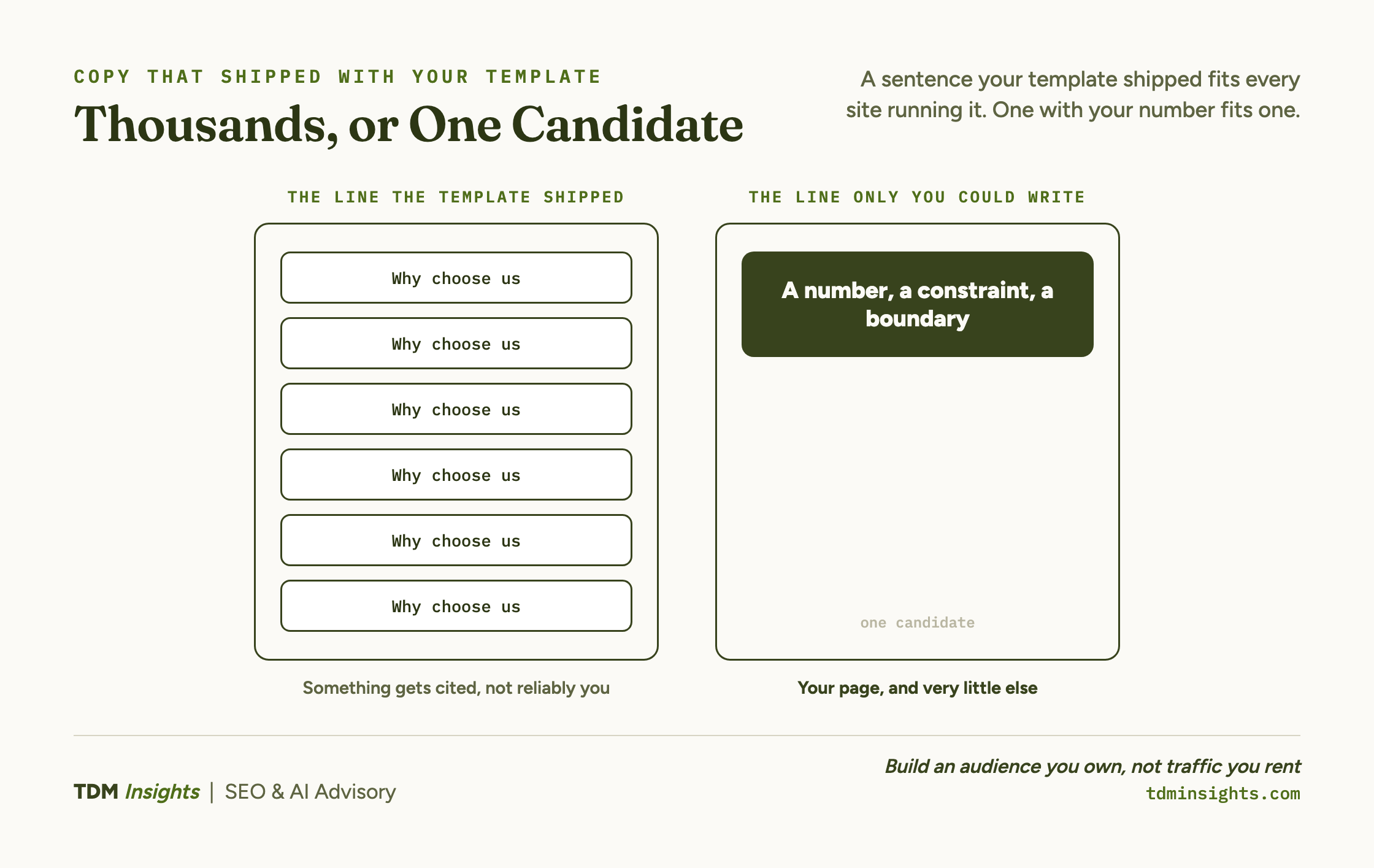
That cost never shows up in a rankings report. Your page holds its position, the traffic looks like last month’s, and the sentence being quoted in an answer belongs to somebody who installed the same theme.
Common Crawl’s notes on how its corpus is built and used describe how much of this material is already sitting in training and retrieval corpora, shared phrasing intact.
The shape of the problem
Your unique paragraphs are what you would be cited for. Your shared sentences are what you are competing on. A page can be almost entirely original and still have its most quotable line be the one line it did not write.
Finding your own duplication with exact-phrase checks you can run for free
The standard tools will not find this. They compare bodies of text, and yours does not match anyone’s.
An exact-phrase search finds it instead, costs nothing, and takes one sitting. Open your home page and the service page that earns you the most work, copy short strings of six to twelve words, and search each one in quotes. Choose:
- The sentence directly under each section heading.
- Every section heading itself.
- Any sentence in your hero that is not a specific claim about what you sell.
- Your primary button label plus the words immediately around it.
- The first sentence of your about page.
Record the number of results for each. A phrase that is genuinely yours returns your page and very little else. A phrase your template shipped returns a wall of unrelated businesses in unrelated categories, and the size of that wall is the finding.
Do the same for your emitted structured data. Open the page source, find the JSON-LD block, and read whether the values describe your business or describe the page type. The WHATWG specification on links is the underlying reference for what that markup is asserting on your behalf.
Similarity can also be measured rather than eyeballed, and the method chosen changes the answer considerably. Sitebulb’s testing of similarity algorithms runs several of them against the same content and shows the spread between them. Read any single similarity score as one method’s reading rather than a settled fact about your page.
Triage: harmless, costly, and actively wrong
Not everything the search turned up needs fixing, and some of it should be left exactly where it is. Sort the findings into three piles before rewriting a word.
The middle row is where the return sits. The bottom row is where the urgency sits, because a system reading incorrect markup is not merely declining to cite you, it is repeating something false about you to whoever asked.
Rewriting the frame, section by section, without touching the theme
Fixing this does not mean changing your theme. The frame is editable content in almost every case, and the work goes page by page from the copy you already have.
Take each costly phrase and attach something only you can say. A heading of “How it works” becomes a heading naming the actual first step. A connective sentence that could bridge any two sections on any site becomes a sentence carrying a number, a constraint, or a boundary. The test is whether a competitor could paste your sentence onto their page without editing a word of it.
The cause underneath is the same one that produces interchangeable copy in the first place. A draft written without specifics supplied defaults to the accurate general case, because the general case is what is true of everybody, and step 7, AI Website Copy: Which Sentences to Keep and Cut, covers supplying those facts before the drafting starts.
For the sentences you want lifted, write them so they stand alone without the paragraph around them. How to Write a Definition AI Will Quote Verbatim covers the construction, and Comparison Tables and Formats LLMs Love to Cite covers the structures that get quoted whole.
Service pages are what a template flattens hardest, because every business in a category is describing broadly similar work in broadly similar words, and the template supplies the same scaffolding to all of them. Step 9, Service Page Content Examples: Six Sections in Order, holds the copy-level fix for those specifically. How to Structure a Page to Rank and Get Cited covers the page-level structure underneath it, and The On-Page AEO Playbook covers the moves that make a passage liftable.
Deciding when the fix belongs in the template rather than the page
Fix it on the page when the phrase appears on one page or two. Fix it in the template when your build generates the same phrase across every page of a type.
Checking which one you are looking at is worth the minute it costs. Rewriting one shipped sentence twenty times by hand is the wrong shape of work, and it comes back the next time the theme updates and regenerates the block.
Emitted markup is almost always a template-level fix, and it is the one that follows directly from the triage above. Step 16, AI Overviews and the Six Schema Types a Build Emits, covers what your build produces on your behalf and what a person still has to write. Schema Markup for AI covers the general case if you want it now.
The shared frame you just measured was settled back at step 2, AI Built WordPress Themes: Four Decisions You Own, when the theme was chosen, and that choice is not one to regret. Knowing what your build ships by default is what lets you decide which defaults to keep, and the markup defaults are the ones to read next.
Book a free diagnosis
If your pages rank and never get quoted, the shared frame is usually why. I will run the phrase checks against your site, tell you which sentences are doing nothing for you, and hand you the list worth rewriting.
Frequently Asked Questions
What is considered duplicate content?
Duplicate content usually means the same words appearing in more than one place. That definition misses the situation a templated site is in, where the words are unique and the frame around them is shared. Duplicate words and duplicate structure are separate problems, and they carry separate costs.
Does Google punish duplicate content?
No penalty attaches to a shared template. Google clusters near-identical pages and selects one to display rather than fining anyone, and its search advocates have declined to name any percentage threshold. The cost that does land is attribution, because a shared sentence gives a system no reason to cite you.
How do you check duplicate content on a website?
Copy short strings of six to twelve words from your headings, hero, and the connective sentences under each section, then search each one in quotes. A phrase that is genuinely yours returns your page and little else. A phrase your template shipped returns a wall of unrelated businesses.
What is the best tool for checking duplicate content?
The standard checkers compare bodies of text and will pass a templated site cleanly, because your prose genuinely is original. They are not built to find shared structure. Exact-phrase searching finds it for free, and it is the connective sentences and heading phrasing you need to check by hand.
How do you fix duplicate content?
Triage before rewriting. Shared layout and section order are harmless and worth keeping, since conventions help readers navigate. Shared phrasing is what costs attribution, so rewrite it with a specific fact attached. Markup carrying demo values is actively wrong about your business and should be corrected first.
Can a website be duplicated?
The frame around your copy is duplicated by design. A template ships identical section order, heading phrasing, connective sentences, and emitted markup to every site that installs it, which is a tooling consequence rather than anyone’s mistake. Count your own with exact-phrase searches and you will see the scale.
Continue Reading:
Previously in this series
- SEO for AI Search When Nothing Else Mentions You Yet, the corroboration problem a new site fails first, which shared template copy makes harder.
Next in this series
- AI Overviews and the Six Schema Types a Build Emits, the markup your build already emits, and the template-level fix for the copy problem above.
From the library
- How to Write a Definition AI Will Quote Verbatim, rewriting the templated sentence so it becomes the one an engine actually quotes.
- Comparison Tables and Formats LLMs Love to Cite, structured formats worth rebuilding once you have triaged which shared markup to fix.
- Structured Data for SEO, the Founder’s 80/20, which schema types are worth checking once you know what your template emits wrong.
Explore TDM Insights Categories