
How to Get Cited by ChatGPT, Perplexity, and AI
One cheat sheet, three engines. The per-engine signals that earn a citation from ChatGPT, Perplexity, and Google AI Overviews.
 By David Jubé · May 1, 2026 · 14 min read
Getting cited is not one task, it is three, because ChatGPT, Perplexity, and Google AI Overviews each retrieve and evaluate sources differently.
The fastest wins come from the signals all three share: a clear, answer-first passage that directly resolves the query, backed by corroboration the engine can verify.
Beyond that shared core, each engine has its own retrieval path and its own taste in sources, so the work splits into one general playbook plus three engine-specific tilts.
This article gives you both, anchored to a model you can reason from instead of a list of tips you have to memorize.
Key takeaways
- To get cited, you give an engine a passage it can lift and a reason to trust it, served on the path that engine actually uses to find sources.
- Every engine first retrieves a candidate set of sources, then evaluates them for trust and relevance, then cites a specific passage in its answer.
- There is a shared core every engine rewards, crawlable, answer-first, and corroborated, plus three tilts: ChatGPT wants originality, Perplexity wants freshness, and AI Overviews want ranking.
- Spend in order: fix crawlability first, then rewrite your priority passages to be answer-first and self-contained, then build corroboration through original data and outside references.
- An llms.txt file is not required, because no major engine currently uses one to decide citations.
The one-line answer: match the engine’s retrieval path
To get cited, you give an engine a passage it can lift and a reason to trust it, served on the path that engine actually uses to find sources.
Two pages can both answer a question well, but the one that gets cited is the one the engine could retrieve, was willing to evaluate as trustworthy, and could extract cleanly.
That is the whole game in one sentence.
It helps to name the steps. Throughout this piece we lean on the three-step model behind every engine: an engine first retrieves a candidate set of sources, then evaluates those candidates for trust and relevance, then cites a specific passage in its answer.
A page can pass retrieval and still fail citation, which is why “we rank but never get cited” is the most common complaint in this category. Each engine runs all three steps, but they run them with different machinery.
So the practical move is not to optimize for “AI” in the abstract. It is to optimize for the retrieval path each engine actually uses, while making the passage so clean that any of them can extract it.
The cheat sheet: three engines, their source signals
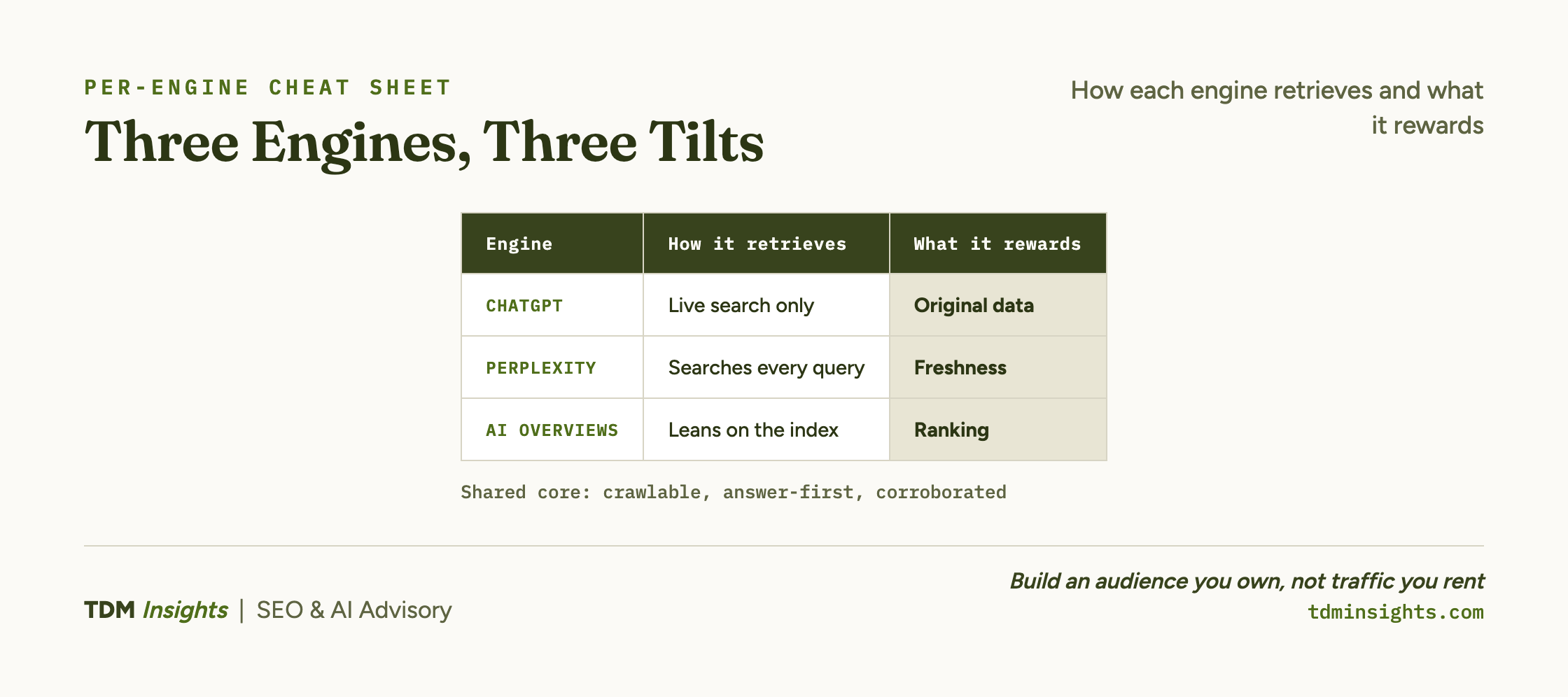
Here is the whole per-engine playbook in one table. Each row is self-contained, so you can act on any single engine without reading the rest.
The columns map to the three-step model: how the engine retrieves, what it evaluates on, and how you earn the lift.
The pattern underneath the table: there is a shared core (crawlable, answer-first, corroborated) and three tilts (ChatGPT wants originality, Perplexity wants freshness, AI Overviews wants ranking).
Build the shared core once, then spend your remaining effort on the engine where your audience actually asks questions.
ChatGPT search: how it retrieves and what earns the cite
ChatGPT does not cite anything in its default state. It answers from training data, and training data has no live links.
Citations only appear when ChatGPT decides a question needs current information and runs a web search. That single fact reorders your priorities: before any optimization, OpenAI’s crawler (OAI-SearchBot) has to be able to reach your pages.
If your robots rules or a firewall block it, you are invisible to ChatGPT’s search no matter how good the page is. Catching that kind of crawl block is exactly what the technical SEO checklist for founders is built to surface.
Once it browses, ChatGPT rewrites your one question into several narrower queries, retrieves pages for each, and keeps the ones whose passages most directly support the answer it is composing. Two things move the needle here.
The first is originality. Reputable practitioner research consistently finds that ChatGPT favors pages carrying original research or first-hand data over pages that merely restate what is already common knowledge, the logic being that the model can already produce the generic version itself.
Several of the engine-by-engine breakdowns in these tactics for earning LLM citations point the same way: give the model something it cannot generate on its own.
The second is corroboration. ChatGPT prefers a claim it can see echoed across independent, authoritative sources, because agreement reads as confidence.
So the ChatGPT play is concrete: open OAI-SearchBot access, lead with a fact only you have, and make sure that fact is reinforced elsewhere on the open web.
Perplexity: the citation-first engine and what it rewards
Perplexity is built around citations from the start. Where ChatGPT cites only when it browses, Perplexity runs a real-time search on essentially every query and shows its sources by default.
That makes it the most generous of the three with citations, and also the most sensitive to freshness.
It retrieves a wide candidate set, then reranks on relevance, recency, authority, and how cleanly the page is structured before it attributes anything.
Three levers do most of the work.
Recency is first: Perplexity skews hard toward recently published or updated content and toward pages that show a visible publish date, so undated evergreen pages quietly lose ground to dated competitors saying the same thing.
Structure is second: it rewards passages that lead with the point and stand alone, the same answer-first shape that helps every engine, and the same shape behind content that ranks and gets cited by AI.
Consensus is third: Perplexity cross-checks claims across domains, so a fact that appears consistently in several reputable places is safer to cite than one that lives only on your site. It also leans more on forums and named-expert content than the other two engines do.
The Perplexity play, then: date your content and keep it current, front-load the answer, and earn corroboration so your claim survives the cross-check. Keeping pages current is its own routine, covered in a content refresh that wins back rankings you lost.
Google AI Overviews: when it leans on the index vs live results
Google AI Overviews behaves least like a separate engine and most like a new layer on top of search you already know.
The dominant signal is organic ranking: the large public studies of AI Overview citations find that the overwhelming majority of cited pages already rank in Google’s top results for the query, most of them inside the top 20.
Google has also stated plainly that there is no special markup, schema, or file you can add to force your way in. You earn an Overview citation the same way you earn a top ranking, then by being structured enough to lift.
Where it gets interesting is the index-versus-live question. For stable, evergreen topics, AI Overviews compose mostly from Google’s existing index, which is why ranking strength dominates.
For fast-moving or time-sensitive queries, the system pulls in fresher live results, which is the seam where a well-ranked but stale page can lose to a newer one.
Google’s own Google on succeeding in AI search guidance reinforces the founder-friendly version of this: the work that surfaces you in AI Overviews is the work that surfaces you in regular search, namely helpful, accurate, well-structured, demonstrably trustworthy content.
There is no AI Overviews-specific hack to buy. There is only ranking, then extractability. If you cannot rank, AI Overviews never see you, which puts the first ninety days of SEO for a startup squarely on the critical path.
The signals all three share, and where to spend first
Strip away the per-engine differences and a shared core remains.
Every engine has to be able to retrieve you, so crawlability is the price of entry. Every engine rewards a passage that answers the exact question in its first sentence and stands on its own without the surrounding page.
Every engine raises its confidence when a claim is corroborated across independent, trustworthy sources rather than asserted in one place. And every engine, to some degree, prefers content that is current over content that is stale.
That shared core is also where the highest-leverage move lives. The single biggest mistake founders make is optimizing for one engine in isolation, when the same answer-first, corroborated, crawlable passage qualifies them across all three at once.
It is worth understanding why corroboration matters so much: engines often cite a third party over your own site precisely because consensus is more trustworthy than a self-serving claim, a dynamic explained well in why AI cites third parties over your own site.
The takeaway is not to give up on being cited yourself. It is to make your claim true, specific, and repeated elsewhere, so that when an engine looks for agreement, it finds you on both sides of the check.
Corroboration is itself an authority play, which is the same lever behind the authority signals AI engines reward: being referenced by other credible sites is what turns a claim into a consensus.
So spend in this order.
First, fix crawlability so every engine can retrieve you. Second, rewrite your priority passages to be answer-first and self-contained. Third, build corroboration through original data and outside references.
Only after those three should you tune for a specific engine, and only the engine where your buyers actually ask their questions.
Book a free diagnosis
ChatGPT wants originality, Perplexity wants freshness, AI Overviews want ranking, and you have one content team. The hard part is not the tactics, it is knowing which engine your buyers actually ask and which signal you are missing on the pages that matter. We will check whether the crawlers can reach you, whether your passages are liftable, and which engine to prioritize. That review is a free diagnosis, founder to founder, no pitch attached.
A 5-step starter plan, mapped to the three-step model
Here is a concrete plan that turns the model into work you can start this week.
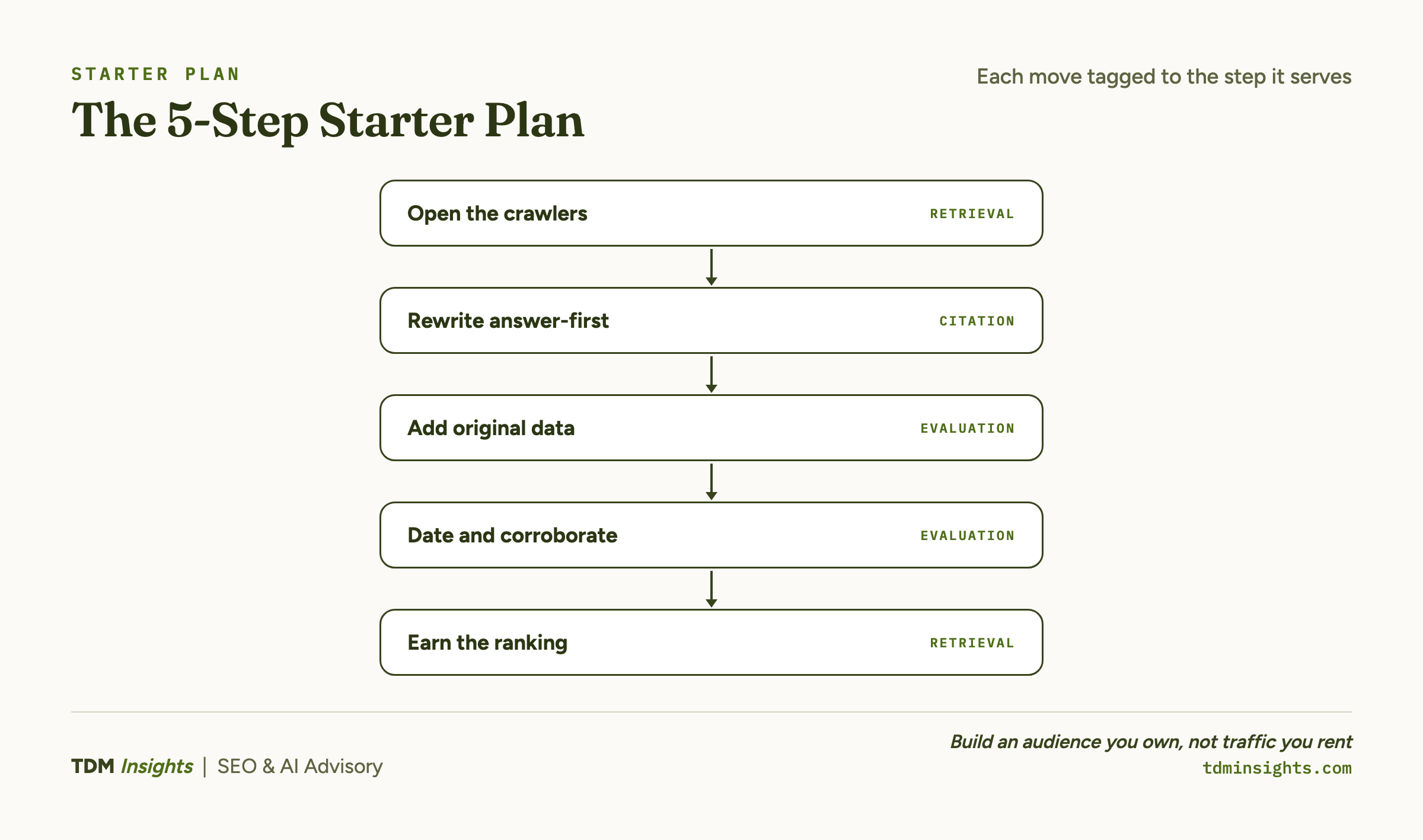
Each step names which part of the three-step model it serves, so you always know what you are buying.
Open the door to the crawlers (Retrieval). Confirm OAI-SearchBot, PerplexityBot, and Googlebot can all reach your priority pages. Check robots rules, firewall and CDN bot filters, and that the pages return clean HTML, not content locked behind JavaScript the crawler will not run.
Rewrite your top ten passages answer-first (Citation). For your ten highest-value questions, put the complete answer in the first one or two sentences of its section, under a heading that names the question. The test: a copied two-sentence excerpt should stand alone. This is the move with the broadest payoff because it serves all three engines at once.
Add original, citable data (Evaluation, ChatGPT tilt). Publish at least one fact the model cannot generate itself: a survey result, a benchmark, a first-hand number from your own work. Pages dense with original, cited statistics earn markedly more AI mentions, and ChatGPT specifically rewards first-hand data.
Date and corroborate your claims (Evaluation, Perplexity tilt). Add visible publish and updated dates, keep time-sensitive pages current, and make sure your key claims appear consistently across reputable sources so the cross-check confirms rather than contradicts you.
Earn the ranking (Retrieval and Evaluation, AI Overviews tilt). AI Overviews draw most of their citations from pages that already rank well in classic search, so your conventional SEO work (relevance, internal links, authority) is also your AI Overviews work. There is no shortcut around the ranking.
One thing this plan deliberately does not include is an llms.txt file.
It is a common question, and the honest answer is that no major engine currently uses one to decide citations, a point the data-grounded Ahrefs on whether llms.txt works analysis lays out clearly. Spend the time on the five steps above instead.
Two of those five steps (steps two and three) are really about the page itself: how a passage is built so an engine can lift it cleanly.
That on-page craft is its own discipline, covered in the on-page craft that makes a passage liftable, including the schema types and answer-first structure that turn a good paragraph into an extractable one.
For the complete how-to backbone behind this plan, the comprehensive Frase’s complete GEO citation playbook is a useful companion read.
And if you want the full picture of where AEO sits in the discovery journey before you execute, start from what answer engine optimization is.
Once the plan is running, the next problem is knowing whether it worked, which is harder than it sounds because AI citations rarely show up in standard analytics.
That is how to tell whether the engines are citing you, and it is the difference between guessing and reporting.
Frequently Asked Questions
How do I get my website cited by ChatGPT?
Get cited by ChatGPT by making sure OAI-SearchBot can crawl your site, then publishing content that answers a specific question in the first sentence with verifiable facts. ChatGPT favors original research, first-hand data, and sources that multiple independent pages corroborate. Strong domain authority and named expert authors raise your odds.
How do I show up in Google AI Overviews?
Rank in Google’s top organic results first: most AI Overview citations come from pages already in the top 20. Google states there is no special markup or file required. Win with accurate, well-structured content, clear heading hierarchy, demonstrated E-E-A-T, and a complete self-contained answer for each question.
What does Perplexity look for when choosing sources?
Perplexity runs a real-time search, then reranks results on relevance, freshness, authority, and clean page structure before citing. It prefers recent content, named experts, and answers written as self-contained passages with the key point in the first words. It also cross-checks claims across multiple domains, so consensus and visible publish dates matter.
Do ChatGPT, Perplexity, and AI Overviews reward different things?
Yes, the engines overlap far less than people assume. Studies of hundreds of millions of citations found only a small share of domains are cited by both ChatGPT and Perplexity. AI Overviews lean on top-ranking Google results, ChatGPT leans on original research and reference content, and Perplexity skews toward forums, freshness, and named expertise.
Does my content need an llms.txt file to get cited by AI engines?
No, an llms.txt file is not required and no major AI provider currently uses it for citations. Google has confirmed there is no special file or markup needed to appear in AI features. Focus instead on crawlable, accurate, answer-first content and organic ranking strength, which are the signals every engine actually reads today.
What is the single highest-leverage move to get cited by AI engines?
Publish original, citable data the engines cannot find elsewhere, then make it crawlable and answer-first. One analysis found a majority of ChatGPT’s top cited pages contained original research or first-hand data. Pages dense with cited statistics earned markedly more AI mentions in a separate audit.
Continue Reading:
More On Answer Engine Optimization
- Answer Engine Optimization: What AEO Actually Is
- GEO vs SEO vs AEO vs LLMO: What They Mean
- How AI Answer Engines Choose Their Sources
- Schema Markup for AI: Answer-First Writing Guide
- How to Measure AI Traffic With No Referrer
- How to Get Cited by ChatGPT
- How to Get Cited by Perplexity
- How to Get Mentioned by Google Gemini
- How to Be the Source Claude Recommends
- How to Show Up in Google AI Overviews
More from TDM Insights
- Backlinks for Startups: Earn Authority, No Budget
- Technical SEO Checklist for Founders, by Severity
- SEO for Startups: What to Do in the First 90 Days
- Content That Ranks and Gets Cited by AI
- Content Refresh: Win Back Rankings You Lost
Explore TDM Insights Categories