
Structure the Archive Before You Write Anything New
Eighteen dormant posts, three retrofittable layers, and no new articles. The cheapest wave in a content programme is the one you own.
 By David Jubé · Jul 9, 2026 · 7 min read
An independent school’s new site had been live for a few days. Eighteen posts had come across from the old platform intact, and the subject-matter input we needed for anything new was still weeks out. So there was a week with no writing in it, and an archive that had just changed shape underneath itself.
The obvious move was to wait. Instead we shipped a structural pass with no new articles in it at all, and it has since become the first wave we run rather than the last.
How to read this: one completed engagement, measured. The client is not named. Scores are Google PageSpeed Insights lab runs taken on the live site before cutover and again after launch, reported on the weaker of mobile and desktop. Counts come from a full page and post census at both points. Measured, not modeled.
Key takeaways
- An existing archive holds structural value that costs nothing in new writing to unlock.
- Categorisation, interlinking, answer formatting and snippet control are all retrofittable, and none of them wait on subject-matter input.
- Structure first also means later content lands into something instead of into a void.
The starting point
The corpus was fine as writing. As a system it did not exist. No working categories, so no archive page grouped anything. No navigation between posts, so a reader who finished one had nowhere obvious to go. Ten of the eighteen shared one identical templated meta description inherited from the old platform, which meant ten search listings competing with the same 57 characters.
Most of all, the posts did not link to each other. Crawlable links are how a page gets discovered and how authority moves between pages. Without them each post was technically published and practically an orphan.
Three layers, no new articles
| Layer | What shipped | Posts |
|---|---|---|
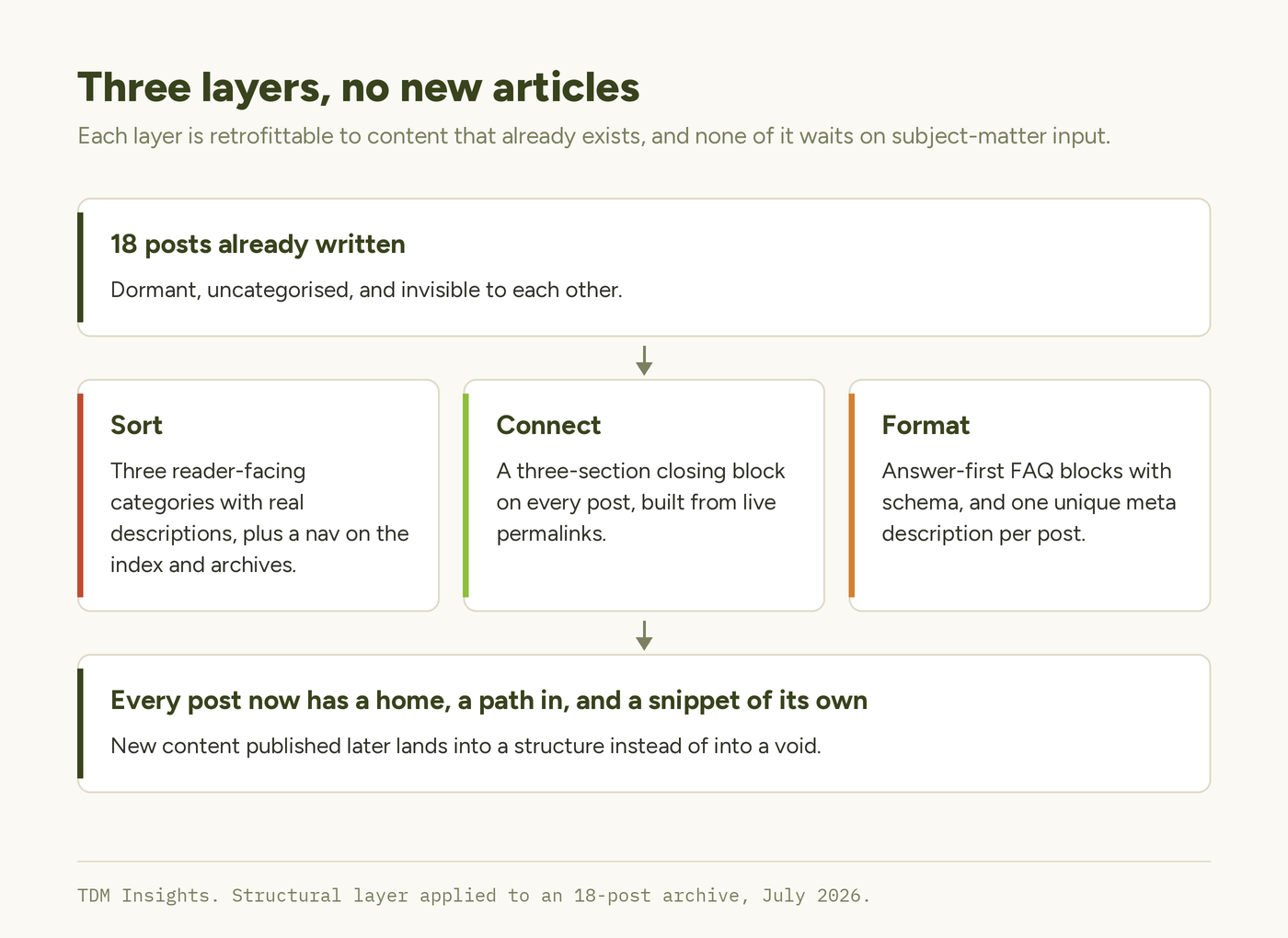
| Sort | Three reader-facing categories with real descriptions, plus a nav on the index and archives | 18 |
| Connect | A three-section closing block built from live permalinks | 18 |
| Connect | One contextual mid-article call to action | 16 |
| Format | A comparison table built from claims already in the prose | 4 |
| Format | A six-question answer-first FAQ block with FAQPage markup | 7 |
| Format | A unique 130 to 140 character meta description | 18 |
| Repair | Heading hierarchy corrected where sections began below their parent | 3 |
Be exact about the claim. No new articles were written. Some new words were: the FAQ answers, the meta descriptions and one line per call to action, roughly two thousand words of connective and answer copy across the whole archive. That is a fraction of a single commissioned post.
Why each layer earns its place
Categories are a reader product, not a taxonomy chore. Given real descriptions they become landing pages in their own right, and they give every post a permanent path in.
The closing block does the most work. Internal links pass authority and signal which pages belong together, and a three-section block gives every post siblings in its own cluster, one cross-cluster link and a route to the category archive. That is the difference between an orphan and a member of something.
Answer formatting is the retrofit most people skip. Six answer-first questions, published visibly and mirrored in FAQPage markup whose text matches the visible answers exactly, turns an essay into something an answer engine can quote a passage from.
Snippet control is per page. A search result snippet is often the only thing a person reads before deciding whether to click, so ten posts sharing one templated line is ten wasted opportunities. One description per page, written to what that page actually answers.
The FAQ layer went on seven posts, not eighteen, and the selection rule is the part worth copying. Only the genuinely informational posts got one, the ones answering a question a reader would plausibly type. Bolting a question block onto a short reflective essay produces filler that reads as filler, and answer engines are not fooled by volume. Retrofits should follow the shape of the content, not a completion percentage.
The read
| Measure across the same 18 posts | Before | After |
|---|---|---|
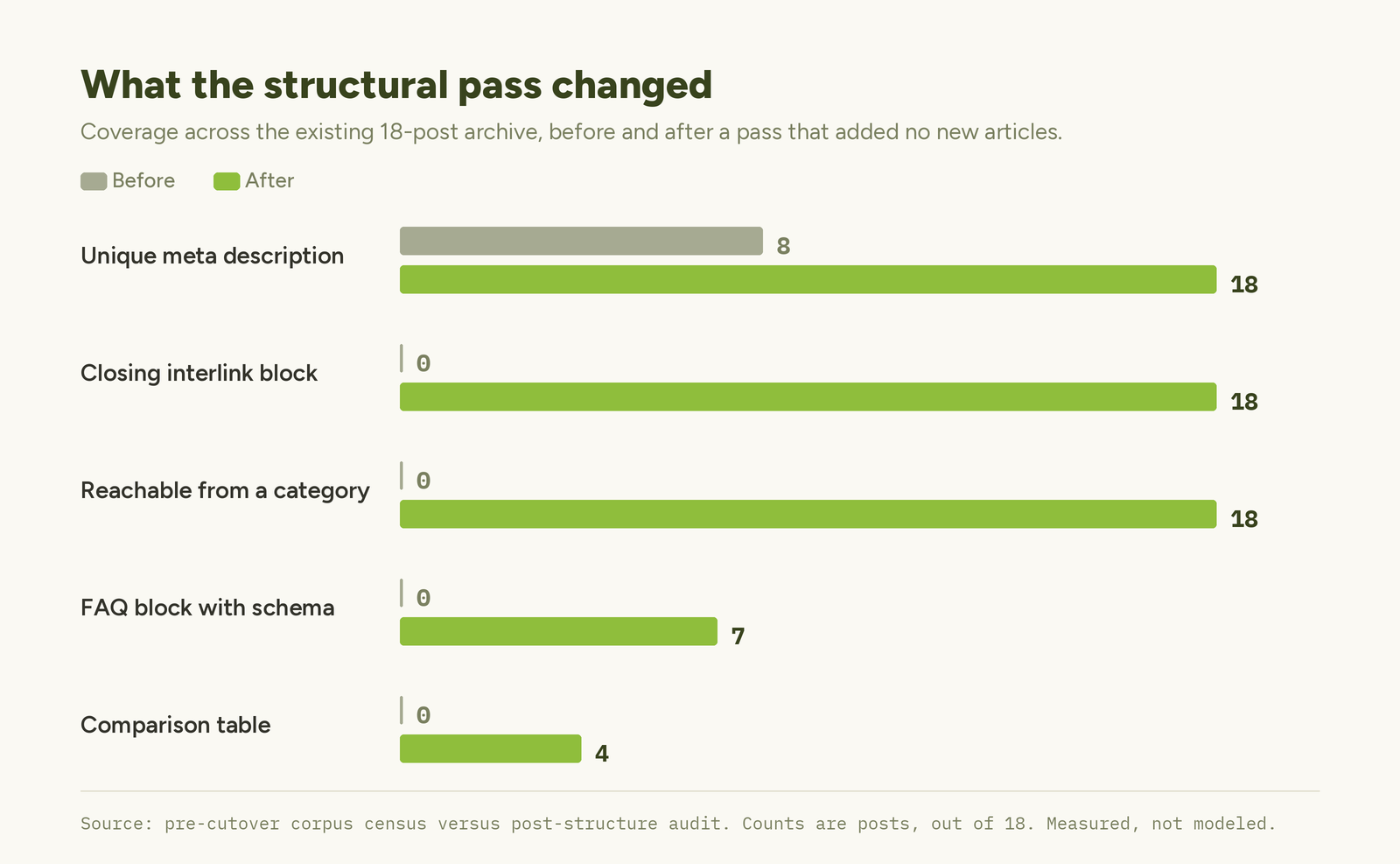
| Posts with a unique meta description | 8 | 18 |
| Posts with a closing interlink block | 0 | 18 |
| Posts reachable from a category archive | 0 | 18 |
| Posts with an FAQ block and FAQPage markup | 0 | 7 |
| Posts with a comparison table | 0 | 4 |
| AEO readiness composite, corpus average | 61 | 69 |
| New articles published | 0 | 0 |
None of this required new topical authority. The archive’s AEO readiness composite moved from 61 to 69 without a single new article, because the gains came from formatting and connection rather than from coverage.
The sequencing argument is the one to take away. A structural layer is the only part of a content programme with no external dependency: no interviews, no subject-matter review, no sign-off on claims. That makes it the right work for the period when everything else is blocked, which on most engagements is the first month.
What this teaches
- Structure before prose. It is cheaper, it compounds immediately, and the content you commission later joins a system instead of starting one.
- A closing block is not decoration. On a site with no internal linking it is the only mechanism by which an older post gets discovered at all.
- Give categories real descriptions. An archive page with a paragraph of human writing is a landing page. Without one it is a list.
- Answer formatting is retrofittable. Old posts carry FAQ blocks and structured data as well as new ones do.
- Snippet control is per page and cannot be templated. Every duplicated meta description is an impression you paid for and did not use.
- Do the structural pass while you are waiting on subject-matter input, not after. It is the one part of a content programme with no external dependency.
Frequently Asked Questions
What should you do with an old blog that was abandoned?
Structure it before you write anything new. Categorise it, interlink it, add answer-first FAQ blocks, and give every post a unique meta description. Those changes need no new articles and no subject-matter input, and they make later content land into a structure rather than into a void.
Do internal links actually help SEO?
Yes. Internal links let crawlers discover pages, pass authority between them and signal which pages belong together. A post with no inbound internal link is effectively an orphan: technically published, practically invisible. Interlinking an archive you already own is the cheapest lift available.
How many internal links should a blog post have?
There is no fixed number. Aim for enough that every post is reachable from at least one other post and one category archive, and that each post offers a reader an obvious next step. In this pass all 18 posts gained a three-section closing block.
Can you add FAQ schema to old blog posts?
Yes, and it is one of the highest-return retrofits available. Write six answer-first questions of roughly 40 to 60 words, publish them visibly on the page, and mirror them in FAQPage structured data. The visible text and the markup have to match exactly.
Do meta descriptions still matter?
They do not rank a page, but they decide whether a listing gets clicked. Templated descriptions repeated across many posts waste every one of those impressions. Write one per page at roughly 130 to 140 characters, describing what that specific page answers.
Is it better to update old content or write new content?
Do both, in that order. Structuring and updating what exists is faster and compounds immediately, because those pages already have age and some history. New content extends your coverage, and it performs better once there is a structure for it to join.
The takeaway in one line: structure the archive you already own before you commission a word, because connection and formatting are the only content work with no external dependency.
Sitting on an archive that nobody reads and nothing links to? Finding that is part of a free diagnosis.
Continue Reading:
More From This Project
More from TDM Insights
- How to Write FAQs That Double as AEO Fuel
- The FAQ Block, Rebuilt for Answer Engines
- Topic Clusters and Pillar Pages: How They Work
- Title Tags and Meta Descriptions That Get Clicks
- How Many Blog Posts Do You Need to Rank?
Explore TDM Insights Topics