
When to Stop Tuning a Site and Rebuild It Instead
The crawl was clean and every finding that mattered still sat on the platform. The ownership test that turns a retainer into a rebuild.
 By David Jubé · Jul 20, 2026 · 7 min read

An independent school hired us for an audit and an on-page programme. The site ran on a hosted website builder, the pages loaded, the content was current, and nothing in the brief pointed at a rebuild. The engagement ended as a full migration to WordPress that launched in July 2026. What moved it there was a single week of diagnostics, and the test that came out of that week is now the first thing we run before scoping technical work for anyone.
The crawl came back clean. No broken internal links, a valid sitemap, correct noindex directives on system pages, no duplicate URLs cluttering the index. On a standard audit template that is a green column, and a green column means a tune-up.
How to read this: one completed engagement, measured. The client is not named. Scores are Google PageSpeed Insights lab runs taken on the live site before cutover and again after launch, reported on the weaker of mobile and desktop. Counts come from a full page and post census at both points. Measured, not modeled.
Key takeaways
- A clean crawl proves the pages are wired correctly to each other. It says nothing about what the platform is capable of.
- Sort every high-severity finding by who owns the fix. If the items you cannot reach sit on the templates that carry your traffic, you have a ceiling rather than a backlog.
- The tell here: the SEO score was 100 before the rebuild and 100 after. Everything that moved was owned by the platform.
The two findings that did not fit
The first was structural. The builder rendered page titles as styled containers rather than real heading elements, so 47 static pages carried no semantic H1 and only one of the seven core templates had one. There is no field in an editor that produces a heading the template refuses to emit.
The second was performance. The slowest page took 13.6 seconds to render its largest contentful element on mobile, caused by JavaScript the platform shipped on every page load. The usual remedies all assume you control what the page sends.
The test: who owns the fix
So we stopped ranking findings by severity and sorted them by reachability. One column for what an editor can change. One column for what the template or the runtime decides.
| Finding | Who owns the fix | Editable in place |
|---|---|---|
| Meta descriptions off specification | The page | Yes |
| Duplicate and stale pages in the index | The page | Yes |
| Thin copy on catalogue pages | The page | Yes |
| Missing internal links between related pages | The page | Yes |
| No semantic H1 on 47 pages | The platform | No |
| Unused JavaScript on every page load | The platform | No |
| Structured data on 2 of 7 templates | The platform | Partly |
| Two live homepages at different addresses | The platform | Partly |
Then we scored the counterfactual. Assume a perfect six months on the left column: every meta rewritten, every duplicate merged, every internal link placed. What is still broken the day that work ends? Still no headings, still the script payload, still no structured data on five of seven templates. That answer turned an on-page retainer into a rebuild.
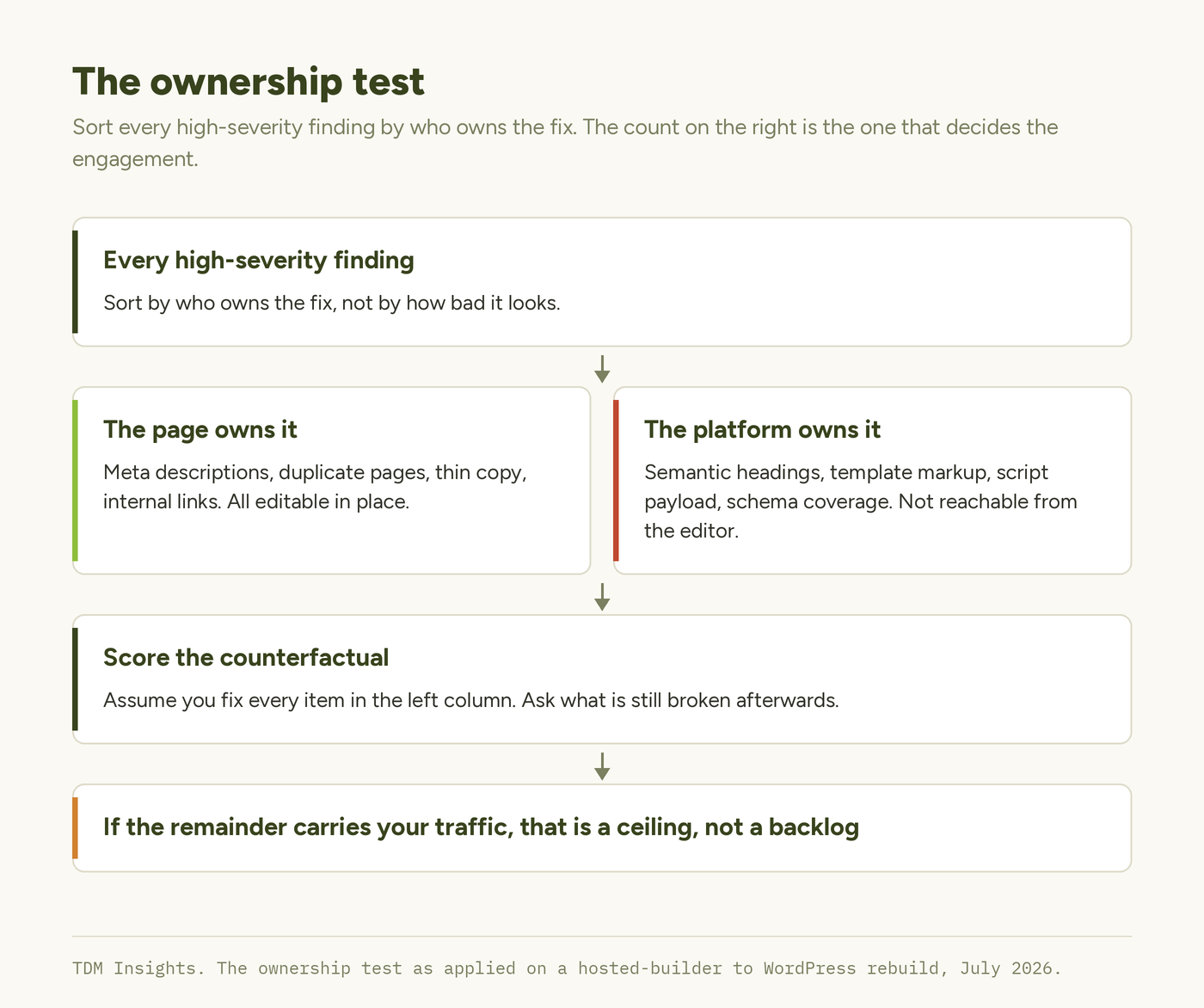
Lead a client with that column, not with the recommendation. A rebuild proposed as a design preference is an argument about taste. The same rebuild proposed as a list of fixes nobody can reach from the editor is an argument about arithmetic.
What the numbers did
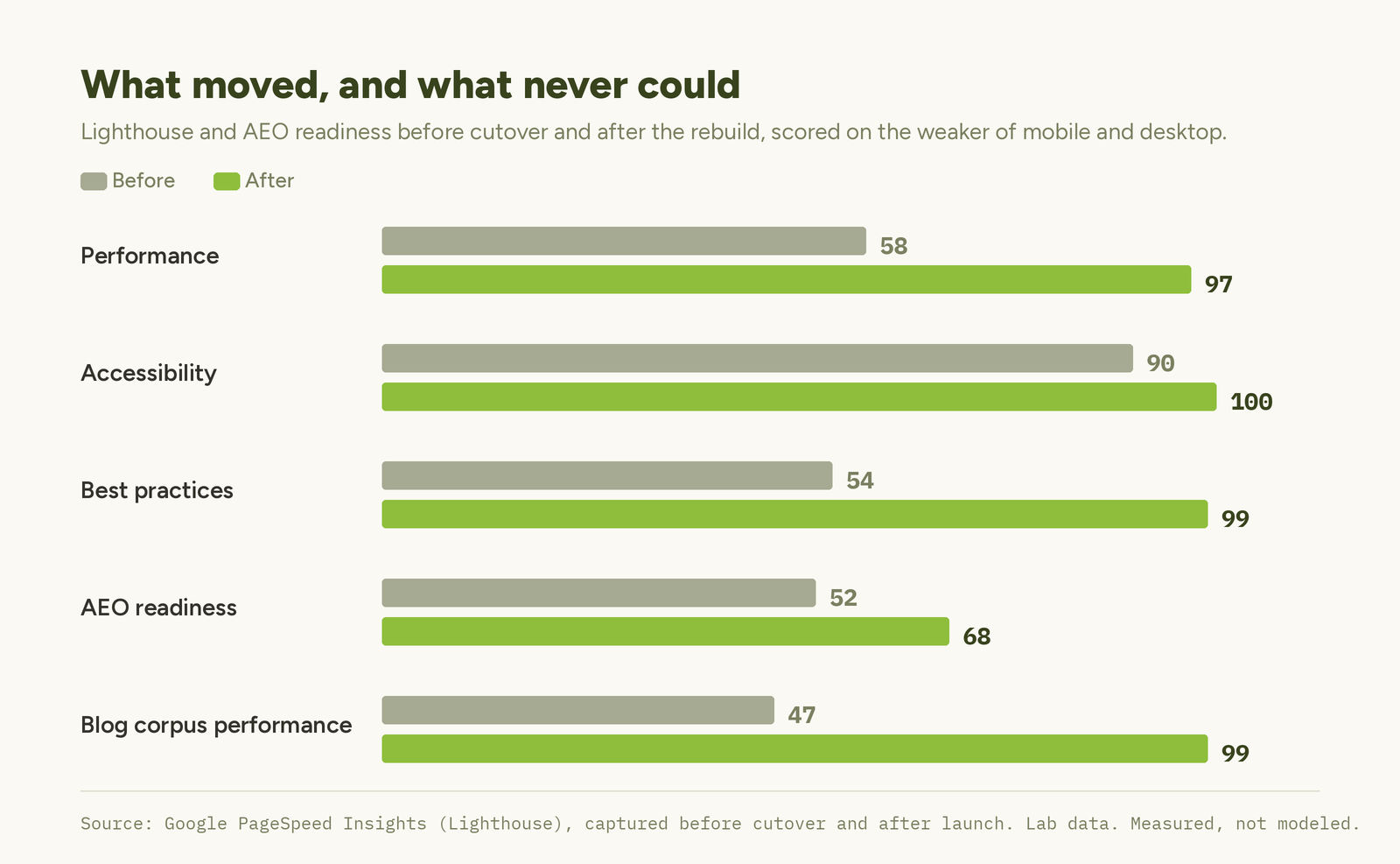
The site was rebuilt with the same content and the same brand. Both captures use the same method, the same URLs and the same Lighthouse tooling, so the comparison is like for like.
| Measure | Before | After |
|---|---|---|
| Performance | 58 | 97 |
| Accessibility | 90 | 100 |
| Best practices | 54 | 99 |
| SEO | 100 | 100 |
| AEO readiness | 52 | 68 |
| Core templates with a semantic H1 | 1 of 7 | 7 of 7 |
| Templates emitting structured data | 2 of 7 | 7 of 7 |
| Slowest page, mobile LCP | 13.6s | 1.7s |
| Blog posts over 4s LCP | 18 of 18 | 0 of 18 |
The full post census is what makes the diagnosis safe. Scoring seven page types tells you about templates. Scoring all 18 posts tells you whether the problem is uniform. It was: every post sat above four seconds in a tight band, the signature of a platform-level cause. A handful of slow outliers would have meant a tune-up.
The read
The line that proves the point is the one that did not move. SEO scored 100 before and 100 after. Every check in that category was already passing, which is exactly what the clean crawl told us. Had tuning been the right call, the weak scores would have sat on dimensions we could reach from the editor. They did not. They sat on dimensions the platform decided, and those are the ones that moved. Worth knowing how the performance score is weighted before leaning on any single number, but the direction here is not subtle.
What this teaches
- Sort findings by who owns the fix before ranking them by severity. Severity tells you what hurts. Ownership tells you whether you can do anything about it.
- A clean crawl is a statement about wiring, not about capability. Crawlers check links, status codes and directives. They do not check whether a template can emit a heading.
- Score the counterfactual out loud. Write down what is still broken after a perfect run at everything you can reach. If that list carries the traffic, you are buying months to arrive at the same ceiling.
- Census the whole corpus, not a sample of page types. Uniform failure points at the platform. Scattered failure points at the pages.
- Capture the baseline before you decide. Once the old site is gone you cannot re-take it, and a rebuild becomes a claim rather than a measurement.
Frequently Asked Questions
When should you rebuild a website instead of optimising it?
Rebuild when the fixes that would move your traffic are owned by the platform rather than the page. Sort every high-severity finding by whether you can reach it from the editor. If the unreachable column holds the items on your highest-traffic templates, optimisation has a ceiling.
Does a clean crawl mean a site is technically healthy?
No. A crawl checks links, status codes, sitemaps and indexation directives. It does not check whether templates emit semantic headings, how much script the platform injects, or whether structured data exists. A site can pass every crawl check and still cap out on what search engines weigh.
Do website builders hurt SEO?
Not inherently, but they set limits. Some render headings as styled containers, ship shared JavaScript on every page, and restrict structured data. Those limits are invisible in a crawl report and unfixable from the editor, which is what turns them into a rebuild decision rather than a task list.
What is a good Lighthouse performance score?
Google treats 90 and above as good, 50 to 89 as needing improvement, and below 50 as poor. Scores are lab measurements rather than real user data, so read them as a diagnostic signal, not a ranking input. Field data from actual visitors is the better judge.
Will rebuilding a website lose my search rankings?
Not if every old address redirects to its match. Ranking history attaches to URLs, so the risk in a rebuild is unmapped addresses, not the new design. Reconcile the full URL inventory before launch and the rankings travel across with the redirects.
How long does a website rebuild take to show SEO results?
Expect no verdict in the first month. Search engines have to recrawl, reindex and re-evaluate the new templates, and redirect equity settles over weeks. Technical and readiness scores move on day one. Organic traffic is a 90-day question at minimum.
The takeaway in one line: sort your findings by who owns the fix, because the column you cannot reach decides whether you are tuning a site or waiting on a ceiling.
Want to know which of your own findings are page-owned and which are platform-owned? That is the first cut a free diagnosis makes.
Continue Reading:
More From This Project
- Legacy Content Is Authority You Already Paid For
- Structure the Archive Before You Write Anything New
More from TDM Insights
- Site Speed: The Fixes That Actually Move Rankings
- Core Web Vitals Explained for Non-Engineers
- WordPress vs Shopify vs Wix vs Squarespace, Compared
- Technical SEO for Founders: What to Fix First
- How to Structure a Page to Rank and Get Cited
Explore TDM Insights Topics