
Landing Page Copy vs Blog Copy: The Difference
Two page types, two jobs. How length, links, navigation, and asks differ, plus how to tell which one a given page should be.
 By David Jubé · May 31, 2026 · 12 min read
Blog copy and landing-page copy do two different jobs. Blog copy earns the reader’s trust on the question they came to answer. Landing-page copy asks them to make one decision.
Use the same words in the wrong place and they fail at the job that page was built to do.
A blog post is allowed to wander. It can link out, cover the nuance, and let a curious reader follow a tangent, because its win is a reader who finishes more convinced than they arrived.
A landing page works the opposite way. Every line points at one action, and anything that pulls attention sideways is a cost. Practitioners who write conversion copy for landing pages treat that focus as the whole point of the page.
This article gives you the side-by-side of the two jobs, dimension by dimension, then the rule for deciding which page type a given goal actually needs.
The reason the distinction matters is structural. Each page sits at a different point in the funnel where each page type does one stage-matched job, and the copy is what carries that job. Get the page type right and the copy right, and the reader moves to the next step instead of stalling.
Key takeaways
- Blog copy and landing-page copy do opposite jobs: blog copy earns trust on the reader’s question, landing-page copy drives one decision.
- Links and navigation are a feature on a blog post and a cost on a landing page, because every extra exit pulls a ready buyer away from the one action.
- Length follows the job, not a fixed count: a blog post is sized by what the topic needs (often past 1,500 words), a landing page by how big the decision is.
- The same words fail on the wrong page type: wandering blog copy leaks attention on a landing page, and terse landing copy earns no trust and nothing to rank on as a blog post.
- Pick the page type by asking whether the goal is a decision or a relationship, then build the handoff so a blog post earns the read and links forward to a dedicated landing page.
Two Jobs, Not One Skill
A common framing treats “copywriting” as a single craft you get better at. It is closer to two crafts that share a vocabulary.
Blog copy is trust work. The reader arrived with a question, often a broad one, and your job is to answer it so completely and so honestly that they leave believing you know the subject. That belief is the asset.
It is why a strong blog post can link out to a research source, admit a tradeoff, and take a detour into an edge case without losing the reader. Depth and candor are what earn the trust, so the copy is built to reward a reader who keeps reading.
Landing-page copy is decision work. The reader is closer to acting, and the page exists to remove every reason to hesitate and make the one next step obvious.
A step-by-step landing-page copywriting guide walks through that mechanic in detail:
- The headline states the single promise.
- The body answers the objections standing between the reader and the action, in the order a hesitating reader raises them.
- The proof shows up early, before the doubt has time to form.
The page strips out the side doors so the reader keeps facing the one you want them to walk through.
You are not in the room when either page does its work. The copy has to carry the whole job on its own, which is exactly why putting the wrong job on the page shows up as a leak you can measure.
The Page-Type Split: A Side-by-Side
Here is the contrast across the dimensions that actually differ. Read it as two jobs, not a better-or-worse ranking.
Two rows do the heavy lifting. Links and navigation are a feature on a blog post and a cost on a landing page.
Unbounce’s analysis of more than forty thousand landing pages found that pages with fewer links converted better, reported in their Conversion Benchmark Report as a consistent pattern: the more places a reader can go, the fewer who take the one action the page was built for. A blog post wants those exits. A landing page cannot afford them.
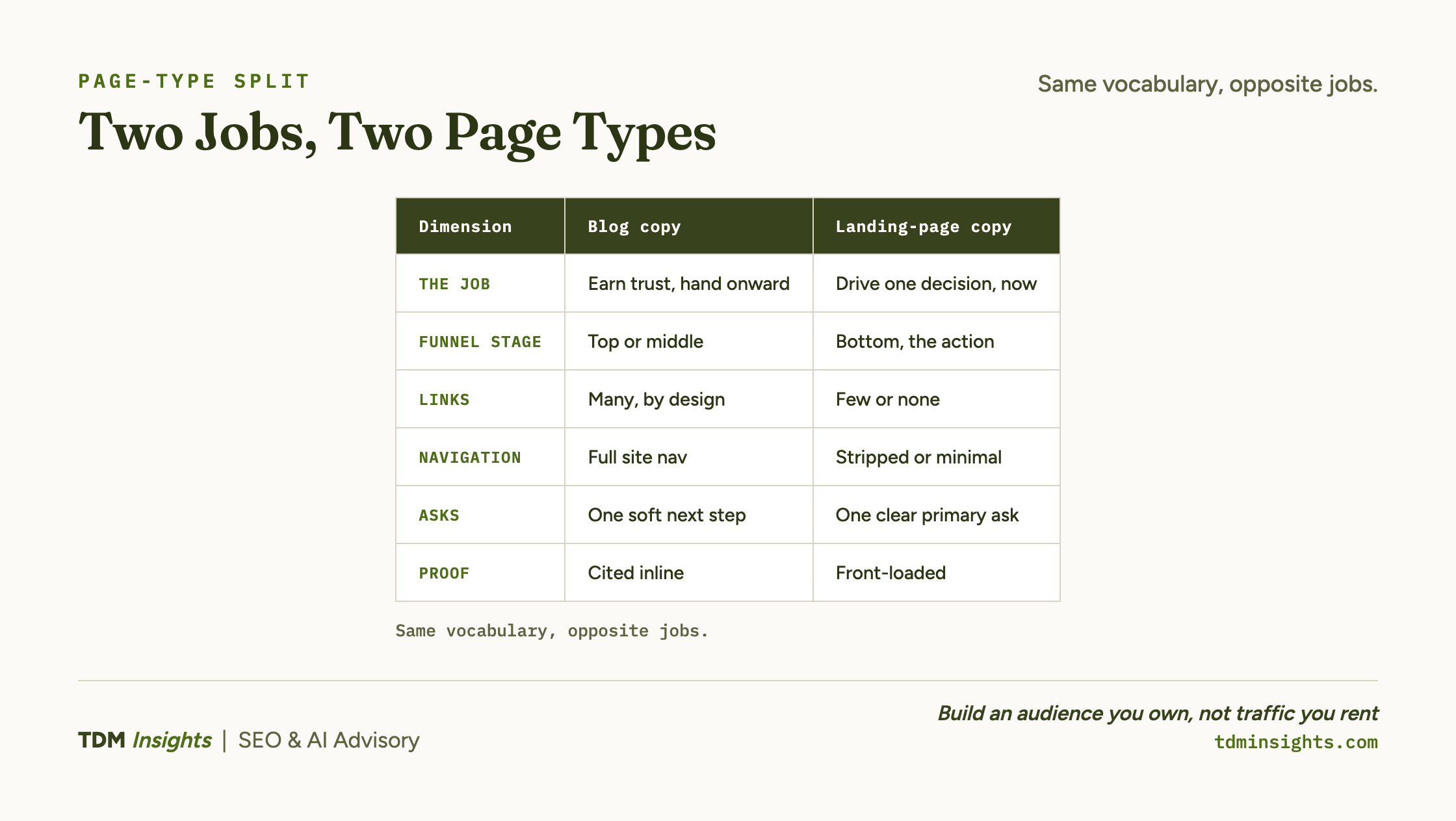
The asks row is where this cluster’s spine shows. A landing page is where the one-CTA rule is strictest, because the whole page is the ask. A blog post carries one soft next step too, but it lives inside a page whose first job is the read.
Book a free diagnosis
If your blog posts read like sales pages or your landing pages read like essays, the symptom is usually a page doing the wrong job for where its reader is in the funnel. A free diagnosis reads a sample of your live pages, names which ones are mismatched to their stage, and shows where a blog post should hand off to a dedicated landing page instead of trying to close the reader itself. It is a working session, founder to founder, not a pitch.
How Long Should Landing-Page Copy and Blog Copy Run?
Length follows the job on both page types, which is why a fixed word count helps neither.
Blog copy is as long as the topic needs to be genuinely useful, and competitive informational topics frequently run past 1,500 words because that is what completeness requires. The number is an output of the intent, not a target you pick. This is the same principle as length following intent rather than a word count: the depth is set by what the question demands, then the post stops.
Landing-page copy follows the size of the decision. A low-commitment ask, a free newsletter, can convert on a short page because there is little to overcome. A high-commitment ask, a paid plan or a booked call, often needs more copy, because more objections stand between the reader and the action and each one has to be answered before the click.
A tactical landing-page copy method makes the same point from the conversion side: the discipline is the same either way. Every line earns its place by moving the reader toward the one decision, and anything that does not is cut.
So both reject a magic number, but for opposite reasons. The blog post is sized by how much the topic needs. The landing page is sized by how much the decision needs.
Why the Same Words Fail on the Other Page
The jobs are opposite, so the copy built for one actively works against the other.
Move wandering blog copy onto a landing page and it leaks attention. The links that kept a curious reader engaged now hand a ready buyer a dozen ways to leave before they act. The detours that built trust now delay the decision.
Guides on writing landing-page copy that drives one action describe the same failure: extra paths pull the reader off the one the page was built for, and the page that was supposed to close stalls.
Run terse landing copy on a blog post and it earns no trust. The reader came with a question and got a pitch, so the page never does the convincing that makes the eventual ask land.
The depth that signals expertise was stripped out in the name of focus, which leaves the page with:
- Nothing to rank on and nothing to cite.
- No question for a search engine to match the page against.
- No evidence to weigh for a reader deciding whether to believe you.
The page asks for the decision before it has done anything to earn it.
This is why the stronger pattern is rarely one page doing both. A strong blog post earns the read and then links to a dedicated landing page for the conversion, so each page does its own job well.
Copyhackers makes the same separation in its definition of conversion copywriting: copy written to drive a single decision is its own craft, distinct from copy written to inform. Stripe’s guide to writing landing-page copy frames the focused page the same way. The handoff between the two is the structure, not a single hybrid page.
Which Page Type Does This Goal Need?
Decide by asking one question: is the goal a decision or a relationship?
A specific, ready-now action, book a call, buy the plan, sign up for the trial, needs a focused landing page. The reader is close enough to act, so the page should remove friction and drive the decision. Teams that frame copywriting around the conversion goal treat that single job as the page’s reason to exist.
Educating, ranking in search, and building trust over months are relationship goals, and those need a blog post, because the win is a reader who comes back more convinced, not one who acts today.
The reader’s readiness is the tiebreaker. If they are not yet ready to act, sending them to a landing page wastes a reader who needed a blog post first. If they are ready, sending them to a blog post buries the action they came for under a read they did not want.
The same logic runs through the search intent behind the query: a query that signals readiness to act calls for a different page than a query that signals a question to answer.
Here is the practical version, in order:
- Name the goal. Is it a single decision, or trust built over time?
- Read where the reader is. A query or a referral that signals readiness points to a landing page. A broad question points to a blog post.
- Match the page type to both. Decision plus ready reader, build a landing page. Question plus exploring reader, write a blog post.
- Build the handoff. The blog post earns the read and links forward to the landing page that closes, so neither page carries a job it was not built for.
When you do write the focused page, a landing-page copywriting method and the CRO-backed advice on landing-page copy that converts both reinforce the same single-message discipline: one promise, one ask, no side doors. Get the page type and the copy aligned, and the next lever is where the one ask sits on the page. The copy can be right and the CTA still buried where no one clicks, which is the next mechanic to fix.
Frequently Asked Questions
What is the difference between a landing page and a blog post?
A landing page is built to drive one specific action, like a signup or a booking, with everything else stripped away. A blog post is built to inform, build trust, and attract organic traffic over time, with room to explore. One page lands a decision; the other earns attention and hands the reader onward.
Why does the same copy style fail on the other page type?
Because the jobs are opposite. Blog copy is allowed to wander, link out, and educate, which keeps a curious reader engaged. Landing-page copy must remove distraction and drive a single decision. Drop wandering blog copy onto a landing page and it leaks attention; drop terse landing copy onto a blog and it earns no trust.
How long should landing-page copy be versus blog copy?
Landing-page copy is as long as the decision requires and no longer, often short for simple asks and longer for high-commitment ones, with every line serving the conversion. Blog copy is as long as the topic needs to be genuinely useful, frequently 1,500 words or more. Length follows the job, never a fixed rule.
Should a landing page have navigation and internal links?
Usually not. A dedicated landing page removes the main navigation and most links so nothing pulls the reader away from the single decision. Studies of tens of thousands of landing pages show fewer links correlate with higher conversion. A blog post is the opposite: links and navigation are features that keep the reader exploring.
How do I know which page type a given goal needs?
Ask whether the goal is a decision or a relationship. A specific, ready-now action (book, buy, sign up) needs a focused landing page. Educating, ranking, and building trust over time need a blog post. If the reader is not yet ready to act, send them to a blog post first and a landing page later.
Can a blog post double as a landing page?
Rarely well. A blog post optimized for traffic and exploration works against the single-decision focus a landing page needs. The stronger pattern is a blog post that earns the read and then links to a dedicated landing page for the conversion, so each page does its own job instead of one page doing both badly.
Continue Reading:
More On Content Conversion:
- How to Build a Content Funnel (TOFU to BOFU)
- The One-CTA Rule: One Ask Per Page Wins
- Where to Place a CTA So It Gets Clicked
- Content-Market Fit: Earn Customers, Not Traffic
- Content ROI: How to Calculate It vs Ad Spend
More from TDM Insights:
- Content That Converts Readers Into Customers
- How Long Should a Blog Post Be? Intent Over Count
- Content Strategy for Founders
- How to Produce Content That Ranks and Gets Cited
- How to Write a Content Brief (That Gets It Right)
Explore TDM Insights Categories: