
Website Content Writing for SEO: The Four Rung Ladder
Website content writing for SEO starts with eight to twelve pages in one order. Get the list, the sequence, and the reason behind it.
 By David Jubé · Aug 25, 2026 · 15 min read

Your site structure is settled and the pages are empty, so the question is no longer where the words go but which words to write first.
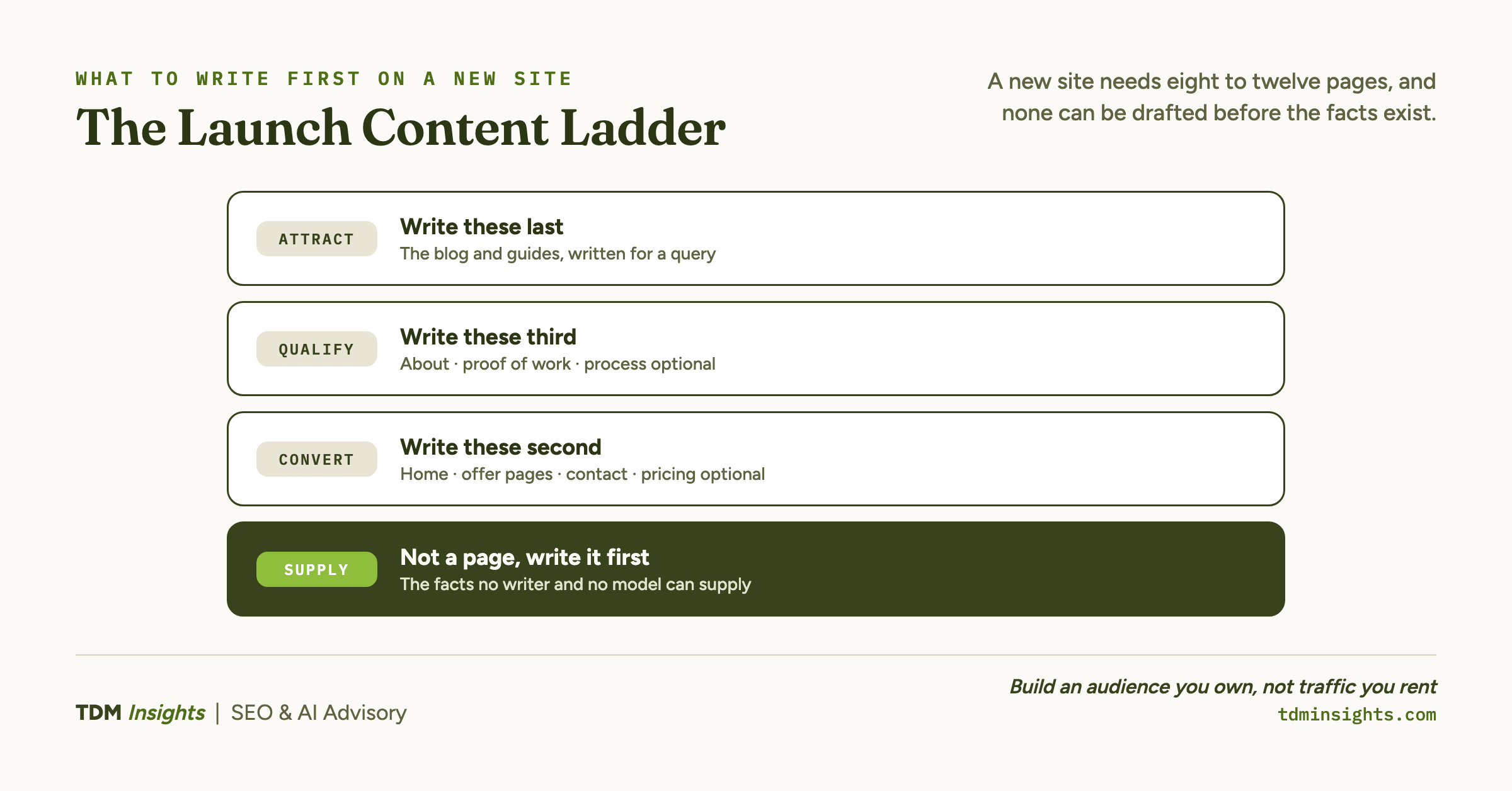
A launch site needs eight to twelve pages, and the order you write them in decides how fast any of them return anything. First the facts only you hold, because nothing above that rung can be drafted without them. Then the pages that sell, because they meet demand that exists today. Then the pages that establish who is behind the work, because an unknown brand has to answer that before anyone buys. The blog comes fourth, and the four quiet months founders lose at launch are usually spent there.
Key takeaways
- A launch site needs eight to twelve pages, and the count follows your offer list rather than a design template.
- The order is Supply, Convert, Qualify, Attract. Each rung depends on the one below it.
- Supply is not a page. It is the set of facts about your business that no model and no writer can invent for you.
- The blog is fourth because it goes looking for demand, while your service pages meet demand that already exists.
- Publishing a blog first is the launch mistake that produces four months of work and no enquiries.
Eight to twelve pages, in the order that pays first
Three of those pages can return something this quarter and the rest cannot, so the first job is working out which three are yours.
Here is the full list for a service business. One home page. One service page for each distinct thing you sell, which is usually two to four. One about page. One contact page. One proof or work page. Optionally a pricing page and a process page.
Count your offers and the page count falls out of it. If you sell one thing to one buyer type, the low end is right and a very small site is a legitimate answer. If you sell four things to three buyer types, twelve pages is not padding, it is the minimum that lets a buyer find the one page written for them.
The failure runs the other way round. A page list gets copied off a template, and each slot then gets filled with whatever seems to fit it. The template has decided the shape of the site before anyone decided what the business needs to say, which is how a launch ends up with an empty services page and a blog with two posts on it.
The four rungs, and why each depends on the one below it
The rungs are not equal and they are not independent. Each one is assembled out of the rung beneath it, which is why sequence decides more than volume does.
I call the sequence the Launch Content Ladder.
Every rung has a job it cannot do alone, and the rung that covers that gap sits directly above or below it. Supply feeds Convert with the specifics that make a service page worth reading. Convert funds Qualify, in the sense that the enquiries it produces are what make the credibility work worth the hours. Qualify supports Attract, because traffic landing on a site with no visible proof converts at a fraction of what it should.
Skip a rung and everything above it underperforms in a way that looks like a writing problem. The copy gets rewritten, the headline gets tested, nothing moves, and the reason is that the missing piece was never on the page being edited.
Supply comes first because nothing above it can be written without it
Supply is the rung people skip, because it is the only one that produces no page at the end of it. It is the set of facts about your business that no writer and no model can supply for you: what you sell and in what units, what you refuse and who you turn away, how the work actually runs and how long each step takes, what you have delivered as figures rather than adjectives, and who does the work and what they did before.
None of that exists on the public web yet. If nobody writes it down, every page above this rung gets drafted from the general case, and the general case reads like every other site in your category. That is why so much launch copy is interchangeable. The sentences are competent. They were assembled from an average, because nothing specific was available to assemble them from.
Write the facts down before you write a single page. A plain document is fine. What matters is that the specifics sit somewhere a writer, or a model working under your direction, can draw on them. Step 7 of this series, AI Website Copy: Which Sentences to Keep and Cut, covers what goes into that document and what changes in a draft once it exists.
Run this before you write anything
Open a blank document and try to write down your prices, your three most common jobs with a real quantity attached, and the two kinds of work you turn down. If any of those takes more than a few minutes, that gap is the reason the drafting will stall later.
Convert comes second because it meets demand that already exists
Your service pages and your home page are the only pages on a launch site that can return something in the first weeks, because they are the only ones answering a question somebody is already asking.
Someone searching for the thing you sell is at the end of a decision rather than the start of one. Google’s own starter guide frames the job of a page as answering what the person came for, and on a service page that question is narrow: do you do this, for people like me, and what happens next. A page that answers all three in the first screen has done the part that decides whether anyone gets in touch.
Write one page per distinct offer. A single page listing everything has to speak to four buyer types at once, so it argues at the level all four share, and that level is always the vague one. Each page needs to name what the buyer receives rather than the category the work belongs to. Step 9 of this series, Service Page Content Examples: Six Sections in Order, covers the section order for a service page in detail, and Content That Converts Readers Into Customers covers the conversion mechanics that sit underneath all of them.
Give each page one ask. A second ask splits the reader’s attention at the point you need it whole, and The One-CTA Rule works through what happens to a page that offers a choice where it should offer a next step.
The home page is written last within this rung, not first. It is the hardest page on the site because it has to work for every buyer type at once, and it gets easier once the service pages exist and you can see what they have in common.
Qualify comes third because an unknown brand has to answer who
A buyer convinced by the offer still has to decide whether to trust you with it, and on a new site there is nothing outside your own domain telling them.
That is the job of the about page, the process page, and the proof page. They rarely bring traffic of their own. They convert traffic that arrived somewhere else, which is why they come after the pages that bring it.
The about page carries the heaviest share of that work, and treating it as a brand-story exercise spends your best answer to the trust question on something else entirely. Step 8 of this series, About Page Content and What Actually Belongs on It, treats it as the record it actually is.
Proof is the hard part for a business with no client list. The honest move is to publish what you can count rather than what you can name: quantities of work by type, years in the craft, qualifications with their issuing body. Writing for E-E-A-T covers how that reads on the page. Where you put it counts as much as what it says, because Nielsen Norman Group’s research on how people read web pages tracks readers scanning down the left of a page and skipping the body of long blocks, so credibility that arrives in the fourth paragraph arrives after they have stopped.
Attract comes fourth because it has to go and find its readers
The blog is fourth because it goes looking for demand rather than meeting it, and reaching people who have not heard of you is slower work than answering people who are already searching for what you sell.
This is where the launch mistake happens. A founder publishes a blog first, because writing posts feels like progress and writing a pricing page feels like exposure. Four months later there is a modest amount of traffic, no enquiries, and a services page that still says “we deliver excellence.” The traffic was never the problem. It arrived at a site with nothing to convert it.
Content written for a query takes time to compound, and that curve is well documented. Ahrefs’ study of how pages accumulate search traffic shows how long it takes to bend. SparkToro’s work on clicks per search is worth reading beside it, because a ranking and a visit are separate events, and a plan that treats them as one overstates what the rung will return.
The rung is worth building. The question is when. How Many Blog Posts Do You Need to Rank covers the volume, and Topic Clusters and Pillar Pages covers how the posts should relate to each other once you start.
When you do start, start with the questions your buyers already ask you. Conductor’s work on educational content makes the case for that as the entry point, and it has the practical advantage of drawing on Supply, which is already written. Decide early which of those posts the rest will point at, because retrofitting that structure onto forty posts is a far bigger job than setting it up on four, and Yoast’s guide to setting one up is the practical version.
Platform choice is not the content question
Somewhere in planning a launch, the question of which content management system to use arrives and consumes a week.
The ladder is identical on every platform. Supply is a document, Convert is a set of pages, Qualify is three more, Attract is a library that grows. Nothing on that list changes because of what renders it, and a service page that never names what the buyer receives will not start naming it because the site moved.
What your platform does affect is how the pages are structured and what markup they emit, which is a build decision covered earlier in this series in WordPress Site Design: Builder, Parent Theme or Code and Site Structure for a New Website: The Two Numbers. How to Structure a Page to Rank and Get Cited covers the page-level version, and web.dev’s guidance on headings and sections covers the markup underneath it.
Where writing your own site stops paying
You can write all of this yourself, and for a site at the low end of the range you probably should. Nobody else holds Supply, and getting it out of your head is the bulk of the work whoever types the pages.
The point where that changes is not about ability and not about money. It is three conditions you can check against your own situation.
- Scope. Your page count crosses roughly twelve, or the set covers more than one line of business. At that size the pages stop being a list and start being a system that has to stay consistent with itself.
- Complexity. Two or more buyer types need genuinely different arguments for the same service. Writing one page that serves both is harder than writing two, and it is where self-written sites blur.
- Handover. The facts in Supply live in more than three people’s heads and have never been written down. Extracting them is a different job from writing, and it is usually the one that stalls.
Moz’s on-page guide and Orbit Media’s planning walkthrough are both solid if you are running this alone, and the Content Marketing Institute’s annual research is useful for understanding what changes as a content operation grows past one person.
Step 10 of this series, Website Content Writer: The Point You Hand It Over, treats that crossover properly. Step 6, Website Content Strategy: Money Pages in Four Weeks, defends this order on payback timing, which is the argument to have ready when the person questioning the sequence is a co-founder rather than yourself.
Book a free diagnosis
If your site is live and the pages exist but the enquiries are not arriving, the problem is usually the order rather than the writing. I will look at your page set, tell you which rung is missing, and hand you the list in the order that fixes it.
Frequently Asked Questions
What must every website have?
Every site needs a home page, one page per distinct service, a contact page, an about page, and some form of proof. That is eight to twelve pages for a typical service business. They are not equal: the service pages and home page can return enquiries within weeks, while the rest support them.
How many pages does a website need?
Between eight and twelve for a launch site, and the count follows your offer list rather than a template. One page per distinct thing you sell, plus home, about, contact, and proof. Sell one thing and the low end is right. Sell four things to three buyer types and twelve is the minimum.
What is website content?
Website content splits into two kinds that behave differently. Pages that answer demand which already exists, such as service and pricing pages, and content that goes looking for demand, such as blog posts and guides. Planning advice treats both as one pile, which is why launch sequencing so often goes wrong.
How do you write content for a website?
Start with the facts only you hold: prices, boundaries, method, proof, people. Nothing above that rung can be drafted without them, whether a person or a model is doing the drafting. Then write the pages that sell, then the pages that establish credibility, then the blog.
Is it better to have a one page website or multiple pages?
One page works when you sell one thing to one buyer type, and it stops working the moment that is untrue. Two distinct offers need two pages, because a single page addressing both addresses neither well. Decide on your offer count, not on design fashion.
What are common website mistakes?
The costliest launch mistake is order rather than quality. Founders publish a blog first because it feels like progress, then find that four months of posts produced traffic and no enquiries, because it arrived at a site whose service pages never said what the buyer receives.
Continue Reading:
Previously in this series
- Rebuild or Redesign: One Staging Test Tells You Which, whether you are redesigning around your content or rebuilding it, which decides how much writing survives.
Next in this series
- Website Content Strategy: Money Pages in Four Weeks, the same page list ordered by payback rather than by dependency.
From the library
- Content Strategy for Founders, where the four rungs lead once they are built, which is a library that compounds.
- How to Write a Content Brief That Gets It Right, planning each rung this way keeps it from turning into the wrong page.
- Landing Page Copy vs Blog Copy, why the Convert and Qualify rungs need different copy rules than the Attract rung does.
Explore TDM Insights Categories