
Comparison Tables and Formats LLMs Love to Cite
AI engines cite tables and ranked lists more than prose. How to build a comparison table an LLM can lift cleanly, and why structure wins.
 By David Jubé · Apr 24, 2026 · 14 min read
A well-built comparison table is one of the formats LLMs cite most: it can earn citations that three paragraphs of the same information will not. The reason is mechanical: a table is already broken into self-contained, comparable cells, so an answer engine can lift one row or the whole grid without losing the relationships between the items. Prose has to be parsed and reassembled first, and every reassembly step is a chance to get it wrong.
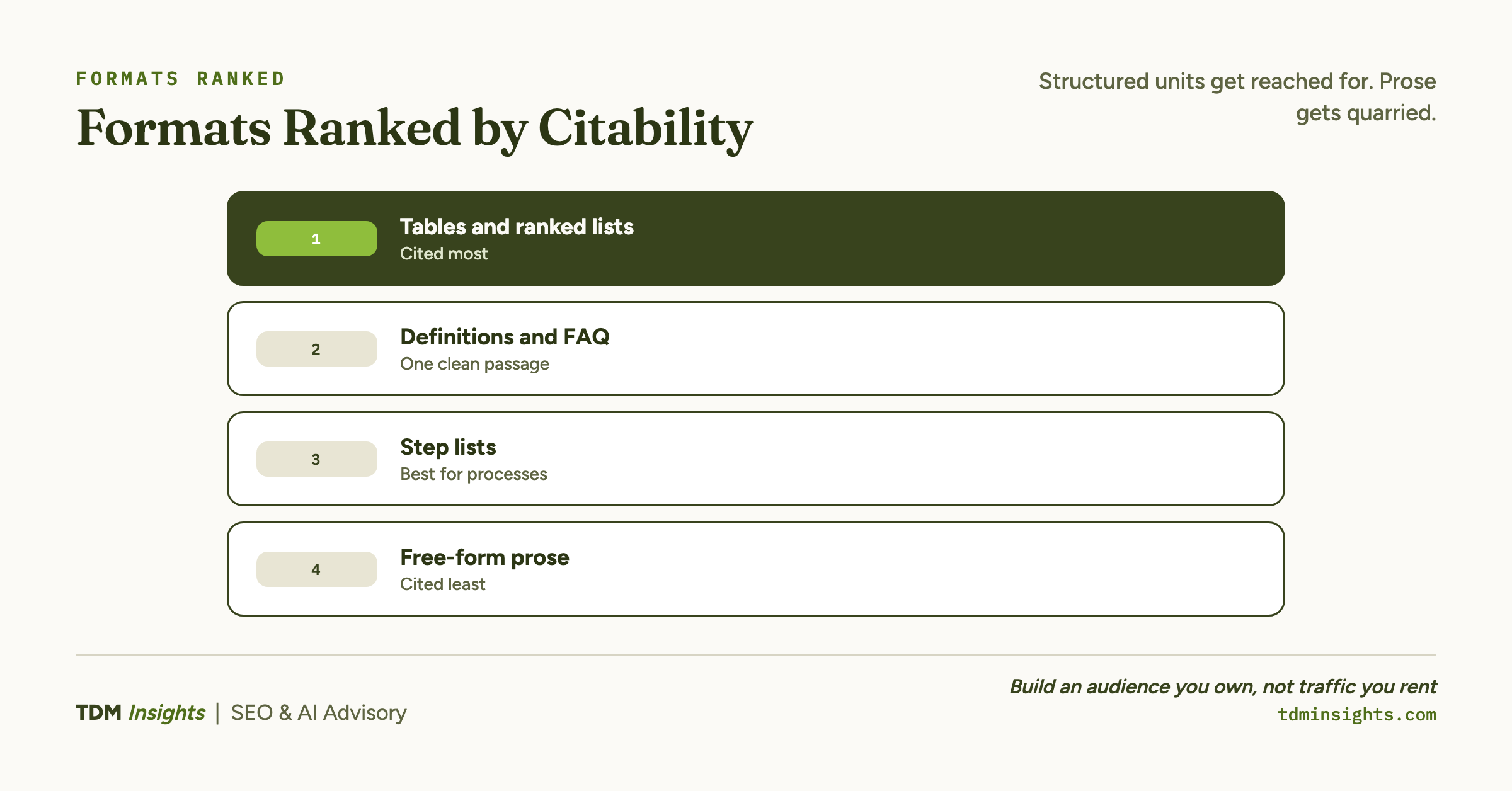
Here is the answer-first version, ranked, so the page demonstrates the format it recommends. It tracks what large-scale citation studies keep finding: a study of millions of AI citations reports that listicles and structured formats take a disproportionate share of the sources answer engines quote.
- Comparison tables and ranked lists are cited most, because each one is a set of pre-labeled units with the relationships already drawn.
- Definition blocks and FAQ answers come next, because each is one self-contained passage an engine can quote whole.
- Step lists earn citations for processes, especially with HowTo schema attached.
- Free-form prose is cited least, because the engine has to do the structuring work the writer skipped.
This is the last tactic in the on-page playbook, and it is the one with a visible test attached. Everything below shows you how to build the extractable formats engines reach for, then how to check whether they are getting quoted.
Key takeaways
- A well-built comparison table earns citations that three paragraphs of the same information will not, because its cells are already self-contained units with the relationships drawn, so an engine can lift one row or the whole grid without reassembly.
- Formats rank by citability: comparison tables and ranked lists lead, definition blocks and FAQ answers come next, step lists earn citations for processes, and free-form prose is cited least because the engine must do the structuring the writer skipped.
- Five rules keep a table liftable: use a native HTML table not an image, give it a plain-word header row, keep one comparison per table, make every cell self-contained, and avoid merged cells and nested tables.
- Reach for a ranked list when sequence carries meaning and a step list when the order is a process; both reduce parsing effort the way a table does, and ItemList or HowTo schema makes that structure explicit.
- A citation is not a click and often sends no referrer, so check whether your formats get quoted by running your target queries in ChatGPT, Perplexity, and Google AI Overviews and logging appearances monthly.
Why Structure Beats Prose at the Citation Step
An answer engine does not read your page the way you do. It runs a sequence: it finds candidate pages, ranks them for trust, and then lifts a specific passage to quote.
That last step is the Citation step, and structure is what wins it. The fuller version of the Citation step where structure wins sits under every format choice on this page.
Think about what the engine needs at the moment of citation. It needs a unit it can pull out cleanly, attribute to you, and drop into its answer without the surrounding page for context.
A table row is exactly that unit. So is a numbered list item. So is one tight definition.
A paragraph is not. A paragraph buries the answer inside connective tissue, hedges, and references to “the above.”
To quote it, the engine has to find the boundary of the claim, strip the dependencies, and reconstruct the meaning. That is work, and work the engine usually skips when a cleaner source is available.
The pattern holds across the data. Ahrefs‘ analysis of which pages get cited by LLMs found that the sources answer engines lean on tend to be the ones that present information in clean, extractable units rather than dense argument. Structured pages do not just rank, they get reached for.
The shift is the same one behind the quotable sentence these formats package: a structured format is a rack of pre-packaged answers instead of a wall the engine has to quarry.
Structure is not a trick for machines, either. The clearest evidence is human. Nielsen Norman Group’s research on how to design tables people and parsers can read shows that a clean table lowers the cognitive load for a reader scanning for one value.
The engine inherits that legibility. A format easy for a person to scan is a format easy for a parser to lift, which is why the human-first version of this work and the AEO version point in the same direction.
The Comparison Table: The Most Liftable Format LLMs Cite
A comparison table is the most liftable structure on a page because it answers a “which one” or “how do these differ” question with the relationships already drawn. The engine does not infer the comparison. You handed it the comparison.
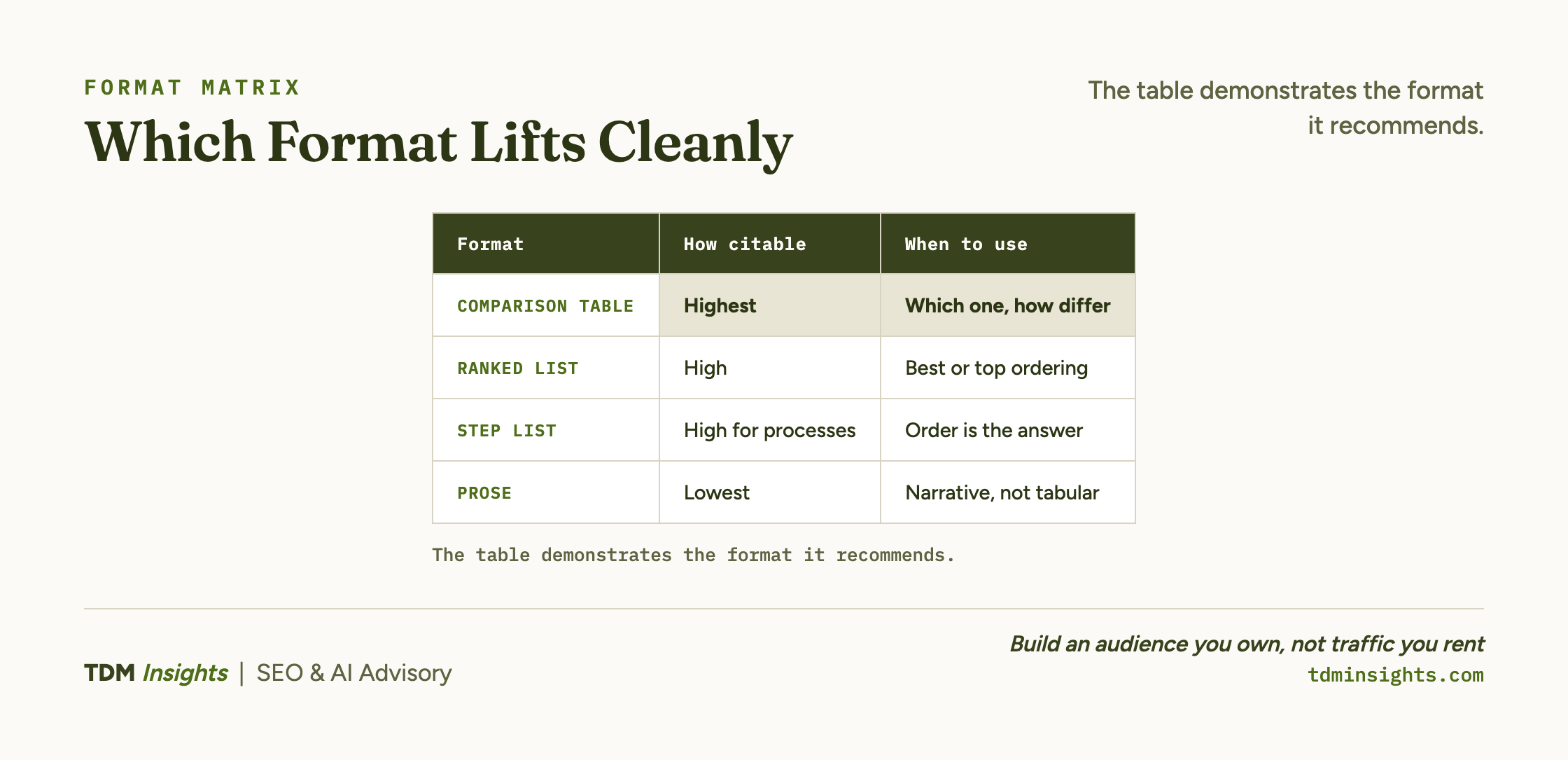
Here is a worked example, built to its own rules. It compares the four formats this article covers, and you can lift any single row without reading the rest of the table.
Notice what makes that table work. Every cell stands on its own.
You can read “Ranked list, High, numbered items create clear extraction boundaries, a best or top question” as one fact, with no need to glance at the header or the row above. That self-containment is the whole game.
One discipline matters more than the rest: one comparison per table. The table above compares formats on citability. It does not also try to compare them on word count, build time, and schema type in the same grid.
When you cram three comparisons into one table, the engine cannot tell which axis a given row belongs to, and a confused unit does not get cited.
Book a free diagnosis
You have now built every liftable unit on the page: the entity signals, the FAQ block, the quotable definition, and the formats engines reach for. The open question is whether it worked. Want to know which of those units AI engines are actually quoting, and what is still leaking before the answer reaches you? We will run your priority pages through retrieval, evaluation, and citation, founder to founder, and tell you the one fix that moves the needle first. No deck, no pitch, just a clear read.
Build Rules That Keep a Table Liftable
Five rules separate a table an engine quotes from one it skips. None of them are about decoration. All of them are about whether a single cell survives being pulled out of context.
- Use a native HTML table, never an image of one. This is the rule founders break most: a picture of a table looks identical to a human but is opaque to the engine, which reads the underlying text and structure, not the pixels. The HTML table element reference and the guide to building HTML tables both show how a real table marks up rows, columns, and headers as text a parser can reach.
- Give it a clear header row that labels every column in plain words. The header is how the engine knows what a cell means, so a column headed “Type” tells it far less than one headed “Format” or “Pricing tier.” The W3C tutorial on accessible data tables shows how proper header markup ties each cell to its column, the same association a parser uses to read your grid.
- Keep one comparison per table. Split a second axis into a second table.
- Make every cell self-contained. A cell reading “see above” or “same as row 1” breaks the moment it is lifted alone, so write the value out, even if it repeats.
- Avoid merged cells and nested tables. A merged cell has no single value, so the engine cannot map it to one row or column, and a table inside a table has no clean boundary at all. If you want machine-explicit structure on top of the HTML, the schema.org Table type gives you the vocabulary to label it.
Add one short intro sentence naming what the table compares, the way “it compares the four formats this article covers” sits above the example earlier. That sentence is what an engine quotes alongside the row, so it doubles as your attribution hook.
When a Ranked List or a Step List Wins Instead
A table is not always the right unit. Two list formats earn citations just as readily when the content fits them better.
Reach for a ranked list when the reader wants a “best,” “top,” or priority ordering and the sequence itself carries meaning. Numbered items create clean extraction boundaries, so the engine can lift item three without items one and two.
The schema.org ItemList type is the markup that makes that ranking explicit to a parser. The answer-first list at the top of this page is doing exactly this work.
The discipline for a ranked list mirrors the table: each item self-contained, the ranking meaningful rather than arbitrary, and the criterion stated up front. “Ranked by how often they get cited” tells the engine what the order means.
Reach for a step list when the answer is a process and the order is the point. A step list pairs naturally with the schema.org HowTo type, a form of structured data for AI that lets you label each step so the engine reads the procedure as an ordered set rather than a paragraph it has to sequence itself.
Both list types do the same favor a table does. They reduce the parsing effort, which is why structured lists get cited more than the equivalent prose.
Semrush‘s study of AI Overviews found that the answers Google surfaces lean heavily on pages that present clear, list-shaped structure, the same bias that rewards a clean table. The choice between them is just a question of what your content is: a comparison, a ranking, or a sequence.
The Mistakes That Make a Format Un-liftable
The fastest way to lose a citation you should have earned is to build a format that looks structured to a human and reads as a blob to the engine. A few mistakes account for the bulk of them.
- The table as an image. Covered above and worth repeating because it is so common and so total: an image table is invisible to the engine, full stop.
- Merged cells. A cell spanning two columns has no single coordinate, so the engine cannot reliably assign its value. The grid that reads cleanly to your eye reads as ambiguity to the parser.
- A missing or vague header row. Without labels, the engine has cells but no idea what they mean, so it cannot trust the unit enough to quote it.
- Cells that depend on the cell next to them. “Higher than the row above” is meaningless once lifted, so write the absolute value, not the relative one.
The pattern under all four is the same. The format breaks when a single unit cannot survive being pulled out alone. Build every cell, item, and step so it can.
Did It Work? The Citation Check, and Where to Go Deeper
You have built the liftable units. The honest next question is whether engines are quoting them, and standard analytics will not tell you, because a citation is not a click and often sends no referrer.
The manual check is straightforward. Run your target queries directly in ChatGPT, Perplexity, and Google AI Overviews, and log when your page or its table appears as a cited source.
Repeat monthly so you can see the trend, not just a snapshot. That is the whole baseline method, and it costs nothing but the time to run the queries.
When you want the rigorous version of this, how to measure whether engines are citing you covers attribution without a referrer in full, so this page links it rather than re-teaching it. Different engines also weight structure differently, which is why how AI Overviews favor structured formats is worth reading once the formats are built.
The formats sit inside the bigger picture, too. This is the final tactic in the full liftable-page checklist, the on-page playbook that assembles entity signals, the FAQ block, the quotable definition, and the structured formats into one citable page.
A note on why we can say this with conviction. We refined this exact format-priority model on a site we operate before bringing it to clients, so the build rules above come from watching real tables get cited and real image tables get ignored, not from theory.
And once you have run the manual check and found a leak you cannot place, that is the moment the diagnosis earns its keep. A free read tells you which of the three steps your priority pages are failing, and which fix moves first.
Frequently Asked Questions
What content formats do AI engines cite most?
AI engines cite structured formats most: ranked lists and comparison tables lead, followed by FAQs and short, self-contained paragraphs. Listicles and ordered lists account for a large share of top AI citations, and tables raise citation rates markedly. Free-form prose is cited least, because it is harder to parse and reassemble.
Why do comparison tables get quoted more than paragraphs?
A comparison table is already broken into self-contained cells with explicit relationships, so an engine can lift one row or the whole grid without reassembling anything. Prose has to be parsed and reconstructed before it can be quoted, which adds interpretation risk. Tables reduce that work and raise the engine’s confidence, so they get cited more often.
How do I build a table so AI can lift it cleanly?
Use a native HTML table, not an image. Give it a clear header row, keep one comparison per table, and make every cell self-contained so it reads correctly on its own. Add a short intro sentence naming what the table compares. Avoid merged cells and nested tables, which break clean extraction.
Do ranked lists and step lists help too?
Yes. Ranked lists work when readers want a “best” or “top” ordering, because numbered items create clear extraction boundaries an engine can lift one at a time. Step lists work for processes and pair well with HowTo schema. Both reduce parsing effort the way tables do, which is why structured lists get cited more than equivalent prose.
Should I use an image of a table or a real HTML table?
Use a real HTML table. AI engines and crawlers read the underlying text and structure of an HTML table, but an image of a table is opaque to them unless every value is also in accessible text or alt content. An image table looks fine to humans and is invisible to the engine you want to cite it.
How do I tell whether my formats are actually getting cited?
Run your target queries directly in ChatGPT, Perplexity, and Google AI Overviews and log when your page or its table appears as a source, repeating monthly to track change. Standard analytics cannot see a citation because it is not a click, so manual query checks or an AI-visibility tracker are how you confirm it.
Continue Reading:
More On On-Page AEO:
- The On-Page AEO Playbook: Build Pages AI Quotes
- Entity SEO: How to Become a Known Thing to AI
- llms.txt Explained: Should Your Site Have One?
- The FAQ Block, Rebuilt for Answer Engines
- How to Write a Definition AI Will Quote Verbatim
More from TDM Insights:
- How AI Answer Engines Choose Their Sources
- How to Measure AI Traffic With No Referrer
- How to Show Up in Google AI Overviews
- Schema Markup for AI: Answer-First Writing Guide
- Content That Ranks and Gets Cited by AI
Explore TDM Insights Categories: