
Entity SEO: How to Become a Known Thing to AI
Entity SEO is how AI learns to trust your brand. Use Organization and sameAs signals plus corroboration to become a cited source.
 By David Jubé · Jun 11, 2026 · 13 min read
When an AI answer engine retrieves your page, it does not stop at “is this relevant.” It runs a second check: can I trust who is behind this claim, and can I tell them apart from every other brand with a similar name. Entity clarity is how you answer yes.
Here is the answer-first version, the one an engine can lift in a single sentence: entity SEO is the practice of making your brand a distinct, well-defined thing that search and AI systems can identify, corroborate, and attribute, so the engine cites your page with confidence instead of skipping it for one it can resolve more cleanly.
That is the whole game at this stage. The engine has already found you. Now it decides whether it believes you, and a brand it cannot pin down is a brand it quietly leaves out.
Two pages can carry identical advice and get opposite outcomes. The one whose author the engine can name, cross-check, and place gets the citation. The anonymous one gets read and discarded.
Everything below is the small-brand path to becoming that first page, with no Wikipedia entry required.
Key takeaways
- Entity SEO is making your brand a distinct, well-defined thing that search and AI systems can identify, corroborate, and attribute, so an engine cites your page with confidence instead of skipping it for one it can resolve more cleanly.
- Entity clarity wins the Evaluation step, not Retrieval: the engine has already found you, and now it decides whether it can trust and attribute a claim to you.
- Three reinforcing signals make you a known thing: consistent naming everywhere, Organization and sameAs schema, and corroboration from independent sources that describe you the same way you describe yourself.
- The sameAs property is the disambiguation lever, linking your homepage identity to official profiles like LinkedIn and Crunchbase so an engine can triangulate you across sources it already trusts.
- A small brand can become a recognizable entity in months by locking its naming, building an entity home page, shipping the markup, and seeding corroboration; you do not need a Wikipedia page, which is an outcome of recognition, not the mechanism for it.
Retrieval Gets You in the Room. Entity Clarity Gets You Believed.
In the model for how AI engines find, evaluate, and cite a source, entity work lives squarely in the Evaluation step. Retrieval assembles a candidate set of pages for a query.
Evaluation decides which of those candidates are trustworthy enough to compose an answer from. Entity clarity is what you win that second step with.
The reason it matters is mechanical, not reputational. A language model holds an internal sense of which named things exist, what they do, and how confident it should be when attributing a claim to them.
A brand it can resolve to one clear identity gets attributed plainly. A brand that is ambiguous, sparse, or contradicted across the web gets hedged, paraphrased without credit, or dropped.
This reframes entity work for a founder. It is not knowledge-panel chasing, and it is not a vanity exercise about getting Google to draw a box next to your name.
It is the trust foundation under every other on-page tactic in the full liftable-page checklist. A flawless answer-first passage on a page the engine cannot source is still an orphan.
It is the first tactic in the build order for a blunt reason: entity trust gates everything downstream. You can engineer the most quotable sentence on the internet, and if the engine cannot decide who said it, no one gets quoted.
The Three Signals That Make You a Known Thing
An engine builds its confidence in your identity from three kinds of evidence, and they reinforce each other. Naming tells it what to call you, markup tells it how to read you, and corroboration tells it you are real.
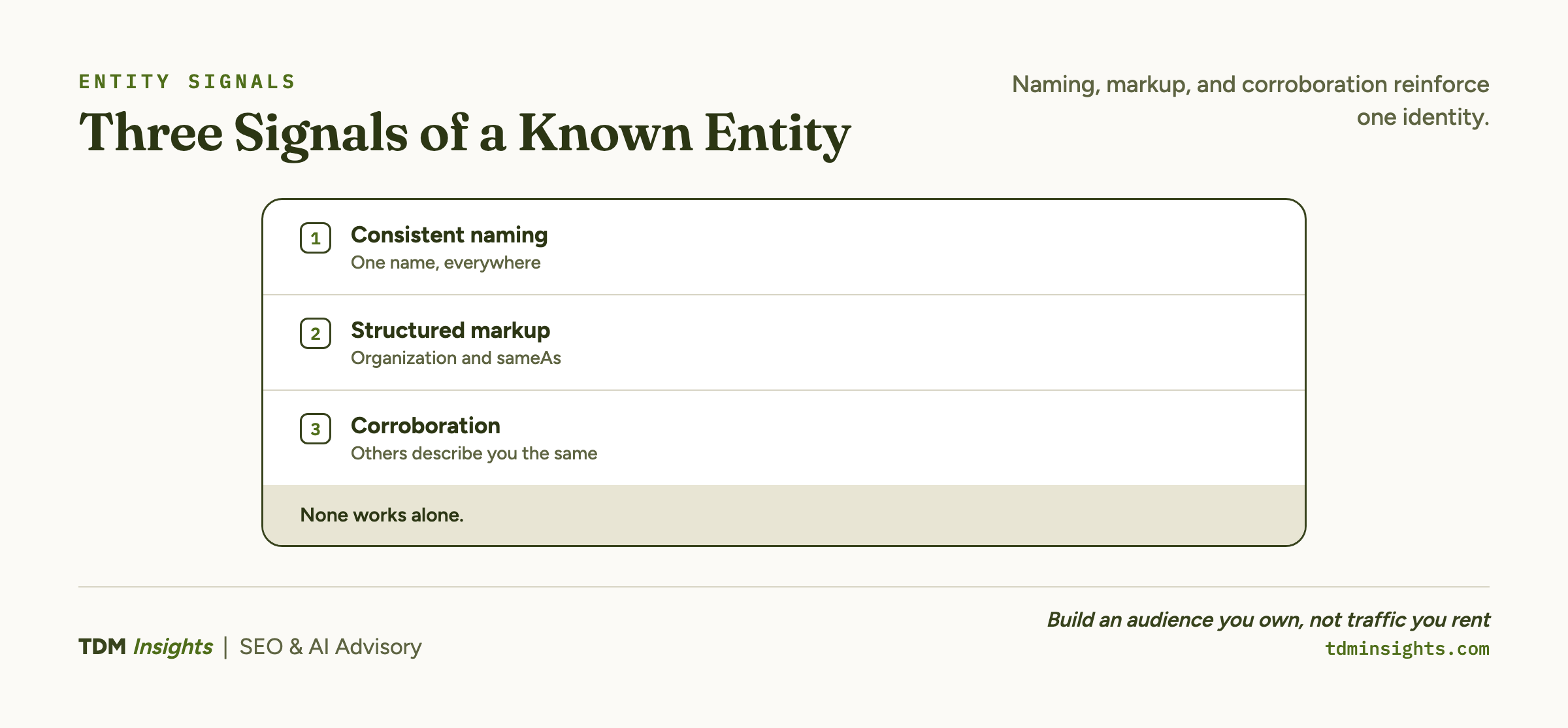
- Consistent naming. Pick one canonical brand name and one canonical spelling, then use them identically everywhere: your site, your footer, your social profiles, your business listings, your bylines. “TDM Insights” in one place and “TDM” in another and “T.D.M. Insights, LLC” in a third reads to an engine as three weakly related things rather than one strong one. Consistency is the cheapest signal you control, and the one founders leak most often.
- Structured markup. Organization and
sameAsschema state your identity in a vocabulary engines parse directly, with no guessing required. - Corroboration. Independent sites describing you the same way you describe yourself are the proof that turns a claim into a fact. One page asserting who you are is a claim. Five credible sources agreeing is an identity.
None of the three works alone. Markup with no corroboration is an unbacked assertion.
Corroboration with inconsistent naming is noise the engine cannot reconcile. You are building one coherent record, from several angles at once.
Organization and sameAs: The Markup That Declares Who You Are
Start with the schema.org Organization type on your homepage. It is the structured declaration of your name, URL, logo, and contact details: the engine-readable version of your identity card.
Google’s own structured-data guidance for organizations lists exactly which properties it reads, so treat that page as the checklist for what to fill in. Get this one block right and you have given every AI crawler a clean, unambiguous statement of who you are to anchor everything else.
The single highest-impact property inside it is the schema.org sameAs property. sameAs links your brand to its official profiles on authoritative sites, which lets an engine triangulate your identity across sources it already trusts and consolidate scattered mentions into one verified record.
It is the disambiguation lever. It says “the thing on this homepage and the thing on these five external profiles are one and the same.”
Here is the concrete shape of it, the part to copy:
{
  "@context": "https://schema.org",
  "@type": "Organization",
  "name": "TDM Insights",
  "url": "https://tdminsights.com",
  "logo": "https://tdminsights.com/logo.png",
  "sameAs": [
    "https://www.linkedin.com/company/tdm-insights",
    "https://www.crunchbase.com/organization/tdm-insights",
    "https://x.com/tdminsights"
  ]
}
The links inside sameAs should point to profiles you actually control and keep current: LinkedIn, Crunchbase, and your main social accounts are the reliable starting set. Each one is a thread the engine can follow back to confirm you exist. Add Person schema for named authors and nest it into the verified Organization, and you extend that same trust to the people writing your content, which matters as much for credibility as the brand itself.
Book a free diagnosis
If your pages rank in Google but the AI answers describe a competitor or, worse, confuse you with a different company entirely, the leak is almost always here. Your entity record is thin, inconsistent, or uncorroborated, so the engine cannot resolve you cleanly enough to cite. We will audit your Organization and
sameAssignals against the way the major engines actually describe you today, founder to founder, and tell you the one gap to close first. No deck, no retainer pitch, just a clear read.
Corroboration: Getting Described the Same Way, Everywhere
Markup states your identity. Corroboration is what proves it, and it is the part you cannot fake with a code snippet. An engine weighs how consistently and credibly independent sources describe you, then sets its confidence accordingly.
Research on what triggers AI brand mentions draws the useful line here: a mention and a citation are different events, and the brands that earn the second one are the brands described consistently across the open web, not the ones shouting loudest on their own domain. Related work on why AI keeps recommending the same brands across different sources points the same direction: salience, the sense that a brand is genuinely a recognized thing, is what drives the recommendation.
For a founder, corroboration is built deliberately and slowly:
- Claim and complete your profiles on the authoritative platforms for your space, with the same name, description, and URL on each.
- Earn mentions in industry press, podcasts, and credible community discussions, where someone other than you describes what you do.
- Keep your business listings accurate and identical across directories, so name and details never contradict each other.
- Publish enough depth on your core topics that you read as an authority on them, not a passing reference.
The mechanism behind this is consensus. An engine trusts a description it sees confirmed from several independent angles far more than one it sees asserted once.
The work is making sure that wherever you appear, you appear as the same recognizable thing. This is the practical edge of semantic SEO: you are not feeding the engine isolated keywords, you are teaching it the stable relationships between your brand, your people, and your topics until they read as one coherent thing.
The Small-Brand Path: Becoming an Entity From Zero
You do not need to be a household name to be a known thing. You need to be a clearly defined one. The path from invisible to recognizable is short and concrete, and a brand a few months old can walk it:
- Lock your naming. One name, one spelling, applied identically across your site, profiles, listings, and bylines.
- Build an entity home. Give the engine one page it can resolve you to: a real About page that states plainly who you are, what you do, and who is behind it.
- Ship the markup. Add Organization and
sameAsschema on your homepage, withsameAspointing to the official profiles you control. - Seed corroboration. Claim your profiles on the authoritative platforms for your field, then earn a handful of independent mentions that describe you the way you describe yourself.
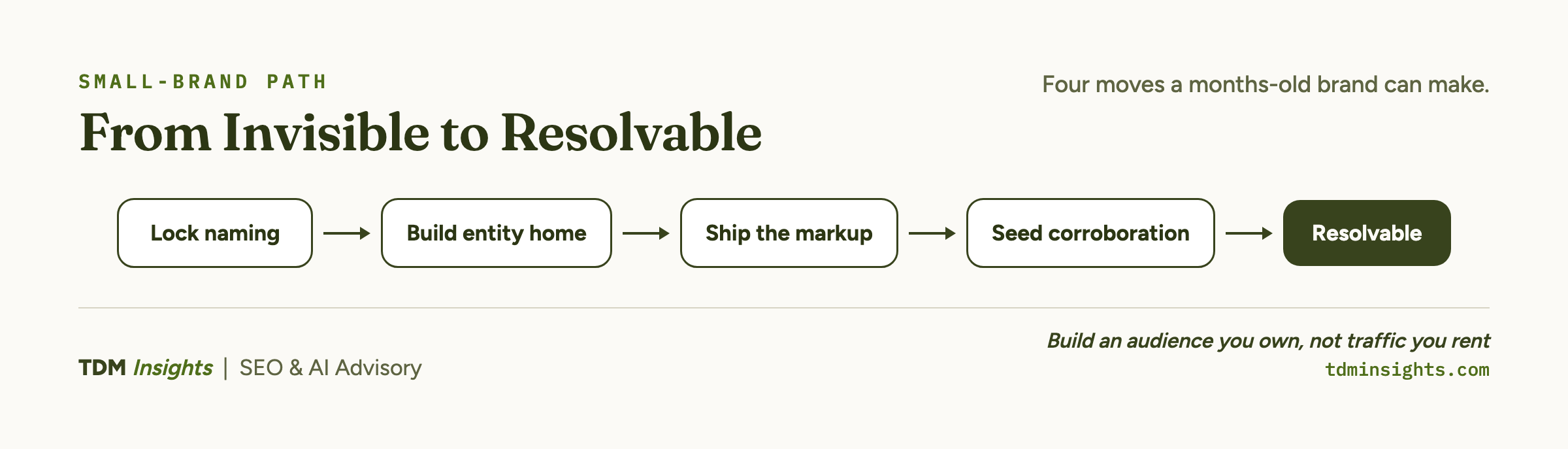
Do those four and you have given an engine everything it needs to treat you as a distinct, attributable source, long before you would ever qualify for an encyclopedia entry. Which is the point worth stating flatly: a founder does not need a Wikipedia page. Wikipedia is an outcome of being a recognized entity, not the mechanism for becoming one, and chasing it as a first move is effort spent on the wrong end of the problem.
What you are building is not fame. It is resolvability.
An engine asks one question about you, “is this a real, distinct thing I can attribute a claim to,” and these four moves answer it directly. As an industry explainer on entity SEO frames it, the shift is from optimizing for keywords to making your brand legible as an entity in the first place.
Practitioner guides like Ahrefs’ walkthrough of entity SEO make the same point from the SEO side: the unit search systems reason about is the entity, not the keyword.
How to Check Whether the Engines Already Know You
Before you build, find out where you stand, because the gaps tell you exactly what to fix. The check takes a few minutes and needs no tools.
Ask the major engines about yourself directly. Query ChatGPT, Perplexity, and Google AI Overviews with your brand name and a few questions a real prospect would ask.
Read the answers for two failure modes: the engine describes you wrongly, or it confuses you with a different company that shares a word in your name. Either one is an entity problem, and it is telling you the engine cannot resolve you cleanly.
Then audit the signals that feed those answers:
- Is your Organization schema present and correct?
- Do your
sameAslinks resolve to live, current profiles? - Is your name spelled and styled identically everywhere it appears?
Every inconsistency you find is a place the engine is losing confidence, and every fix is a thread tied back into one clean record. Google’s resource on optimizing content for AI in Search points in the same direction: clear, well-attributed content is the same content that wins in AI surfaces, so the entity work pays off in both places at once.
The work compounds. With your identity resolved, the next tactic is making sure the engine can actually reach the content where your authority lives, which is where the access work and the truth about llms.txt come in. Entity clarity also sits underneath the wider strategic shift that is answer engine optimization itself, and engines weight these identity signals differently, which is its own subject in the per-engine citation playbook.
We refined this exact sequence on a site we operate before bringing it to clients, so the order above is grounded in what actually moved citations, not in vendor theory.
Frequently Asked Questions
What is entity SEO?
Entity SEO is the practice of making your brand, people, and topics recognizable as distinct, well-defined entities that search and AI systems can identify and connect to a knowledge graph. Instead of optimizing only for keywords, you give engines structured, corroborated signals about who you are, so they can confidently attribute and cite your content.
What is the sameAs property and why does it matter for AI?
The sameAs property in Organization schema links your brand to its official profiles on authoritative sites like LinkedIn, Crunchbase, and your social accounts. It lets AI systems triangulate your identity across multiple trusted sources, consolidating scattered mentions into one verified entity record. That verification raises an engine’s confidence that you are real, distinct, and citable.
How does being a known entity make AI more likely to cite me?
AI engines run a verification check before citing, cross-referencing a brand against structured signals across the web to confirm it is a distinct, trustworthy entity. The more consistently and authoritatively your brand is described across credible sources, the more confidently an engine attributes content to you. Strong entity signals also reduce hallucinated or wrong attributions.
Do I need a Wikipedia page to be an entity AI recognizes?
No. A Wikipedia page helps but is not required, and chasing one is not the point. What engines need is consistent naming, Organization and sameAs schema, an authoritative about page, and corroborating mentions across independent credible sites. A small brand can build a recognizable entity with those signals long before it qualifies for an encyclopedia entry.
Which schema markup builds entity trust fastest?
Organization schema on your homepage is the foundation, declaring your name, URL, logo, and sameAs links to official profiles. Adding Person schema for named authors and nesting your services within the verified Organization strengthens the chain. Nesting these connected signals into one interconnected graph gives engines a single, verifiable identity to trust and cite.
How do I check whether AI engines already recognize my brand as an entity?
Ask the major engines directly: query ChatGPT, Perplexity, and Google AI Overviews about your brand and see whether they describe you accurately or confuse you with another entity. Then audit your Organization schema, your sameAs links, and the consistency of your name across the web. Gaps and wrong details show where corroboration is missing.
Continue Reading:
More On On-Page AEO:
- The On-Page AEO Playbook: Build Pages AI Quotes
- llms.txt Explained: Should Your Site Have One?
- The FAQ Block, Rebuilt for Answer Engines
- How to Write a Definition AI Will Quote Verbatim
- Comparison Tables and Formats LLMs Love to Cite
More from TDM Insights:
- How AI Answer Engines Choose Their Sources
- How Each AI Engine Picks Sources to Cite
- Schema Markup for AI: Answer-First Writing Guide
- Structured Data for SEO: The Founder’s 80/20
- Content Strategy for Founders
Explore TDM Insights Categories: