
The On-Page AEO Playbook: Build Pages AI Quotes
On-page AEO, built section by section. The five-tactic liftable-page checklist that moves a page from ranked to quoted by AI answer engines.
 By David Jubé · Jun 23, 2026 · 16 min read
A page becomes quotable when an answer engine can lift one self-contained passage from it and attribute that passage to you without losing meaning.
That is a build problem, not a writing problem, which is why this playbook treats an answer engine optimization (AEO) page as five assembled parts: a trusted entity, clean machine access, an extractable FAQ block, a verbatim-ready definition, and the structured formats engines reach for first.
Here is the answer-first version, the one you can lift in a single sentence: on-page AEO is the practice of structuring, formatting, and writing one page so AI answer engines can extract, trust, and cite its content directly, rather than merely rank it as a clickable link.
You do not “write for AI.” You build extraction surfaces, in order.
Everything below names the build order, walks each of the five tactics, shows what one assembled page looks like in practice, and tells you the two parts to do first if you only do two.
Key takeaways
- On-page AEO is the practice of structuring, formatting, and writing one page so AI answer engines can extract, trust, and cite a self-contained passage from it, not merely rank it as a link.
- Build an answer-engine-ready page as five parts in order: a trusted entity, clean crawler access, an extractable FAQ block, a verbatim-ready quotable sentence, and the structured formats engines reach for first.
- The order is a diagnosis tool: when a page you expected to get cited stays silent, walk the five tactics from the top and fix the first one that fails, because identity gates access and access gates answers.
- Schema markup, keyword density, and “secret tags” do not move citations on their own; the passage has to stand alone first, then markup makes a good passage easier to extract.
- If you only do two things, write a self-contained answer-first passage near the top and add a clean comparison table or ranked list where the topic genuinely fits, since those pay off on the next crawl.
On-Page AEO Is the Citation Step, Made Concrete
If you have read how AI engines find, evaluate, and cite a source, you already hold the spine: an engine retrieves a candidate set, evaluates it for trust, then lifts a specific passage and attributes it. Retrieval and evaluation are largely site-level and reputation-level work. Citation is where the page itself earns or loses the quote.
On-page AEO is that third step turned into a checklist you can run with your hands.
The distinction matters because it tells you where to spend. A page can be perfectly retrievable and perfectly trusted and still never get cited, because the best answer on it is buried three scrolls down, hedged across four sentences, or written so it only makes sense after the two paragraphs above it.
The engine wants a passage it can stand behind in isolation. If you do not supply one, it reaches for a source that did.
That is the quiet trap in many page audits. Teams check whether the page ranks, confirm it does, and conclude the page is healthy. Ranking and citation are separate outcomes, though, produced by separate processes.
A page can hold position one, lose the visit to the AI summary sitting above it, and never once appear as a named source inside that summary. The on-page work is what closes that gap.
So the work is concrete. You are assembling passages an engine can pull whole.
This is also the on-page half of the answer-first writing and schema overview the wider category covers. We refined this exact build on a site we operate, where structured, answer-first pages drove roughly 10.1 times the search impressions in 28 weeks, before bringing it to clients.
The format below is the one we use, not vendor theory. It also tracks the wider field: an independent AEO overview from Ahrefs lands on the same conclusion, that extractable, well-structured content is what AI answers pull from.
The Liftable-Page Checklist: Five Tactics, One Build Order
The five tactics run in sequence because each one depends on the one before it. An engine cannot trust a passage from a source it cannot identify, and it cannot identify a source it cannot reach. Order first, polish second.
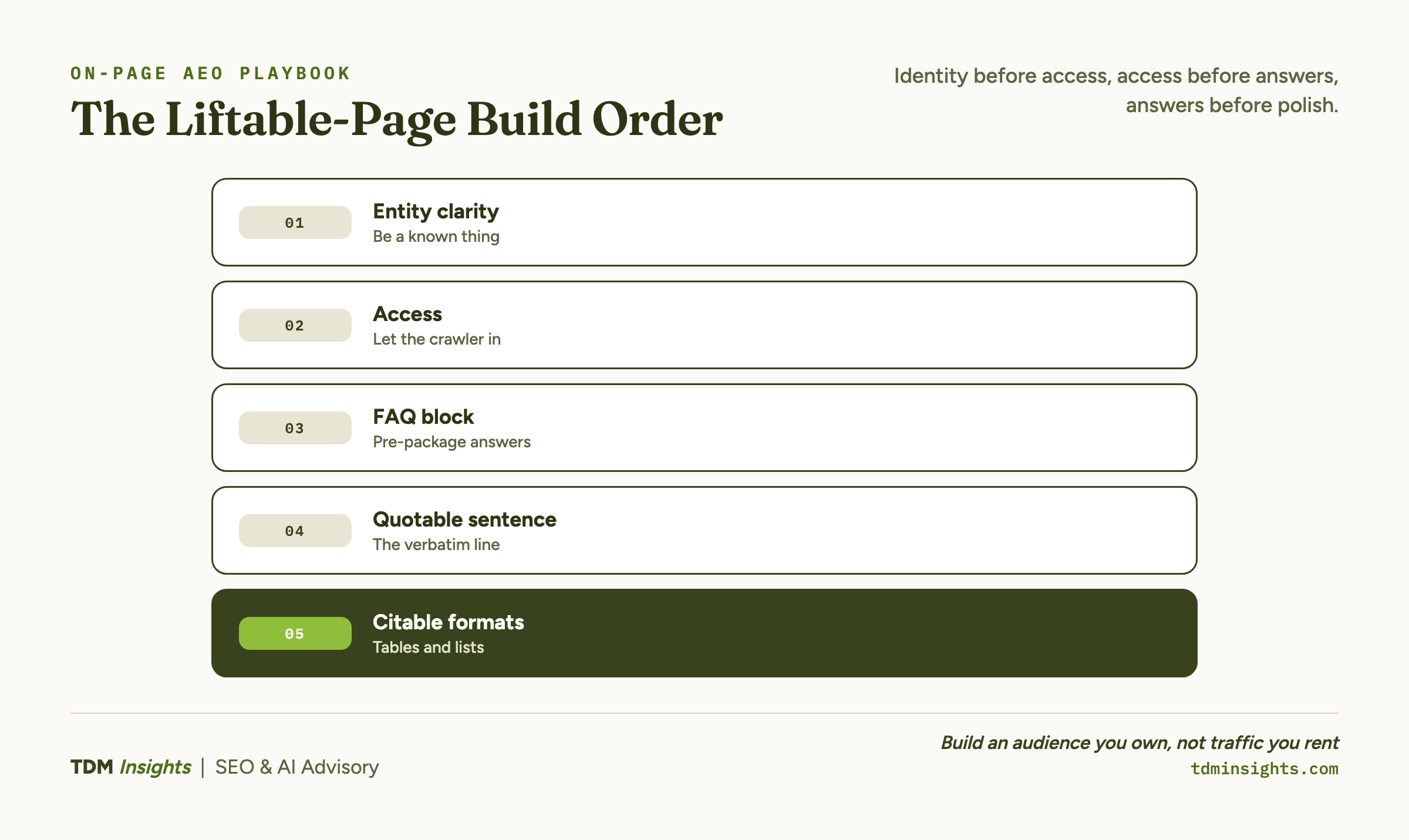
- Entity clarity. Make the engine certain who you are and what this page is about, using consistent Organization signals and unambiguous subject framing. A source the engine cannot place is a source it will not name.
- Access. Confirm the AI crawlers can actually fetch the page, and use an llms.txt file to point them at what matters. Retrieval is the gate; if the bot cannot read it, nothing downstream counts.
- FAQ extraction. Build a question-and-answer block where each answer is a self-contained unit that resolves one real question on its own. These are the cleanest pre-packaged liftable objects on the page.
- The quotable sentence. Engineer the single definition or claim you most want lifted, written so it reads whole and attributable with no surrounding context. This is the highest-value object on the page.
- Citable formats. Use the structures engines reach for first: comparison tables, ranked lists, and tight step sequences where the topic is genuinely tabular or ordered.
Here is the same build order as one liftable reference you can run a page against:
Hold the build order as the model you keep: you are not writing prose and hoping a machine likes it. You are assembling self-contained units, identity before access, access before answers, answers before polish.
The order is also a diagnosis tool. When a page you expected to get cited stays silent, walk the five tactics from the top and stop at the first one that fails.
If the engine cannot place who you are, fixing your FAQ block changes nothing, because the page never clears evaluation to begin with. If the crawler cannot reach the page, the cleanest definition on the open web sits unread.
Working the list in order keeps you from polishing tactic four while tactic one is the actual leak. Spend on the step that is broken, not the step that is easiest.
Tactic 1, be a known thing: entity clarity
An answer engine cites named, identifiable things. Before it will attribute a passage to you, it has to be confident that “you” is a specific, corroborated entity it can place in its model of the web.
This is why the first move is to become a known thing to AI: state your Organization, your authorship, and your subject consistently, and back it with sameAs links to the profiles that confirm the same identity elsewhere. The schema.org vocabulary is the shared language that lets you label those entities and relationships so an engine parses them without guessing. Mark up your Organization, your author, and the page itself so the identity is machine-readable, not just visible.
Entity work compounds quietly. It rarely produces a citation on its own, but it is the floor every later tactic stands on. A flawless answer-first passage attributed to an anonymous, unplaceable source gets skipped for the same passage from a source the engine already knows.
Tactic 2, let the machines in: access and llms.txt
Retrieval is a gate, and the key is whether AI crawlers can fetch the page at all. The strongest passage on the cleanest entity is invisible if the bot that builds the candidate set never reaches it.
Two checks settle nearly all of it:
- Confirm crawler access. Make sure your robots rules allow the AI crawlers you want, named individually, since the search bots and the training bots are separate and you may treat them differently.
- Point them at what matters. Consider whether your site should have an llms.txt file, a plain-text map that points language models at your highest-value pages.
Google’s own resource on optimizing for generative AI features is direct that there is no secret markup that earns a citation, just reachable, well-structured, genuinely useful content.
Access is binary in a way the other tactics are not. You either pass the gate or you do not exist downstream.
Tactics 3 and 4, pre-package the answers: the FAQ block and the quotable sentence
With identity and access settled, you build the objects engines actually lift. Two are worth most: the FAQ block and the single quotable sentence.
The FAQ block, rebuilt for answer engines, is a set of self-contained question-and-answer pairs where the answer leads with the direct resolution in its first sentence and stands alone without the rest of the page. Each pair is a pre-packaged liftable unit, and the schema.org FAQPage type gives you a clean way to label each question and answer so an engine reads the structure without parsing the layout. An engine fielding that exact question can pull your answer whole and attribute it cleanly, which is why a well-built FAQ block is one of the highest-yield surfaces on any page.
The quotable sentence is the single highest-value object on the page, and many readers jump straight to it: engineer the one sentence engines lift verbatim. This is the definition or core claim you want named most, written so it reads complete and attributable with no setup.
Independent research on how different AI engines choose which sources to recommend shows engines converge on clean, confident, self-contained statements over hedged ones. State the thing plainly, in one sentence, near the top of its section.
The two objects pull together. The quotable sentence is the answer to the page’s main question; the FAQ pairs are the answers to the questions the reader asks next. Build both and you give the engine more than one clean unit to pull, which raises the odds that at least one of them matches the exact phrasing of a live query.
Tactic 5, use the formats engines reach for
Engines lift structure faster than they lift paragraphs. A comparison table, a ranked list, or a tight numbered sequence hands the machine a pre-parsed object it can drop into an answer with minimal interpretation, which is why these formats punch above their length.
Comparison tables and the formats LLMs love to cite covers where this pays and where it does not. The discipline is honest fit:
- A table only where the content is genuinely a comparison.
- A list only where items are parallel.
- A numbered sequence only where order matters.
A forced table reads worse to a human and gives the engine nothing extra. A practitioner AI search optimization checklist and an industry overview of answer engine optimization both land on the same point: structured, scannable formats are disproportionately what gets quoted.
Book a free diagnosis
If your pages rank but the AI answers never name you, the leak is almost always concentrated in one of these five tactics, not spread across all of them. We will run your priority pages through the liftable-page checklist, founder to founder, and tell you the single fix that moves citations first: whether the engine cannot place who you are, cannot reach the page, or simply cannot find one passage clean enough to quote. No deck, no retainer pitch, just a clear read on where you stand.
What does one assembled page look like in practice?
Take a page targeting “what is on-page AEO.” The entity layer is already set, so the Organization and author are stated and corroborated, and the engine can place the source.
Access is confirmed, so the AI crawlers can fetch it. Now you build the answer surfaces.
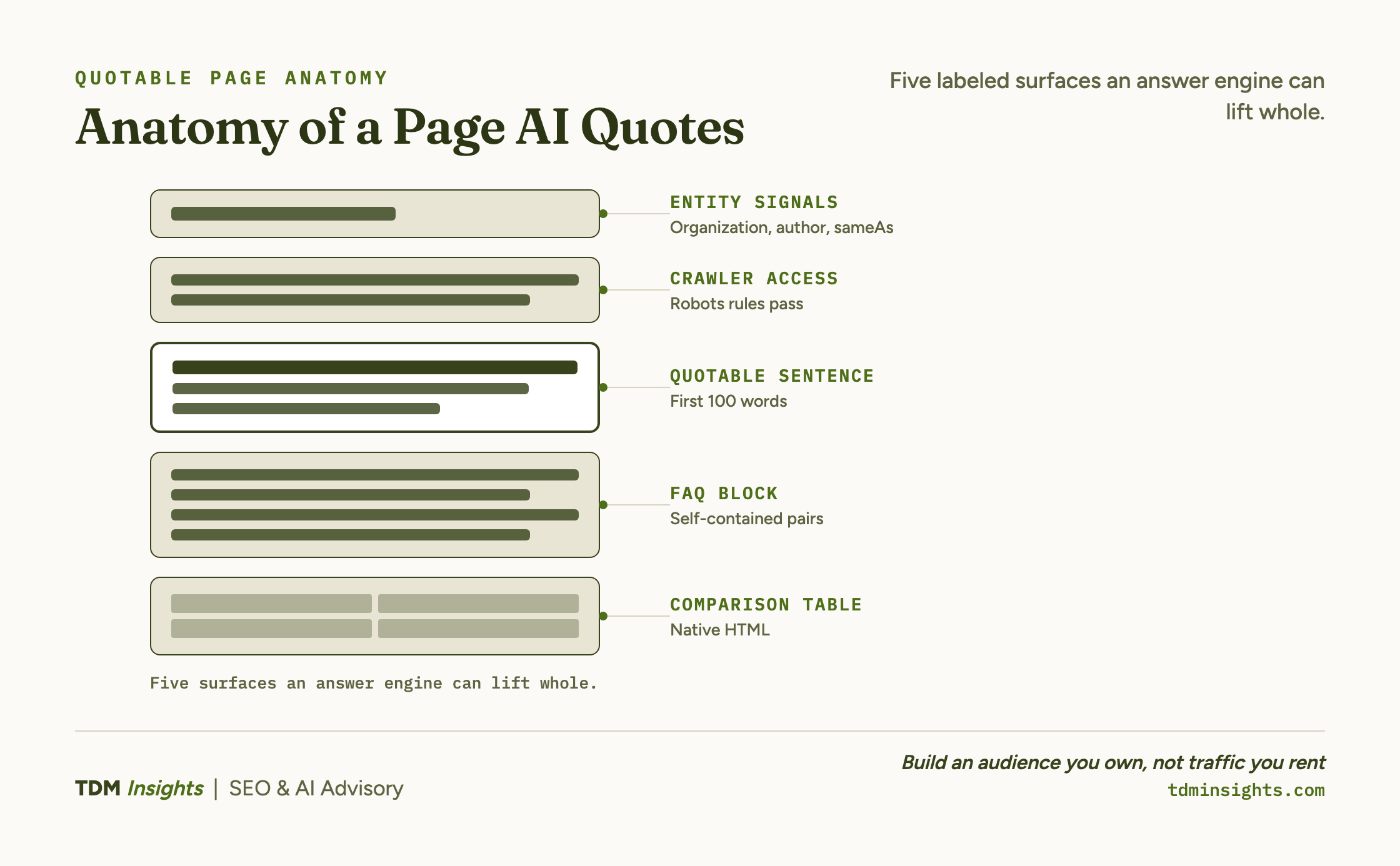
The first sentence of the page is the definition you want lifted, written whole: “On-page AEO is the practice of structuring one page so AI answer engines can extract, trust, and cite its content.”
Read alone, it resolves the question. No pronoun points elsewhere, no “as described above” leans on context. That is the quotable sentence doing its job.
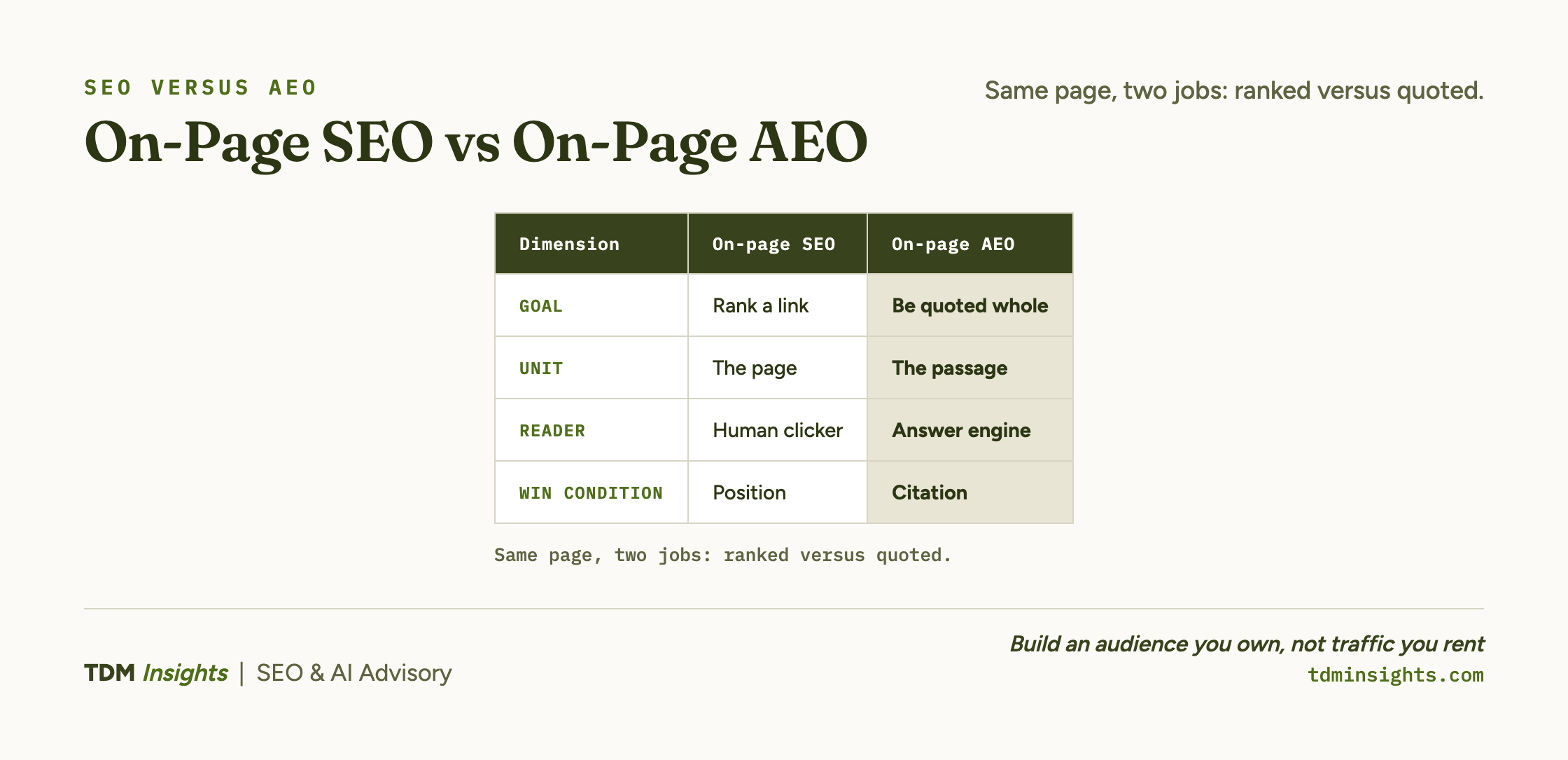
Below it, a short comparison table contrasts on-page SEO with on-page AEO, one row per dimension, because the topic is genuinely a “versus.” This is the kind of structured object an on-page AEO checklist from a content platform treats as core, not optional.
Further down, a six-question FAQ block answers the real follow-ups a searcher types next, each answer leading with its direct resolution. Run the cold-read test on any of them: copy two sentences out, read them alone, and confirm they still answer the question without the surrounding paragraphs.
That is the whole craft. Identity and access let the page into the room. The quotable sentence, the FAQ units, and the table are the parts the engine can pull whole and attribute to you.
Notice what the page is not doing. It is not stuffing the target phrase into every paragraph, and it is not padding to a word count to look authoritative.
Each section earns its place by resolving a real question a reader or an engine might pose. When you build this way, the same page that gets cited by an answer engine is also the page a human finds easy to scan, because a self-contained passage reads cleanly whether a machine lifts it or a person skims it.
The two audiences want the same thing: the answer, stated plainly, where they expect it.
What does not move citations
A short list, because the temptation is real and the payoff is not.
- Schema markup alone. Markup describes what is already on the page; it cannot rescue a buried, hedged, or context-dependent answer. The passage has to be self-contained first, then schema makes a good passage easier to extract.
- Keyword density and padding. An engine lifts the cleanest passage, not the longest section, and a 3,000-word page with no liftable unit loses to a tight one that has three. Google’s own guidance on creating helpful content is blunt about this: write for people first, and the signals that earn trust follow.
- A secret tag. There is none. The signals that earn citations are the unglamorous ones already named: a placeable entity, a reachable page, and answers written to stand alone.
The 80/20: which two tactics to do first
If you only do two things, write a self-contained, answer-first passage near the top of the page, and add a clean comparison table or ranked list where the topic allows. Those are the two units engines lift most readily, and they pay off on the next crawl rather than over months.
Entity and access work compounds underneath them, and it is worth doing, but it is slower to show a result. The trust strategy that sits above all five tactics, what answer engine optimization actually is, is the strategic frame the page-level work serves.
Start where citations actually break. Ask whether the engine can even tell who you are, then build your entity first.
Frequently Asked Questions
What is on-page AEO?
On-page AEO is the practice of structuring, formatting, and writing an individual page so AI answer engines can extract, trust, and cite its content. It covers entity signals, crawler access, answer-first passages, self-contained FAQ units, quotable definitions, and structured formats like tables. The goal is being lifted into an AI answer, not just ranked.
Is on-page AEO different from on-page SEO?
It overlaps heavily but adds one job. On-page SEO structures a page to rank a clickable link. On-page AEO does that and goes further, building self-contained passages an engine can lift whole into a synthesized answer. The SEO best practices still apply; AEO layers extractability and entity clarity on top of them.
Where should I start to make a page AI will quote?
Start with entity clarity, then crawler access. An engine will not cite a source it cannot identify or reach, so confirm it knows who you are through Organization and sameAs signals, and that AI crawlers can fetch the page. Only then does answer-first writing, FAQ structure, and table formatting pay off.
Do I need every on-page AEO tactic, or is there an 80/20?
There is a clear 80/20. If you do only two things, write a self-contained answer-first passage near the top of the page and add a clean comparison table or ranked list where the topic allows. Those two formats are the units engines lift most readily. Entity and schema work compounds after.
How do I know if my page is liftable by AI?
Run the cold-read test: copy any two-sentence passage out of the page and read it alone. If it still fully answers a real question without the surrounding paragraphs, an engine can lift it. If it relies on “as mentioned above” or a pronoun pointing elsewhere, it is not yet liftable.
Does adding schema markup alone get a page cited by AI?
No. Schema markup helps engines parse and label your content, but it cannot rescue a buried, hedged, or context-dependent answer. Markup only describes what is already on the page. The passage itself has to be self-contained and answer-first first; schema then makes a good passage easier for the engine to extract.
Continue Reading:
More On On-Page AEO:
- Entity SEO: How to Become a Known Thing to AI
- llms.txt Explained: Should Your Site Have One?
- The FAQ Block, Rebuilt for Answer Engines
- How to Write a Definition AI Will Quote Verbatim
- Comparison Tables and Formats LLMs Love to Cite
More from TDM Insights:
- How AI Answer Engines Choose Their Sources
- Schema Markup for AI: Answer-First Writing Guide
- Answer Engine Optimization: What AEO Actually Is
- How to Show Up in Google AI Overviews
- How to Write FAQs That Double as AEO Fuel
Explore TDM Insights Categories: