
Use AI to Write Without Sounding Like AI
Name the tells, keep a human on the parts that matter, skip the slop. How to write with AI without sounding like it.
 By David Jubé · May 4, 2026 · 9 min read
AI content reads like AI for identifiable reasons. Once you can name them, you can fix them, and the fix is not a “humanizer” tool that swaps a few words.
Language models predict the next likely word from patterns in their training data. They do not draw on having done the thing. That single fact explains every tell: the even sentence rhythm, the safe transitions, the abstractions where a specific should be, the words a person rarely reaches for in conversation.
So the goal is not to disguise AI writing. It is to use AI for what it is genuinely good at, scaffolding and first-pass volume, and keep a human in the parts a model cannot supply: the angle, the first-hand detail, the point of view, and the edit that cuts the filler.
Google does not penalize content for being AI-generated. Google Search Central’s guidance on AI-generated content is explicit: it rewards helpful, original, people-first content and demotes thin, derivative pages, whether a person or a model produced them.
The tool is not the issue. Publishing raw output at scale is.
This article names the tells, gives the division of labor that works, and walks the edit that turns a competent draft into one worth reading.
Key takeaways
- AI writing sounds artificial because models predict likely words instead of drawing on lived experience, so use them for scaffolding and first-pass volume while you supply the angle, first-hand detail, and point of view.
- Google does not penalize content for being AI-generated; it rewards helpful, original, people-first pages and demotes thin derivative ones, so the real problem is publishing raw output at scale without editing.
- Fix the named tells: vary uniform rhythm by following a long sentence with a short one, swap filler verbs like leverage and delve for plain words, and delete empty intensifiers such as robust and seamless.
- Split the work and edit hard: let the model outline, summarize, and draft, then read it aloud, add real numbers and named sources, cut filler like ‘in order to,’ and state a clear position.
Why AI Writing Sounds Like AI
The smoothness is the giveaway. Model output is balanced almost to a fault: sentences of similar length, paragraphs of similar weight, every claim hedged the same careful amount.
That evenness reads as competent and forgettable. Human writing has a rhythm because a person is thinking in real time, dwelling on one point and rushing past another. A model has no reason to dwell, so it never does.
The second cause is the absence of stakes. A model has not lost money on a bad decision or been surprised by a result.
It cannot tell you the thing it learned the hard way, because it learned nothing the hard way. Microsoft’s own explainer on making AI text sound more natural frames the same gap: the raw output is plausible and generic, and the work is adding what only a person knows.
This is the draft stage of the brief-to-draft-to-proof production system. The brief set the target; the draft has to hit it without reading like a machine filled in a template, the same standard behind getting cited by ChatGPT, Perplexity, and AI.
The Tells, and the Fix for Each
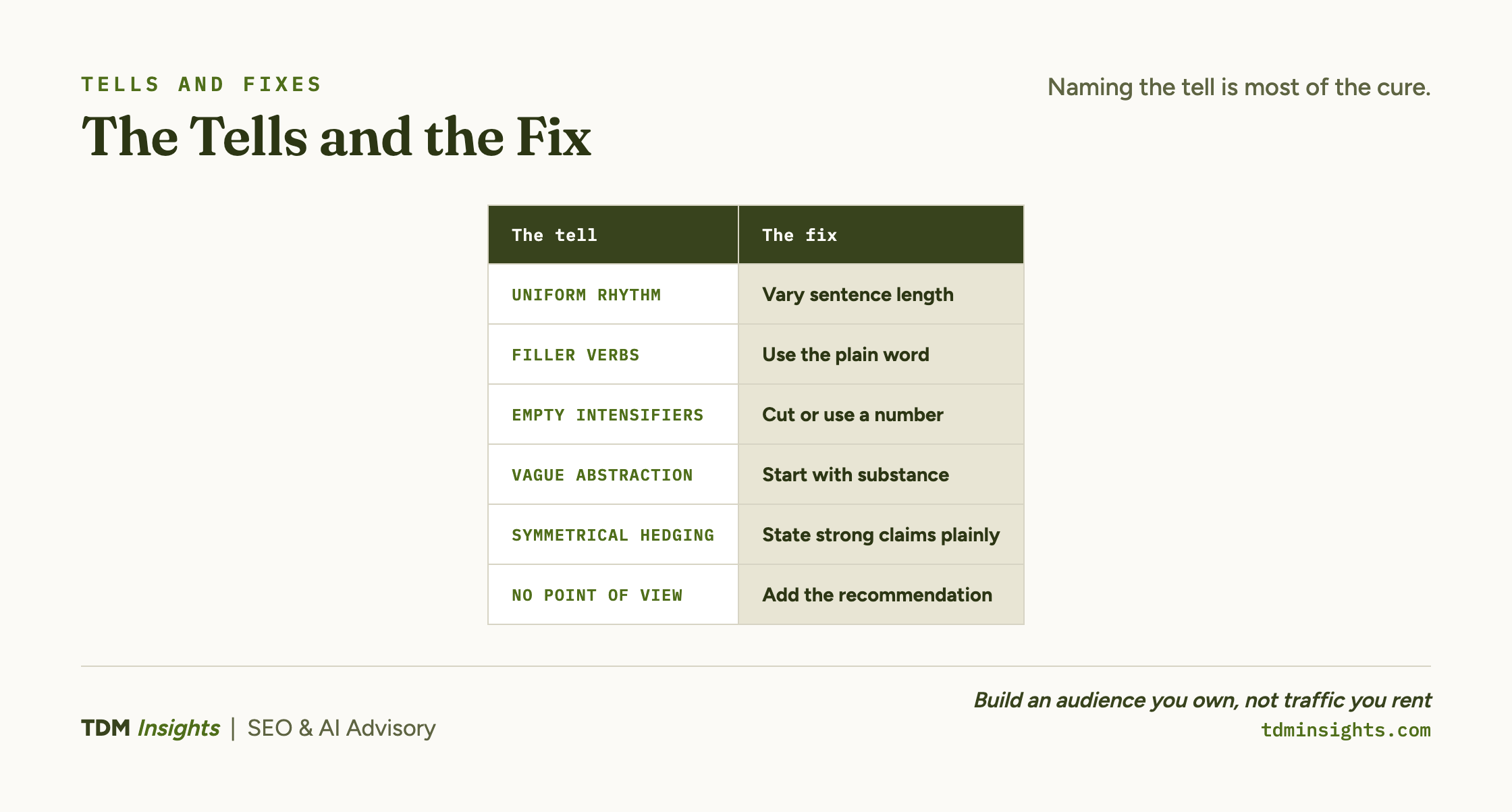
Naming the tells is most of the cure, because you cannot edit out what you cannot see. Here are the common ones and what to do instead.
The pattern is consistent. Replace what any model would generate with what a person who did the work would say. NN/g’s research on writing concisely for the web shows that plain, concise prose outperforms padded prose with real readers, which is the opposite of the bloated default a model produces unprompted.
The Division of Labor That Works
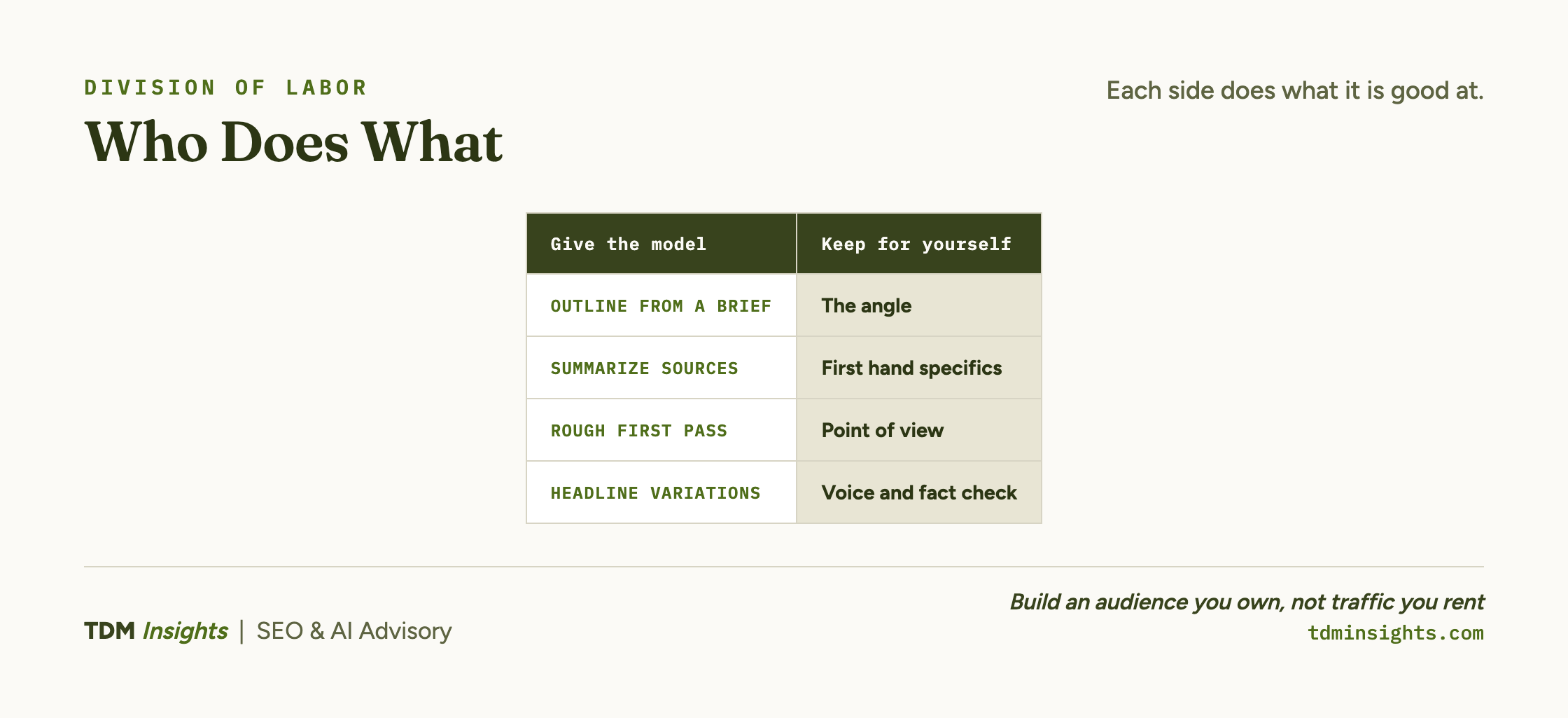
The human-in-the-loop model is not “let AI write, then proofread.” It is a split where each side does what it is good at.
Give the model the mechanical work:
- Outlining from a brief
- Summarizing source material
- Producing a rough first pass to react against
- Generating variations on a headline or transition
- Catching repetition and awkward phrasing on the edit
Keep for yourself the work that carries the value:
- The angle, the reason this piece beats what already ranks
- First-hand specifics: the numbers, the screenshots, the mistakes
- The point of view and the recommendation
- The voice, so the page sounds like your brand and not a default
- The fact-check, because models invent confident, wrong details
Animalz calls this the content cyborg approach, a human and a machine each handling the part they do best. The aim is to keep brand voice intact while the model handles the volume.
The principle holds: the model accelerates the parts that do not need judgment, and you spend your time on the parts that do. One of those judgment calls is where the piece belongs in your topic clusters and pillar pages, since a model cannot tell which neighbors it should support.
Book a free diagnosis
If you have started using AI to draft and you are not sure whether the output reads like everyone else’s, a free diagnosis scans a sample of your published pages for the tells: uniform rhythm, filler verbs, empty intensifiers, and the missing point of view that marks a draft no one edited for substance. You leave with the specific lines to fix and a read on whether AI is speeding you up or quietly flattening your voice.
The Edit That Turns a Draft Human
The draft a model gives you is a starting point, not a finished piece. The edit is where the work happens, and it has a small number of high-leverage moves.
Read it aloud first. Your ear catches the stiff lines your eye skims past, every time.
Then add the specifics the model could not invent. A generic claim becomes credible the moment you attach a real number, a named source, or a thing that actually happened. Proving experience on the page covers exactly which proof to weave in, because the proof is what makes a page worth citing rather than skimming, the same specifics that matter for answer-first writing with schema rather than empty filler.
Cut the filler ruthlessly. Every “it is worth noting that” and “in order to” is a place the model padded.
Removing them tightens the prose and removes a tell at the same time. The same edit applies after publishing, when updating an older post to win back rankings it lost means cutting the stale lines a model left behind and adding the detail it never had.
Finally, say the thing the model would not. Take a position. The opinion is the part a reader remembers, and it is the part no model can supply, because it requires having decided something.
Will AI-Assisted Content Rank
Yes, when it is genuinely helpful, accurate, and built around real expertise. An edited, fact-checked, AI-assisted article competes like any other.
The answer is not more drafts; coverage is a deliberate call about how many posts a topic actually needs to rank, each one edited to the bar. NN/g’s piece on why GenAI needs to write for the web makes the case that raw model output misses the standards real web writing demands: scannability, specificity, and a reason to keep reading.
The reason slop does not get cited is the same reason it does not rank. It comes down to extractability and trust, the same forces behind how AI answer engines choose their sources: an engine has no reason to quote a page that says nothing only that page could say.
A flood of unedited drafts also pulls the whole library’s average down, which is why it helps to understand what AEO actually is and GEO vs SEO vs AEO vs LLMO before you publish at scale.
Frequently Asked Questions
Does Google penalize AI-generated content?
No, Google does not penalize content simply for being AI-generated. Its systems reward helpful, original, people-first content that demonstrates experience, expertise, authoritativeness, and trustworthiness, regardless of how it was produced. What Google does penalize is low-value content created mainly to manipulate rankings, whether a human or an AI wrote it.
Why does AI writing sound like AI?
AI writing sounds artificial because language models predict the next likely word from patterns rather than from lived experience, so they default to even sentence lengths, generic transitions, and filler phrases. The result reads smooth and balanced but rarely says anything specific, surprising, or personal, which is exactly what a reader remembers.
What are the telltale signs of AI-written content?
The clearest tells are uniform sentence rhythm, repetitive hedging, vague abstractions instead of concrete examples, overused words like “delve,” “leverage,” and “robust,” and a complete absence of real opinion or first-hand detail. Content that reads competently but tells you nothing you could only learn from doing the thing is usually machine-drafted.
How do you make AI content sound human?
Make AI content human by editing for substance, not just style. Add first-hand examples, real numbers, and a clear point of view the model could not invent. Vary sentence length, cut filler phrases, read it aloud to catch stiff lines, and replace abstractions with specifics. The draft is a starting point, not a finished piece.
Can you use AI to write content the right way?
Yes. Used as a drafting and research assistant, AI speeds up outlining, summarizing, and first drafts while a person supplies judgment, voice, and original insight. This human-in-the-loop approach keeps quality high. Problems start only when teams publish raw output at scale without editing, fact-checking, or adding anything a reader could not get elsewhere.
Will AI-assisted content rank in Google?
Yes, AI-assisted content can rank well when it is genuinely helpful, accurate, and built around real expertise. Google evaluates the result, not the tool. Thin, derivative pages produced in bulk tend to lose ground, while edited, fact-checked content that answers the query better than competing pages can rank like any human-written article.
Continue Reading:
More On Content Production and Quality
- How to Produce Content That Ranks and Gets Cited
- How to Write a Content Brief (That Gets It Right)
- Writing for E-E-A-T: Prove Experience on the Page
- How Long Should a Blog Post Be? Intent Over Count
- How to Write FAQs That Double as AEO Fuel
More from TDM Insights
- How to Get Cited by ChatGPT, Perplexity, and AI
- Schema Markup for AI: Answer-First Writing Guide
- How AI Answer Engines Choose Their Sources
- Answer Engine Optimization: What AEO Actually Is
- GEO vs SEO vs AEO vs LLMO: What They Mean
Explore TDM Insights Categories