
How to Measure AI Traffic With No Referrer
AI sends traffic with no referrer to trace. The observable proxies that prove your AEO is working, no paid tool required.
 By David Jubé · Apr 7, 2026 · 16 min read
AI answer engines frequently send visitors with no referrer, so standard analytics undercounts the traffic answer engine optimization (AEO) actually drives.
You can still measure it by triangulating observable proxies: branded-query lift, direct and dark traffic patterns, AI-bot crawls in your server logs, and direct citation checks, each mapped to a step in how engines choose sources.
None of this requires a paid tool to start. It requires a method, and a method is what this article hands you.
If you have done the AEO work and you cannot tell whether it landed, you are not alone, and the answer is not “buy a tracker.”
The answer is to stop expecting a single clean number and start reading three or four imperfect signals together. That is the whole craft of measuring something that hides from your analytics on purpose.
Key takeaways
- AI answer engines often send visitors with no referrer, so a session that ChatGPT or AI Overviews earned lands in GA4 as Direct and standard analytics undercounts the traffic AEO drives.
- You cannot recover a single clean number, so you triangulate: read three or four imperfect proxies together until they move in the same direction across the same weeks.
- The proxies worth charting are branded-query lift in Search Console, Direct-channel spikes on deep content pages, and AI-crawler hits in your server logs.
- Mapping each proxy to the three-step model, Retrieval then Evaluation then Citation, tells you exactly which step a page is leaking.
- You do not need a paid tracker to start; check ten to twenty priority queries by hand each month, and a citation you can screenshot is the single most trustworthy AEO metric you have.
Why AI traffic is hard to see
AI traffic is hard to see because the visit often arrives stripped of the one field that would explain where it came from: the referrer.
When someone reads an answer from ChatGPT, Perplexity, or Google’s AI Overviews, clicks through to your page, and lands on your site, your analytics frequently records that visit as Direct, the same bucket as someone typing your URL by hand.
The citation that earned the visit is invisible, and the click that followed it is mislabeled.
This is the structural problem at the center of AEO measurement. The discipline asks you to optimize for being cited inside an AI answer, but the moment that citation pays off, your instruments lose the trail.
So the goal is not to recover the perfect attribution you have for organic search. It is to assemble enough independent, observable proxies that, taken together, tell you the truth with confidence.
You triangulate.
The referrer problem: what analytics does and doesn’t show
To measure AI traffic, you first have to understand exactly where it disappears. There are two mechanisms, and both end in the same place.
The first is technical. AI surfaces routinely apply a noreferrer policy to their outbound links, which instructs the browser not to pass the originating URL along. The visit reaches you, but the “where from” field is blank.
The second is behavioral. A large share of AI users do not click a live link at all. They read the answer, see your domain named as a source, and open a fresh browser tab to type or paste the URL.
There is no link click to track, so there is nothing for analytics to attribute.
Both paths land in the same bucket. In Google Analytics 4 (GA4), a session with no referrer and no campaign tagging is classified as Direct.
The platform’s GA4 default channel group rules spell out the logic: a session only becomes a Referral when a valid referring domain is present, so a stripped or absent referrer defaults to Direct by design.
This is not a bug in your setup. It is how channel attribution works, and it means a rising Direct line can be one of your clearest AEO signals, not noise to ignore.
The practical takeaway: do not look for an “AI” channel in GA4 and conclude there is no AI traffic when you do not find one.
The traffic is there. It is wearing a Direct costume.
Observable proxies: branded queries, direct and dark traffic, bot logs
Here is the shift that makes measurement possible. Instead of chasing one missing number, you watch several signals that AI activity reliably moves.
Each one is observable with tools you already have.
Branded-query lift. When an AI engine cites you, a share of readers do not click. They search your brand name in Google afterward to find you directly.
So a rise in branded-query impressions and clicks in Google Search Console, tracked against the timeline of your AEO work, is a leading indicator that engines are surfacing you in answers.
It is indirect, but it is hard to fake and easy to chart.
Direct and dark traffic patterns. Watch your Direct channel in GA4 for landing pages that have no business receiving direct visits. Nobody types the URL of a deep blog post from memory.
When a specific article’s Direct sessions climb, that is dark AI traffic surfacing.
The scale of this is real: Contentsquare data on how much AI traffic there is found that only a minority of AI-influenced visits are correctly attributed, with much of the rest hiding inside Direct.
So a Direct-channel spike on content pages is a proxy worth charting, not dismissing.
AI-bot crawls in your server logs. This is the most direct proxy of all, because it measures the engine’s behavior rather than the user’s. Before any engine can cite you, it has to fetch your page.
Your server logs record every one of those fetches by user agent: GPTBot and OAI-SearchBot for OpenAI, PerplexityBot for Perplexity, Google-Extended and the standard Googlebot family for Google’s AI features.
A rising count of legitimate AI-crawler hits on a page tells you it has entered the retrieval pool, the first step of getting cited.
These three proxies are not equally strong, and that is the point. Read alone, each one is suggestive.
Read together, moving in the same direction across the same weeks, they are convincing. That is triangulation, and it is the only honest way to measure a channel built to be invisible.
Measuring each step of the model
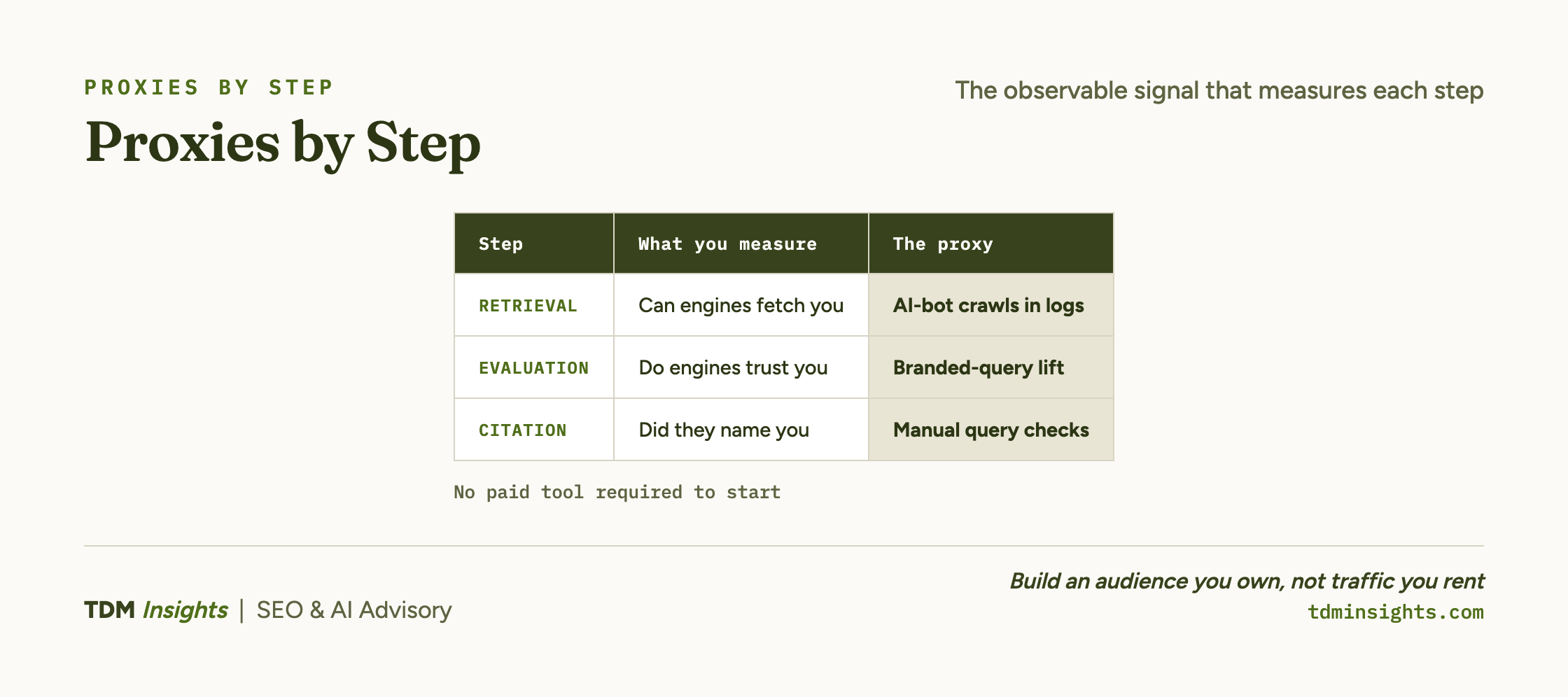
The cleanest way to organize all of this is to map each proxy to a step in the three-step model you are measuring. Engines find, evaluate, and cite a source in that order: Retrieval, then Evaluation, then Citation.
If you know which step you are measuring, you stop confusing a retrieval signal for a citation win, and you can tell exactly where your page is leaking.
Measuring Retrieval. Retrieval is whether the engine can find and fetch your page at all. The proxy is your server logs. Confirm that AI crawlers are actually hitting the pages you care about, at a healthy cadence.
If GPTBot has never fetched a page, that page cannot be cited, full stop, and no amount of answer-first rewriting fixes a retrieval problem.
One caution: log entries can be spoofed, so verify the crawler is genuine before you trust the hit.
Google publishes the canonical method for verifying Googlebot via reverse DNS, and the same reverse-lookup discipline applies to other engines’ bots.
For the full roster of agents to watch, including the AI-specific ones, Google’s list of Google-Extended and other Google crawlers is the authoritative reference.
Measuring Evaluation. Evaluation is whether the engine trusts and prefers you once it has retrieved you.
There is no direct meter for this, so you read it through corroboration and authority signals: branded-query lift (readers seeking you out by name), growth in pages that get retrieved repeatedly, and your standing on the queries where competitors get cited instead of you.
Evaluation is the fuzziest step to measure, which is fitting, because it is the fuzziest step in the model.
Measuring Citation. Citation is the payoff: did the engine actually name you in a visible answer? The only reliable way to know is to look.
Run your priority queries in each engine and record whether your domain appears as a source.
This is manual, it is unglamorous, and it is the single most trustworthy AEO metric you have, because a citation is a fact you can screenshot.
A tool can automate the checking at scale, but the underlying act, asking the question and reading the sources, is what produces ground truth.
This mapping is also a diagnosis. If logs show retrieval but you never appear in answers, your problem is at the Citation step, which usually means the page is built to rank but not to be lifted.
That is the on-page work covered in the answer-first writing and schema craft this verifies. Measurement and craft are two ends of the same loop.
Do you need a tool? When the paid AEO trackers earn their keep
You do not need a paid AEO tracker to start, and you should not buy one before you have run the manual method long enough to know what you are looking for.
Start free. Pick your ten to twenty most important queries, check them by hand across ChatGPT, Perplexity, and Google AI Overviews once a month, and log the results in a spreadsheet.
That is real data, and it costs you an hour.
The paid trackers earn their keep when one of three things outgrows manual effort: query volume (you are tracking hundreds of queries, not dozens), cadence (you need weekly or daily readings, not monthly), or benchmarking (you need to see competitors’ citation share alongside your own across the same prompt set).
At that point the subscription is cheaper than the labor, and the tools add genuine signal, especially competitor visibility you cannot easily reconstruct by hand.
The rule is simple: begin manual, upgrade only when the time you spend checking exceeds what the tool costs.
It is worth knowing why this measurement matters even when the absolute traffic numbers look small.
Ahrefs published Ahrefs’ own AI search conversion data showing that AI-referred visitors, while fewer in raw count, converted at a notably higher rate than traditional organic visitors. That higher intent only pays off if the page itself is built as content that converts readers into customers once they arrive.
Under-measured does not mean unimportant. A channel that sends fewer but more decided visitors is exactly the channel you want to prove out, which is the case for measuring it carefully rather than waving it off.
How to report AEO progress credibly
Reporting AEO well means showing direction over time across a small, stable set of metrics, never a single hero number ripped out of context.
The four metrics worth standing behind: citation share across your tracked queries, month-over-month change in AI-crawler visits from your server logs, AI Overview impressions from Search Console’s generative report, and any identifiable AI-referral sessions in GA4.
Each is imperfect alone. Together they tell a credible story, and credibility is the entire job when the data is fuzzy.
The honest framing is “here is how these four signals moved over the last quarter,” with the timeline of your work overlaid.
Trend beats snapshot, because the snapshot invites a fight about the absolute number and the trend tells the truth about whether the work is compounding. The same patience applies here as anywhere in search, which is why an honest timeline for how long SEO takes is the right frame for reading these curves.
When ChatGPT’s referral footprint matters at all, it shows up first as the kind of branded-query and direct-traffic movement described above. Longitudinal datasets like Semrush’s 17 months of ChatGPT clickstream data confirm that AI-as-a-referrer is a growing line, not a rounding error, which is why a credible report charts its direction rather than its size on any single day.
Measuring this way is also how you decide whether the broader investment is paying off, which is the same question every founder eventually asks about search itself: how to judge whether the work is paying off. The measurement discipline answers it.
Book a free diagnosis
AI traffic hides in your Direct channel and your server logs, and most founders never go looking. If you have done the AEO work but cannot tell whether it landed, the gap is measurement, not effort. We will check whether the engines are crawling and citing you, read the proxies you already have, and tell you which signals to chart first. That review is a free diagnosis, founder to founder, with no tracker to buy.
A simple AEO measurement dashboard you can stand up this week
You can build a working AEO dashboard in a spreadsheet this week, with no paid tool.
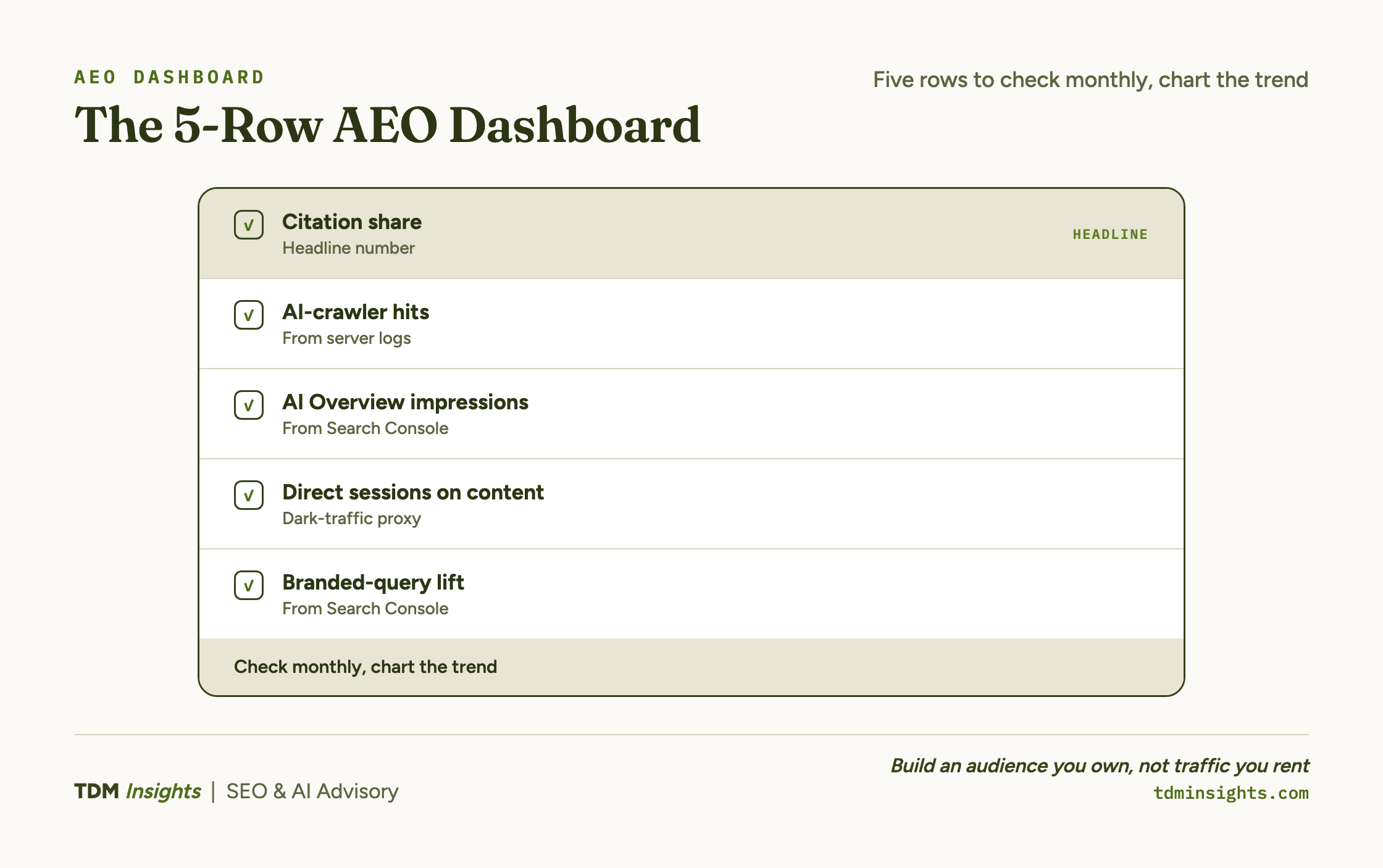
Here is the minimum viable version. Five rows, checked monthly, charted over time.
- Citation share. List your ten to twenty priority queries. Once a month, run each in ChatGPT, Perplexity, and Google AI Overviews and mark whether your domain appears as a cited source. Citation share is the count of queries where you appear, divided by the total. This is your headline number.
- AI-crawler hits. From your server logs (or a log-analysis filter), count monthly fetches from GPTBot, OAI-SearchBot, PerplexityBot, and Google-Extended on your priority pages. Verify the bots are genuine before trusting the count. Rising hits mean rising retrieval.
- AI Overview impressions. Pull these from Google Search Console’s generative-AI reporting where available, and note month-over-month change. This proxies how often Google is putting you in front of an AI answer.
- Direct-channel sessions on content pages. In GA4, isolate Direct sessions landing on deep content URLs (the ones nobody types from memory). Track the trend. This is your dark-traffic proxy.
- Branded-query lift. From Search Console, chart impressions and clicks on your brand name over the same months. A rise that tracks your AEO work is evidence engines are surfacing you.
Update it on the same day each month, overlay the timeline of what you shipped, and read the five rows together.
When three or four move up in the same window, that is not a coincidence. That is AEO working, and you can now prove it without a single paid subscription.
For context on why server-log verification belongs in any credible setup, Search Engine Land’s coverage of bot verification best practice is a useful primer, and Semrush’s 80-million-record ChatGPT clickstream study is a reminder of how much real behavior sits behind the proxies you are charting.
Stand up those five rows and you have crossed the gap that stalls most founders. You did the AEO work, and now you can see it working.
The only question left is whether you are reading the signals correctly, and whether the gaps the dashboard reveals are the ones worth fixing first. When a tracked page slips, that is the trigger for a content refresh to win back the rankings you lost, and the whole measurement habit sits inside the first ninety days of SEO for a startup.
Frequently Asked Questions
How do I know if AI engines like ChatGPT and Perplexity are citing my site?
You confirm AI citations by running your target queries directly in each engine and logging when your domain appears as a source, then repeating monthly to track change. Standard analytics cannot see this because a citation is not a click. For coverage across many queries, an AI-visibility tracker automates the same checks at scale.
Why doesn’t traffic from AI tools show a referrer in my analytics?
AI traffic usually arrives without a referrer because the source is stripped before it reaches you. ChatGPT often applies a noreferrer attribute on outbound links, and many users copy a URL into a fresh browser tab instead of clicking. Both cases land in GA4 as Direct rather than as an AI referral.
What is “dark” AI traffic and how much of it is there?
Dark AI traffic is any visit influenced or started by an AI assistant that your analytics cannot attribute to AI. Studies estimate only a minority of AI-driven visits show up correctly, with a large share landing in Direct. The rest hides inside Direct, Organic, or generic Referral buckets.
What can I actually measure for AEO without a referrer?
You can measure three signals that do not depend on a referrer: AI crawler hits in your server logs (GPTBot, PerplexityBot, OAI-SearchBot), citation appearances from manual or tracked query checks, and AI Overview impressions in Search Console’s generative AI report. Together these proxy AI visibility when click data is missing.
Do I need a paid AEO tracking tool, or can I do this manually?
You can start manually by checking 10 to 20 priority queries each month across ChatGPT, Perplexity, and AI Overviews, then logging citation counts in a spreadsheet. Paid tools become worth it when query volume, competitor benchmarking, or weekly cadence outgrow manual checks. Begin free, then upgrade once tracking time exceeds the subscription cost.
How do I report AEO progress to a client or stakeholder?
Report AEO progress with a small set of repeatable metrics: citation share across tracked queries, month-over-month change in AI crawler visits from server logs, AI Overview impressions from Search Console, and any identifiable AI referral sessions in GA4. Show direction over time rather than a single absolute number.
Continue Reading:
More On Answer Engine Optimization
- Answer Engine Optimization: What AEO Actually Is
- GEO vs SEO vs AEO vs LLMO: What They Mean
- How AI Answer Engines Choose Their Sources
- How to Get Cited by ChatGPT, Perplexity, and AI
- Schema Markup for AI: Answer-First Writing Guide
More from TDM Insights
- Is SEO Worth It for a Startup? When to Invest and When to Wait
- How Long Does SEO Take? An Honest Timeline
- Content That Converts Readers Into Customers
- Content Refresh: Win Back Rankings You Lost
- SEO for Startups: What to Do in the First 90 Days
Explore TDM Insights Categories