
AI Generated Content SEO: Four Kinds of Evidence
AI generated content is not penalised for being generated. Learn what to add to a page so a retrieval system has a reason to quote you.
 By David Jubé · Aug 1, 2026 · 13 min read
Generated copy is not penalised for being generated. No published guidance treats a draft’s origin as a fault, and that answer solves less than it sounds like it does, because ten pages of accurate, readable, on-topic copy can still give a retrieval system nothing to lift. Accuracy is not evidence.
What gets quoted is a specific claim with something attached to it: a number you measured, a date, a named constraint, a result you can point at. Generation defaults to the safe general statement, because the specifics are the part nobody supplied. Supplying them is a pass over a handful of sentences rather than a rewrite of the site.
Definition craft is a separate job, and How to Write a Definition AI Will Quote Verbatim covers the sentence an engine lifts whole. The material you attach to that sentence is what decides whether anything lifts it at all.
Journey position thirteen of eighteen works one rung of the ladder that AI SEO: The Five Rungs That Decide If You Get Cited installs at position twelve, and it is the rung you can fix yourself.
Key takeaways
- Being generated is not what a search or answer engine reacts to. Shipping unreviewed output at volume is.
- Retrieval works at the passage level, so the unit you edit is the sentence a system could quote alone.
- Four kinds of evidence make a passage quotable: a measured number, a dated observation, a named constraint, a first-hand result.
- Better prompting cannot supply a fact nobody holds. The evidence step belongs to a person, at the brief rather than in a rewrite loop.
- Attaching a specific to every sentence buries the point instead of making it. Three sentences carry the weight.
What the guidance names is unreviewed volume, not the tool that drafted the page
Google’s spam policy on scaled content names the practice it acts on: pages produced at volume to manipulate rankings, with nobody reviewing what ships. Unsupervised production at scale is the named behaviour, and the tool that produced the words appears nowhere in the definition.
The relief that follows is real and narrow. No hidden penalty is waiting for you, and no advantage is on offer either, which leaves the finished page carrying the entire result.
Research on how AI-generated content actually performs finds that pages shipped without a review pass do not carry their own weight, which is a performance finding rather than a punishment. By one research team’s count, the share of published articles now written by AI has reached rough parity with the human-written share, so the method itself distinguishes nothing. What distinguishes a page is what only you could put in it, and putting it in the right place means knowing which part of a page actually gets read.
Retrieval lifts passages, so the passage is the unit that matters
Answer engines do not quote pages. Watch a cited answer and you see a sentence or two doing the work, with the page named underneath as its source. OpenAI’s documentation on attribution describes citations as spans tied back to a source, which matches what the answers put on screen.
Once you have seen that, the page average stops being the thing to improve. A page can be strong throughout, hold no single span that stands alone, and get read start to finish without ever being quoted. Automated scoring will not catch it either, because a content score grades the checklist rather than the passage, which is what makes Ahrefs’ own data on content scores and where pages rank worth reading before you chase a number.
Three properties make a passage liftable:
- It states one claim, in a sentence that survives the paragraph around it being removed.
- It names the subject rather than leaning on a pronoun pointing back at the heading.
- It attaches something checkable, so quoting it transfers a fact rather than an opinion.
Structure gets you the first two, and The On-Page AEO Playbook covers that layer. A drafting pass handles both well once you ask for them. The third property is where the supply problem lives, because nobody structures their way to a fact they never had.
Four kinds of evidence a page can carry, ranked by how hard they are to fake
Evidence on a page is narrower than the word suggests. Four types cover what a page can honestly carry, and each resists copying differently.
Ranked by resistance, the order runs constraint, first-hand result, dated observation, measured number. A competitor can quote your figure. Nobody can inherit the limit you learned by hitting it, which is why the least impressive-looking of the four holds up best.
CMI’s research on differentiated content shows the same gap from the other end, since teams naming differentiation as their problem describe a sourcing failure rather than a writing one. Moz on demonstrating first-hand experience gives the on-page form these four take, and every one of them works at sentence level. None needs a redesign, and where the evidence is comparative a table earns its place, which Comparison Tables and Formats LLMs Love to Cite covers.
Prompting cannot supply what nobody told it: where the human step sits
Prompt tuning is where the instinct goes next, and it is the wrong lever. A better instruction changes how a claim is phrased, not whether the number behind it exists. Ask for specifics without supplying any and you get the accurate general case in more confident language, which is the tool working correctly on the input it was handed.
The fix therefore sits upstream of the draft. Journey position 7, AI Website Copy: Which Sentences to Keep and Cut, is where those facts get supplied, at the brief, before a first pass exists. Fix the input once and every draft after it starts from your facts. Tune the prompt instead and you rewrite output forever, because the missing thing was never in the room.
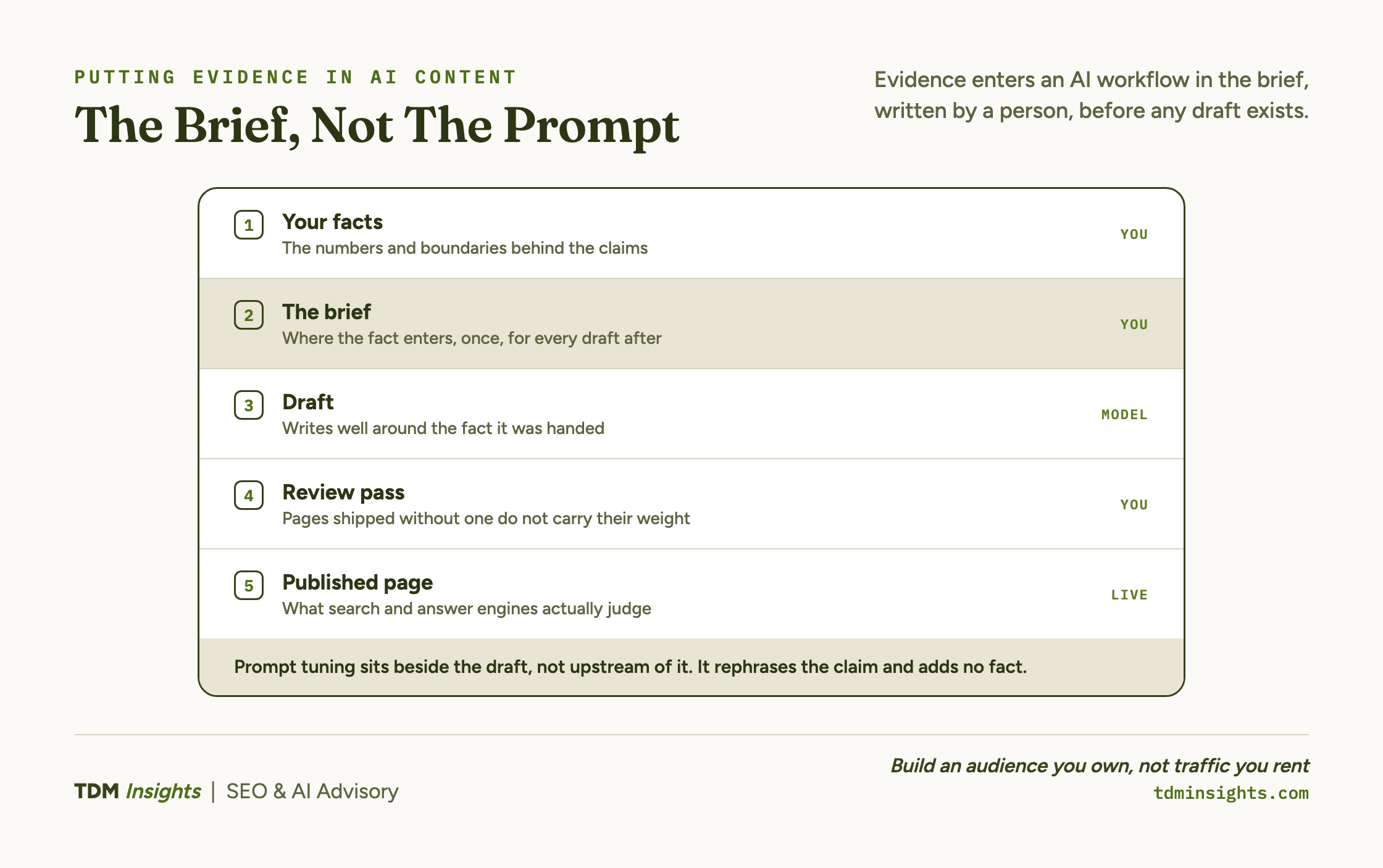
The Web Almanac’s measurement of page content shows how consistently pages share the same structural furniture, so the frame around your copy is common property. The contents need not be. Everything either side of the supply step can be assisted: a model drafts the sentence around your fact well, and it cannot go and get the fact.
Finding evidence when you have no data yet
A new site has no analytics history, no case study library, no published research. That objection assumes evidence means data, and three sources are open on day one that have nothing to do with data.
Constraints you already operate under
You know who you turn away, what you refuse to do, and the condition that makes a job go wrong. Each of those is a named constraint, the hardest evidence type to copy.
Write it as a limit with a consequence attached rather than as a disclaimer. “This stops working past a few thousand SKUs, because the manual review step becomes the bottleneck” is evidence. “Results may vary” is noise.
Observations you can date from today
You cannot backfill a year of observation, and you can start one this week. A dated note about a live job becomes quotable the moment it reaches the page with its date on it, which costs a habit rather than a project.
Results from work you have already done
Prior work counts even when the business is new, provided the vertical carries the story and the client stays unnamed. State the starting position, the change, and the period it covered.
Survey data on which content formats actually perform puts original research at the strong end year after year, and original research is the one format that cannot exist without first-hand evidence in it. How to Be the Source Claude Recommends reads that requirement from the engine side, and NN/g on the cues readers use to judge credibility shows it holding for a human reader too. Specificity is what survives being pulled out of context, which is exactly what a retrieval system does to your sentence.
Rewriting one generated page, worked end to end
Take the services page of an example two-person bookkeeping practice.
The draft as it stands
The generated version reads: “We provide reliable bookkeeping services tailored to your business. Our experienced team keeps your books accurate and up to date, so you can focus on growing your company.”
Nothing there is wrong. Nothing there is theirs either, and a system reading it has no reason to attribute any of it to this practice rather than to the thousand pages saying the same thing.
Which three sentences carry the weight
Mark the sentences a reader would repeat to somebody else. On a services page that is normally three: what you do, who it suits, and what happens when it goes right. Those are the claims load-bearing enough to deserve evidence attached to them.
Attach a specific to every sentence instead and the page turns dense while still reading as nobody’s, because the reader cannot tell which fact was the point.
The three-sentence test
If you cannot mark three sentences a reader would quote to a colleague, the page has no candidates and the problem is not the writing. Everything outside those three can stay general at no cost, which is what makes the pass finishable in an afternoon.
The same page with evidence attached
The rewrite: “We handle bookkeeping for owner-operated trades businesses running between three and twelve staff. Below three staff the work is simpler than our process assumes, and we say so rather than take the job. Our monthly close lands within five working days of month end, which is the number we hold ourselves to and the one clients ask about first.”
Three sentences, three evidence types: a named boundary, a stated constraint, a measured commitment. Barely longer than the draft it replaced, and now quotable, because every claim names something a competitor cannot borrow without lying.
Building the evidence pass into the workflow so it happens every time
One rewritten page proves the method on one page. A workflow is what stops the next twenty shipping without it.
The one check that catches an unevidenced draft
Ask one question of each marked sentence: could this appear unchanged on a competitor’s page?
If yes, it carries no evidence, and either you supply the specific or you accept that this claim is not one of the three. Both answers are fine. Neither is the same as leaving it.
Order matters more than coverage, because the pass does not scale to a whole archive at once. Journey position 6, Website Content Strategy: Money Pages in Four Weeks, already ranked your pages by the demand that exists today, so run the pass on those first. Auditing chronologically spends the effort on the pages with the least to gain, and it is the default nobody chooses on purpose.
Quotable and chosen are two different finishing lines, and Being Cited by AI Is Not the Same as Being Chosen covers the second one. Evidence is rung three, the rung you can fix without anyone’s permission, while the rung that breaks first for a brand new site is the one nothing on your own site can reach: journey position 14, SEO for AI Search When Nothing Else Mentions You Yet.
Book a free diagnosis
If your pages read well and nothing quotes them, the read I run first is which rung is actually failing, because evidence and corroboration look identical from the inside and take opposite fixes. You get back which pages are three sentences short of quotable, and which wait on something off your domain.
Frequently Asked Questions
Is AI generated content bad for SEO?
No. Search and answer engines judge the published page, not how the first draft was produced. What costs you is shipping unreviewed output at volume, because the accurate general statement it defaults to gives no system a reason to prefer your page over a thousand others saying it.
Does Google allow AI content for SEO?
Yes. Google’s published spam policy names scaled content abuse, which is producing pages at volume primarily to manipulate rankings with nobody reviewing what ships. Drafting with a model is not the behaviour that policy describes. Supervised production that adds evidence and gets read before publishing sits outside it entirely.
What is the 30 percent rule in AI content?
No such rule exists. No search or answer engine publishes a percentage of generated text that is safe or unsafe, and no detector supports one reliably enough to act on. What is observable instead is whether a page carries a specific claim nobody else could make. Judge the page on that.
How do you write for AI search?
Write passages that survive being lifted alone. Each should state one claim in a sentence that reads correctly out of context, and attach one specific to it: a measured number, a dated observation, a named constraint, or a first-hand result. A model drafts the sentence well once you supply the specific.
How do you get 100 percent on an SEO score?
You satisfy the checklist the tool grades: keyword placement, heading order, length, links, readability. A full score and a quotable page are unrelated things. Those checks measure what an automated pass already handles, and none of them looks for the one specific claim that gives a system a reason to quote you.
What are common SEO mistakes to avoid?
The mistake specific to a fast-produced site is publishing accurate general statements nobody reviewed for a single quotable specific. The familiar ones still apply: pages aimed at a topic rather than a query, no internal links pointing into new pages, and structured data describing your category instead of your business.
Continue Reading:
Previously in this series
- AI SEO: The Five Rungs That Decide If You Get Cited, the Citability Ladder in full, and where evidence sits on it.
Next in this series
- SEO for AI Search When Nothing Else Mentions You Yet, the rung above evidence, where another domain has to state the same facts about you.
From the library
- What Google Actually Penalizes About AI Content, purpose and evidence, the two tests that decide whether a page is safe.
- Scaled Content Abuse Is About Quality, Not About AI, why the policy names purpose as the violation, never the tool that drafted the page.
- The Evidence of Effort a Reader Can Actually See, a longer ranked list of the effort signals a reader notices first.
- Writing for E-E-A-T: Prove Experience on the Page, the wider on-page proof checklist that first-hand experience evidence sits inside.
- Making AI a Writing Partner That Earns Its Place, where a model can assemble evidence and where the fact still must come from you.
Explore TDM Insights Categories