
Answer Engine Optimization: What AEO Actually Is
Ranking and getting cited by AI are two different wins. What AEO actually means, why it matters now, and where to start.
 By David Jubé · Jun 6, 2026 · 15 min read
Answer engine optimization is the work of getting your page chosen as a source by AI systems like ChatGPT, Perplexity, and Google’s AI Overviews, not just ranked in a list of links.
The distinction matters because the head term alone draws roughly 2,400 searches a month at a cost-per-click near 25 dollars, which tells you buyers, not just the curious, are trying to understand it.
Here is the answer-first version, the one you can lift in a single sentence: answer engine optimization (AEO) is the practice of structuring your content so that AI answer engines cite it directly inside the synthesized answer they show a user, instead of merely listing it as a clickable result.
The goal moves from “rank a link” to “be the source the engine quotes.”
Everything below explains how that shift happened, how it differs from SEO, and the three questions to ask about any page you own.
Key takeaways
- Answer engine optimization is the work of getting your page chosen as a source by AI systems like ChatGPT, Perplexity, and Google’s AI Overviews, not just ranked in a list of links.
- The goal moves from ranking a clickable link to being the source the engine quotes inside its synthesized answer.
- AEO does not replace SEO; it sits on top of it, because an engine still has to find your page through crawlability, indexation, and authority before it can quote you.
- Getting cited runs in three steps: Retrieval, then Evaluation, then Citation, and any page that is not showing up is failing one specific step.
- A page can rank on page one and still never get cited, because ranking position and AI citation are separate outcomes produced by separate processes.
Answer Engine Optimization, Defined in One Paragraph
AEO is being chosen as a source by an AI answer engine. When someone asks ChatGPT, Perplexity, or Google a question and the system writes one composed answer, that answer is stitched together from a handful of pages the engine decided to trust.
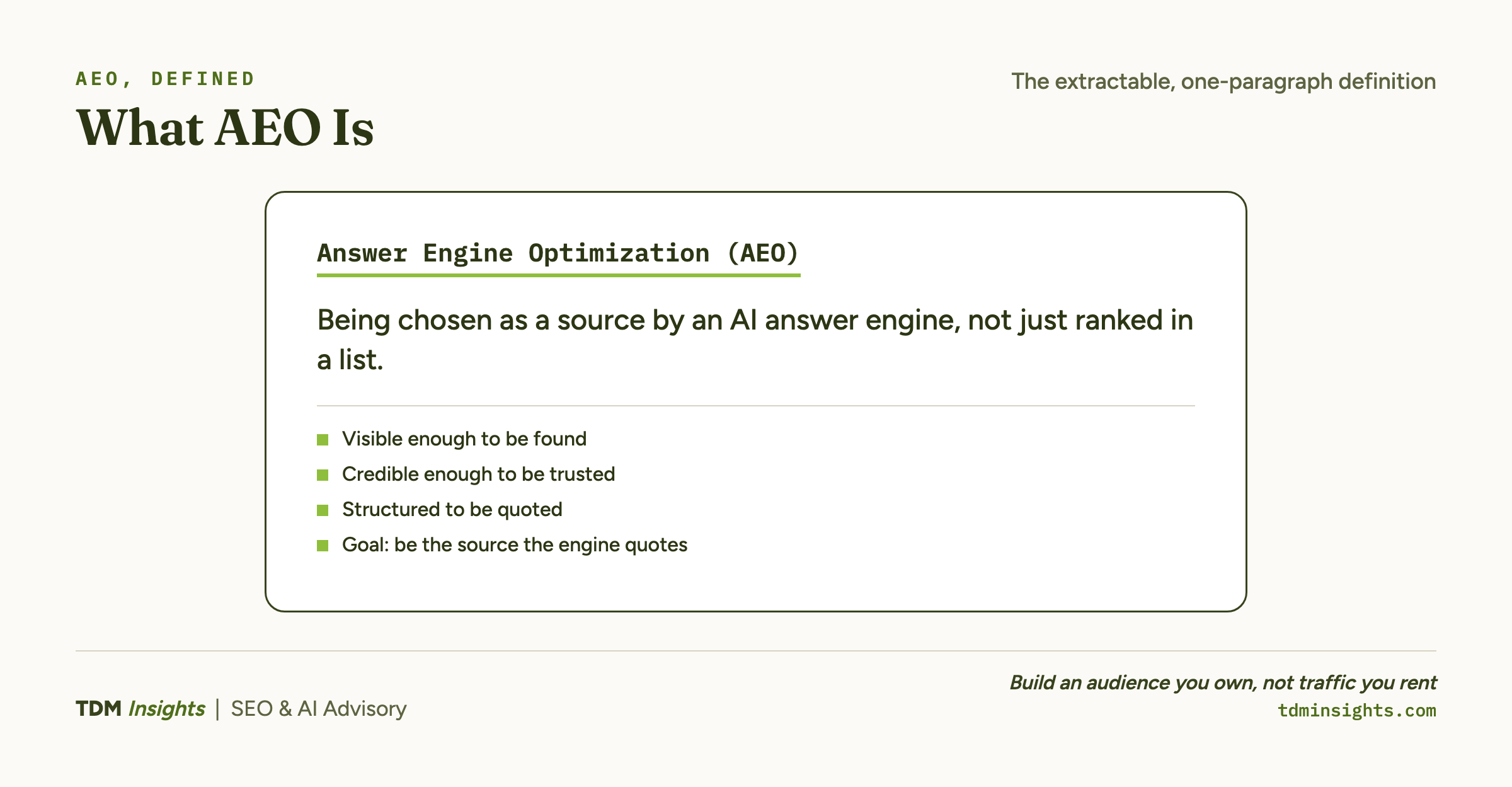
AEO is the discipline of making your page one of those pages: visible enough to be found, credible enough to be trusted, and structured cleanly enough that a specific passage can be pulled out and attributed to you.
It is not a new channel you bolt on. It is the same content earning a different, harder kind of win: a mention inside the answer, not just a spot in the list beneath it.
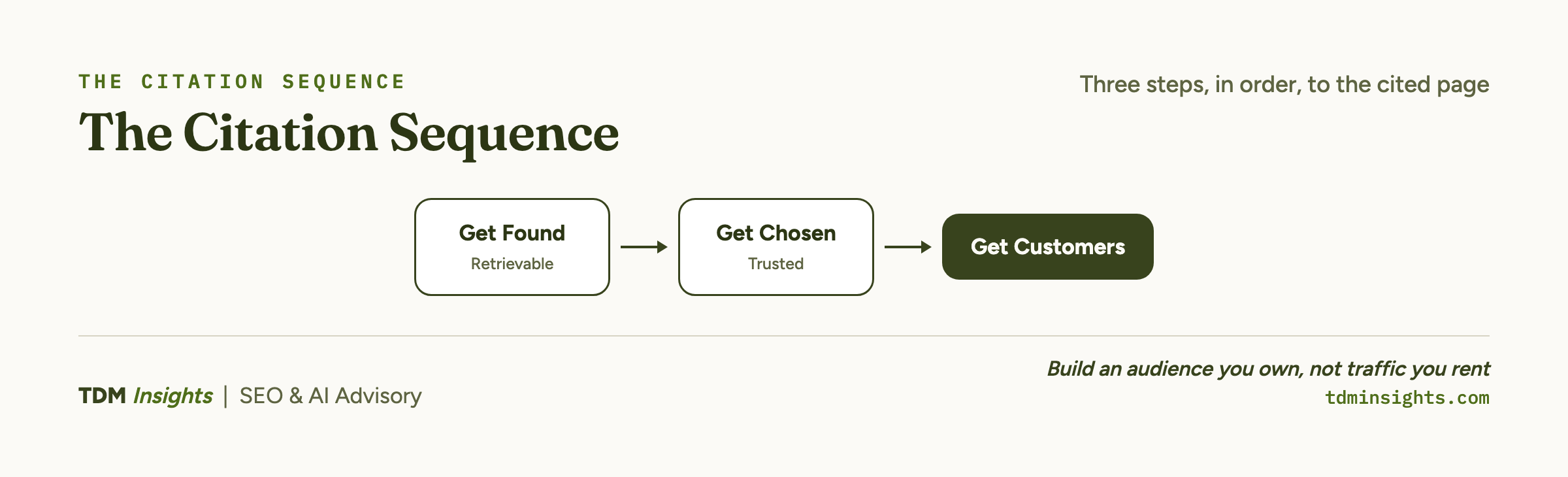
Keep one mental model from the start, because the rest of this cluster runs on it: getting picked by an AI engine is a sequence of Get Found, then Get Chosen, then Get Customers.
You have to be retrievable before you can be trusted, and trusted before a passage of yours gets lifted into the answer. Miss any step and the page that “should” be cited simply is not.
What Changed: From Ten Blue Links to One Synthesized Answer
For two decades, search worked one way: you typed a query, you got ten blue links, and your job as a publisher was to rank as high in that list as possible.
The user did the synthesizing. They clicked, read, compared, and decided. Search engines pointed; people resolved.
That changed in public in May 2024, when Google began rolling out Google’s May 2024 AI Overviews launch announcement to all US users, placing a single AI-written answer above the traditional results for a growing share of queries.
The engine now does the synthesizing. It reads several sources, composes one answer, and shows that answer first. The links are still there, but they sit below a response that often satisfies the question on its own.
This was not entirely without precedent. Google had spent years training users to expect answers on the page itself, first through Google’s featured snippets documentation, the answer boxes that pulled a paragraph or list straight to the top of results.
AI Overviews are the same instinct at full strength: instead of quoting one page in a box, the engine paraphrases several pages into a paragraph.
The lineage matters because the skill that won featured snippets, writing a clean, self-contained answer, is the same skill that wins AI citations now.
The consequence for a founder is blunt.
The behavior is shifting fast: NN/g research on AI search behavior documents how people increasingly pose full questions to AI tools and accept the composed answer rather than browsing a list.
If your visibility strategy assumes the user will scroll to your link and click it, you are optimizing for a habit that is fading.
AEO vs SEO: The Same Plumbing, a Different Finish Line
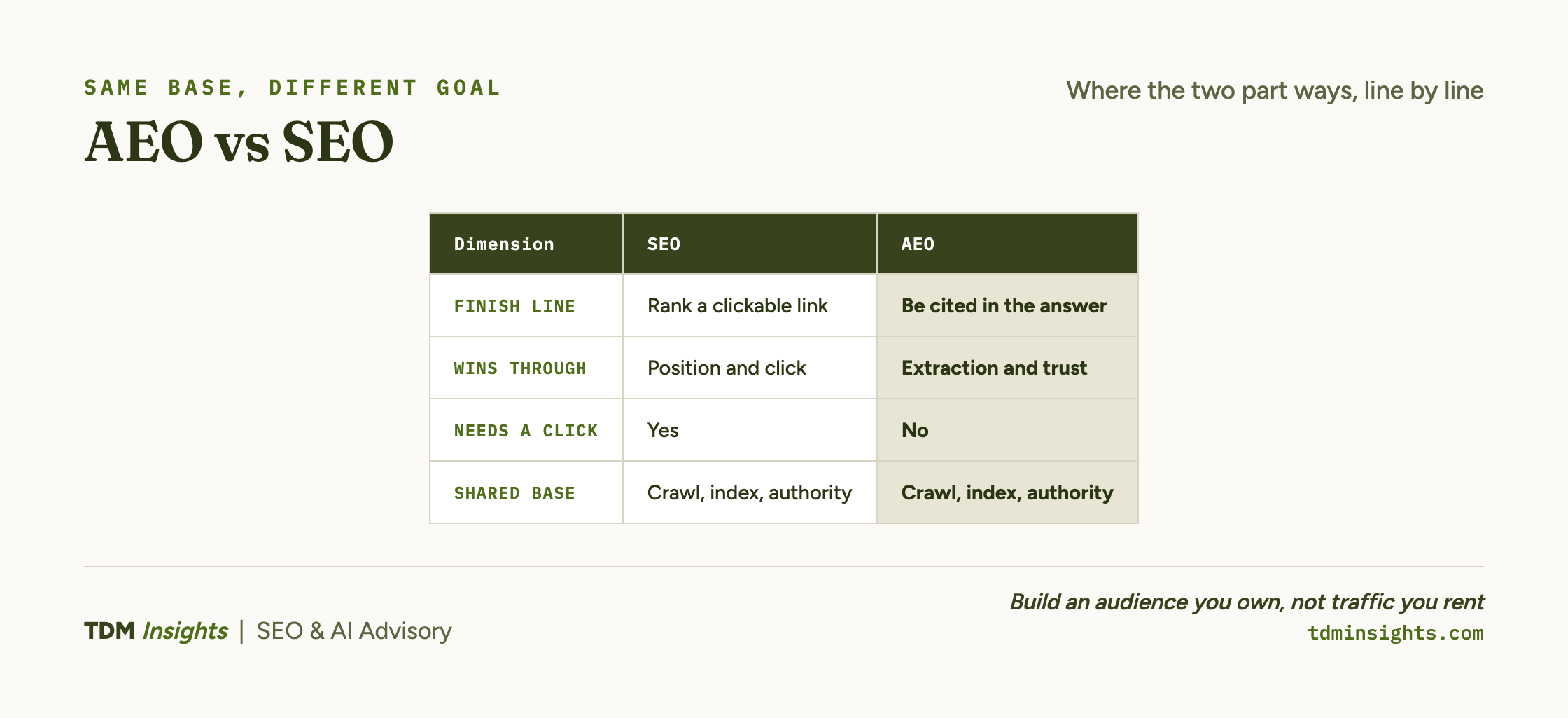
The cleanest way to hold the difference: SEO optimizes to rank a clickable link; AEO optimizes to be cited inside the answer.
SEO wins traffic through position and click-through. AEO wins visibility by being the source an engine extracts, even when the user never clicks through to your site.
HubSpot on AEO vs traditional SEO lays out the same split: one discipline competes for the click, the other competes for the citation.
But the plumbing underneath is shared, and this is the part most “SEO is dead” takes get wrong. An answer engine still has to find your page before it can quote it, and finding pages runs on the same crawlability, indexation, and authority signals that classic search has always rewarded.
Backlinko’s guide to answer engine optimization makes the practical version of this point: the pages that get cited tend to be pages that were already doing the SEO fundamentals well.
AEO does not replace that work. It sits on top of it.
So the finish line moves, not the foundation. You still need to be indexed, authoritative, and relevant.
What changes is the last yard: instead of finishing at “ranked number three,” you finish at “quoted in the answer.”
If you want the full four-way breakdown of what AEO, GEO, and LLMO actually mean, that comparison is its own article, because the terms multiply faster than the underlying ideas do.
How AI Engines Actually Pick a Source
Once you accept that the win is a citation, the obvious question is: how does the engine decide whom to cite?
The honest short answer is that it happens in three steps, and you can reason about any page by asking which step it is passing or failing.
This is the spine of the whole AEO category, and there is a dedicated walkthrough of how AI engines find, evaluate, and cite a source, but here is the preview.
First comes Retrieval. The engine assembles a candidate set of sources for the query, from its index, a live web search, or a connected tool.
If your page is not retrievable, not crawlable, not indexed, not present where the engine looks, nothing else matters. You are not in the room. This is where the technical SEO fundamentals every founder should check do their quiet work.
Second comes Evaluation. The engine ranks and filters those candidates for trust and relevance before it composes anything.
This is where E-E-A-T (experience, expertise, authoritativeness, trustworthiness), clear entity signals, and corroboration across independent sources do their work. A page can be retrieved and still get screened out here for being thin, anonymous, or unsupported.
Third comes Citation. The engine lifts a specific passage and attributes it. Only extractable, answer-first, unambiguous passages get pulled.
A perfectly authoritative page can clear the first two steps and still fail this one because its best answer is buried three scrolls down, hedged across four sentences, or written so it only makes sense in context.
The reason this model is worth memorizing is that it turns a vague frustration (“we’re not showing up in AI”) into a diagnosis (“we’re failing at the Citation step”).
Different leaks need different fixes.
Book a free diagnosis
If you are reading this because your pages rank but the AI answers never name you, you already know the symptom. What you likely do not have yet is the diagnosis: which of the three steps is actually leaking on your priority pages. We will run those pages through retrieval, evaluation, and citation, founder to founder, and tell you the one fix that moves the needle first. No deck, no retainer pitch, just a clear read on where you stand.
Why “We Rank But Never Get Cited” Is the Defining AEO Problem
The most common complaint is some version of: “We rank on page one, so why does the AI answer never mention us?”
It feels like a contradiction. It is not. Ranking position and AI citation are separate outcomes produced by separate processes.
Two mechanisms drive the gap. The first is that answer engines run their own retrieval and frequently cite a page that does not hold the top organic spot, while ignoring the page that does.
Independent research backs this up: Pew Research Center’s analysis of clicks with AI summaries found that users are meaningfully less likely to click any link when an AI summary appears, which means the value of holding rank one drops precisely when an AI answer is present.
You can own the position and still lose the visit to the summary above you.
This is the zero-click problem, and it is not small or new. SparkToro’s 2024 zero-click baseline found that for every 1,000 US Google searches, only 374 clicks went to the open web.
The trend has only deepened since: SparkToro’s zero-click search study puts the figure at less than a third of Google searches still sending a click.
Read those two numbers together and the strategic point is unavoidable: most of the search result is being answered on Google’s own page, so the win has to move from “earn the click” to “be the source quoted in the answer.”
The second mechanism is the Citation step from the model above. A page can be retrieved and trusted but still skipped because no single passage on it cleanly resolves the question.
The engine wants a sentence it can quote and stand behind. If your strongest answer is implied across a section rather than stated in one liftable block, the engine reaches for a competitor who wrote it plainly.
Put together, these explain the defining AEO problem: rank is necessary less and less, and sufficient almost never.
The work is no longer just climbing the list. It is making sure that when the engine builds its answer, your page is both in the candidate set and written to be quoted.
What AEO Does Not Mean (Debunking the “SEO Is Dead” Claim)
It is worth saying plainly, because the loudest takes get this wrong: AEO does not mean SEO is dead. The claim is seductive and false.
Retrieval, the first step an engine takes, runs on crawlability, indexation, and authority, which is the entire body of work SEO has always done.
Kill your SEO and you remove yourself from the candidate set before evaluation even begins. You cannot be cited from a page no engine can find.
What is actually dying is the assumption that ranking is the end of the job. For years, a top-three position was close enough to a guaranteed slice of clicks.
That guarantee is eroding because the answer now sits above the links, and the answer often satisfies the user. AEO is the response to that erosion, not a replacement for the machinery that gets you ranked in the first place.
The useful framing is layered, not either-or. SEO earns you the right to be considered. AEO earns you the citation once you are.
The evidence backs this up. When Yext analyzed 6.8 million AI citations across ChatGPT, Gemini, and Perplexity in 2025, it found that 86 percent came from sources the brand already owns or manages, such as its own site and listings. Prepared, well-structured content is what earns the citation, and established brands that have already done that work hold the clearest advantage.
Treat them as one stacked discipline. If you want the deeper argument for why AEO still depends on solid SEO, the startup-focused version covers the foundation work that the whole AEO layer rests on.
Where to Start: The Three Questions to Ask About Any Page
You do not need a tool or a budget to begin. You need to run any important page through three questions, one per step of the model.
1. Can the engine find it? (Retrieval.) Is the page indexed, crawlable, and present where engines look? Does it load cleanly, carry the right internal links, and appear in normal search for its target query?
If the page is invisible to standard search, it is invisible to the answer engines too. Fix retrieval first, because the next two questions do not matter until you pass this one.
2. Will the engine trust it? (Evaluation.) Is the authorship clear? Is the claim corroborated by sources the engine already trusts? Are your entities, who you are, what you do, what this page is about, stated consistently and unambiguously?
Structured data helps here. The the schema.org vocabulary FAQ explains the shared vocabulary that lets you label your entities and relationships so an engine can parse them without guessing.
3. Can the engine lift it? (Citation.) Does a single passage answer the question completely, on its own, without the rest of the page for context? Is the answer in the first sentence of its section, or buried?
Google’s own Google’s guide to optimizing for generative AI features is direct on this point: there is no secret markup that earns a citation, just accurate, well-structured, genuinely useful content with the answer made easy to extract.
Run those three questions and you will usually find the leak is concentrated in one step, not spread across all three.
That is the whole value of the model: it tells you where to spend.
This connects back to the bigger discipline, too. Strong AEO is downstream of writing content that both ranks and gets cited by design, not as a happy accident. It is also downstream of a content strategy that treats the library as an asset, and of the topic clusters that build the authority engines reward.
And once you have done the work, the next problem is proving it worked, which is its own challenge because AI answers often send no referrer. We cover how to measure AEO when there’s no referrer separately, because measurement is where most founders stall.
A closing note on why we can talk about this with conviction rather than theory.
We refined this exact model on a site we operate before bringing it to clients, so the approach is grounded in practice rather than slideware.
New to this? Start with the next question every founder asks: what do AEO, GEO, and LLMO actually mean? That four-acronym breakdown, linked earlier in this article, is the natural next read.
Frequently Asked Questions
What is answer engine optimization?
Answer engine optimization (AEO) is the practice of structuring content so AI answer engines like Google AI Overviews, ChatGPT, and Perplexity cite it directly inside a synthesized answer. The goal shifts from ranking a link to being named as the source the engine quotes, summarizes, or speaks aloud to the user.
How is AEO different from SEO?
AEO optimizes for being cited inside an AI answer, while SEO optimizes for ranking a clickable link on the results page. SEO wins traffic through position and click-through. AEO wins visibility by being the source an engine extracts, even when the user never clicks through to your site.
Why does answer engine optimization matter now?
It matters because Google launched AI Overviews to all US users in May 2024, putting one synthesized answer above the ten blue links. Searches that trigger an AI Overview now see far higher zero-click behavior, so ranking alone no longer guarantees traffic. Being cited in the answer is the new visibility.
Can a page rank well but still get no AI citations?
Yes. Ranking position and AI citation are separate outcomes. Answer engines compress multiple sources into one response and may quote a lower-ranked page while ignoring the top result. A page can hold position one, lose its click to the AI summary, and never appear as a cited source.
How do you measure AEO success?
Measure citation share, not rank position. Track how often answer engines mention or link your brand across ChatGPT, Perplexity, Gemini, and Google AI Overviews, which competitors get cited instead, and which questions surface you. Traditional rank tracking misses this, because a cited brand and a ranked link are different results.
What is zero-click search and how does it connect to AEO?
Zero-click search is a query that ends without the user clicking any result, because the answer appears directly on the page. A large and growing share of Google searches now end click-free. AEO is the response: if the click is disappearing, the win is being the source quoted inside that on-page answer.
Continue Reading:
More On Answer Engine Optimization
- GEO vs SEO vs AEO vs LLMO: What They Mean
- How AI Answer Engines Choose Their Sources
- How to Get Cited by ChatGPT, Perplexity, and AI
- Schema Markup for AI: Answer-First Writing Guide
- How to Measure AI Traffic With No Referrer
- How to Write a Definition AI Will Quote Verbatim
- llms.txt Explained: Should Your Site Have One?
More from TDM Insights
- SEO for Startups: What to Do in the First 90 Days
- Technical SEO Checklist for Founders, by Severity
- Content Strategy for Founders: A Library That Ranks, Gets Cited, and Pays for Itself
- Topic Clusters and Pillar Pages: How They Work
- Content That Ranks and Gets Cited by AI
Explore TDM Insights Categories