
The CTR Fix: Same Ranking, More Clicks
We rewrote titles and meta descriptions on 108 pages. The meta-description group's CTR rose 0.39 points net of control, with clicks up 67%.
 By David Jubé · Jun 2, 2026 · 7 min read
A page can rank well and still lose. It sits on page one, collects impressions, and almost nobody clicks. The ranking is fine. The result on the page that matters, your site, is poor.
That gap between rank and clicks is the most under-worked lever in SEO. It does not need a new article or a single new backlink. It needs you to rewrite what the searcher actually sees in the result: the title and the snippet beneath it.
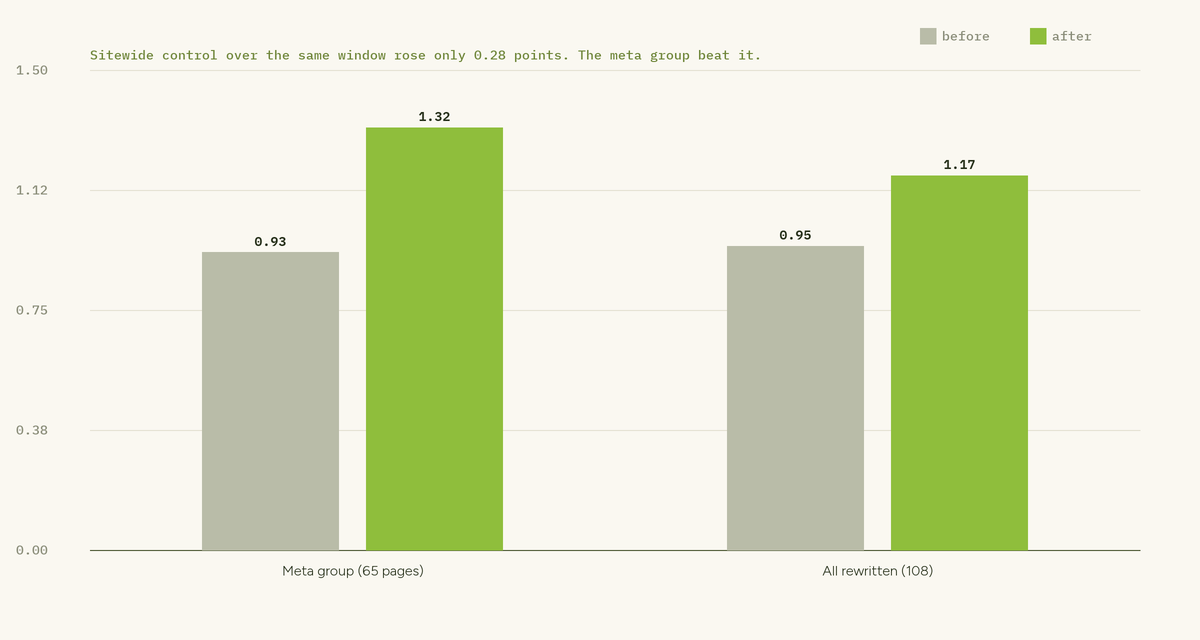
Here is the before and after on click-through rate, for the meta group and for all 108 rewritten pages.
Key takeaways
- Rewriting titles and meta descriptions on 108 pages lifted click-through rate without touching the content or the rankings.
- The meta-description group (65 pages) gained 0.39 points of CTR net of a sitewide control, with clicks up 67%.
- It is the cleanest causal win of the program: same positions, same pages, more clicks, traced to one change.
The setup: page one, but quiet
Across the library, a band of pages had the same profile. Decent positions, healthy impressions, and a click-through rate that did not match. The titles were generic or truncated. The meta descriptions were missing, too long, or said nothing that earned the click.
The ranking work had already been done by the content. The snippet had not. So the snippet was the lever.
The method: rewrite the snippet, not the page
We did not add words to the articles, build links, or chase positions. We rewrote two things per page: the title tag and the meta description.
Titles were sharpened to front-load the real query and lead with a benefit or a number. Meta descriptions were rewritten to 130 to 140 characters so they display in full and make a concrete promise. The change shipped to 108 pages on May 18 in one batch: 78 titles and 65 metas, 0 failures.
| Scope | Count | What changed |
|---|---|---|
| Titles rewritten | 78 | Front-load the query, lead with a benefit or number |
| Meta descriptions rewritten | 65 | 130 to 140 characters, one concrete promise |
| Pages touched | 108 | No body edits, no new links, no ranking work |
The result: same positions, more clicks
Because the whole site was rising, the honest read nets the change against a sitewide control. Over the settling window, May 19 to Jun 1, the meta-description group did this:
| Metric | Before | After | Change |
|---|---|---|---|
| Meta group CTR | 0.93% | 1.32% | +0.39 pts |
| Meta group clicks per day | 26.5 | 44.1 | +67% |
| All 108 pages CTR | 0.95% | 1.17% | +0.23 pts |
The control matters. The rest of the site, untouched by this change, gained 0.28 points of CTR over the same window from the general rise. The meta group gained 0.39. That 0.11-point gap is the part the rewrite earned that the tide did not give. Across all 108 pages, impressions rose 22% and clicks 51% as the sharper snippets earned both more visibility and more clicks per view.
Why the snippet is the highest-leverage edit
The content already ranked. That work was spent and banked. The title and meta are the only part of an SEO result the searcher reads before deciding to click, and they are the fastest thing to change.
You can rewrite a snippet in minutes and measure the effect in weeks, with no risk to the ranking you already hold. Few SEO levers are that cheap, that fast, or that safe.
What this teaches
- Rank and clicks are two different jobs. Content earns the ranking. The title and meta earn the click. A page can win the first and lose the second, so audit them separately.
- The snippet is the cheapest lever you own. No new writing, no links, no ranking risk. Rewriting the title and meta is minutes of work against clicks you are already entitled to.
- Net every result against a control. The site was rising anyway. Only by subtracting the sitewide control could we see the 0.39-point lift the rewrite actually earned. Claim the delta, not the tide.
- Write the meta to the character budget. Metas were cut to 130 to 140 characters so they show in full and make one concrete promise. A truncated snippet is a wasted one.
- Front-load the query in the title. Lead the title with the real search term and a benefit or a number. The searcher scans the first few words; earn the click there.
- Pilot, then scale. An earlier 33-page meta pilot proved the lever moved before we pushed it to 108 pages. Validate cheap, then batch.
What this does not claim
Honesty keeps the note useful. The whole site’s authority and traffic were rising across this window, which is exactly why the headline number is netted against a sitewide control rather than reported raw. CTR also moves with seasonality and with how often a page triggers an AI Overview, which compresses clicks independently of the snippet. Title rewrites in aggregate roughly tracked the rising tide, with big individual winners; the cleanest, control-beating signal came from the meta-description group, which is the result we lead with. What the data supports is narrow and real: on those pages, at those positions, rewriting the snippet earned measurably more clicks than doing nothing.
Frequently Asked Questions
What is a good click-through rate in SEO?
It depends on position: results near the top of page one earn far higher CTR than those lower down. Rather than chase a universal number, compare each page to its own position benchmark. A page ranking well with a CTR below similar-position pages is under-clicked and worth a title and meta rewrite.
How do I improve click-through rate without improving rankings?
Rewrite the two things searchers actually read: the title tag and the meta description. Front-load the real query, lead with a benefit or number, and write the meta to about 130 to 140 characters so it shows in full. On the site above this lifted CTR 0.39 points at unchanged positions.
Does the meta description affect SEO rankings?
Not directly. Google often rewrites meta descriptions and does not use them as a ranking factor. They affect click-through rate, which is what turns a ranking into a visit. A strong meta does not move your position; it moves how many people choose your result over the others.
Why do high-impression pages get low clicks?
Usually the snippet is the problem, not the ranking. A generic or truncated title, a missing or vague meta description, or an AI Overview sitting above the result all suppress clicks while impressions stay high. Rewriting the title and meta is the first fix; it is cheap and carries no ranking risk.
How long does it take to see CTR changes after a rewrite?
Allow a few weeks. Search needs to recrawl the page and serve the new snippet, then enough impressions have to accumulate to read the new rate reliably. The rewrite above shipped on one day and settled into a clear, measurable lift over the following two weeks.
What length should a meta description be?
Aim for roughly 130 to 140 characters so the full snippet displays without truncation on most results. Use the space for one concrete promise tied to the search intent, not a keyword list. A meta that gets cut off mid-sentence wastes the part that earns the click.
The takeaway in one line: before you chase a higher ranking, rewrite the title and snippet on the rankings you already hold, because that is the cheapest click you will ever win.
Curious how many of your page-one results are quietly under-clicked? A free diagnosis finds the snippets leaking the most clicks first.
Continue Reading:
More From This Series
- Build the Cluster, Not the Post
- Clusters Compound. Scattered Posts Plateau.
- From Zero: A Cold-Start Cluster
- The Experiment We Killed
More from TDM Insights
- Title Tags and Meta Descriptions That Get Clicks
- How to Read the SERP Before You Write a Word
- Search Intent: The Four Types That Decide Everything
- Content Refresh: Win Back Rankings You Lost
- How to Show Up in Google AI Overviews
Explore TDM Insights Topics