
Schema Markup for AI: Answer-First Writing Guide
What makes a passage liftable by AI, plus the schema types that carry weight. Answer-first writing, made concrete.
 By David Jubé · Apr 19, 2026 · 16 min read
A page becomes liftable when a single passage answers the question completely without needing the rest of the page for context.
Schema markup helps an engine parse that passage, but it cannot rescue a buried or hedged answer, which is why answer-first writing comes before any markup.
That is the rule for this whole guide: write the standalone answer first, then add the structured data that labels it. Get the order wrong and you are decorating a passage no engine can use.
This article is also the demonstration. It is built to be lifted: every section leads with its answer, the claims stand on their own, and the closing JSON-LD block is the real structured data this page would ship with.
If the craft works, an answer engine should be able to quote any section here without reading the rest of the page.
Key takeaways
- A passage is liftable when it answers the question in full, on its own, in the first sentence or two of a section, under a heading that names the question.
- Answer-first writing comes before any markup, because schema labels a passage but cannot rescue a buried or hedged answer.
- A self-contained claim holds true when you copy it out of the page and paste it somewhere with no surrounding context, and that extractability test is the single most useful habit for answer-first writing.
- For answer engines, the highest-leverage schema types are Article or BlogPosting, FAQPage, HowTo, Organization, and Author or Person.
- One rule governs all of it: schema must describe content the user can see, because marking up what is not on the page earns penalties, not citations.
What “AI can lift” means, in one rule
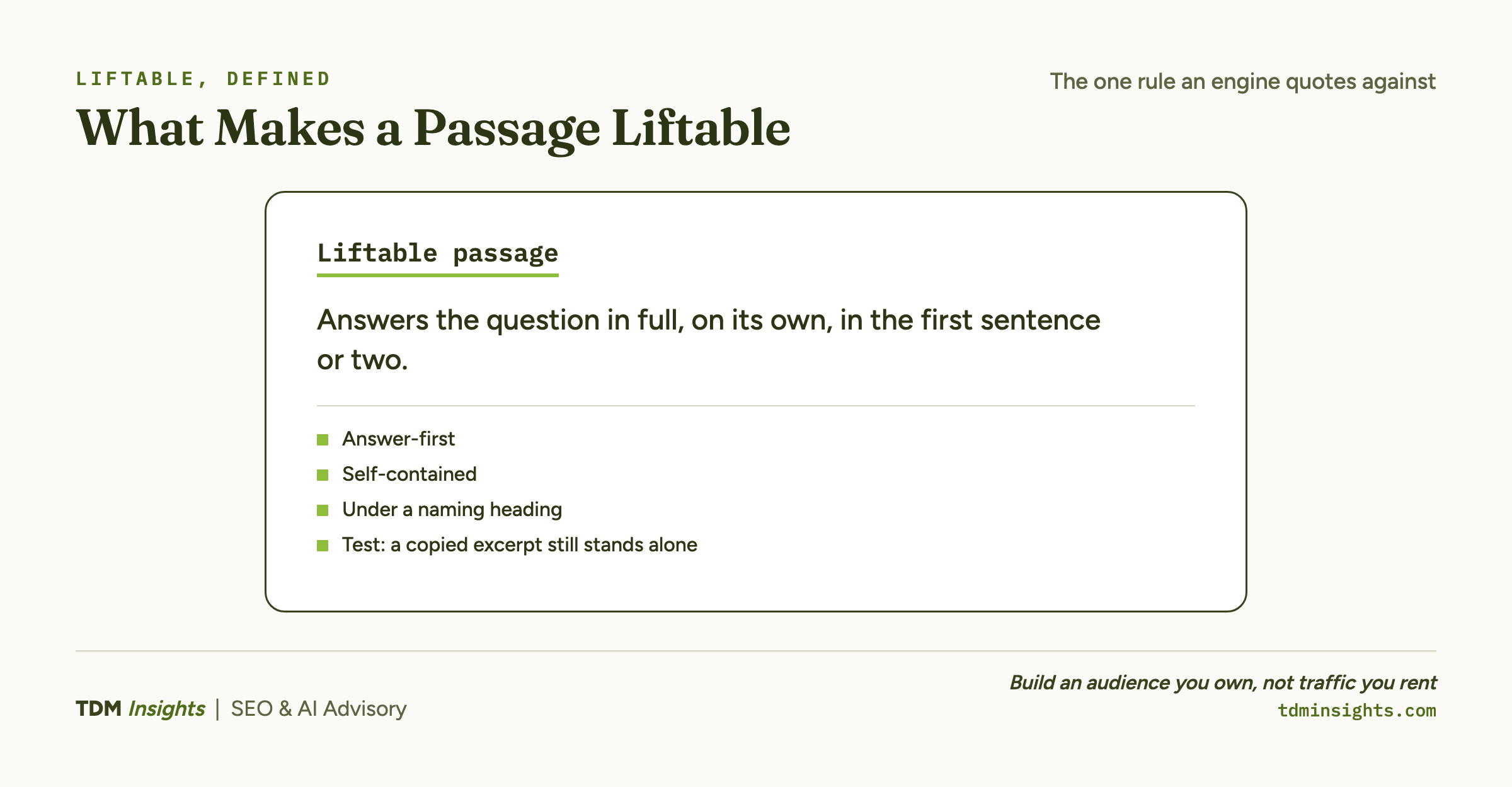
A passage is liftable when it answers the question in full, on its own, in the first sentence or two of a section, under a heading that names the question. That is the entire test.
An AI answer engine retrieves multiple pages, then composes one answer by pulling the specific sentences that resolve the query. It does not read your page top to bottom and summarize it the way a person might.
It scans for self-contained units it can quote with confidence, attribute to you, and drop into a synthesized response.
This maps directly to the Citation step this executes: the engine has already retrieved your page and judged it trustworthy, and now it is deciding which exact sentences to lift.
Two pages of equal authority can split here. The one with answers buried under three paragraphs of preamble loses the citation to the one that states the answer up top.
Liftability is the difference, and it is almost entirely a writing-and-structure problem, not a tooling problem.
The rest of this guide is the page-build checklist that produces liftable pages: answer-first structure, self-contained claims, a real FAQ block, the schema types that matter, and entity clarity. Applied across a whole library, this craft is what turns a content strategy for founders into pages engines reach for, and it is worth knowing how many blog posts you actually need to rank before you build at scale.
Schema comes near the end on purpose. It is the label, not the content.
Answer-first structure: the first 100 words do the work
Answer-first writing puts the direct answer in the opening sentence of a section, before any context, history, or qualification.
This is the journalistic inverted pyramid applied to the web: lead with the conclusion, then add the supporting detail underneath for the reader who wants it.
Nielsen Norman Group’s research on the inverted-pyramid writing structure found that web readers scan rather than read in sequence, so the most important information has to come first or it gets missed.
The same front-loading that helps a skimming human helps an extracting engine, because both stop reading once they have the answer.
The practical move is simple. Take any section heading framed as a question, and make the very next sentence the complete answer.
Not a setup (“There are several factors to consider when…”), not a definition of the question, the actual answer. Then expand.
Nielsen Norman Group’s companion piece on writing for the web with the inverted pyramid makes the case that this structure matters more online than in print, precisely because the reader’s attention drops off a cliff after the opening.
Here is the before-and-after, because the gap is concrete:
Buried (not liftable): “There’s a lot of debate about how schema affects AI citations, and to understand it you first need to understand how engines parse content. Once you know that, the role of structured data becomes clearer. In short, it can help.”
Answer-first (liftable): “Schema markup raises the odds of an AI citation but does not guarantee one. It labels your facts and entities so engines can extract them confidently. Content quality, authority, and freshness still decide selection.”
The second version answers the question in the first three sentences, each of which could be quoted alone. The first version makes the engine work for it, so the engine moves on to a page that does not.
Writing self-contained claims (the extractability test)
A self-contained claim is one sentence, or a short cluster of two to four sentences, that holds true when you copy it out of the page and paste it somewhere with no surrounding context.
That is the extractability test, and it is the single most useful habit for answer-first writing.
If a sentence relies on “this,” “as mentioned above,” “the second option,” or “it” pointing at something three paragraphs back, it cannot be lifted, because the engine would be quoting a fragment that means nothing on its own.
Run the test the way an engine effectively does. Copy any two-sentence excerpt from a section. If it stands alone and is still true and clear, it is liftable.
If you have to scroll up to understand who “they” are or what “this approach” refers to, it fails, and so will the citation.
Lumar’s explainer on content chunking for AI extractability frames this as chunking: structuring content into discrete, self-describing units rather than one long flowing argument, so the engine can grab a clean chunk instead of a dangling reference.
In practice, writing self-contained claims means naming the subject again instead of pronoun-chaining, keeping one idea per chunk, and front-loading the conclusion of each chunk.
It reads slightly more repetitive to a human who is reading linearly, but it reads far better to a human who is scanning, and it is the only form an engine can reliably quote.
Pair short, declarative claims with the descriptive headings from the previous section and you have the basic liftable unit: a question-shaped heading followed by a standalone answer.
The FAQ block: why it punches above its weight for AEO
A genuine FAQ block is the most efficient liftable structure you can add to a page, because it is answer-first by construction: each question is a real query, and each answer is a self-contained chunk sitting right underneath it.
The format forces the discipline the previous two sections asked for. You cannot bury the answer in a FAQ, because the question is the heading and the answer has nowhere to hide.
That is why a tight six-question FAQ often earns citations that the body of the same article does not.
The questions have to be real ones people actually ask, not strawmen you invented to host a keyword.
Pull them from the engines themselves: the “People also ask” box, the related-questions list inside an AI answer, and the autocomplete suggestions for your topic. Then answer each in 40 to 60 words, direct answer first, no preamble.
The reward is twofold. A skimming reader gets their question resolved instantly, and an answer engine gets a clean question-answer pair it can map to a user’s near-identical query and quote verbatim. The same front-loaded clarity is what makes content that converts readers into customers work once the reader is on the page.
This guide carries a six-question FAQ at the end, and the closing JSON-LD marks it up as a FAQPage so the structure is machine-readable as well as human-readable.
It is the same move recommended in the cross-cluster work on writing content that ranks and gets cited: the FAQ block is where ranking craft and citation craft converge, because it serves the snippet, the AI answer, and the human all at once.
Book a free diagnosis
Answer-first structure, self-contained claims, the right schema: the craft is learnable, but applying it across a live site is where founders stall. If your pages read well to a human yet never get lifted into an AI answer, the problem is usually liftability, and it hides in plain sight. We will run a sample of your pages through the extractability test and the schema check, then hand you a free diagnosis with the specific passages to rewrite first.
Schema that matters: FAQPage, Article, HowTo, Breadcrumb, Organization
For answer engines, the highest-leverage schema types are Article (or BlogPosting), FAQPage, HowTo, Organization, and Author or Person.
Article and Organization establish who published the content and what authority sits behind it. FAQPage and HowTo expose self-contained question-and-answer and step structures that engines lift directly. Everything else is secondary for AEO.
You do not need a sprawling structured-data deployment; you need these few types, implemented in JSON-LD, reflecting content that is actually visible on the page.
Use JSON-LD, the format Google recommends, placed in the page head or body as a script block.
Google’s Article structured data guidance covers the Article and BlogPosting implementation, including the author, publisher, and date fields that signal provenance.
For step-based content like the checklist below, schema.org’s HowTo structured data is the right type, and the schema.org getting started with schema.org doc walks through the JSON-LD basics if you are wiring this up for the first time.
Moz’s structured data primer is a clean evergreen overview if you want the conceptual version before the spec.
One rule governs all of it: schema must describe content the user can see.
Marking up a FAQ that does not appear on the page, or claiming an author who is not credited, is a violation that earns penalties, not citations.
As Google’s how structured data markup works doc puts it, the markup is a parsing aid for visible content, not a back channel for hidden claims.
BrightEdge’s analysis of structured data in the AI search era reaches the same conclusion from the AI-visibility side: structured data raises extraction confidence, but only when it mirrors what is on the page.
Here is the real JSON-LD this page ships with for its Article and FAQ layers, shown so you can copy the pattern. It is the same block reproduced in full at the end of the article, because this page practices what it documents:
{
  "@context": "https://schema.org",
  "@type": "BlogPosting",
  "headline": "Schema Markup for AI: Answer-First Writing Guide",
  "description": "Schema markup for AI plus answer-first writing: the on-page moves that make a passage liftable, the schema types that matter most.",
  "author": {
    "@type": "Organization",
    "name": "TDM Insights",
    "url": "https://tdminsights.com",
    "email": "contactus@tdminsights.com"
  },
  "publisher": {
    "@type": "Organization",
    "name": "TDM Insights",
    "url": "https://tdminsights.com",
    "email": "contactus@tdminsights.com"
  },
  "mainEntityOfPage": {
    "@type": "WebPage",
    "@id": "https://tdminsights.com/schema-markup-for-ai-answer-first-writing-guide"
  }
}
Notice what the block does and does not do. It names the publisher and author so the engine can attribute the page to a known entity, it ties the content to a canonical URL, and it carries the same description that appears in the meta.
It makes no claim the page does not back up. That restraint is the point.
Entity clarity: making sure the engine knows who and what you are
Entity clarity means defining your brand, your people, and your topics as consistent, identifiable entities with stable names, attributes, and relationships across the page and across your site.
AI systems do not read prose the way humans do. They extract entities and the connections between them, then map those entities to a knowledge graph.
When your brand is called three slightly different things, your author has no bio, and your topic is described loosely, the engine has to guess at the connections, and guessing lowers its confidence, which lowers your citation odds.
The fixes are mundane and they compound. Use one canonical brand name everywhere, not a marketing variant in the header and a legal variant in the footer.
Credit a real, named author with a consistent byline and a bio that states their expertise, which is the experience-and-expertise signal the engine’s evaluation step looks for.
Define your core topics in plain, stable language and link them together internally so the engine can see the topical relationships, which is exactly what topic clusters and pillar pages are built to do.
Writesonic’s guide to structured data in AI search frames the Organization and Author markup as the machine-readable layer of this same work: the schema names the entity, and consistent on-page signals confirm it.
Entity clarity is also where the schema and the prose have to agree. If your Organization schema says one name and your page says another, you have created ambiguity instead of resolving it.
The engine trusts the page when the visible content, the internal links, and the structured data all point at the same entity.
That alignment is the quiet, unglamorous work that separates a page an engine cites with confidence from one it treats as a maybe.
A page-build checklist mapped to the Citation step
Here is the page-build checklist, in order, mapped to the Citation step of how answer engines choose sources. Work it top to bottom on any page you want lifted.
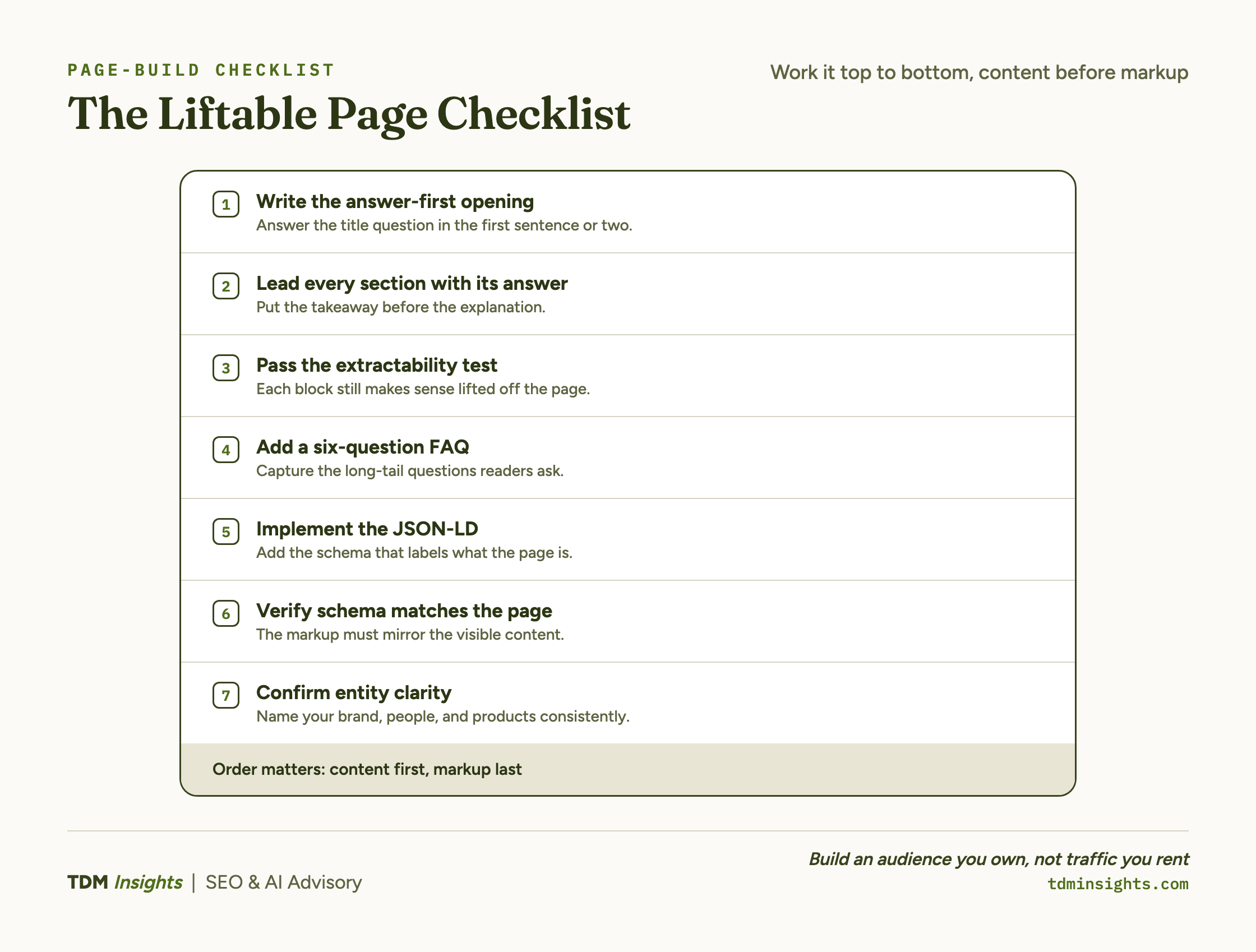
Each step produces a liftable unit, and the order matters: content first, then the markup that labels it.
- Write the answer-first opening. State the page’s core answer in the first 100 words, in one or two self-contained sentences an engine could quote verbatim. This is the single highest-leverage step.
- Lead every section with its answer. Frame each H2 as the question it resolves, then make the next sentence the complete answer before any context.
- Pass the extractability test on each section. Copy any two-sentence excerpt. If it does not stand alone, rewrite it to name its subject and drop the back-references.
- Add a genuine six-question FAQ block. Use real questions from People-also-ask and AI answers, answered in 40 to 60 words, direct answer first.
- Implement the JSON-LD. Add BlogPosting (or Article), FAQPage, and HowTo where the body is a real procedure, plus Organization and Author. Use the pattern shown above.
- Verify schema matches visible content. Every marked-up FAQ, step, and author must appear on the page. Test the markup in Google’s Rich Results Test before publish.
- Confirm entity clarity. One canonical brand name, a named author with a bio, and internal links that tie your topics together, all agreeing with the schema.
Once the page is built this way, the next job is to confirm it is working, which is its own problem because AI answers rarely send a referrer.
The forward step is to measure whether the work is getting lifted: track citation appearances, AI-bot crawls in your server logs, and branded-query lift, so the craft on this page can be proven rather than assumed.
And if you want the strategic frame behind the per-engine tactics this checklist serves, the playbook for the per-engine playbook this craft serves shows where each engine weights these signals differently.
All of it sits under one definition, which is what answer engine optimization is in the first place: getting your page chosen as a source, not just ranked.
Frequently Asked Questions
What does answer-first writing actually look like?
Answer-first writing puts the direct answer in the opening sentence of a section, before any context or backstory. It mirrors the journalistic inverted pyramid: lead with the conclusion, then add supporting detail. AI engines and featured snippets pull from passages that resolve the question immediately, so the answer must stand alone up top.
Does schema markup help AI cite my page?
Schema markup raises the odds of being cited but does not guarantee it. Structured data labels your entities and relationships so engines like ChatGPT, Perplexity, and Google AI Overviews can extract facts confidently instead of guessing. Many AI-cited pages carry at least one schema type. Content quality, authority, and freshness still decide selection.
Which schema types matter most for AEO?
For answer engines, the highest-leverage types are Article (or BlogPosting), FAQPage, HowTo, Organization, and Author or Person. Article and Organization establish who published the content and their authority. FAQPage and HowTo expose self-contained question-and-answer and step structures that engines lift directly. Schema only helps when it reflects content that is actually visible on the page.
How do I make a passage easy for AI to extract?
Make each passage self-contained: one idea, two to four sentences, roughly 40 to 120 words, sitting under a descriptive heading that names the question. The reader or model should grasp the point without scrolling elsewhere. A quick test is copying any two-sentence excerpt. If it cannot stand alone for you, an AI engine cannot lift it either.
What is entity clarity and why does it matter for AI?
Entity clarity means defining your brand, people, and topics as consistent, identifiable entities with stable attributes and relationships across the page. AI systems do not read prose the way humans do; they extract entities and the connections between them. Clear, consistent entity signals let engines map your content to a knowledge graph, reducing ambiguity and improving trust.
Does FAQ schema still earn rich results?
Google retired the visible FAQ rich result broadly across the web, so FAQPage schema rarely produces the expandable SERP snippet it once did. It still has value: the markup clarifies question-and-answer structure for AI answer engines and helps them isolate clean, quotable passages. Treat FAQ schema as an AEO and extractability signal now, not a rich-result play.
Continue Reading:
More On Answer Engine Optimization
- Answer Engine Optimization: What AEO Actually Is
- GEO vs SEO vs AEO vs LLMO: What They Mean
- How AI Answer Engines Choose Their Sources
- How to Get Cited by ChatGPT, Perplexity, and AI
- How to Measure AI Traffic With No Referrer
More from TDM Insights
- Content That Ranks and Gets Cited by AI
- Content That Converts Readers Into Customers
- Content Strategy for Founders: A Library That Ranks, Gets Cited, and Pays for Itself
- Topic Clusters and Pillar Pages: How They Work
- How Many Blog Posts Do You Need to Rank?
Explore TDM Insights Categories